
.svg)
Best Neighborhoods in Forest City, NC
by 10 Federal Storage
Published on April 16, 2026
Forest City doesn't make national headlines the way Asheville or Charlotte do, and that's largely the point. Tucked into the foothills of the Blue Ridge Mountains in Rutherford County, this small county seat of about 7,400 people operates at a pace and a price point that most of North Carolina has forgotten. Median home prices still sit well below $200,000. Rent in many parts of town runs under $900 a month. The cost of living index sits roughly 18% below the national average. And yet you're 35 minutes from the Chimney Rock State Park trail network, a short drive from Lake Lure, and within the broader regional orbit of both Charlotte (just over an hour east on US-74) and Asheville (about 50 miles west).
Forest City is a town that rewards people who are willing to look past name recognition for genuine livability. The Thermal Belt Rail Trail winds 13.5 paved miles through town and connects to neighboring Spindale and Rutherfordton, a rare pedestrian and cycling amenity for a community of this size. The 2019 renovation of Forest City Pavilion on Park Square added a meaningful gathering place to a downtown that has been quietly reinvesting in itself. The Facebook (Meta) data center, which chose Forest City in 2010 for a $450 million investment, brought infrastructure and stability to the local economy that continues to ripple through Rutherford County. And Isothermal Community College, just across the Spindale border, provides workforce development and educational access that anchors the regional talent pipeline.
For renters and buyers considering a move to the area, Forest City functions less like a city of distinct named neighborhoods, as smaller towns do, and more as a collection of community areas and corridors, each with its own character, price point, and lifestyle trade-offs. This guide breaks down six of those areas in detail: from the walkable Main Street core to the rural acreage of the Bostic corridor, from the practical convenience of the West Main Street commercial strip to the quiet residential character of Piney Ridge. We've also covered the adjacent community of Spindale, which is so closely integrated with Forest City that many residents effectively live in one and access services in both.
Quick Facts: Forest City at a Glance
- Population: ~7,370 (town proper); ~66,000 (Rutherford County)
- Nickname: The "Christmas Town" of North Carolina (for its famous Hometown Holidays lights display)
- County Seat: Yes, Forest City is the county seat of Rutherford County
- Climate: Humid subtropical with mountain foothills influence; warm summers, mild winters, occasional snow; average high 71°F, average low 47°F
- Primary employers: Rutherford Regional Health System, Meta (Facebook) Data Center, manufacturing sector, Rutherford County School District, retail trade along US-74
- Median home price: ~$178,000–$205,000 (Zillow/Redfin, early 2026), significantly below state and national averages
- Cost of living index: ~82 (approximately 18% below the national average of 100)
- Outdoor access: Chimney Rock State Park (~25 miles), Lake Lure (~22 miles), Green River Game Lands, Thermal Belt Rail Trail (within town)
- Higher education nearby: Isothermal Community College (Spindale, adjacent); Gardner-Webb University (~30 miles); Western Carolina University (~60 miles)
Quick Facts: Renting in Forest City
- Median rent (all unit types): ~$815–$875/month
- Average 1BR rent: ~$539–$700/month
- Average 2BR rent: ~$623–$850/month
- Rent vs. national average: Dramatically below, roughly 50–65% lower than the national median rent
- Most affordable areas for renters: Northeast Forest City, Alexander Mills corridor, Bostic/rural areas
- Rental market character: Dominated by single-family homes, duplexes, and small apartment complexes; limited large apartment community inventory
- Year-over-year rent trend: Up approximately 1–2% annually, remaining one of the most affordable rental markets in the Carolinas
- Vacancy note: Forest City's rental market is tighter than its small size might suggest, quality rentals move quickly; being prepared to act decisively pays off
Table of Contents
- Forest City Housing & Rental Market Overview
- Downtown / Park Square & Main Street Corridor, Most Historic, Most Walkable
- West Main Street Corridor, Best for Convenience & Practical Living
- Piney Ridge & Northeast Forest City, Best Quiet Residential Area
- Alexander Mills, Best for Affordable Space & Rural Character
- Spindale, Best Neighboring Community for Arts, Education & Amenities
- Bostic & Lake Lure Area, Best for Outdoor Living & Mountain Access
- How to Choose Your Forest City Neighborhood
- Self Storage in Forest City, Storage Depot
- Frequently Asked Questions
FOREST CITY HOUSING & RENTAL MARKET OVERVIEW
Forest City's housing market is one of the most genuinely affordable in North Carolina. The median home value sits between $178,000 and $205,000 depending on the data source and the month, a figure that represents roughly 45–50% below the national median home price and meaningfully below even North Carolina's overall state median. For buyers, this translates into real purchasing power: a budget that would buy a modest condo in Raleigh or a small starter home in Charlotte purchases a 3-bedroom ranch with a yard, a detached garage, and potentially a few acres in Rutherford County. Homes here tend to sell more slowly than in the Triangle or Charlotte metros, average days on market can stretch past 80–120 days, which gives buyers negotiating leverage that has largely evaporated in North Carolina's larger markets.
The rental market reflects the same affordability profile. Median rents for all unit types run $815–$875 per month, with one-bedroom apartments averaging in the $539–$700 range and two-bedrooms in the $623–$850 range, according to Zumper and Apartments.com data from early 2026. These figures are 50–65% below the national median rent, a meaningful advantage for anyone relocating from a higher-cost market or managing a fixed income. The trade-off is that Forest City's rental supply is heavily weighted toward older single-family homes, duplexes, and small apartment complexes rather than modern amenity-rich apartment communities. Those seeking resort-style pool amenities, fitness centers, and package rooms will find limited options here; those seeking clean, affordable space in a quiet community will find genuine value.
Rutherford County's economy has diversified meaningfully over the past decade. Rutherford Regional Health System remains the largest institutional employer, and the county's manufacturing base, historically rooted in textile production, has evolved toward more varied light industrial and technology-adjacent uses. The Meta data center brought significant infrastructure investment and created downstream employment in facilities management and technical support. Remote workers have increasingly discovered Forest City as a genuinely affordable base with access to outdoor recreation that rivals far more expensive mountain towns. US-74 (the future Corridor K of Appalachian Development Highway) provides the primary regional connection east toward Charlotte and west toward Murphy, while I-40 and I-26 are each 40–50 miles away. For anyone willing to manage a semi-rural commute or work remotely, Forest City's cost-of-living advantage is substantial and real.
1. DOWNTOWN / PARK SQUARE & MAIN STREET CORRIDOR, MOST HISTORIC, MOST WALKABLE
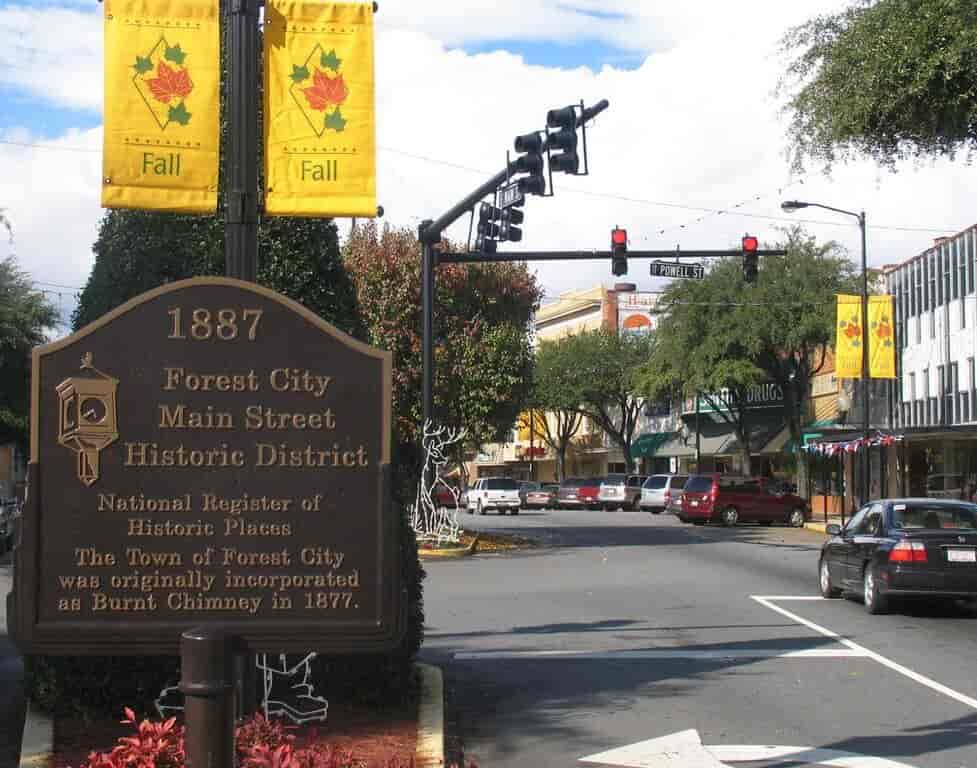
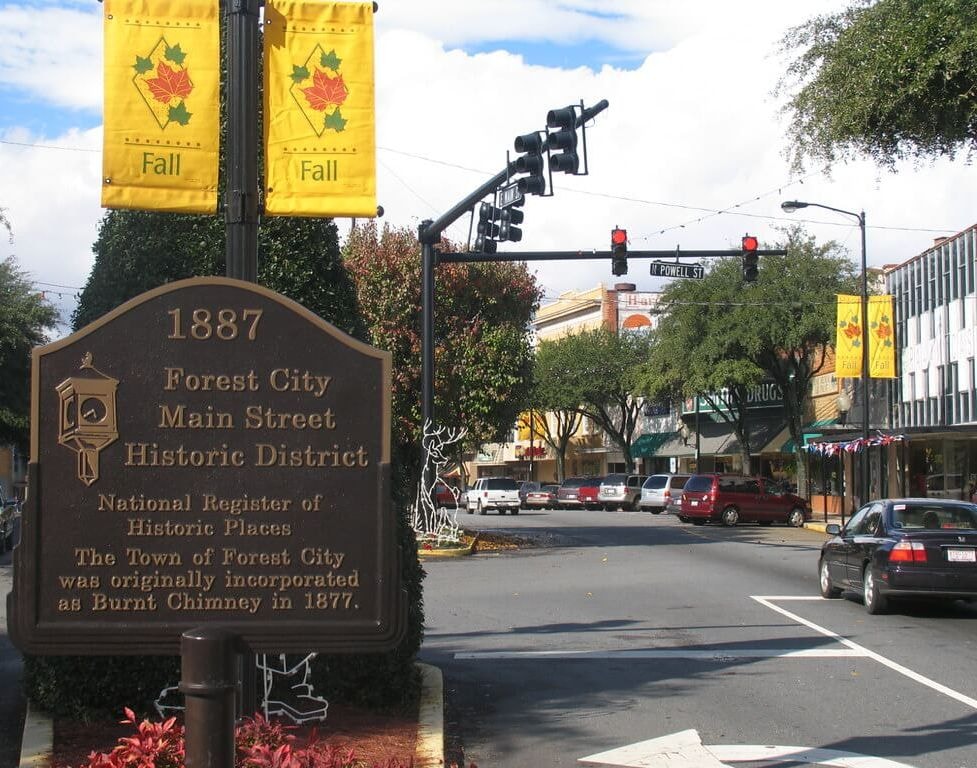
Forest City's downtown is compact by any measure, but it punches above its weight in character, community investment, and walkable amenities relative to what you'd expect from a town of 7,400 people. The four-lane boulevard formed by the merged US-74 Business/US-221A corridor widens as it passes through the historic district, creating a Main Street that feels genuinely civic rather than incidental. The 2019 construction of Forest City Pavilion on Park Square, a multimillion-dollar public investment designed by Odom Engineering, transformed the town center into an events destination, with concerts, markets, and community gatherings that bring the region together throughout the year. Surrounding the Pavilion, locally owned restaurants, shops, professional services, and small-scale commercial uses fill the historic storefronts that line North and South Powell Street.
For the holidays, downtown Forest City becomes something else entirely. The annual Hometown Holidays celebration, which begins on Thanksgiving Night and runs through early January, illuminates Main Street with an estimated one million lights, earning Forest City a reputation as one of North Carolina's best Christmas towns and drawing visitors from across the western Piedmont and foothills. If you're considering a downtown address, it's worth knowing that the neighborhood's energy spikes dramatically during the holiday season, which many residents consider a genuine asset rather than a disruption.
Housing in and immediately around downtown skews older, craftsman-era bungalows, small brick ranches, and early-20th-century homes that have aged with varying degrees of care. Buyers will find that the most updated properties move quickly, while others offer genuine opportunity for renovation at accessible prices. Renters will find a limited but existent inventory of apartments and rental homes within walking distance of Park Square. The downtown's walkability advantage is real within the immediate core, you can reach local restaurants, professional offices, and services on foot, though a car remains necessary for most daily shopping and errands as commercial density thins out quickly.
Median Home Price: $100,000–$200,000 (varies significantly by condition and proximity to core; renovated homes command premiums) | Average Rent: 1BR: $600–$800/mo | 2BR: $700–$950/mo
Safety: Downtown Forest City, like most small-town commercial cores, sees a higher proportion of total reported incidents than purely residential areas, property crime associated with commercial activity accounts for most of this. Residential streets immediately surrounding the historic district are generally quiet. Prospective residents should walk the area at different times of day to form their own assessment.
Walkability / Transit: Forest City's most walkable area by a significant margin. Park Square, dining, and professional services are accessible on foot. The Thermal Belt Rail Trail connects downtown to Spindale, Rutherfordton, and Ruth, offering a rare car-free corridor for recreation and light commuting. Rutherford County public transit provides limited demand-response service; a personal vehicle is still recommended for shopping and most daily errands.
Top Amenities:
- Forest City Pavilion at Park Square, Multi-million-dollar public amphitheater and gathering space; hosts concerts, farmers markets, Cherry Bounce Festival, and Hometown Holidays events year-round
- Hometown Holidays / Christmas Town, One million lights, carriage rides, and community events from Thanksgiving through early January; one of the most celebrated small-town holiday traditions in North Carolina
- Thermal Belt Rail Trail access, Paved 13.5-mile multi-use trail beginning in downtown Forest City and connecting through Spindale and Rutherfordton; ideal for cycling, running, and walking
- First Citizens Bank, town government offices, Rutherford County Courthouse, Concentration of civic and financial services within walking distance
- Local dining and retail, Independently owned restaurants, coffee, and shops serving the downtown core
- Cherry Bounce Moonshine Festival, Annual celebration of the county's moonshining heritage with music, food trucks, and local crafts; one of the year's signature community events
Best For: Buyers willing to take on renovation projects at accessible price points, renters who prioritize walkability and community character, history and architecture enthusiasts, anyone who wants to be within walking distance of Forest City's best events and public spaces
Nearest Storage Depot Location:
- 903 W. Main St, Forest City, NC 28043, Located just west of the downtown core along the Main Street corridor; climate-controlled units available, 24-hour access, convenient for downtown residents managing home renovation overflow, seasonal storage, or business inventory
2. WEST MAIN STREET CORRIDOR, BEST FOR CONVENIENCE & PRACTICAL LIVING
If downtown is Forest City's historic heart, the West Main Street corridor is its practical engine. Stretching west from the downtown core along US-74 Business, this commercial and residential corridor is where most of Forest City's day-to-day commerce concentrates: the Walmart Supercenter that anchors regional retail, Food Lion, fast food chains, a Dollar General cluster, auto service shops, medical offices, pharmacies, and the community college proximity that makes this stretch of town one of the most active in the county. It's not the most scenic part of Forest City, but it's the part that makes life operationally easy, and for renters and buyers who prioritize practical convenience, that matters considerably.
The residential areas that back up to and thread between the West Main commercial strip feature a mix of housing types spanning several decades. Modest mid-century ranches sit alongside more recently constructed single-family homes, with some newer infill development that reflects the area's ongoing activity as the town's commercial center. Home prices here are generally accessible, buyers can find move-in-ready properties in the $140,000–$200,000 range without the renovation risk that some of the older downtown stock requires. The area's density of services means that daily errands require minimal driving, and the US-74 access makes regional commuting to communities like Shelby, Marion, or Rutherfordton efficient.
The proximity to Storage Depot's West Main Street facility, located at 903 W. Main St., directly along this corridor, also makes this area practical for residents managing a move, home renovation, or business inventory storage needs. The facility's climate-controlled units and 24-hour secure access align well with the active, practical character of this neighborhood.
Median Home Price: $140,000–$200,000 | Average Rent: 1BR: $600–$800/mo | 2BR: $700–$900/mo
Safety: The West Main commercial corridor sees the retail-area property crime that accompanies any active commercial zone. The residential streets that run parallel to and off of the main boulevard are generally quieter and earn more favorable safety profiles.
Walkability / Transit: Better than the surrounding residential areas for errands, thanks to the density of commercial services along the main corridor. A car is still practical for most trips, but this is one of Forest City's more pedestrian-accessible zones for everyday needs. The Thermal Belt Rail Trail is within reasonable cycling distance from most residential streets near West Main.
Top Amenities:
- Walmart Supercenter, Regional retail anchor serving much of Rutherford County; located along the US-74/West Main corridor
- Food Lion grocery, Convenient full-service grocery within the corridor
- Medical and pharmacy access, Multiple physician practices, urgent care options, and pharmacy services concentrated in the West Main commercial zone
- US-74 regional access, Direct connection east to Shelby, Kings Mountain, and Charlotte; west toward Marion and the mountains
- Storage Depot at 903 W. Main St., Climate-controlled self storage with 24-hour access directly on the corridor
- Isothermal Community College proximity, Just across into Spindale; the corridor provides straightforward access for students and staff
Best For: First-time buyers seeking move-in-ready homes at accessible prices, renters who prioritize practical convenience over neighborhood aesthetics, commuters who value US-74 access, anyone managing a move or requiring storage services who benefits from the West Main corridor's commercial density
Nearest Storage Depot Location:
- 903 W. Main St, Forest City, NC 28043, Located directly on the West Main corridor; serves residents of West Main, downtown, and the broader Forest City area with climate-controlled units, drive-up access, and secure 24-hour entry
3. PINEY RIDGE & NORTHEAST FOREST CITY, BEST QUIET RESIDENTIAL AREA
For residents who want to live within Forest City's town limits but prefer distance from the commercial noise of the West Main corridor and the foot traffic of downtown, the Piney Ridge corridor and broader northeast quadrant of Forest City offers the town's most consistently residential character. Piney Ridge Road and its surrounding streets are lined with established single-family homes on tree-covered lots, the kind of neighborhood where people know their neighbors, dogs are walked regularly, and the pace is genuinely slow. Nextdoor residents in this part of Forest City consistently describe the area as beautiful, peaceful, dog-friendly, and welcoming, the exact qualities that attract families, retirees, and remote workers who choose small-town North Carolina life intentionally.
The housing stock here trends toward mid-century brick ranches and 1960s–1980s construction, sturdy, well-established homes that have been lived in and updated over decades. Buyers will find that their dollar buys more square footage here than almost anywhere else in the state, a 3-bedroom, 2-bath brick ranch with a large yard in this area can often be found in the $150,000–$190,000 range. Rentals exist but are primarily landlord-owned single-family homes rather than managed apartment complexes, so availability requires active searching and relationships with local property managers. The northeast Forest City area also provides convenient access to US-221, which connects north to Shelby and south toward Rutherfordton and the broader Rutherford County network.
James F. Crowe Park, located within this northeast quadrant, provides community green space, athletic facilities, and gathering space that supports the neighborhood's family-friendly character. The area is also within the Rutherford County School District boundaries, with local elementary and middle school access that parents consistently rate as one of the draws of this part of town.
Median Home Price: $145,000–$195,000 | Average Rent: 1BR: $550–$750/mo | 2BR: $700–$850/mo
Safety: Northeast Forest City and the Piney Ridge corridor consistently earn among the better safety profiles within the town, lower traffic volume, established community networks, and predominantly owner-occupied housing contribute to a quiet, stable residential environment.
Walkability / Transit: Limited walkability for daily errands, a car is needed for most shopping and services. The Thermal Belt Rail Trail is accessible by bike from most streets in this area. Internal neighborhood walking for recreation and social interaction is comfortable and common.
Top Amenities:
- James F. Crowe Park, Community park with athletic fields, open green space, and recreational facilities; a neighborhood gathering point for families
- Piney Ridge Self Storage, Local storage option directly on Piney Ridge Road for residents managing overflow
- Rutherford County School District access, Local schools serving elementary and middle grade students within the neighborhood footprint
- US-221 access, North-south route connecting to Shelby, Marion, and Rutherfordton; efficient regional commute option
- Thermal Belt Rail Trail, Accessible by short drive or bike ride for recreation along the 13.5-mile paved corridor
- Quick downtown access, Downtown Park Square and West Main commercial services are both within a 5–10 minute drive
Best For: Families seeking a quiet, established residential environment within Forest City town limits, retirees wanting a peaceful neighborhood at an accessible price, remote workers who prioritize quality of life over commute proximity, anyone who wants the stability of owner-occupied neighborhood character without the premium of more developed markets
Nearest Storage Depot Location:
- 903 W. Main St, Forest City, NC 28043, A short drive from the Piney Ridge and northeast residential areas; climate-controlled units with 24-hour secure access serve residents managing seasonal items, renovation overflow, or household transitions
4. ALEXANDER MILLS, BEST FOR AFFORDABLE SPACE & RURAL CHARACTER
In 1999, the community of Alexander Mills merged with and became part of Forest City, extending the town's footprint along the Second Broad River corridor to the east and giving Forest City residents access to a quieter, more rural neighborhood character at the far edge of town limits. Alexander Mills is not a neighborhood in the traditional urban sense; it's a small community area where residential lots run larger, surrounding acreage is more common, and the relationship between neighbors and the land feels distinctly different from the in-town neighborhoods closer to Main Street. For buyers who want the technical advantage of being within Forest City's municipal limits while living in a setting that feels more like the surrounding rural county, Alexander Mills provides a genuine option.
Housing values here are among the lowest within the town's boundaries, with many properties available in the $100,000–$160,000 range, and some that include meaningful acreage at prices that would be unimaginable in most of North Carolina. The tradeoff is distance from commercial services: Alexander Mills residents rely on a car for virtually all daily needs, and the drive to West Main Street commercial services or downtown takes 10–15 minutes. For residents willing to accept that trade, the spatial value is difficult to match.
The Second Broad River provides a natural boundary and a recreational asset, fishing and casual outdoor access along the river corridor is part of what makes this community appealing to outdoor-oriented buyers. The Bostic Sunshine Highway (NC-181) connects Alexander Mills south toward Bostic and the broader rural county, making this a reasonable base for residents whose lives and work extend throughout Rutherford County rather than concentrating in Forest City's commercial core.
Median Home Price: $95,000–$165,000 (with significant variation depending on lot size and acreage) | Average Rent: Limited rental inventory; single-family homes $600–$800/mo where available
Safety: Alexander Mills is a quiet, rural community area with very low crime activity. Its distance from commercial corridors and low-density residential character contribute to the stability and safety that rural community areas in this part of North Carolina typically exhibit.
Walkability / Transit: Minimal. A personal vehicle is essential for all daily needs. Rural road conditions are generally good. The area is popular for personal walking and cycling recreation on lower-traffic rural roads.
Top Amenities:
- Second Broad River access, Fishing, informal outdoor recreation, and a natural landscape backdrop along the river corridor that runs through the community
- Large residential lots and acreage, Space that would be cost-prohibitive in larger markets; gardens, small farms, and outbuildings are common
- Bostic Sunshine Highway (NC-181) access, Connects south to Bostic and rural Rutherford County; scenic drive through rolling foothills
- Rutherford County School District, Local school access for families within the merged municipal area
- Forest City municipal services, Despite its rural character, Alexander Mills residents access Forest City town services by virtue of the 1999 merger
- Short drive to downtown and West Main, 10–15 minutes to full commercial services, medical access, and town amenities
Best For: Buyers seeking maximum space per dollar, those relocating from rural areas who want to maintain a rural lifestyle at a low price, retirees on fixed incomes who want acreage and quiet, small-scale homesteaders, anyone who prioritizes land and space over proximity to commercial amenities
Nearest Storage Depot Location:
- 903 W. Main St, Forest City, NC 28043, Located along the West Main corridor; serves Alexander Mills residents who need secure storage for outdoor equipment, farm and garden tools, seasonal items, or household overflow during property transitions
5. SPINDALE, BEST NEIGHBORING COMMUNITY FOR ARTS, EDUCATION & AMENITIES
Spindale borders Forest City directly to the west, so closely integrated that residents of both communities regularly move between them for work, shopping, services, and education without thinking of it as crossing a meaningful line. For the purposes of this guide, Spindale deserves its own profile because it offers a distinct set of advantages that complement or exceed what Forest City proper provides in several important categories, particularly arts and cultural programming, higher education access, and a residential character that many residents find preferable to Forest City's more commercially active corridors.
Isothermal Community College, the anchor institution of higher education for Rutherford and Polk counties, is located on a 128-acre campus in Spindale, just steps from the Forest City border. The college offers associate degrees, certificates, and workforce development programs, and its campus includes one of the most disproportionately impressive performing arts facilities in rural western North Carolina: the 1,300-seat Isothermal Mainstage Performing Arts Center, which hosts a full season of professional music, theater, and entertainment programming that draws audiences from throughout the regional foothills. For residents who value access to live performing arts without driving to Asheville or Charlotte, the ICC Mainstage is a genuine differentiator.
Spindale's residential areas offer similar price points to Forest City, median home values in the $150,000–$220,000 range, with a mix of mid-century single-family homes, newer infill construction, and some rental inventory associated with the college's student and staff population. The Thermal Belt Rail Trail passes through Spindale, connecting to both Forest City to the east and Rutherfordton to the west and providing the multi-use trail corridor that gives the Broad River Valley communities a recreational infrastructure well above what most small rural towns can claim.
Median Home Price: ~$150,000–$220,000 | Average Rent: 1BR: $600–$800/mo | 2BR: $750–$950/mo
Safety: Spindale is a quiet residential community with crime rates consistent with similar small towns in western North Carolina. The college campus and surrounding residential neighborhoods maintain a stable, family-friendly environment. As with all neighboring communities, crime levels vary by street and block.
Walkability / Transit: The Thermal Belt Rail Trail provides meaningful walking and cycling connectivity through Spindale to both Forest City and Rutherfordton. A car is still needed for most commercial errands. The college campus creates pedestrian activity in its immediate vicinity during the academic year.
Top Amenities:
- Isothermal Community College, 128-acre campus offering associate degrees, workforce certificates, and continuing education; tuition is among the lowest in the state for residents of Rutherford and Polk counties
- Isothermal Mainstage Performing Arts Center, 1,300-seat performing arts venue hosting professional touring productions throughout the year; one of the most impressive cultural facilities in rural western NC
- Thermal Belt Rail Trail, The trail passes directly through Spindale, connecting to Forest City to the east and Rutherfordton to the west; fully paved and maintained for cycling, running, and walking
- Spindale House, Historic community gathering space and event venue within Spindale
- Direct Forest City access, All of Forest City's commercial services, medical facilities, and downtown amenities are a 5–10 minute drive or short bike ride via the trail
- Rutherford Regional Health System access, The county's primary hospital and health system is accessible from Spindale as easily as from Forest City
Best For: Students and staff affiliated with Isothermal Community College, arts and culture enthusiasts who value access to live performing arts, buyers and renters who want a quieter residential community with access to Forest City's commercial services, anyone who considers trail access and outdoor recreation a daily lifestyle priority
Nearest Storage Depot Location:
- 903 W. Main St, Forest City, NC 28043, Located just across the Spindale border on West Main Street; serves Spindale residents and students moving to or from the area with flexible month-to-month leases and climate-controlled unit options
6. BOSTIC & LAKE LURE AREA, BEST FOR OUTDOOR LIVING & MOUNTAIN ACCESS
Rutherford County's geography is one of its most compelling and underappreciated assets. Less than 25 miles from Forest City, the landscape transforms dramatically, from the rolling western Piedmont foothills into the dramatic gorge and mountain terrain around Lake Lure and Chimney Rock. For residents whose lifestyle priorities center on outdoor recreation, scenic living, and access to state parks and natural areas, the Bostic corridor and the Lake Lure basin represent the county's most evocative residential option. This isn't a neighborhood in the traditional sense, it's a lifestyle choice that uses Forest City as a regional service hub while living in a setting that most people associate with destinations rather than home addresses.
Bostic, the small community on the northeastern edge of Forest City (with which it shares a geographic border), is the entry point to the scenic Cherry Bounce Trail, a rural driving route through rolling green hills that connects to the Bostic Lincoln Center, which preserves and exhibits evidence supporting the theory that Abraham Lincoln was born in this region, and to Washburn's General Store on the Bostic Sunshine Highway, one of the oldest continually-operated family businesses in North Carolina. The Green River Game Lands, one of North Carolina's premier public hunting, fishing, and outdoor recreation areas, are accessible from the Bostic and Rutherfordton corridors.
Lake Lure, approximately 22 miles from Forest City via US-74A and US-64, sits in a glacially-carved mountain basin and offers some of the most striking residential real estate in western North Carolina, at prices that, while higher than the Forest City median, remain dramatically below comparable lake-access properties in more developed mountain markets. Chimney Rock State Park, with its famous 535-step staircase to the summit and panoramic views of the Broad River Valley, anchors the tourism economy of the area while providing permanent residents with extraordinary access to world-class hiking, rock climbing, and natural beauty as a matter of daily life.
Median Home Price: Bostic area: $130,000–$200,000; Lake Lure area: $300,000–$600,000+ (waterfront and mountain-view properties) | Average Rent: Very limited rental inventory in both areas; Bostic area homes $650–$900/mo where available
Safety: Both the Bostic corridor and the Lake Lure area are rural communities with very low crime rates and strong community identity. Lake Lure's seasonal tourism economy introduces some commercial activity during peak season; residential areas maintain the quiet character of mountain and rural communities throughout the year.
Walkability / Transit: These are rural areas where a personal vehicle is essential for all daily life. Mountain and rural road conditions require awareness, particularly in winter weather events that bring ice and snow more frequently than to the lower-elevation Forest City area. The payoff is access to miles of hiking trails within minutes of home.
Top Amenities:
- Chimney Rock State Park, One of North Carolina's most iconic parks; 535-step staircase to 75-mile views, rock climbing, hiking, and the historic Chimney Rock geological formation; ~22 miles from Forest City
- Lake Lure, 720-acre natural lake in a mountain basin; boating, kayaking, swimming, and waterfront living within Rutherford County
- Green River Game Lands, Over 12,000 acres of public hunting and fishing land in the Rutherford/Polk/Henderson county corridor; exceptional wildlife and outdoor access
- Bostic Lincoln Center, Historical interpretive center presenting evidence that Abraham Lincoln's roots trace to this part of Rutherford County; a unique regional cultural asset
- Washburn's General Store, One of the oldest family-operated businesses in North Carolina; a living piece of regional heritage on the Bostic Sunshine Highway
- Cherry Bounce Trail, Scenic rural driving route through Bostic and the surrounding foothills connecting Forest City's outskirts to the county's most picturesque landscapes
Best For: Outdoor recreation enthusiasts, retirees seeking scenic mountain-adjacent living at accessible prices, remote workers who prioritize landscape and recreation access over urban convenience, buyers who want maximum acreage per dollar in a setting with genuine mountain character
Nearest Storage Depot Location:
- 903 W. Main St, Forest City, NC 28043, Located in Forest City proper, this facility serves Bostic and Lake Lure area residents who need secure storage for outdoor and recreational equipment, hunting and fishing gear, seasonal household items, or overflow from rural properties
HOW TO CHOOSE YOUR FOREST CITY NEIGHBORHOOD
Forest City is small enough that no neighborhood puts you dramatically far from any other part of town, the entire municipality spans just over 8 square miles, and even the most distant residential areas are within a 15-minute drive of downtown. What the neighborhoods here offer, more than geographic separation, is a difference in lifestyle context: the density and walkability of the Main Street core versus the practical convenience of the West Main corridor versus the quiet residential feel of Piney Ridge and the rural freedom of Alexander Mills and the Bostic area. Here's how to think through the decision:
Choose Downtown / Park Square if you value walkability, community events, and historic character; you're willing to take on renovation or accept an older building in exchange for the ability to walk to Forest City's best public spaces; and the Hometown Holidays celebration and Thermal Belt Rail Trail proximity matter to your daily life.
Choose West Main Street if practical convenience is your primary priority, you want grocery stores, pharmacies, and retail within an easy drive without navigating residential streets. This corridor suits buyers who want a move-in-ready home at an accessible price and renters who value proximity to services over neighborhood aesthetics.
Choose Piney Ridge / Northeast if you want a quiet, established residential neighborhood within town limits. This is the part of Forest City that feels most like a traditional family neighborhood, established trees, owner-occupied homes, and a community pace that appeals to families, retirees, and those seeking stability.
Choose Alexander Mills if space per dollar is your overriding priority and you're willing to accept car-dependence as a condition of rural living within Forest City's town limits. The Second Broad River corridor and large lots make this the best choice for buyers who want land.
Choose Spindale if the performing arts center, Isothermal Community College access, and Thermal Belt Rail Trail connectivity are meaningful to your lifestyle. Spindale functions as a seamless extension of Forest City with slightly more emphasis on arts and education infrastructure.
Choose the Bostic / Lake Lure area if you came to western North Carolina for the mountains and you want to live as close to that landscape as your budget and remote-work situation allow. This choice prioritizes scenery, recreation, and rural quiet over all other factors.
SELF STORAGE IN FOREST CITY, STORAGE DEPOT
Moving to, from, or within Forest City and Rutherford County often involves the kind of logistics that benefit from a secure storage buffer: waiting for closing dates to align, managing a home renovation while staying put, downsizing from a larger property, clearing space during a seasonal transition, or simply handling the outdoor recreation and hobby equipment that rural mountain-foothills living tends to accumulate. Storage Depot, part of the 10 Federal Storage family, operates the area's most accessible self-storage facility directly on the West Main Street corridor, making it convenient for residents throughout Forest City and the surrounding communities.
The facility's climate-controlled units protect belongings from Rutherford County's humid subtropical climate, where warm, humid summers and seasonal moisture can cause real damage to furniture, electronics, documents, and sensitive materials stored in non-climate-controlled environments. Drive-up units provide efficient loading and unloading access, gated entry and video surveillance deliver security, and fully online reservations and flexible month-to-month leases mean you can get started without visiting an office or signing a long-term contract.
Storage Depot in Forest City
- 903 W. Main St, Forest City, NC 28043, Located on the West Main Street corridor, close to downtown Forest City, US-74, and Isothermal Community College. Serves residents throughout Forest City, Spindale, Rutherfordton, Bostic, and Ellenboro. Climate-controlled units available to protect belongings from humidity and temperature swings. 24-hour secure access, video surveillance, and flexible month-to-month rentals. Convenient for families in transition, students moving on and off campus, businesses managing seasonal inventory, and residents with outdoor equipment, hunting gear, or hobby items that need a dedicated storage space.
Unit sizes range from compact 5x5 units for boxes and small items up to larger units accommodating full household contents. View available units and reserve online here.
WELCOME TO FOREST CITY
Forest City rewards people who are willing to look past size for substance. It's not a city with a skyline or a nationally recognized food scene or a neighborhood that shows up in lifestyle magazine roundups. What it has is something increasingly rare in North Carolina: genuine affordability, mountain-foothills scenery, a tight-knit community that values what it has, and outdoor recreation access that most far more expensive towns can only approximate. Whether you're drawn to the historic character of downtown Park Square, the practical accessibility of West Main Street, the quiet residential stability of Piney Ridge, or the wide-open landscape of the Bostic and Lake Lure corridors, Forest City has a version of itself that fits a range of lifestyles, all at price points that have become exceptional in the modern North Carolina market.
And wherever you land in the area, Storage Depot has a Forest City facility ready to support your move, your seasonal storage needs, or your ongoing overflow, with climate-controlled units, 24-hour access, month-to-month leases, and fully online rental at 903 W. Main St.
View available units and reserve online today.
About Storage Depot, Forest City
Storage Depot, part of the 10 Federal Storage family, operates a self-storage facility in Forest City, NC at 903 W. Main St. (28043), close to downtown, US-74, and Isothermal Community College. Climate-controlled and standard units available, with 24-hour secure access, video surveillance, and flexible month-to-month leases. Serving Forest City, Spindale, Rutherfordton, Bostic, Ellenboro, and the broader Rutherford County area. View all Forest City units here.
FREQUENTLY ASKED QUESTIONS ABOUT FOREST CITY NEIGHBORHOODS
By median home value, Alexander Mills offers the lowest prices within Forest City's town limits, many properties in the $95,000–$160,000 range, some with meaningful acreage. Among the in-town residential neighborhoods, Piney Ridge and the northeast quadrant offer the most accessible prices for standard single-family homes, typically in the $145,000–$195,000 range. The broader Bostic corridor outside town limits offers rural properties at similarly accessible price points. On the rental side, Forest City's overall median rent of approximately $815–$875 per month makes the entire market one of the most affordable in North Carolina, individual units in the northeast residential areas can be found for $550–$750 per month for a one-bedroom.
Forest City, like most small towns, has a mixed crime picture that depends heavily on which part of the community you're asking about. The city-level crime index is elevated relative to the national average, driven primarily by property crime associated with commercial activity in the retail corridors. The residential neighborhoods, particularly Piney Ridge, northeast Forest City, Alexander Mills, and the Spindale border areas, are considerably quieter and maintain the low-incident profiles typical of rural western North Carolina residential communities. Prospective residents are encouraged to visit specific streets and talk to neighbors rather than relying solely on aggregate city-level crime statistics, which can be misleading for a town of this size where a small number of commercial corridor incidents skew the overall numbers.
Increasingly, yes. Forest City's combination of dramatically below-average cost of living, mountain-adjacent scenery, and improving internet infrastructure has made it a genuine discovery for remote workers relocating from higher-cost markets. The town's cost-of-living index of approximately 82 (18% below the national average) means that a remote salary benchmarked to Raleigh, Charlotte, or a northern city goes meaningfully further here. The tradeoff is that internet infrastructure, while improving, is not uniform across all areas, prospective remote workers should verify specific connection quality (and check whether fiber, cable, or fixed wireless broadband is available) at any specific address before committing to a location. In-town areas and the West Main corridor generally have more reliable connectivity than rural outskirts.
Forest City falls within the Rutherford County Schools district, which serves K–12 students throughout the county. Forest City residents are primarily served by West End Elementary, Spindale Elementary, and Forest City-Dunbar Middle School, with high school students attending Chase High School or Forest City's own high school facilities. For post-secondary education, Isothermal Community College in adjacent Spindale offers the lowest-cost credential and associate degree options in the region, with tuition that can be covered in full for Rutherford and Polk County residents through the Lee L. Powers Service Scholarship. Gardner-Webb University (about 30 miles east) and Western Carolina University (about 60 miles west) provide four-year options within reasonable commuting distance.
Forest City sits roughly at the midpoint between Charlotte and Asheville on the US-74 corridor. Charlotte is approximately 65–70 miles east, a drive of about 75–90 minutes depending on traffic and route. Asheville is approximately 50–55 miles west, typically a 60–75 minute drive via US-74 and I-26. This positioning gives Forest City residents meaningful access to both metro areas for employment, medical specialization, entertainment, and travel without having to pay metro-area housing costs. The tradeoff is that regular commuting to either city would be demanding for most people, Forest City functions best as a base for remote workers and those with regional employment in Rutherford County itself.
The outdoor recreation access from Forest City is one of the most underappreciated aspects of the community. Within 25 miles: Chimney Rock State Park (hiking, rock climbing, panoramic views), Lake Lure (boating, kayaking, swimming), and Green River Game Lands (public hunting and fishing across 12,000+ acres). Within Forest City itself, the Thermal Belt Rail Trail provides 13.5 miles of paved multi-use trail connecting through Spindale and Rutherfordton. The South Mountains State Park, with its 58-foot waterfall at High Shoals Falls, is approximately 45 minutes north. For whitewater paddling, the Green River Narrows (an advanced whitewater kayaking destination that draws expert paddlers internationally) is approximately 45 minutes southwest near Saluda.
About the Author
10 Federal Storage
Our team at 10 Federal Storage has been in the self storage industry for decades. With knowledge gained from multiple universities and in the field, we are well-prepared and excited to assist with your storage needs. When you rent a unit with us, you can feel confident that our seasoned customer service team’s help will make your transition as seamless as possible. Customer satisfaction is our number one priority, and we strive to make your experience exceptional with our automated leasing options, diverse unit sizes, and a strong commitment to sustainability.