
Corporate Sustainability
Sustainability That Starts With Using Less
Our facilities run without on-site staff. There's no staffed office running all day, no daily drive to open up, and no paper lease to print. Here's what that model saves, how we measure it, and the claims we won't make.
- ContactlessNo staff stationed on site
- PaperlessLeases, billing, and codes handled online
- EfficientLED lighting with motion sensors
What our facilities run without
- Staffed front office Not on site
- Daily drive to open and close Not needed
- Paper lease and sign-up forms Signed online
- Mailed paper bills Paperless billing
- Keys at a counter Codes by text and email
Our friendly customer support team still answers your questions, just not from behind a counter.
Our Approach to Sustainability
Most sustainability pages open with a list of upgrades. Ours opens with what we left out. 10 Federal Storage facilities are fully contactless: you rent, sign your lease, and pay online, and your gate and unit codes arrive by text and email. No one is stationed on site, so there's no staffed office to heat, cool, and light during business hours, and no daily drive to open up and lock up.
That operating model is our starting point. On top of it, we've added efficient lighting and temperature controls, water-saving fixtures and landscaping, and paperless billing at every property.
Sustainability also covers how we treat people and the rules we hold ourselves to. Our social and governance commitments follow, along with a short list of claims we don't make.
Self Storage Starts With a Smaller Footprint
The median self-storage facility uses less than half the energy per square foot of the median U.S. office building.
Storage buildings don't need much energy to do their job. Most units are never heated or cooled, and no one lives or works inside them. The U.S. Environmental Protection Agency's ENERGY STAR program publishes national median energy use for each building type, and self storage sits near the bottom of the list.
Site energy is the energy a building draws from its utilities. Figures are U.S. national medians from the EPA ENERGY STAR Portfolio Manager. Climate-controlled buildings use more energy than drive-up units because they hold a steady temperature year round. Our own measured results are in Measuring Our Footprint.
Median energy use by building type
Site energy, in kBtu per square foot per year. U.S. national medians.
| Label | Value | Category |
|---|---|---|
| Self storage | 20.2 | peak |
| Warehouse | 22.7 | off-season |
| Office | 52.9 | off-season |
| Multifamily | 59.6 | off-season |
| Hotel | 63.0 | off-season |
| Strip mall | 103.5 | off-season |
Measuring Our Footprint
Our 2023 baseline is the benchmark we measure every year against.
In late 2023, we partnered with GreenPlaces, a sustainability platform, to measure our carbon emissions across all three scopes. The results became our 2023 baseline, published in our 2024 Impact Statement.
- Scope 1 — 326.8 t. Direct emissions: refrigerant from cooling equipment, plus fuel burned in vehicles and on-site equipment.
- Scope 2 — 441.4 t. The electricity we buy to run our buildings.
- Scope 3 — 792.5 t. Our wider value chain: purchased goods and services, upstream fuel and energy, employee commuting, business travel, and waste.
2023 carbon emissions baseline
1,560.8 metric tons of CO2e in total, in metric tons of CO2 equivalent. Scopes 1, 2, and 3 make up about 21%, 28%, and 51% of the total. Source: 10 Federal Storage 2024 Impact Statement, measured with GreenPlaces.
| Label | Value | Category |
|---|---|---|
| Scope 1 | 326.8 t | shoulder |
| Scope 2 | 441.4 t | shoulder |
| Scope 3 | 792.5 t | peak |
93% of our measured locations beat the national average
93% of our measured locations were more energy efficient than the national average in the U.S. Energy Information Administration's Commercial Buildings Energy Consumption Survey.
Each year, we compare our results with this baseline, aiming to lower both our total emissions and our emissions per employee.
Environmental Sustainability
Four practices, and where each one applies.
Efficient Lighting and Temperature Control
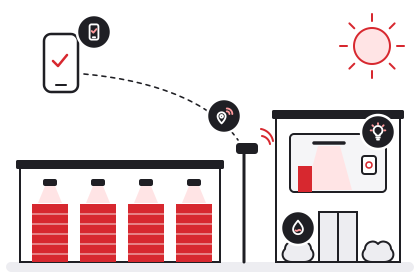
Our facilities use LED lighting, and motion sensors keep interior lights off until someone needs them. We retrofit existing locations with LED lighting and build it into every expansion project. In climate-controlled buildings, programmable thermostats and building automation hold a steady temperature without running equipment harder than it needs to, and we've upgraded HVAC equipment in many of those buildings.
Where it applies: LED lighting and motion sensors across our facilities. Thermostats and building automation in climate-controlled buildings.
Paperless Rentals and Billing
Renting a unit doesn't produce a stack of paper. You choose a unit, sign your lease, and pay online, and your gate and unit codes arrive by text and email. Billing is paperless at every property, and you manage your account and payments in MyAccount.
Where it applies: Every facility.
Fewer Trips to Each Site
Because no one is stationed on site, there's no daily commute to open and close each facility. Gate access and security systems are managed remotely, and our field team visits for maintenance and inspections. We also use autonomous drones to monitor properties remotely, which cuts down on travel to each site. Read more about how contactless move-in works.
Where it applies: Every facility.
Water Use
Self storage uses little water to begin with, because no one lives in the buildings and no staff work on site all day. Where our facilities have restrooms or landscaping, we use low-flow fixtures and water-efficient landscaping with smart irrigation, and we monitor sites to catch leaks and wasted water.
Where it applies: Every facility. Fixtures and landscaping where a site has them.
How to Store With a Lighter Footprint
A few choices on your end help too, and most of them save you time or money.

Use Climate Control When It Matters
Use Climate Control When It Matters
A climate-controlled unit holds a steady temperature, which protects wood furniture, electronics, photographs, and instruments. Patio furniture, tools, and plastic bins do fine in a standard unit, which isn't heated or cooled.

Size It for One Trip
Size It for One Trip
Our storage unit size calculator works from what you own, so you can plan one truckload instead of two and rent a unit that fits it the first time.

Reuse Boxes and Bins
Reuse Boxes and Bins
We don't sell packing supplies, so start with what you have: boxes from a recent move, plastic totes you'll use again, and moving blankets in place of single-use wrap.

Donate Before You Store
Donate Before You Store
If you're downsizing, sort a donate pile before move-in day. Storing only what you plan to keep means a smaller unit and fewer trips.

Clear Out Fully at Move-Out
Clear Out Fully at Move-Out
Items left in a unit after move-out rarely get a second life. Give yourself time to donate, sell, or recycle what you don't want before your last day.
Governance Commitment
Good governance shows up in everyday policies. Here's how ours work.
Code of Conduct
Code of Conduct
Every employee is trained on our code of conduct, which sets our expectations for honesty, transparency, and ethical behavior.
Compliance Training
Compliance Training
Employees and executives complete compliance training, so each person understands their responsibilities under the laws and regulations that apply to our business.
Risk Management
Risk Management
We regularly review our operations to identify, assess, and reduce risk, and we update those processes as the business grows.
Sustainability in Acquisitions
Sustainability in Acquisitions
When we evaluate a facility to buy, our facilities team looks for sustainability improvements during the due diligence tour, and our Investment Committee weighs them in every acquisition review. That way, the budget for upgrades is planned alongside our other priorities.
Servicemember Protections
Servicemember Protections
We follow the Servicemembers Civil Relief Act (SCRA) and verify active-duty status at signup. Our military storage guide explains how renting works around orders and deployments.
Account Security
Account Security
Each rental account has one account holder. Requests to transfer access, such as after an account holder passes away, go through a compliance review before anyone new can enter the unit.
Privacy and Accessibility
Privacy and Accessibility
Our privacy policy explains how we handle your information, and our accessibility statement describes our approach to website accessibility.
What We Don't Claim
Broad environmental claims are easy to make and hard to back up. Here's where ours stop.
- No carbon-neutral or net-zero label. We measure our emissions, and measuring them isn't the same as eliminating them, so we don't use those labels.
- No reduction claims yet. The emissions figures on this page are our 2023 baseline. We'll report reductions once we've measured them against it.
- The EPA figures aren't ours. The energy chart describes self storage as a building type. Our own results are the 2023 baseline figures above.
- Climate control costs energy. A climate-controlled unit uses more energy than a standard unit. If your belongings don't need a steady temperature, a standard unit is the lower-energy choice.
Corporate Sustainability FAQs
Does 10 Federal Storage use energy-efficient lighting?
Yes. Our facilities use LED lighting, and motion sensors keep interior lights off until someone needs them. In climate-controlled buildings, programmable thermostats and building automation hold a steady temperature without running equipment harder than it needs to.
Is self storage an energy-efficient type of building?
Compared with most commercial buildings, yes. The U.S. EPA's ENERGY STAR program lists a national median site energy use of 20.2 kBtu per square foot per year for self-storage facilities, compared with 52.9 for offices and 59.6 for multifamily housing. Most storage units are never heated or cooled, and no one lives or works in them.
Is climate-controlled storage worse for the environment than a standard unit?
It uses more energy, because the building holds a steady temperature year round. Our climate-controlled buildings use programmable thermostats and building automation to keep that energy use in check. If you're storing things that don't need a steady temperature, like patio furniture or tools, a standard unit is the lower-energy choice.
Does 10 Federal Storage offer paperless billing?
Yes. Billing is paperless at every property. You rent, sign your lease, and pay online, your gate and unit codes arrive by text and email, and you manage payments in MyAccount.
How does a contactless facility reduce environmental impact?
Because no one is stationed on site, there's no staffed office running during business hours and no daily commute to open and close each facility. Renting online also removes printed leases and sign-up paperwork.
Does 10 Federal Storage publish a sustainability report?
Yes. Our 2024 Impact Statement reports our 2023 baseline: 1,560.8 metric tons of CO2e across Scopes 1, 2, and 3, measured with our sustainability partner GreenPlaces. It also found that 93% of our measured locations were more energy efficient than the national average in the U.S. Energy Information Administration's Commercial Buildings Energy Consumption Survey.
Corporate Sustainability
Storage Without the Front Office
Find a contactless, month-to-month unit near you and see special deals on available units. Own a storage facility? Our management services bring the same contactless model to your property.
Social Sustainability
How we support the communities we serve, the people who work here, and the people who rent from us.
Our Communities
We encourage our team members to volunteer for causes they care about, and we offer paid time off to do it. We also organize and take part in charitable events in our markets throughout the year.
Our Team
Our benefits include competitive health coverage, an Employee Assistance Program, and flexible work schedules, along with training and development programs to help people grow. Based on employee ratings, Comparably named 10 Federal Storage a 2022 Best Company for Perks & Benefits. See open roles on our careers page.
Our Customers
Every rental is month-to-month, so no one is locked into a lease they no longer need, and our friendly customer support team is there when you have a question. We gather feedback through regular customer surveys and use it to improve how renting works.