

Home Gym Ideas and What They Cost
by 10 Federal Storage
Published on April 23, 2026
A home gym is one of the few home projects where the same stated goal, "I want to work out at home", can mean a $400 corner of the bedroom or a $60,000 dedicated studio, and both can be the right answer. The mistake people make isn't picking the wrong treadmill. It's not deciding, before they buy anything, what kind of home gym they're actually building.
National cost surveys put the typical home gym project between roughly $2,150 and $13,750, with an average right around $7,750, and bare-bones setups starting as low as $300. Full garage or basement conversions with proper flooring, electrical, and HVAC work run $20,000 to $40,000 before you've bought a single dumbbell. Below are the most common home gym ideas, what they cost, and which ones are worth the money for the kind of training you'll actually do.
First, Decide What You're Actually Building
Every home gym falls into one of four scopes. Pinterest lumps them together; your bank account will not.
- A corner setup ($300–$1,500), dumbbells, a mat, resistance bands, maybe an adjustable bench tucked into a spare corner. No room conversion, no construction.
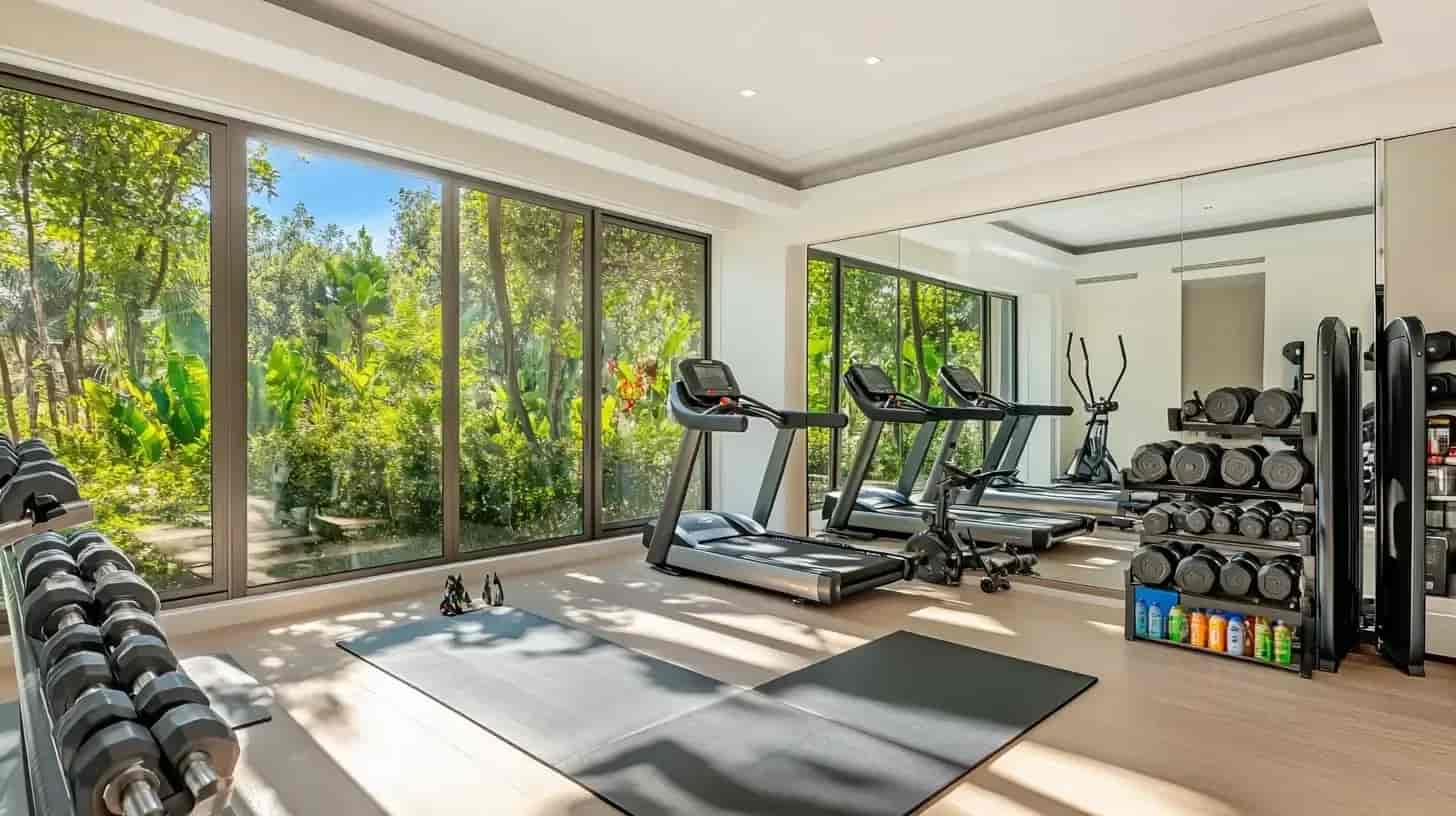
- A spare-room conversion ($2,000–$8,000), a dedicated room with upgraded flooring, a mirror, proper lighting, and a mix of strength and cardio equipment. Minor room prep, no structural work.
- A garage or basement conversion ($6,000–$30,000), a real dedicated gym with rubber flooring, HVAC or a mini-split, dedicated circuits, and a full equipment loadout. The workhorse tier for serious lifters and families who'll use it daily.
- A dedicated studio or luxury gym ($30,000–$100,000+), built-in cabinetry, commercial-grade equipment, mirrored walls, sound system, sometimes a sauna or cold plunge. A construction project, not a setup.
Roughly 30 to 50 percent of a serious home gym budget goes to equipment. Another 20 to 40 percent goes to flooring, mirrors, lighting, electrical, and climate control, the stuff that makes the space actually usable. Labor, if you hire it, runs $50 to $150 per hour for general contractors and electricians, and that's where budgets quietly run over.
One thing worth putting in your pocket before you read on: a home gym rarely recoups its cost at resale the way a kitchen or bathroom remodel might. Remodeling Magazine's Cost vs. Value Report has consistently favored kitchen and bath projects as the strongest returns; home gyms don't make the list because most buyers would rather see a finished basement or a bonus room. That doesn't make a home gym a bad investment, gym memberships run $50 a month on average, and the math catches up fast, but the justification is "we'll use this every week for ten years," not "it'll pay for itself when we sell."
Idea 1: The Corner Setup
Budget: $300–$1,500 · Timeline: 1 weekend
The cheapest honest home gym you can build. A corner of a spare bedroom, a section of the basement, or a quiet end of the garage becomes a functional workout space with a yoga mat, a set of adjustable dumbbells, and whatever else fits in a closet when you're done. For most people who say they want to "get back into working out," this is the right starting point, and frequently the right ending point.
What goes into it:
- Adjustable dumbbells, 5–50 lb pair, $200–$500
- Yoga mat or two interlocking foam tiles, $20–$80
- Resistance band set, $25–$60
- Adjustable bench (optional), $150–$350
- Kettlebell or two, 20–35 lb, $40–$120
- Jump rope, foam roller, pull-up bar that fits a doorframe, $50–$150 combined
The real trick at this tier is resisting the urge to upgrade before you've actually used what you have for three months. A pair of adjustable dumbbells and bodyweight training covers 80 percent of what most people need. If you're still using the setup consistently after a season, then talk about a rack.
Idea 2: The Spare Bedroom Conversion
Budget: $2,000–$8,000 · Timeline: 1–2 weeks
A dedicated room changes the math. You don't negotiate with yourself about clearing floor space, the equipment stops having to hide, and you can close the door on a sweaty mat and deal with it later. For houses with an underused guest room, office, or flex space, this is the sweet spot, enough square footage for a real workout, not so much that you're renovating.
What goes into it:
- Floor protection, interlocking foam tiles ($1–$3/sq ft) for low-impact use, or luxury vinyl plank ($5–$12/sq ft installed) if you're upgrading the flooring anyway
- One or two full-length mirrors, frameless, $100–$300 total
- Brighter lighting, swapping a standard fixture for a flush-mount LED runs $50–$200 DIY, $200–$500 if hired
- A mix of cardio and strength equipment, $1,500–$5,000 depending on focus (see Ideas 5–7)
- A wall-mounted TV or tablet holder for streaming workouts, $150–$600 plus the screen
- Storage, a pegboard, a small rack for weights, a hook rail, $100–$400
Two practical notes. Upstairs rooms have weight limits; standard residential floors are rated for 40 pounds per square foot of live load, which is fine for a treadmill or a bench but marginal for a fully loaded power rack with heavy plates. If the equipment is heavy and the floor feels bouncy, the gym belongs on a slab. And most spare bedrooms have carpet, leave it if you're doing bodyweight and dumbbells, but pull it and put down something waterproof if you're doing anything with sweat, dropped weights, or a treadmill.
Idea 3: The Basement Gym
Budget: $5,000–$20,000 · Timeline: 2–6 weeks
A basement is the default right answer for a real home gym in most American houses. You've got concrete slab underfoot that can handle any amount of weight, ceilings usually tall enough for overhead presses, and a space that nobody's trying to sleep directly above at six in the morning. The tradeoff is the work it takes to make the space pleasant to be in.
Where the money goes:
- Rubber flooring, rolled rubber or 3/8-inch interlocking tiles, $3–$8 per square foot for materials, $5–$10 installed ($700–$2,000 for a typical 150–200 sq ft gym area)
- Dehumidifier, non-negotiable in most basements, $250–$500
- Additional lighting, often doubling what's there, $300–$1,200 including fixtures and an electrician
- One or two dedicated 20-amp circuits for cardio equipment and sound, $300–$600 each
- Mirror wall or large individual mirrors, $200–$800
- Paint, usually to cover unfinished block or an old ceiling, $200–$800
- Equipment, $2,500–$12,000 depending on scope
The two most common basement-gym mistakes are underestimating humidity and overestimating ceiling height. Concrete basements hold moisture that will rust cast iron plates and warp wood floors if you installed them; a dehumidifier running in the background solves this for the price of a pair of shoes. Ceiling height matters more than people think, you need about eight feet clear to press a barbell overhead with a six-foot-tall lifter, and some basements don't have it. Measure before you buy a squat rack.
Idea 4: The Garage Gym Conversion
Budget: $6,000–$30,000 · Timeline: 3–8 weeks
The enthusiasts' pick, and increasingly the default for serious lifters. You trade a parking spot (or half of one) for an uninsulated concrete box that, with the right treatment, becomes the best training environment most people will ever have access to. Drop weights without waking anybody up. Leave the power rack loaded. Open the garage door and lift in the driveway when the weather's good.
Cost varies wildly based on how far you take the finish:
- Minimal conversion ($6,000–$10,000), rubber stall mats or interlocking tiles over the existing concrete, better lighting, a box fan, no insulation or climate control. Works fine in mild climates; miserable in a Carolina July or a Minnesota February.
- Comfortable conversion ($12,000–$20,000), insulation in the walls and ceiling, drywall and paint, LED lighting, a mini-split for heating and cooling, dedicated circuits, and proper rubber flooring. This is the version most people end up wanting after two seasons of the minimal one.
- Full conversion ($25,000–$40,000+), replace the garage door with a wall and a proper entry door, finished walls and ceiling, full HVAC tie-in, large windows, mirrors, and built-in storage. At this tier you're committing the space permanently, which affects resale.
Component costs for reference: insulation runs $500–$2,000 for a typical one- or two-car garage; drywall and paint add $1,500–$4,000; a ductless mini-split costs $2,500–$6,000 installed; new electrical circuits run $300–$600 each; and replacing the garage door with a framed wall and entry door is $2,000–$5,000 on top. Permits are required in most jurisdictions for anything structural or mechanical, budget $500–$2,000 for those.
The resale question is real and worth addressing directly. Buyers generally want a garage to be a garage. Leaving the garage door in place and building a stud wall behind it, so the space can be converted back, is the cheap hedge that protects resale without compromising the gym. Removing the door entirely raises the conversion ceiling and lowers the buyer pool.
Idea 5: The Cardio-Focused Setup
Budget: $1,500–$10,000 · Timeline: 1 day to 1 week
If your goal is heart-rate and endurance work, running, cycling, rowing, the equipment side is simpler and the space requirements are smaller than most people expect. A decent treadmill or bike can live in about 30 square feet of footprint and does everything an hour at the gym used to.
What the main options cost:
- Folding treadmill ($600–$1,500), fine for walking, jogging, and moderate running. Belts and motors on cheaper units wear out faster under heavy use.
- Commercial-grade treadmill ($1,800–$4,500), NordicTrack, Sole, Horizon, Precor. Holds up under hard running and heavier users; worth it if the treadmill is your main tool.
- Walking pad under a standing desk ($200–$500), a category that barely existed five years ago and now quietly sells in huge numbers. Not a running machine, but a genuinely different thing.
- Stationary bike ($300–$1,500), upright, recumbent, or indoor cycle. The budget tier is fine; the real decision is whether you want interactive content (see below).
- Peloton, NordicTrack iFit, or similar connected bike ($1,500–$2,500 plus $24–$44/month subscription), the subscription cost over three years often exceeds the hardware cost, so price it in from the start.
- Rowing machine ($400–$1,800), Concept2 is the category benchmark at around $1,100 and lasts forever.
- Elliptical or AMT ($700–$3,500), large footprint, low impact, works well in a basement.
One thing that surprises people: cardio machines draw real power. A treadmill with a 3-horsepower motor can pull 15–20 amps under load, enough that it should ideally live on its own 20-amp circuit if you're doing hill work at any weight. A shared circuit with a space heater or a vacuum on it will trip the breaker mid-workout.
Idea 6: The Strength-Focused Setup
Budget: $2,000–$8,000 · Timeline: 1–3 days to assemble
The most durable investment in home gym equipment. A good power rack and a set of plates will outlast every other piece of gear you own, and most of what you'd do in a commercial gym's free-weight area is just a rack, a bench, a barbell, and plates.
The standard loadout:
- Power rack or squat rack ($400–$1,800), the backbone. A four-post power rack with safety bars is the safest option for training alone. Folding wall-mount racks (PRx, Rogue RML-3W) work for garages where a parking spot still matters.
- Olympic barbell ($150–$500), a 1,000-pound-rated bar at $250 does everything most lifters need.
- Weight plates, 300 lb set ($400–$900), iron is cheaper, bumper plates are quieter and floor-friendlier. Most garage gyms end up with a mix.
- Adjustable bench ($200–$600), the flat-incline-decline kind. Don't cheap out here; a wobbly bench under a bench press is dangerous.
- Adjustable dumbbells ($300–$700), PowerBlock, Bowflex SelectTech, or Nuobell. A pair up to 50 lb covers most accessory work.
- Pull-up bar ($40–$200), usually included with the rack, or doorframe-mounted for spare-room setups.
- Dip attachment, landmine, or other rack add-ons ($60–$300 each)
The used market on strength equipment is excellent. A $900 rack sells used for $500 in every metro area in the country, and iron plates are essentially indestructible, a used set from Facebook Marketplace is indistinguishable from a new one after a year. Cardio machines depreciate the opposite way (belts, motors, electronics all age), so buy strength used and cardio new if you're budget-conscious.
Idea 7: The All-in-One or Smart Equipment Gym
Budget: $2,500–$10,000 · Timeline: 1 day to set up
A newer category that's eating into both sides of the market. All-in-one trainers, Force USA, Inspire Fitness, Bowflex, Tonal, combine a rack, cable system, Smith machine, and often a bench into a single footprint. Smart equipment, Tonal, Mirror (now Lululemon Studio), Tempo, Peloton's Guide, add screens, trainers, and programming to the hardware.
What the options look like:
- Cable-and-rack all-in-one ($1,500–$4,000), Force USA G3, Inspire FT2, Bowflex Revolution. Good for a single-user gym with limited space; compromises on heavy free-weight work.
- Commercial-style all-in-one ($4,000–$10,000), Force USA G15 or G20, Inspire M5. Essentially replaces a small commercial gym's selectorized line.
- Tonal ($3,500–$4,000 plus $60/month), digital weight via electromagnetic resistance, wall-mounted, small footprint. Works for a lot of people and dramatically doesn't for serious lifters.
- Mirror / Tempo / Peloton Guide ($1,000–$2,500 plus subscription), class-based smart equipment, thin hardware, strong content libraries.
The honest assessment is that all-in-ones are excellent for small spaces and one or two users who want variety, and compromised if your training is progressive heavy barbell work. Smart equipment is excellent for motivation and structured programming, and the subscription math is real, $60 a month for ten years is $7,200 on top of the hardware. For about a third of buyers, that's still a better deal than a gym membership plus a personal trainer. For another third, the hardware ends up a drying rack.
Idea 8: The Shed, Outbuilding, or Dedicated Studio
Budget: $15,000–$75,000+ · Timeline: 2–6 months
For people who've outgrown the basement or want to keep the gym entirely separate from the house. A purpose-built gym shed, a converted detached garage, or a freestanding studio typically delivers the best training environment money can buy for the household, and costs in line with that.
What shows up at this tier:
- A pre-built shed shell (10x12 to 14x20), $4,000–$15,000, installed on a slab or gravel pad
- A custom or higher-end outbuilding, $25,000–$75,000+
- Full insulation, drywall, and finish, $3,000–$8,000
- A subpanel pulled from the house ($1,500–$4,000) plus circuits and lighting
- Mini-split HVAC, $2,500–$6,000
- Commercial-grade rubber flooring or a floating platform, $1,500–$5,000
- A permitted footing and slab if needed, $3,000–$10,000
- Premium equipment loadout, $10,000–$30,000+
- Optional: sauna ($3,000–$10,000), cold plunge ($2,000–$12,000), half-bath ($8,000–$20,000)
A detached gym triggers permits, and usually setbacks, utility connections, and sometimes neighborhood approvals. Factor in $1,000–$5,000 for permitting and 6 to 12 weeks of lead time before construction starts. It's also the idea with the worst resale math, a dedicated gym outbuilding returns maybe 20 to 30 percent of its cost to a future buyer, because it's highly specific and the next owner may not lift.
Where the Money Actually Goes
Every home gym idea above is built from the same handful of components. Here's the deeper breakdown for the decisions you'll actually make.
Flooring
The one thing not worth skipping. A concrete floor will destroy dropped weights and your joints, and a carpeted floor will absorb sweat and rust iron. Installed costs per square foot:
- Interlocking foam tiles, $1–$3. Fine for yoga, stretching, and light bodyweight work. Compresses permanently under anything heavy.
- Horse stall mats, $2–$3. The original garage-gym flooring, sold at farm supply stores. Heavy, hard to cut, and smell strongly of rubber for the first month. Still a reasonable choice for a pure deadlift platform.
- 3/8-inch interlocking rubber tiles, $4–$8. The default for dedicated home gyms. Easy DIY, handles dropped weights, comes in colors.
- Rolled rubber, $5–$12. Seamless and commercial-looking, best for larger spaces. Heavy rolls are a two-person install.
- 3/4-inch rubber or a dedicated deadlift platform, $10–$18. For serious Olympic lifting or any setup where bumper plates are being dropped routinely.
- Turf strip, $3–$7. For sled work, prowler pushes, and functional drills. Usually runs along one wall as a narrow insert.
Mirrors
Form feedback, light amplification, and the difference between a workout space and a gym. A single frameless full-length mirror at Home Depot or Lowe's is $60–$120; a mirrored wall built from 4x6-foot gym mirrors is $400–$1,500 in materials, and another $300–$800 for installation if you don't want to handle large mirrored glass yourself. Skip the stick-on tiled mirrors, the seams distort the image and the adhesive fails in humid basements.
Lighting
Most gym spaces are underlit, especially garages and basements. Bright, cool-white LED is the right answer, 4000K to 5000K, enough fixtures to hit 50–75 foot-candles at the floor. Budget $300–$1,200 for fixtures and installation in a typical room, more if you're adding circuits. A single garage usually needs two or three 4-foot LED shop lights ($30–$60 each) to be genuinely bright.
HVAC and Ventilation
A gym generates heat, humidity, and smell, and most garages and basements weren't designed to move any of that. Options, cheapest to most expensive:
- A box fan or two, $40–$150. Moves air, doesn't cool it. Enough for mild weather in a garage.
- A portable dehumidifier, $200–$500. Non-negotiable in most basements; optional in most garages.
- A window or portable AC, $300–$800. Works for spare rooms and small garages.
- A ductless mini-split, $2,500–$6,000 installed. The gold standard for garages and outbuildings; heats and cools efficiently, runs quietly, no ductwork required.
- Tying into the main HVAC, $1,500–$5,000 if it's feasible. Sometimes isn't, because the system is already at capacity.
Electrical
Most garages have one circuit shared between the door opener, lights, and outlets, not nearly enough for a gym. Plan on:
- One dedicated 20-amp circuit for cardio equipment (treadmill, rower, bike), $300–$600
- One circuit for sound, TV, and general use, $300–$600
- A 240-volt circuit if you're adding a sauna, infrared heater, or commercial-grade treadmill, $500–$900
- A subpanel if you're stacking multiple additions, $1,500–$4,000
In a typical spare-room or basement gym, the existing circuits usually handle everything except a heavy treadmill. In a garage conversion, new circuits are almost always part of the project.
Equipment Tiers
Budget, mid, and premium loadouts for the two most common directions:
- Strength, starter ($1,000–$2,000): entry-level rack, basic barbell, 230-lb plate set, flat bench, adjustable dumbbells to 50 lb.
- Strength, mid ($2,500–$5,000): full power rack with safeties and pull-up bar, quality 1,500-lb barbell, 300-lb bumper set, flat-incline-decline bench, adjustable dumbbells, a few rack attachments.
- Strength, premium ($5,000–$15,000+): Rogue, Sorinex, or Titan commercial-grade rack, competition barbell, full bumper set plus competition plates, GHD, lat pulldown attachment, specialty bars.
- Cardio, starter ($600–$1,500): one decent machine (treadmill, bike, or rower) plus a jump rope and a mat.
- Cardio, mid ($2,000–$5,000): commercial-grade treadmill or a connected bike/rower, plus a secondary machine.
- Cardio, premium ($5,000–$15,000): full commercial treadmill (Precor, Woodway), plus a rower and an elliptical or AMT.
What's Worth Doing Yourself
Home gyms have a wider DIY lane than kitchens or bathrooms. Most of what makes a gym a gym, the flooring, the mirrors, the equipment itself, is bolt-together or stick-down work, and the electrical and HVAC pieces are where the pros are genuinely needed.
Fair game to tackle yourself:
- Interlocking rubber tile or foam tile flooring installation
- Rolled rubber flooring in rooms with simple shapes (it's heavy, but not skilled work)
- Mounting frameless mirrors with adhesive and J-channel
- Assembling racks, benches, and all-in-one trainers
- Installing a pull-up bar in a doorframe or between joists
- Mounting a wall TV where a junction box and stud exist
- Hanging pegboards, shelving, and storage racks
- Swapping out an existing light fixture for a brighter LED
- Painting walls and ceilings
- Installing LVP or laminate flooring in a spare room
- Hanging a heavy bag from a ceiling mount (if you can hit solid joists)
Worth hiring out:
- New electrical circuits, especially 240-volt or subpanel work
- Mini-split HVAC installation (refrigerant lines require EPA certification)
- Insulation and drywall in a garage conversion, unless you've done it before
- Replacing a garage door with a framed wall and entry door
- Cutting or framing egress windows in a basement
- Any structural reinforcement for floor loads in an upstairs gym
- Plumbing for a gym bathroom, sauna, or cold plunge
- Large mirrored-wall installations over 6 feet tall (breakage risk is real)
- Commercial-grade flooring with seams that need to be welded or chemically bonded
The honest middle path for most garage or basement gym projects: do the demo, flooring, painting, mirror install, and equipment assembly; hire pros for the electrical, HVAC, insulation, and drywall. A weekend of your own labor on the finish work saves $1,000 to $3,000 and gets the project done on your schedule rather than a contractor's.
The Storage Problem Nobody Plans For
Home gym projects have a storage problem that kitchen and bathroom remodels don't, and it catches people by surprise in both directions.
First, there's the displacement during the project. Converting a garage, basement, or spare bedroom into a gym means moving a lot of stuff, and "a lot" usually understates it. A typical two-car garage holds the cars, the lawn mower, a workbench, bikes, camping gear, holiday decor, paint cans, sports equipment, and the stuff that got shoved out of the house when somebody else moved in. A basement holds off-season clothes, old furniture, the kids' outgrown everything, family photos, and whatever hasn't been thrown away in a decade. A spare bedroom holds the guest bed, the out-of-season wardrobe, and the desk you meant to use as an office. All of it has to go somewhere before the flooring goes down.
Second, and this is the part people don't plan for, a home gym is a permanent displacement. Unlike a kitchen remodel, where the dishes eventually go back, the stuff that used to live in the garage or basement never comes back. Once the rubber floor is down and the rack is bolted in, the lawn mower, the holiday bins, and the second set of tires need a permanent home somewhere else, for as long as the gym exists.
For many homeowners, that's where short-term self-storage turns into long-term self-storage. 10 Federal Storage runs 130+ fully automated self-storage facilities across 14 states, and home gym conversions are a common reason our customers open a unit. Because every location is fully automated with contactless online rental and 24/7 access, the timing lines up with the project rather than fighting it:
- Reserve a unit online a week or two before demo, no office visit, no waiting on someone to hand you a key
- Move the garage or basement contents the weekend before the flooring goes in
- Access the unit at any hour during and after the project, the automation doesn't care if it's 6 a.m. on a Sunday
- Keep the unit only as long as you need it, with no long-term commitment, a month for the buildout, or ongoing for the bikes and holiday bins that now live there
One more angle worth mentioning. Plenty of home gym owners eventually want a bigger rack, a second cardio machine, or a specialty piece they don't use every week, a GHD, a rowing machine, a second treadmill for a spouse. A small unit long-term, holding the seasonal equipment you displaced and the rotating gear you don't use weekly, keeps the gym itself uncluttered without forcing a second round of furniture decisions.
Start Smart: Your Next Steps
A home gym is the rare home improvement where the same square footage can cost $400 or $60,000, and both numbers can be defensible. The deciding factor isn't how much you spend, it's how honestly you've answered what kind of training you'll actually do three times a week for the next decade.
If you're ready to move forward, this is the order that saves the most money and frustration:
- Name the project honestly. Corner setup, spare room, garage or basement conversion, or dedicated studio. Write it down. Every other decision depends on this one.
- Pick your training style before your equipment. Strength, cardio, hybrid, or class-based. A rack-and-barbell buyer and a Peloton buyer both want "a home gym," and almost nothing about the two setups is the same.
- Measure the space three times, floor area, ceiling height, and doorway width. A power rack won't fit through a standard interior door fully assembled, and an overhead press needs more vertical clearance than most people check for.
- Get quotes for anything electrical, HVAC, or structural. A mini-split installed by three contractors typically quotes within 15 to 25 percent of each other, outside that range, somebody's wrong.
- Clear the space and reserve storage before the flooring goes down. Find your nearest 10 Federal Storage facility and reserve a unit online in minutes, fully automated access, no long-term commitment, and you can keep it as long as the seasonal stuff needs a home.
- Do the flooring, mirrors, painting, and equipment assembly yourself. Hire out the electrical, HVAC, insulation, and drywall. This split saves $1,000–$3,000 on a typical project and finishes faster.
- Buy the strength equipment used and the cardio equipment new. Iron plates and racks are effectively indestructible; treadmill motors and bike electronics aren't.
- Hold 10 to 15 percent of your budget in reserve. Something will surprise you, the circuit that needs upgrading, the dehumidifier you didn't plan for, the rack attachment you decide you want after the first month.
The best home gym is the one you actually use, which is almost never the most expensive one. Start with the scope that matches your training, buy the equipment that matches the scope, and resist the urge to upgrade until you've earned the need for it.
About the Author
10 Federal Storage
Our team at 10 Federal Storage has been in the self storage industry for decades. With knowledge gained from multiple universities and in the field, we are well-prepared and excited to assist with your storage needs. When you rent a unit with us, you can feel confident that our seasoned customer service team’s help will make your transition as seamless as possible. Customer satisfaction is our number one priority, and we strive to make your experience exceptional with our automated leasing options, diverse unit sizes, and a strong commitment to sustainability.