
.svg)
How to Organize Your Attic: A Storage Guide That Protects What's Up There
by 10 Federal Storage
Published on May 6, 2026
The attic is where stuff goes to be remembered later. Wedding dresses, baby clothes, college yearbooks, old photo albums, the box from grandma's house nobody wants to open. It's a one-way trip, things go up, and unless someone moves or dies, they don't come down.
That's the problem. The attic is being asked to do a job, long-term preservation, that it is uniquely bad at. The space directly under your roof is the harshest microclimate in the entire house, and the very items people put up there are the ones that climate is designed to destroy.
This guide walks through how to actually organize an attic, what should be up there, what shouldn't, how to build a system that protects what stays, and how to rescue the irreplaceables that are quietly being ruined right now.
First, Understand What Your Attic Actually Is
An attic is an unconditioned, often poorly accessed, structurally limited space directly under your roof. In summer, attic surface temperatures regularly hit 130–150°F. In winter, they sit just above outdoor temps. Humidity swings are wider than anywhere else in the house. And the floor isn't really a floor, it's ceiling joists for the room below, designed to hold drywall and a layer of insulation, not heavy boxes.
Before you organize anything, accept that: the attic is the worst place in your home for most of the items currently up there. Once that's settled, the rest of the plan makes sense.
Step 1: The Safety and Structure Inspection
Before you move a single box, inspect, ideally on a cool morning before the sun has heated the roof:
- Test the access. Pull-down stairs over 15 years old often have weakened hinges or stretched cables. Open them fully and put weight on each step before climbing with a load.
- Check what you're walking on. If you're stepping on bare joists or scattered boards, you're one missed step from putting your foot through the ceiling below. If your attic isn't decked, that's the first project, not storage.
- Look for daylight. Visible light at the eaves, around vents, or near the chimney means pest entry points. Look for water staining on the underside of the roof sheathing, especially around vent stacks. Check for droppings, chewed insulation, and old nests.
- Note the lighting. Most attics have one bare bulb at the access or none at all. You can't organize what you can't see.
- Check insulation depth. Code minimum in much of the country is now R-49, roughly 14–16 inches of blown cellulose or fiberglass. If insulation sits below joist height, you've got decking room. If it sits above joist height, you can't store on the floor without compressing insulation and ruining its R-value.
If any of these turn up problems, leaks, pests, structural concerns, fix those before you organize. Storing valuable items in an attic with an active leak is the most expensive form of denial.
Step 2: Get Everything Down
You need help with this, both for moving heavy boxes down the stairs and for triage on the ground.
Pull every box, bin, and loose item down. Yes, all of it. If a box has been sitting up there for 20 years, the bottom may have rotted out, handle from underneath, not by the flaps. Sort on the ground floor in a clear space where you can spread things out without them going right back up.
While the attic is empty:
- Vacuum or sweep the accessible decked areas
- Re-inspect the roof underside in better light
- Patch any pest entry points you found in Step 1
- Add or upgrade lighting, battery-powered LED puck lights are cheap and surprisingly effective
- Drop a portable hygrometer up there to measure actual humidity over the next few days
Step 3: The Four-Pile Sort
Four piles, with a hard climate-damage filter running through all of them:
- Keep in the attic, heat- and humidity-tolerant items, used rarely, light enough to retrieve safely.
- Toss or recycle, anything already destroyed, anything broken, anything you've forgotten you owned.
- Donate or sell, items in good shape that you genuinely don't use. The five-year rule applies: if you haven't touched it in five years, you won't touch it in the next five either.
- Store somewhere else, items worth keeping that the attic is actively damaging. We'll come back to this, because in attics this pile is enormous and most people get it wrong.
The "keep in the attic" pile should be smaller than you expect. The honest test for any item is three questions: Is it genuinely heat- and humidity-tolerant? Is it used rarely enough that the climbing-up-and-down cost is acceptable? Is it light and small enough to retrieve safely alone? If it fails any one of those, it doesn't belong up there.
Step 4: Zone What's Left
Attic zoning is about access, not ergonomics. There are really only two zones worth thinking about:
- The reachable zone, within a few steps of the access point, easy to retrieve without crawling. Seasonal items go here: holiday decorations, off-season luggage, the annual stuff.
- The deep zone, past the access, requires walking the decked path or moving things to reach. This is for true long-term archive material you don't expect to retrieve often.
Don't bury seasonal items in the deep zone or you'll stop bothering to get them out. Don't burn your reachable zone on archive material you never touch. Walk the empty space and decide where each zone starts and ends before anything goes back up.
Step 5: Build the Storage Systems
Attic storage has its own rules. Here's what works:
Decking. If your attic isn't already decked, this is non-negotiable for any storage use. Lay 23/32" tongue-and-groove plywood or OSB across the joists. Critical: don't compress the insulation. If your insulation sits above joist height, modern R-49 cellulose typically does, use raised decking systems that sit on stilts above the insulation, preserving the R-value. AtticDek, AtticMaxx, and similar plastic stilt systems are designed for exactly this.
Lighting. Hardwired lighting is best, but battery-powered motion-sensor LED pucks work surprisingly well and require no electrician. Place them every 6–8 feet along the central walking path. Cold doesn't bother LEDs; heat shortens their life, so plan to replace them every few years.
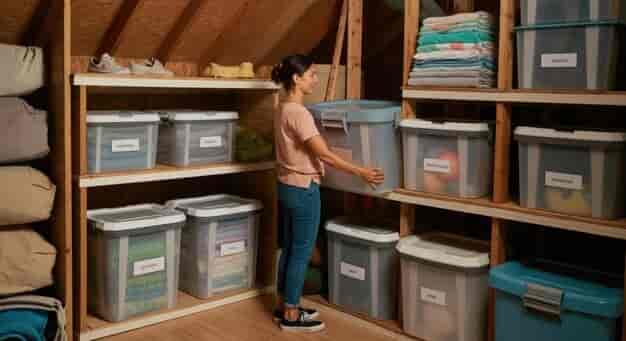
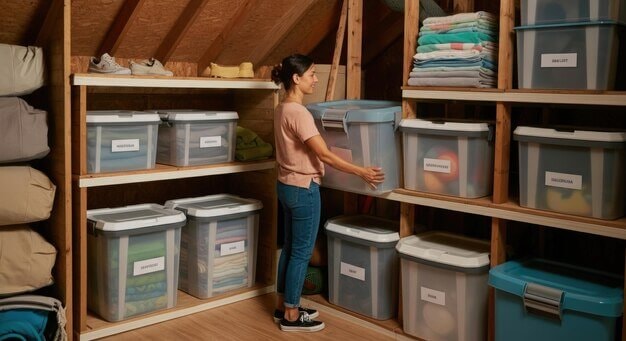
Bins. Heavy-duty, locking-lid plastic only. Cardboard in an attic deteriorates fast, attracts pests, and leaks contents into your insulation when it fails. Standardize on one or two sizes. The 27-gallon size is common; for archive material, smaller 17-gallon bins are easier to lift down through a pull-down stair without back strain. Label both the lid and the long side so you can identify a bin whether it's stacked or shelved.
Weight distribution. Ceiling joists in older homes (pre-1980) were often sized only for a finished ceiling load, typically 10 pounds per square foot live load. Modern joists handle 20–30 psf, but check before loading. Spread heavy items across multiple joists rather than concentrating weight, and don't stack bins more than two high, the higher they go, the harder retrieval becomes, and the more likely a fall takes out the ceiling below.
Rope assist for heavy items. If you're regularly moving anything over about 30 pounds through a pull-down stair, a simple rope-and-hook system mounted to a ridge beam dramatically reduces accident risk. Coming down a folding stair with a heavy box held in front of you is one of the most common ways homeowners hurt themselves.
What NOT to Store in Your Attic
This is the section that matters most.
An attic in summer regularly hits 130–150°F because the roof above is absorbing direct sun and radiating heat downward into whatever's stored. Winter swings to the opposite extreme. Humidity moves dramatically because the attic is poorly sealed against the outside. And because most homeowners only go up there a few times a year, the damage compounds silently for years before anyone notices.
Here's what should never live in your attic:
- Photographs and photo albums, heat causes prints to stick together and fade; humidity grows mold on the emulsion. A single bad summer can destroy an entire decade of family photos.
- Important documents, birth certificates, tax records, deeds, passports, kids' school records. Heat yellows paper, humidity warps it, pests shred it for nesting material.
- Wedding dresses and heirloom textiles, heat sets stains permanently, humidity yellows fabric, moths and silverfish find them. The wedding dress in the attic is a near-universal mistake.
- Books, pages stick, bindings warp, mold blooms. Hardcover and older books are especially vulnerable.
- Vinyl records and tape media, vinyl warps above 100°F, magnetic tape demagnetizes with heat, both suffer in humidity.
- Electronics, heat dramatically shortens component life. Lithium batteries can swell, leak, or in rare cases ignite at attic summer temperatures.
- Wax candles and anything with a low melting point, they will literally melt and slump. Same goes for crayons, certain plastics, lipstick, and vinyl toys.
- Wine, oils, canned food, pantry overflow, heat ruins wine and accelerates spoilage in everything else. Pests in the attic find food storage fast.
- Leather and wool, mildew, dry rot, and moth damage are near-guaranteed within a few years.
- Musical instruments, wood instruments crack, glue joints fail, brass tarnishes severely.
- Artwork, paint cracks, canvas warps, pigments fade.
- Pesticides, paints, solvents, heat causes pressurization, separation, and in some cases chemical breakdown that produces toxic fumes. These need a cool, ventilated space, ideally a flammable-storage cabinet, and never the attic.
If you're looking at this list and recognizing most of what's currently in your attic, that's the typical experience. The attic, more than any other space in the house, has been used for decades as the default warehouse for exactly the wrong category of items.
This is where 10 Federal Storage's climate-controlled units come in. A climate-controlled unit holds steady temperature and humidity year-round, the opposite of what your attic does. A 5x10 climate-controlled unit holds the equivalent of a small bedroom's worth of bins, easily enough for the average household's pile of photos, documents, heirloom textiles, books, and leather goods. It costs less per month than the value of a single damaged item from the list above.
What Actually Belongs in an Attic
The much shorter list. The attic is reasonable storage for:
- Holiday decorations made of plastic, metal, or glass, artificial trees, glass ornaments, plastic figurines, string lights, in sealed bins
- Hard-shell luggage (not leather)
- Camping gear: sleeping bags in dry sacks, tents in stuff sacks, cookware
- Heat-tolerant hobby gear in sealed containers
- Building leftovers, extra tile, trim pieces, hardware, paint chip cards (but not the paint itself)
- Empty boxes for warranty returns and large appliance moves
That's a much shorter list than what's likely up there now. That's by design.
Common Mistakes That Wreck Attics
A few patterns:
- Storing on top of insulation. Compressing insulation can cut its R-value in half. Always store on a decked surface above the insulation, never on the insulation itself.
- Skipping a moisture monitor. A $15 hygrometer tells you whether your attic is the dry kind that can support storage at all, or the damp kind that's silently destroying everything up there.
- Trusting cardboard. Cardboard in attics doesn't last. It feeds pests, absorbs humidity, and collapses under stacking pressure. No exceptions.
- Forgetting what's up there. Attic storage is so out-of-sight that families routinely pay movers to relocate items they don't even remember owning. Keep a simple inventory, even a phone note, taped near the access hatch.
- Going up alone with heavy items. Pull-down stair falls are a leading cause of homeowner injury. Use a rope assist or a helper for anything heavy or awkward.
- Treating "out of sight" as "preserved." The biggest mistake of all. Stuff in the attic isn't being saved, for a long list of items, it's being slowly destroyed. Visibility and preservation aren't the same thing.
The Maintenance Rhythm
Attics don't need frequent maintenance, turnover is slow, but the visits matter more because problems compound silently:
- Twice a year (1 hour), one inspection in late spring, one in late fall. Walk the perimeter looking for new water stains on the roof underside, fresh pest sign, and any items that have shifted, tipped, or had bins damaged. Spring catches winter ice-dam damage; fall catches summer heat damage.
- Annually (half a day), full re-evaluation. Open at least three random bins to spot-check for pest intrusion or moisture damage. Re-read your inventory list. Are items still up here that you forgot you had? They go.
- Every five years (project), major reassessment. By this point your life has changed enough that what made sense to keep five years ago may not now. Treat it as a smaller version of the original cleanout.
When the Attic Was Never the Right Place
After honest sorting, most households find their attic should be holding maybe 30–40% of what's currently up there. The rest splits into two buckets:
- Items that should leave the household entirely (donate, sell, recycle, dispose)
- Items worth keeping that the attic is actively destroying
The second bucket is where climate-controlled storage earns its keep. 10 Federal Storage operates 130+ fully automated self-storage facilities across 16 states, and rescuing irreplaceables from attic damage is one of the most common reasons households rent climate-controlled space. Because every 10 Federal location is automated with 24/7 access and contactless rental, you can:
- Reserve a unit online any time, including the same Saturday you're cleaning out the attic
- Drive directly there with a load, no waiting for office hours, no scheduling around staff
- Access your unit any hour of any day for the seasonal swap
- Choose climate-controlled specifically for items the attic was destroying
A 5x10 climate-controlled unit holds the equivalent of a small bedroom, easily enough for the average household's photos, documents, heirloom textiles, books, and leather goods. A 10x10 covers extended family archives or items from estate transitions. The point isn't to relocate everything from the attic. It's to put the irreplaceable things somewhere that won't slowly destroy them while you're not looking.
Quick-Start Checklist
If you're tackling your attic this weekend:
- Inspect first: stairs, decking, insulation, leaks, pest sign, fix problems before you store anything
- Add lighting and drop a hygrometer up there for a few days
- Bring everything down to a main-floor sorting area
- Sort into four piles: keep in attic, toss, donate, store somewhere else
- Be ruthless: anything heat- or humidity-sensitive should not go back up
- Install proper decking, raised over insulation if needed, and standardized locking-lid plastic bins
- Reachable zone for seasonal items, deep zone for true archive
- Schedule semi-annual inspections in spring and fall
- Drop off donations and dispose of pesticides or solvents within 48 hours, before you talk yourself out of it
- Move the irreplaceables, photos, documents, heirloom textiles, books, leather, to climate-controlled storage where they'll actually survive
Done right, this is a one-weekend project that protects what's up there for the next decade, instead of a one-Saturday project that quietly wastes another ten years of climate damage. Ready to move your photos, documents, and heirlooms somewhere they'll actually last? Find your nearest 10 Federal Storage facility and reserve a climate-controlled unit online in minutes, no office hours, no waiting.
About the Author
10 Federal Storage
Our team at 10 Federal Storage has been in the self storage industry for decades. With knowledge gained from multiple universities and in the field, we are well-prepared and excited to assist with your storage needs. When you rent a unit with us, you can feel confident that our seasoned customer service team’s help will make your transition as seamless as possible. Customer satisfaction is our number one priority, and we strive to make your experience exceptional with our automated leasing options, diverse unit sizes, and a strong commitment to sustainability.