

Kitchen Remodel Ideas and What They Cost
by 10 Federal Storage
Published on April 23, 2026
The kitchen is the most expensive room in the house to remodel, and it's not close. It's also the one most people get wrong, not because they pick the wrong cabinets, but because they don't decide what kind of project they're doing before they start. A cabinet refresh and a full gut renovation are both called "kitchen remodels" on Pinterest. One costs $5,000. The other costs $85,000. Confusing them is the single most common and expensive mistake homeowners make.
Here's the useful news: almost no kitchen actually needs the full gut. Most kitchens need one or two well-chosen changes that make the space feel new without blowing up the whole footprint. Below are the most common kitchen remodel ideas, what they cost, and which ones are worth the money.
First, Decide Your Scope
Every kitchen project is really one of four types. They get talked about interchangeably. They cost nothing alike.
- A cosmetic refresh ($500–$5,000), paint, hardware, faucet, maybe a new light fixture. The kitchen looks like itself, only intentional.
- A minor remodel ($15,000–$30,000), keep the cabinet boxes and the layout, replace fronts, countertops, appliances, backsplash, and flooring. This is the version that quietly dominates the returns conversation.
- A full mid-range remodel ($35,000–$75,000), all new cabinets, counters, appliances, and finishes, usually in the same footprint. New kitchen, old walls.
- A major or luxury remodel ($75,000–$200,000+), layout changes, wall removal, custom cabinetry, premium appliances, sometimes an addition. A construction project, not a remodel.
Nationally, the average kitchen remodel lands around $27,000 to $35,000, with most projects falling somewhere between $15,000 and $75,000 depending on scope. Cabinets alone usually consume 30 to 40 percent of the budget, and labor runs another 25 to 40 percent. Everything else, countertops, appliances, flooring, plumbing, lighting, fights over what's left.
One thing worth putting in your pocket before you read on: Remodeling Magazine's Cost vs. Value Report has consistently ranked the minor kitchen remodel as one of the top-returning home improvements you can make, often recouping close to or above 100 percent of its cost at resale. Major remodels typically return 40 to 55 percent. That's not an argument against major remodels, it's an argument for knowing which one you're doing and why.
Idea 1: The Paint-and-Hardware Refresh
Budget: $500–$2,500 · Timeline: 1–2 weekends
The cheapest honest upgrade you can make to a tired kitchen. If the cabinet boxes are sound and you don't hate the layout, a weekend of painting and swapping hardware will buy you three to five more years of not caring about the kitchen. That's a legitimate outcome, not a compromise.
What goes into it:
- Cabinet paint, DIY with a quality enamel and a good roller, $150–$400 in materials; $1,500–$4,500 if you hire it out
- New cabinet hardware (pulls and knobs), $100–$400 for a typical kitchen
- New faucet, $150–$600 plus $200–$300 to install if you don't DIY
- A new light fixture or two over the sink and island, $100–$500
- Fresh wall paint, $50–$200 in materials
The trick is paint prep. Sand, degrease, prime with a bonding primer, and use a cabinet-rated enamel. Skip any of those steps and you'll be peeling paint off the door edges within a year.
Idea 2: The Cabinet Reface
Budget: $5,000–$13,000 · Timeline: 3–5 days
Refacing replaces cabinet doors, drawer fronts, and the visible side panels while keeping the existing boxes in place. It runs 30 to 50 percent cheaper than full replacement and takes a fraction of the time. Worth it when the boxes are in good shape, the layout still works, and you mostly just want the kitchen to look different.
What you're paying for:
- New doors and drawer fronts in your choice of style and finish
- Matching veneer on cabinet end panels and face frames
- New hinges (soft-close is worth the small upcharge)
- New hardware
Refinishing, sanding and repainting the existing doors in place, is the even cheaper cousin at $1,500–$4,500. It's fine work for a DIYer with patience, but a pro shop will spray the doors off-site in a controlled environment and the finish will be dramatically better than anything you can get with a roller. If you're hiring it out anyway, reface rather than refinish.
Idea 3: The Minor Remodel
Budget: $15,000–$30,000 · Timeline: 2–4 weeks
This is the sweet spot that the Cost vs. Value Report has been quietly celebrating for a decade. You keep the existing layout and cabinet boxes. You replace fronts, countertops, appliances, sink, faucet, backsplash, and flooring. No walls move. No plumbing moves. No electrical panel gets touched.
The result is a kitchen that looks and functions like a brand-new one, at a third the cost of a full gut. It's also the project most likely to return what you put into it if you sell within a few years.
What goes into it:
- Cabinet refacing or new doors on existing boxes ($5,000–$10,000)
- Quartz or budget granite countertops ($2,000–$5,000 installed for a typical kitchen)
- Mid-range stainless appliance package ($3,500–$8,000)
- New backsplash ($600–$2,500 depending on tile and labor)
- New flooring, LVP, tile, or engineered wood ($1,500–$4,500)
- New sink and faucet ($400–$1,200 installed)
- Fresh paint and new lighting ($500–$2,000)
The discipline here is resisting the urge to scope-creep into a major remodel. "As long as we're doing all this, we might as well move the sink" is how $25,000 projects become $70,000 projects. If moving the sink is what you actually want, that's a different idea, see below.
Idea 4: The Full Mid-Range Remodel
Budget: $35,000–$75,000 · Timeline: 5–10 weeks
The classic "new kitchen" most people picture. All new cabinets (not just fronts), new counters, new appliances, new flooring, new everything, but still within roughly the existing footprint. You might relocate an outlet or two, add an island if there's room, and upgrade the lighting. Walls stay where they are.
What separates this from a minor remodel is that the cabinet boxes come out. That unlocks better quality cabinets, proper soft-close hardware throughout, and the ability to tweak sizes and configurations. It also triples the cost, because cabinets and cabinet installation are the two line items that drive kitchen budgets.
Typical component ranges:
- Semi-custom cabinets ($8,000–$25,000 for a typical kitchen)
- Quartz countertops ($3,000–$7,000)
- Mid-range appliance package ($5,000–$13,000)
- Tile backsplash ($1,000–$3,000)
- Hardwood or high-end LVP flooring ($2,500–$6,000)
- New sink, faucet, disposal ($600–$1,800)
- Updated lighting, recessed, pendants, undercabinet LED ($1,000–$3,500)
- Labor, demo, and installation (roughly 30–40 percent of the total)
Semi-custom cabinets are the right answer for most homeowners in this tier. They get you 80 percent of custom's look and fit for 40 to 60 percent of the price, and the construction quality gap between semi-custom and fully custom is smaller than the price gap suggests.
Idea 5: The Island Addition
Budget: $4,000–$20,000 standalone · Timeline: 1–3 weeks
If your kitchen has the floor space for one and doesn't have one yet, adding an island is the single highest-impact change you can make. It adds counter space, storage, seating, and a social center all at once. It's also one of the few kitchen changes that measurably improves daily function rather than just appearance.
Costs depend heavily on what the island does:
- A simple prep island (cabinets, countertop, seating overhang), $4,000–$8,000
- A working island with a sink, add $2,000–$5,000 for plumbing and a subfloor drain line
- An island with a cooktop, add $3,000–$7,000 for electrical, gas, and downdraft or overhead venting
- A full prep-plus-cook-plus-seating island, $12,000–$20,000+ all-in
Two practical notes. You need at least 42 inches (48 is better) of clearance on all sides for the space to actually work, if you can't fit that, a peninsula is the right answer instead. And once you run plumbing or gas through the floor to an island, you've crossed into permit territory, which adds cost and time but also protects you at resale.
Idea 6: The Open-Concept Conversion
Budget: $50,000–$120,000+ · Timeline: 8–14 weeks
Taking down the wall between the kitchen and living or dining room. This has been the dominant remodeling trend for two decades and continues to drive a meaningful share of full-gut projects. It's also where "minor remodel" budgets go to die, because it's never just the wall.
What the project actually entails:
- Structural assessment, is the wall load-bearing? (Usually yes at least partially.)
- Engineering for a properly sized beam, plus the beam itself and new support posts or columns
- Rerouting any plumbing, HVAC ducts, or electrical that runs through the wall
- Patching floors, ceilings, and adjacent walls where the old wall used to be
- Reworking the kitchen layout, because what worked against a wall rarely works in an open floor plan
- Usually a new island or peninsula to define the space that used to be defined by the wall
This is a full mid-range remodel plus a structural project plus a design project. The $50,000 floor assumes a non-load-bearing wall and no major mechanical rerouting. The $120,000+ ceiling is realistic for load-bearing walls in older homes where plumbing stacks and HVAC trunks run through them. Get a structural engineer involved before the contractor quotes, not after.
Idea 7: The Small or Galley Kitchen Optimization
Budget: $15,000–$40,000 · Timeline: 3–6 weeks
Small kitchens get treated like problems to solve. They're not, they're just kitchens with different rules. A well-optimized galley or L-shape under 100 square feet often functions better than a sprawling open kitchen, because everything is within two steps of everything else. The remodel math is friendlier too, because less square footage means less material.
Where the money goes well in small kitchens:
- Cabinets that go all the way to the ceiling, no wasted space above, and the visual lift makes the room feel taller
- Full-depth drawers instead of door-front lower cabinets, dramatically more usable storage per inch
- A counter-depth refrigerator that doesn't stick into the walkway
- Inset or recessed-panel doors rather than chunky raised-panel, which visually crowd small rooms
- Light, consistent finishes, one wood tone or one paint color throughout, rather than a contrasting island
- Undercabinet lighting, which has an outsized effect in small rooms
Small-kitchen mistakes to avoid: a peninsula that narrows the walkway below 42 inches, a microwave hood that cuts visual height above the range, and oversized appliances selected for a future kitchen you don't have yet.
Idea 8: The Chef's or Luxury Remodel
Budget: $100,000–$250,000+ · Timeline: 3–6 months
Full custom cabinetry, professional-grade appliances, premium stone, multiple cooking zones, and almost always structural changes. This is the kitchen people post about. It's also the kitchen that returns the smallest percentage of its cost at resale, typically 35 to 50 percent, because the finishes outstrip what any normal buyer wants to pay for.
That doesn't make it wrong. It just means the justification has to be "we love cooking and will live here for fifteen years," not "this will pay for itself."
What shows up at this tier:
- Fully custom cabinetry in exotic hardwoods or painted inset frames ($25,000–$80,000+)
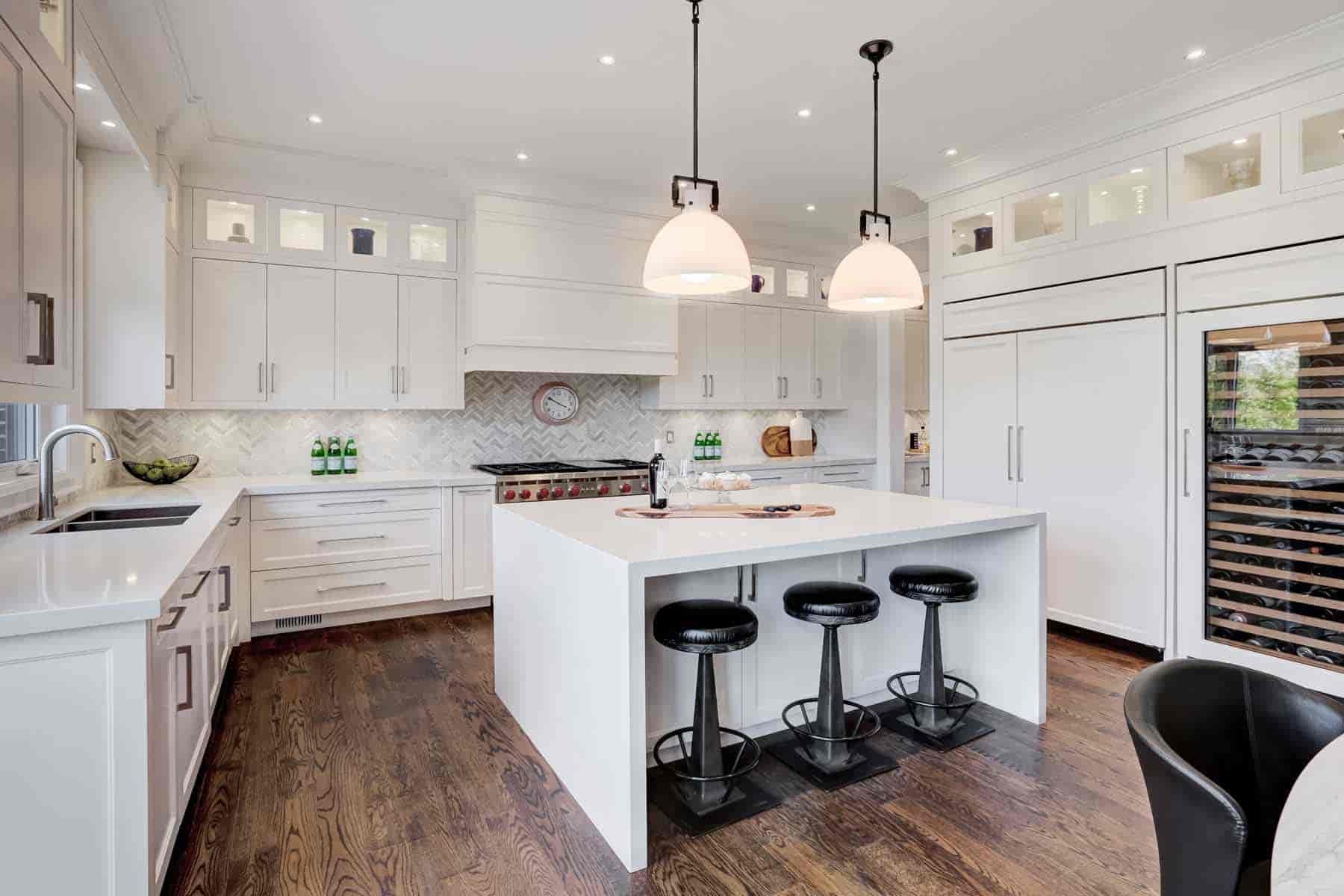
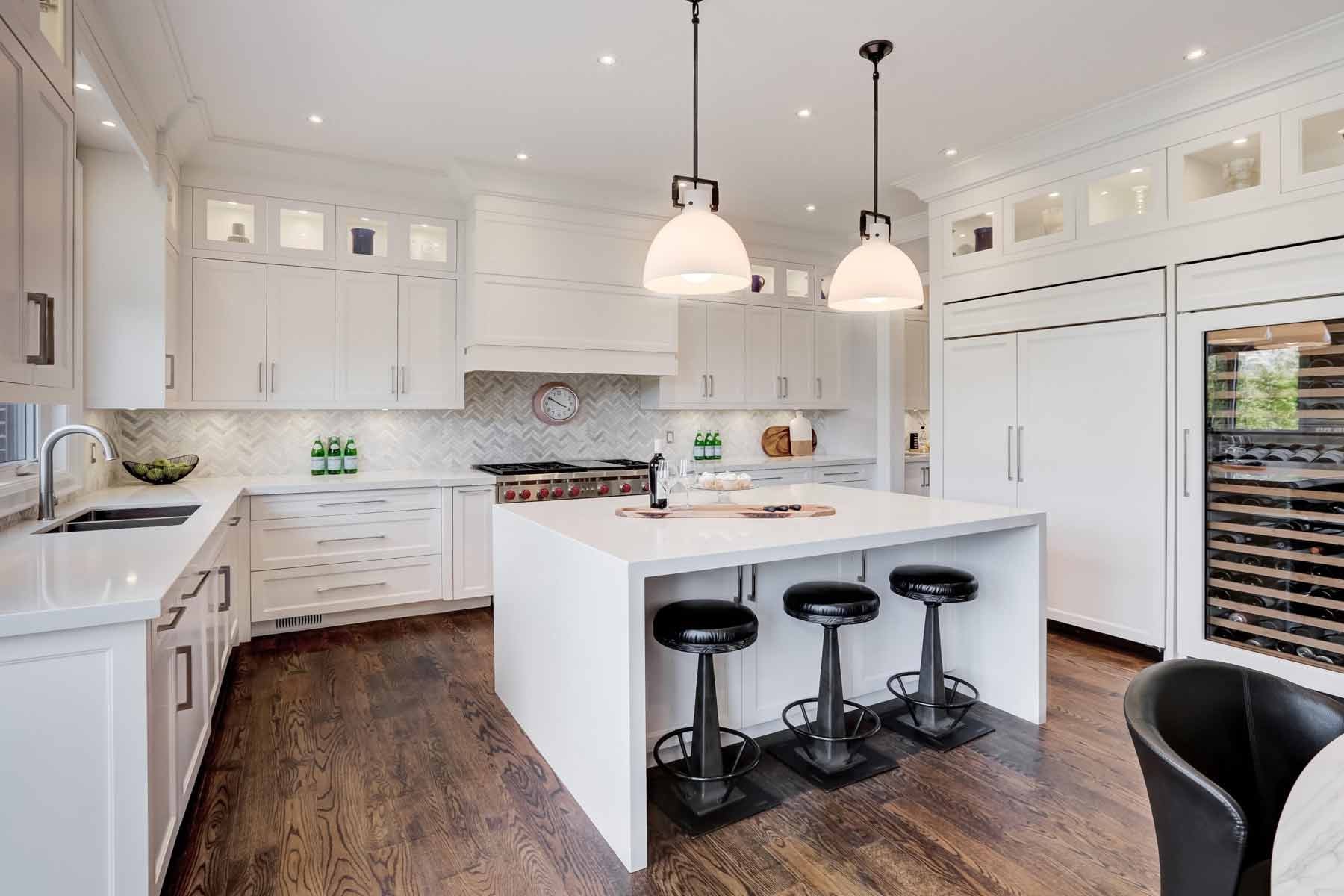
- Professional range, Wolf, Thermador, La Cornue, BlueStar ($8,000–$20,000) with a matching hood
- Built-in or panel-ready refrigeration, Sub-Zero, Thermador, integrated Miele ($9,000–$18,000)
- Steam oven, speed oven, wine fridge, or a second dishwasher ($3,000–$8,000 each)
- Premium stone countertops, marble, exotic quartzite, Dekton ($5,000–$15,000+)
- Waterfall island edges, which roughly double the island's countertop cost
- Layered lighting design, recessed, pendant, undercabinet, toe-kick, in-cabinet ($3,000–$8,000)
- Butler's pantry or scullery, which is effectively a second, back-of-house kitchen ($15,000–$40,000 on top of the main kitchen)
The easiest place to overbuild at this tier is appliances. A 48-inch Sub-Zero and a 48-inch Wolf dual-fuel range together can clear $30,000 before installation. If you don't actually cook like a restaurant, a 36-inch pro range and a counter-depth fridge get you 90 percent of the daily experience for 40 percent of the cost.
Small Kitchen Moves That Punch Above Their Weight
Idea 7 covered small kitchens at the project level. This section is for the tactical moves, the specific changes that behave differently in a small kitchen than they would in a larger one. If you're under about 100 square feet (or under 70 for a galley), these are the ones where the math actually tilts.
Make the Room Feel Bigger Without Changing the Footprint
Perceived size and actual size aren't the same thing, and small kitchens respond dramatically to visual tricks that bigger rooms can ignore.
- Swap one run of uppers for open shelving. Removing a wall of cabinet doors, not all of them, just one run, opens up the room visually in a way that almost nothing else does. Two thick wood shelves and some brackets, $200–$600, or a few hundred more for nicer materials.
- Use glass-front doors on one or two upper cabinets. Same visual-breaking effect as open shelving, without committing to the dust and the editing.
- Go with larger floor tiles or wide-plank LVP. Fewer seams equals less visual chop. A 12x24 tile reads quieter than a 6x6.
- Skip the contrasting island. Two-tone cabinets look great in a 200-square-foot kitchen and terrible in an 80-square-foot one. Pick one finish and commit.
- Replace a swing door to an adjacent room with a cased opening or pocket door. A door that opens into your kitchen eats about 10 square feet of usable floor. Removing it costs $300–$900 for a cased opening, $1,500–$3,500 for a pocket door.
- Consider a pass-through instead of a full wall removal. If the open-concept thing appeals but the structural cost doesn't, cutting a wide pass-through window over a counter delivers 60 percent of the visual effect for 15 percent of the cost ($1,500–$4,000 versus $50,000+).
Steal Storage You Didn't Know You Had
Small kitchens usually aren't short on storage so much as short on accessible storage. The stuff is there; you just can't get to it.
- Toe-kick drawers at the base of your lower cabinets. They cost $150–$400 per drawer to add and hold a surprising amount of flat stuff, baking sheets, cutting boards, placemats, the waffle iron you use twice a year.
- Pull-out pantry in a 9- or 12-inch tall narrow cabinet. More actually usable storage than a 24-inch deep pantry cabinet with fixed shelves, because nothing gets buried in the back.
- Real corner solutions, lazy Susan, magic corner, or diagonal corner cabinet. The blind corner is the worst storage in the average kitchen. Upgrading it during a remodel is a $200–$800 accessory cost with outsized daily impact.
- Wall-mounted storage over the counter. Magnetic knife strip, a single pot rail, a hanging utensil bar, a small spice shelf. Under $200 total and reclaims a whole drawer's worth of cabinet space.
- Over-the-sink cutting board or a roll-out prep surface. Turns the sink into temporary counter when you need it.
- Under-cabinet hooks for mugs. Frees up an entire shelf for things that don't hang as neatly.
Right-Size the Appliances
The average American kitchen is sold appliances sized for the average American kitchen, which is not a small kitchen. Scaling down here is where real square footage gets reclaimed.
- Microwave drawer under the counter ($900–$1,800) instead of an over-the-range unit. Reclaims the entire wall above the stove for a real hood, shelving, or just breathing room.
- 18-inch dishwasher or a single dishwasher drawer ($700–$1,500) where a standard 24-inch won't fit or eats a key cabinet run. Holds 8 place settings instead of 14, which matters approximately never for a 1- or 2-person household.
- 24- or 27-inch apartment range if you rarely cook for more than two or three. Saves 3–6 inches of wall space that can become a pull-out pantry or a usable counter section.
- Counter-depth or compact refrigerator. A 24- or 30-inch counter-depth fridge sticks out 6–10 inches less than a standard-depth unit. The walkway clearance this buys you is often the difference between a kitchen that feels tight and one that feels fine.
- Combination convection-microwave instead of a separate wall oven in a layout where you don't really need two ovens.
Rolling, Foldaway, and Temporary Solutions
A real built-in island usually doesn't fit in a kitchen under 150 square feet without wrecking the walkways. These alternatives get you most of what an island does without the footprint cost.
- Rolling kitchen cart or butcher-block island ($200–$1,200). Wheel it in for prep, wheel it out when you need the floor. Better than a permanent island that clogs the room.
- Drop-leaf counter extension off a wall or the end of a cabinet run. Folds flat when not in use, gives you a 2-seat breakfast bar when it is.
- A narrow peninsula under 24 inches deep. Not a code-compliant breakfast bar, but a real prep surface and a soft room divider. Works where a full island doesn't.
The combined effect of three or four of these moves in a single small kitchen is usually more dramatic than the same dollars thrown at one big change. You can do $3,000–$6,000 worth of these adjustments in a weekend or two and have a kitchen that functions like it grew by 20 square feet.
Where the Money Actually Goes
Every kitchen project above is built from the same handful of components. Here's the deeper breakdown for the decisions you'll make with a contractor, a cabinet rep, or at the counter of the appliance store.
Cabinetry
The biggest line item in almost every project. The three tiers:
- Stock cabinets, $60–$300 per linear foot. Pre-built in standard sizes, available from big-box stores and online sellers, ready to install in days rather than weeks. Quality ranges from particleboard-and-prayer to genuinely decent plywood boxes.
- Semi-custom cabinets, $150–$700 per linear foot. Standard sizes adjustable in 3-inch increments, many door styles and finishes, better construction than stock. Lead times usually four to eight weeks. The right answer for most kitchens.
- Fully custom cabinets, $500–$1,500 per linear foot. Built to your exact dimensions by a cabinetmaker, any door style, any material, any feature. Lead times of 8 to 16 weeks, sometimes longer.
Refacing ($5,000–$13,000) and refinishing ($1,500–$4,500) are the alternatives when the existing boxes are sound. Between the two, refacing lasts longer and looks better.
Countertops
Second biggest visual impact after the cabinets, and the range of prices is huge. Installed costs per square foot, cheapest to most expensive:
- Laminate, $20–$50. Has come a long way, and the best modern laminates from Wilsonart or Formica look convincingly like stone at a distance. Still the budget pick.
- Butcher block, $50–$150. Warm, forgiving, needs oiling. Works best as an accent, say, on an island, rather than as the entire kitchen's run.
- Tile, $30–$60. Classic, customizable, grout lines are a maintenance headache. Uncommon in new installs now.
- Solid surface (Corian and similar), $60–$130. Seamless, repairable, nonporous. Unpopular relative to quartz but genuinely practical.
- Quartz (engineered stone), $50–$200. The default choice for most mid-range and above projects. Nonporous, never needs sealing, available in hundreds of patterns.
- Granite, $60–$200. Natural stone, each slab unique, needs sealing once a year or so. Lost market share to quartz but still excellent.
- Marble, $80–$250. Beautiful, etches if you look at it wrong, high maintenance. Worth it to the right person. Expensive mistake for everyone else.
- Premium and exotic stones (quartzite, soapstone, Dekton), $100–$300+. Stone-yard shopping required.
Appliances
Packages cluster around four pricing tiers. Installation is usually $125–$300 per appliance, more for gas or dedicated circuit work.
- Budget package ($2,000–$5,000), Frigidaire, entry-level GE or Whirlpool. Fridge, range, dishwasher, microwave in stainless. Perfectly functional; nobody will be impressed, but nobody will notice they're cheap either.
- Mid-range package ($5,000–$13,000), GE Profile, KitchenAid, LG, Bosch 300. French-door fridge, convection range, quieter dishwasher. The volume tier for real kitchen remodels.
- Premium package ($13,000–$30,000), Bosch 800, Café, Fisher & Paykel, Bertazzoni, JennAir. Panel-ready options, pro-style finishes, dual-fuel ranges.
- Luxury package ($30,000–$70,000+), Sub-Zero, Wolf, Miele, Thermador. Built-in and paneled refrigeration, professional ranges, often a steam oven and secondary fridge drawers.
Buying a package from a single brand usually nets a 10 to 20 percent discount versus mixing brands. Budget extra for gas lines ($300–$800) or dedicated 240-volt circuits ($200–$500 each) if you're changing fuel types.
Flooring
Kitchen flooring has to survive water, dropped cast-iron, and kids. Installed costs per square foot:
- Sheet vinyl or budget laminate, $3–$7. Cheapest honest option.
- Luxury vinyl plank (LVP), $5–$12. Waterproof, convincing wood look, DIY-friendly. The fastest-growing category for good reason.
- Porcelain or ceramic tile, $8–$20. Indestructible, cold underfoot, and brutal on anything you drop. Grout needs occasional resealing.
- Engineered hardwood, $9–$18. Real wood veneer over plywood, more dimensionally stable than solid hardwood, acceptable in kitchens with normal-human spill response times.
- Solid hardwood, $10–$22. Gorgeous, refinishable, does not love standing water.
Lighting and Electrical
The most underspent category in most budgets and the one that makes the biggest difference in how the finished kitchen feels. A good lighting plan includes three layers: ambient (recessed cans or a central fixture), task (undercabinet LED, pendants over prep surfaces), and accent (in-cabinet or toe-kick). Budget $1,500–$4,000 for lighting materials and another $500–$2,500 for electrical labor. Add more if you're moving outlets, adding circuits for an island, or upgrading the panel.
Plumbing, Sink, and Faucet
Keeping the sink in the same spot is a major cost control. Moving it to an island or the opposite wall typically adds $1,500 to $4,000 for the plumber, more if it requires cutting the slab. A mid-range stainless single-bowl sink runs $250–$700 installed; a quality faucet with a pull-down spray is $200–$600 for the fixture plus $200–$300 to install. A garbage disposal is $150–$400 installed. A pot-filler over the range is $400–$1,200 including the rough-in and is almost never worth it.
Backsplash, Paint, and Finish Work
A tile backsplash runs $600–$3,000 for materials and installation on a typical kitchen wall, more for intricate patterns, stone slab, or herringbone layouts that waste material. Paint on walls and trim is a few hundred dollars in materials and a day of labor. These are the cheapest real upgrades in the kitchen and the ones that tie the rest of the design together.
What's Worth Doing Yourself
Kitchens have a narrower DIY lane than garages or basements. Too many systems converge here, water, gas, electrical, structure, for a homeowner to safely take on the whole job. But there's real money to save in the right places.
Fair game to tackle yourself:
- Demolition, ripping out old cabinets, counters, backsplash, and flooring
- Painting walls, trim, and ceiling
- Painting or refinishing existing cabinets (with patience and proper prep)
- Swapping hardware, pulls, knobs, hinges
- Installing a new faucet and garbage disposal where the plumbing already exists
- Luxury vinyl plank flooring in a standard layout
- Tile backsplash, if you've tiled before and the pattern is simple
- Assembling ready-to-assemble cabinets
- Swapping out light fixtures where a junction box already exists
Worth hiring out:
- Cabinet installation, the layout, shimming, and alignment are where bad kitchens go wrong
- Countertop fabrication and install, stone is heavy, breakable, and unforgiving
- Any gas line work (almost always required by code)
- New electrical circuits, panel work, or anything involving the service
- Moving plumbing, especially through a slab
- Structural work, including wall removal of any kind
- Appliance hookups for gas ranges and hardwired installations
- Professional floor refinishing if you want it to look professional
The honest middle path for most homeowners: do the demo, the painting, and the light finish work; hire pros for the cabinets, counters, plumbing, electrical, and structural. A weekend of your labor on demo alone can save $1,500 to $3,000.
The Storage Problem Nobody Plans For
Ask any contractor what surprises homeowners most about a kitchen remodel, and the answer isn't the cost or the schedule. It's that the kitchen is unusable for weeks, and all the things that were in it have to go somewhere.
A typical kitchen holds a staggering amount of stuff. Dishes, glassware, mugs, pots, pans, sheet pans, bakeware, small appliances, pantry goods, cleaning supplies, trash and recycling, spices, cookbooks, the drawer with the batteries and the takeout menus. The pantry alone on many houses holds more by volume than a small bedroom's closet. All of it has to move during the project, and the project will take:
- A few days for a cosmetic refresh or cabinet reface
- 2–4 weeks for a minor remodel
- 5–10 weeks for a full mid-range remodel
- 3–6 months for a major remodel, layout change, or addition
For the shorter projects, stacking boxes in the dining room works, badly. For anything past about two weeks, it stops working. You lose a room of the house, you trip over bins, and you can't find the coffee grinder for a month. And if the project is a gut renovation with dust-generating demo, leaving fine china and upholstered chairs anywhere near the work zone is a mistake you only make once.
This is where short-term self-storage quietly becomes part of most serious kitchen projects. 10 Federal Storage runs 130+ fully automated self-storage facilities across 14 states, and kitchen remodels are one of the most common reasons our customers rent a unit. Because every location is fully automated with contactless rental and 24/7 access, the logistics line up with a remodel schedule rather than fighting it:
- Reserve a unit online the week before demo, no office visit required
- Move kitchen contents the weekend before the contractor starts
- Access the unit whenever you need to grab something during the project
- Cancel the unit when the kitchen is back in service, no long-term commitment
There's a second angle worth mentioning. The modern kitchen trend toward drawer-heavy cabinets and dedicated pantry cabinets actually holds less stuff than the wall-to-wall upper cabinets it usually replaces. Plenty of homeowners finish a beautiful new kitchen, move back in, and realize there's no good home for the bread machine, the turkey roaster, the holiday serveware, or the extra cases of sparkling water. A small unit long-term, for the rarely-used-but-can't-part-with items, solves that cleanly without forcing another round of cabinetry decisions.
Start Smart: Your Next Steps
A kitchen remodel is the rare home improvement where the same square footage can cost $3,000 or $200,000, and both numbers can be defensible. The deciding factor isn't how much you spend, it's how clearly you understand which project you're actually doing before the first invoice shows up.
If you're ready to move forward, this is the order that saves the most money and stress:
- Name the project honestly. Refresh, minor, full mid-range, or major. Write it down. Everything else flows from that decision.
- Figure out what's non-negotiable, the thing that's actually broken about your current kitchen. Build the remodel around solving that, not around a Pinterest board.
- Get at least three itemized quotes for anything involving cabinets, counters, and a general contractor. Prices on identical scopes commonly vary 30 percent between bidders.
- Reserve a storage unit before demo starts. Find your nearest 10 Federal Storage facility and book online in minutes, automated access, no long-term commitment, and you can cancel when the kitchen's back.
- Do the demo, paint, and easy finish work yourself. Hire out cabinets, counters, plumbing, electrical, and anything structural. The mixed approach beats full-DIY and full-contractor on cost and quality.
- Hold 15 to 20 percent of your budget in reserve. Something behind the walls will surprise you. The only question is what.
Whatever version of a new kitchen you're building, the best time to start planning is before the first cabinet rep walks through your door. Measure the space, pick your idea, and work backward from there.
About the Author
10 Federal Storage
Our team at 10 Federal Storage has been in the self storage industry for decades. With knowledge gained from multiple universities and in the field, we are well-prepared and excited to assist with your storage needs. When you rent a unit with us, you can feel confident that our seasoned customer service team’s help will make your transition as seamless as possible. Customer satisfaction is our number one priority, and we strive to make your experience exceptional with our automated leasing options, diverse unit sizes, and a strong commitment to sustainability.