
.svg)
Patio Design Ideas and What They Cost
by 10 Federal Storage
Published on April 23, 2026
"Patio" is one of the loosest words in home improvement. It can mean a $900 pea-gravel square behind a rental, or a $60,000 outdoor living room with a roof, a kitchen, a fireplace, and heaters rated for January. Both are real patios. Both are Googled with the same three letters. Nothing about the word tells you which project you're actually looking at, which is why most patio planning conversations start somewhere between confused and slightly doomed.
The useful news is that the decision tree for patios is simpler than it looks. Once you settle two questions, how the ground is covered, and what (if anything) goes over the top of it, almost every cost question follows in a straight line. Below are the most common patio ideas, what they realistically cost, which ones are worth the money, and where most budgets quietly leak.
First, Decide Your Scope
Every patio project is really one of four types. They use the same vocabulary. They don't use the same checkbook.
- A basic ground-level patio ($1,500–$6,000), a clean surface to put furniture on. Gravel, plain concrete, or a modest paver square. No cover, no built-ins.
- A mid-range patio ($6,000–$18,000), a larger, better-looking surface in pavers, stamped concrete, or flagstone, usually with borders, lighting, and a fire pit or small built-in feature.
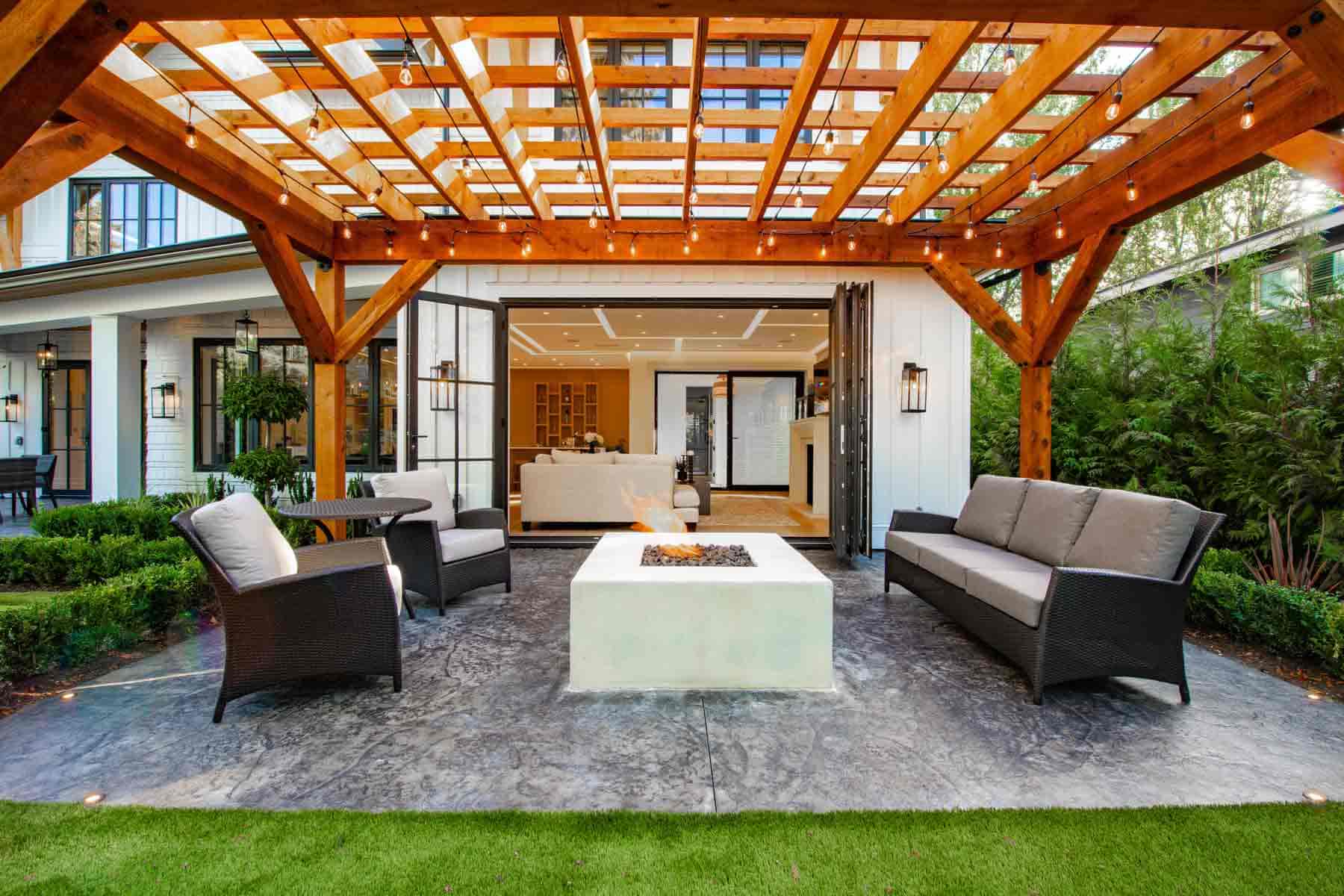
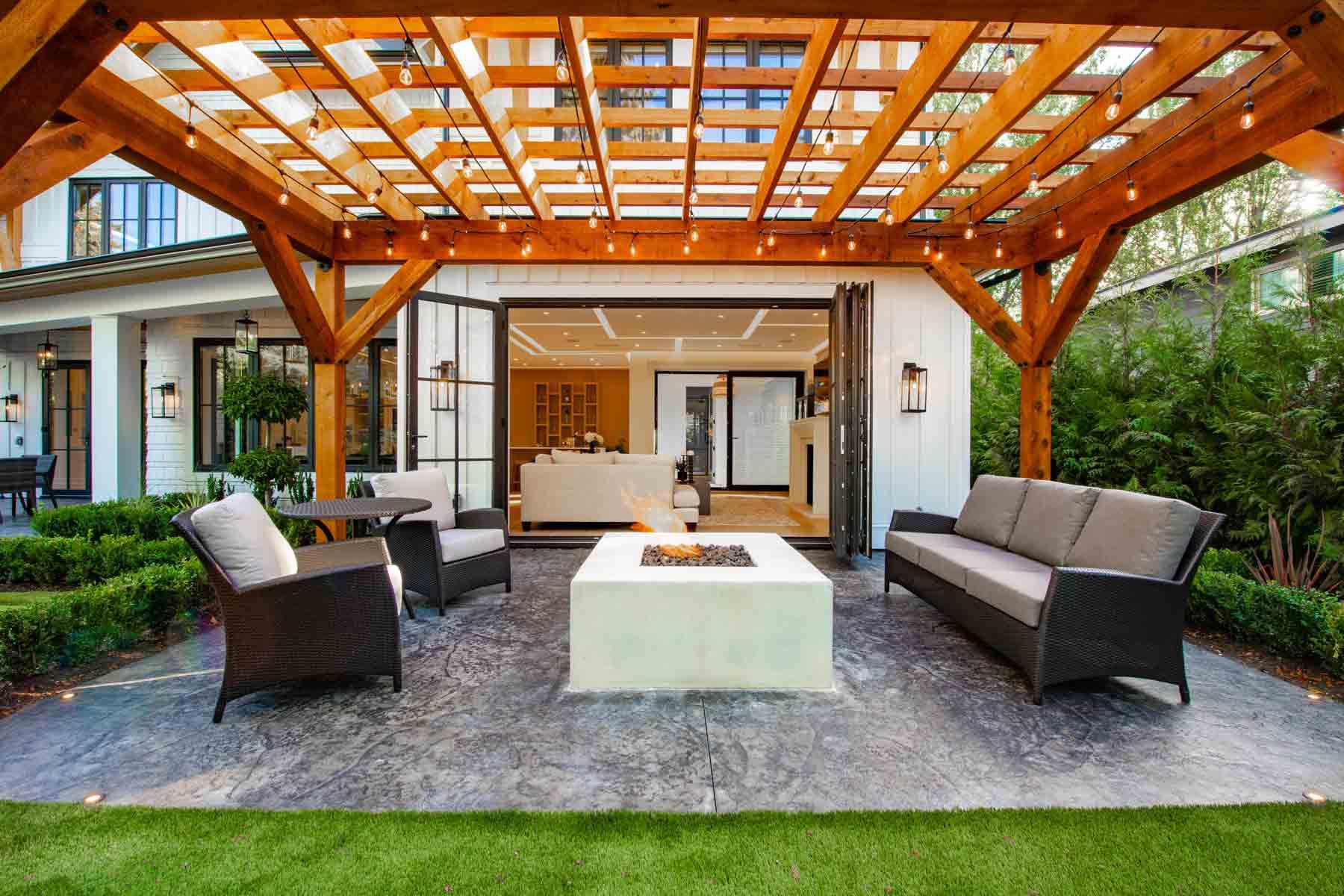
- A covered patio ($15,000–$40,000), all of the above plus a pergola, gable roof, or screened structure. You've moved from a surface to an actual outdoor room.
- An outdoor living room ($30,000–$100,000+), covered patio plus outdoor kitchen, fireplace, premium materials, and full electrical and gas. A construction project, not a weekend idea.
Nationally, basic patio installation runs roughly $5 to $35 per square foot installed, with most ground-level projects landing between $3,000 and $8,000 before covers or built-ins enter the picture. Material choice drives half the bill; labor and site prep drive most of the rest. If your yard slopes, expect another $500 to $5,000 for grading alone before anyone pours anything.
One thing to stash in your pocket before going further: Remodeling Magazine's Cost vs. Value Report has consistently ranked outdoor-living projects as solid, not spectacular, returns on resale, with patios generally recouping 50 to 80 percent of their cost and simple, well-designed additions often doing better than sprawling ones. That's a perfectly fine return for something you'll actually use every week in warm weather. Just don't pretend you're building a patio purely as an investment. You're building it because you want to be outside.
Idea 1: The Gravel or Decomposed Granite Patio
Budget: $500–$3,000 · Timeline: 1–3 weekends
The cheapest real patio you can install, and the most underrated. A well-edged gravel or decomposed-granite patio with a compacted base looks intentional, drains on its own, and costs a fraction of anything poured or paved. It's also the one kind of patio a reasonably handy homeowner can install alone in a weekend without hating themselves by Sunday night.
What goes into it:
- Excavation to roughly 4–6 inches and weed-barrier fabric
- A compacted gravel base and 1–2 inches of finish stone on top
- Steel, aluminum, or paver edging to keep the stone in place
- Optional stepping stones or large pavers set into the gravel for furniture legs
The catch is furniture. Thin chair legs sink into loose gravel. Either use large pavers as a floor within the patio for the dining set, or commit to heavier furniture with wide feet. Skip the river rock, it rolls, it's noisy underfoot, and it's miserable to walk on barefoot. Crushed angular gravel or decomposed granite locks together and stays put.
Idea 2: The Concrete Slab, Plain or Decorative
Budget: $1,500–$8,000 · Timeline: 3–5 days (plus cure)
A poured concrete patio is the workhorse of American backyards for a reason. It's cheap, durable, and when finished well it reads as "intentional" rather than "industrial." A plain broom-finished slab runs about $5 to $10 per square foot installed. Add color or decorative finishes and the number climbs fast.
Three versions worth knowing:
- Plain broom finish ($5–$10/sq ft), utilitarian, honest, boring in a way that ages fine
- Stained or single-color concrete ($8–$12/sq ft), a real upgrade for a small upcharge, especially in warm earth tones
- Stamped concrete ($8–$20/sq ft), patterned to look like stone, slate, or brick; convincing from a distance, less so up close
Concrete's weak point is cracking. Every concrete slab will crack eventually, the question is whether the cracks follow the control joints the contractor cut, or run wherever they feel like. A good concrete contractor cuts joints within 24 hours of the pour, at a depth of roughly one-quarter the slab thickness, and plans them to land where cracks would naturally want to go. A bad one skips this step and you have a web of random cracks within two years.
Stamped concrete is where opinions split. It's cheaper than real stone, easier to maintain than pavers, and legitimately attractive when installed by someone who knows what they're doing. It's also easy to over-color and end up with a patio that looks like the lobby of a chain restaurant. If you go this route, ask to see a contractor's actual finished work in daylight, not their portfolio photos.
Idea 3: The Paver Patio
Budget: $4,000–$14,000 · Timeline: 1–2 weeks
Pavers are where most mid-range patio budgets land, and for good reason. Concrete pavers run roughly $10 to $17 per square foot installed, brick and higher-end concrete pavers $15 to $25, and the look holds up for decades. Individual pavers can be lifted and replaced if one cracks, which is an advantage no poured slab can match.
What's in the number:
- Excavation and grading (critical, a paver patio is only as good as its base)
- A compacted gravel base, 4–6 inches deep, plus an inch of sand
- The pavers themselves, laid in a pattern (running bond, herringbone, basketweave)
- Polymeric sand swept into the joints and activated with water
- Edge restraints to keep the outer pavers from migrating over time
The base is the whole job. A paver patio on a thin or poorly compacted base will heave, settle, and pit within a couple of winters. On a proper base, it'll look sharp for twenty-plus years with nothing more than the occasional sand re-sweep. If you're getting quotes and one contractor is dramatically cheaper than the others, ask how deep they're digging and how many passes they're making with the plate compactor. That's usually where the corners get cut.
Pattern complexity affects price more than people expect. Straight running bond on a rectangular patio is fast to lay. A herringbone pattern with curved edges produces a lot of cut pavers and wasted material and adds 15 to 25 percent to labor.
Idea 4: The Flagstone or Natural Stone Patio
Budget: $5,000–$16,000 · Timeline: 1–2 weeks
Natural stone is the premium move. Flagstone runs $15 to $32 per square foot installed for dry-laid, more for stone set in mortar on a concrete base. Bluestone, travertine, and limestone all land in a similar range. What you're paying for isn't just material, it's the time it takes to fit irregular stones together cleanly.
Two installation approaches, with different lifespans:
- Dry-laid on a gravel base, faster, cheaper, more forgiving; individual stones can shift over time but can be lifted and reset
- Wet-set on a concrete slab, permanent, more stable, roughly 30–50 percent more expensive, and a nightmare if you ever want to change the design
Flagstone is also one of the few patio materials that doesn't look dated a decade later. The irregular shape reads as natural rather than of-its-moment. The trade-off is that the joints collect debris, and walking surfaces need to be relatively flat or chairs will wobble. Ask for stones that are gauged (cut to a consistent thickness) if flat matters to you.
Idea 5: The Small Bistro or Courtyard Patio
Budget: $800–$5,000 · Timeline: 2–4 days
Not every patio needs to be big. A 7-by-7 or 8-by-10 patio, just large enough for a small table, two chairs, and room to scoot back, is the single most-used outdoor space in most houses. It's also the easiest to do well on a budget, because the total square footage is small enough that premium materials don't blow up the number.
Where the small patio quietly wins:
- Enough flagstone for 60 square feet costs less than $2,000 in material; enough for 400 square feet gets expensive fast
- A compact footprint drains easily and rarely needs serious grading
- One nice fixture, a hanging lantern, a statement planter, a single good chair, carries the whole space
- It's within DIY reach for most homeowners in a weekend or two
The design trick for small patios is restraint. One purpose. Morning coffee, or evening drinks, or a reading corner, pick the use case and build around it. Small patios that try to be a dining room and a lounge and a fire pit area end up being none of those, with furniture you constantly have to shuffle.
Idea 6: The Pergola-Covered Patio
Budget: $5,000–$20,000 · Timeline: 3–7 days for the pergola
A pergola is the cheapest way to make a patio feel like a room without actually building a roof. It anchors the space, casts partial shade, and gives string lights, curtains, and climbing plants something to hold onto. A prefabricated wood or aluminum pergola runs roughly $1,500 to $6,000 installed over an existing patio; a custom wood build is $4,000 to $10,000; a louvered aluminum pergola with adjustable slats is $6,500 to $18,000 and is the one version that actually sheds rain when you close it.
Honest trade-offs:
- Open-slat wood pergolas look beautiful and block maybe 40 percent of direct sun. They do not block rain. At all.
- Prefab aluminum pergolas are quick to install, maintenance-free, and come in finishes that look convincingly like wood from six feet away
- Louvered pergolas open and close like shutters and are the one option that genuinely extends patio usability into wet weather
The upgrade most pergola owners regret skipping is integrated lighting. Wiring it in during the build costs a few hundred dollars. Retrofitting later means drilling into finished posts, which nobody wants to do. If you're installing one, run a conduit and add a weatherproof outlet at the post base while the crew is already on site.
Idea 7: The Fully Roofed or Screened Patio
Budget: $12,000–$35,000+ · Timeline: 2–4 weeks
A real roof, gable, shed, or lean-to, transforms a patio into a three-season space. Expect roughly $70 to $155 per square foot for a built gable roof with proper footings, framing, and shingles that match the house. A shed-style lean-to attached to the house is cheaper, around $20 to $60 per square foot. Add screens and you've built a screened porch, which runs $50 to $175 per square foot depending on whether it's a conversion or a new structure.
What you're actually paying for:
- New concrete footings to support the roof load, usually required even on existing patios
- Posts, beams, rafters, sheathing, and roofing material matched to the house
- Flashing and proper water management where the new roof meets the existing one
- A permit, an inspection, and in most jurisdictions a structural drawing
The cost-controlling move is matching the existing roof pitch and shingles rather than introducing a new angle. The house reads as planned rather than patched. A mismatched roofline is the fastest way to make a $25,000 addition look like a $5,000 mistake.
This is also the point at which DIY is no longer a realistic path. Amateur roof ties into the main house are a leading cause of water damage, not next winter, but five winters from now, quietly, behind the siding. Hire the roof out and use your sweat equity somewhere else.
Idea 8: The Outdoor Living Room
Budget: $25,000–$75,000+ · Timeline: 6–12 weeks
The full treatment: a covered patio with an outdoor kitchen, a fireplace or gas fire pit, built-in seating, permanent lighting, ceiling fans, heaters, and sometimes a TV. You are no longer adding a patio, you are adding a room that happens to be outside.
Typical component ranges:
- The patio surface itself (upgraded pavers or stone): $6,000–$16,000
- The cover (pergola, louvered, or solid roof): $5,000–$25,000
- Outdoor kitchen with grill, counter, and a burner or two: $7,000–$25,000
- Full outdoor kitchen with sink, refrigerator, and cabinetry: $20,000–$50,000
- Built-in gas fire pit: $2,000–$6,000; custom outdoor fireplace: $6,000–$20,000
- Lighting, ceiling fans, heaters, speakers: $2,000–$8,000
- Electrical and gas rough-in, permits, and hookups: $2,500–$8,000
Two things worth knowing before you sign. First, outdoor kitchens have a well-documented ROI story in warm climates, often recouping the majority of the investment at resale in the Sun Belt, and a much weaker one in the North, where the season is short. Second, the most common regret isn't what homeowners put in; it's what they included that they never use. The pizza oven. The second refrigerator. The built-in ice chest. Build around the two or three things you will use weekly, and resist the contractor's upsell on everything else.
Where the Money Actually Goes
Two patios with the same square footage and the same material can come in $4,000 apart in quotes. The difference almost always hides in these line items.
Site Prep and Grading
The single most variable cost in a patio project. Level, well-draining ground might need $500 of prep. A sloped yard, buried roots, poor drainage, or a site the contractor can only reach by wheelbarrow can easily add $2,000 to $5,000. If you're getting multiple quotes and the numbers vary wildly, this is usually why. Ask each bidder to break out excavation, hauling, and base prep as their own line.
The Base
For pavers and stone, the base is the work. Expect 4 to 6 inches of compacted aggregate under a paver patio and 6 to 8 inches in climates with hard frost. Thinner bases are how you get heaving and settling in years three through five. If a quote is suspiciously cheap, the base is almost always where the corners are being cut.
Surface Material
Roughly what each option costs installed, on a properly prepared site:
- Gravel or decomposed granite, $2–$7 per square foot
- Plain concrete, $5–$10 per square foot
- Stamped or stained concrete, $8–$20 per square foot
- Concrete pavers, $10–$17 per square foot
- Brick or premium pavers, $15–$25 per square foot
- Flagstone and natural stone, $15–$35 per square foot
Drainage
The invisible line item. A patio that slopes the wrong way funnels water toward the house foundation, a small mistake that becomes a very expensive one. Proper patio installation grades the surface a quarter-inch per foot away from the house, and in problem yards adds French drains or channel drains at another $500 to $2,500. This is not optional, and any contractor who brushes past it should be struck from your list.
Edging and Borders
Not structural on poured concrete, critical on pavers. Plastic, aluminum, or steel edge restraints cost $2 to $6 per linear foot installed. Skipping them saves a few hundred dollars at install and means paying for a repair job within five years when the outer pavers start creeping sideways.
Lighting and Electrical
The most underspent category in most patio budgets. Low-voltage landscape lighting runs $80 to $300 per fixture installed, and a patio needs a minimum of four to eight fixtures to feel lit rather than dim. Running a new 20-amp circuit to a covered patio for fans, heaters, or a TV adds $500 to $1,500 depending on the run. A single weatherproof outlet added during the build is $200 to $400. Added later, it's $600 to $1,200 and a hole in your drywall.
Fire Features
A portable steel fire pit costs $150 to $800 at any home center. A permanent stone or masonry fire pit with a gas line runs $2,000 to $6,000. An outdoor fireplace, built in place, is $6,000 to $20,000 depending on size, material, and whether it's wood-burning or gas. The honest question to ask before building a permanent one: how many times a year will you actually use it? If the answer is fewer than twelve, the portable version is the right call.
Covers, Heaters, and Shade
Retractable awnings run $1,000 to $6,000 for motorized units. Wall-mounted or freestanding patio heaters are $150 to $800 per unit. Ceiling fans rated for damp or wet locations are $150 to $500 plus $200 to $400 to install. A good shade sail is under $300 and solves a lot of problems for very little money.
What's Worth Doing Yourself
Patios have a wider DIY lane than kitchens. The work is mostly outside, mostly not structural, and mostly forgiving of slow progress. There's real money to save if you pick your spots.
Fair game to tackle yourself:
- A gravel or decomposed-granite patio with proper edging, on a level site
- Excavation and base prep on a small patio (rent a plate compactor, don't skip this)
- Laying a small paver patio, 100–150 square feet, on a flat site
- Building or assembling a prefab pergola kit
- Installing a fire pit kit from a home center
- Planting the beds and softscape around the patio
- Low-voltage landscape lighting with a plug-in transformer
- Staining or sealing concrete or pavers
- Hanging string lights and installing a shade sail
- Demolishing an old patio surface (sledgehammer, dumpster rental, a weekend)
Worth hiring out:
- Anything requiring a concrete pour larger than a small pad, forming, pouring, and finishing concrete is a pro skill, and you get one shot
- Large paver installations over 200 square feet, especially on sloped sites
- Stamped and stained concrete finishes, timing and technique determine the outcome
- Flagstone set in mortar over a concrete base
- Any patio roof tied into the house roofline
- Gas line work for fire pits, fireplaces, and outdoor kitchens (required by code in virtually every jurisdiction)
- Electrical beyond a single plug-in circuit
- Anything requiring a permit, structural review, or engineered drawing
- Grading a yard with real slope or drainage problems
The honest middle path for most homeowners: hire out the hardscape (pour, pavers, or stone), and handle the softscape, lighting, and finish details yourself. A weekend of your labor on beds, mulch, and string lights makes an installed patio feel finished for almost no money.
Where the Cushions Actually Live in February
A patio isn't a displacement project the way a kitchen remodel is, it doesn't kick you out of a room of your house, but it does create a quieter, year-round storage problem most homeowners don't see coming until the first cold snap.
A properly kitted-out patio accumulates more gear than people realize. Cushions. Throw pillows. Umbrellas and bases. A chiminea or patio heater. String lights. An outdoor rug. A fire pit cover. Bins of charcoal or wood. Seasonal planters. Heavy furniture that you don't want to drag into the garage every October but also don't want to leave out in a Nor'easter. Left exposed, soft goods mildew and fade in one season. Left crammed into the garage, they eat the space you need for the car, the mower, the bikes, and everything else a garage is supposed to hold.
This is where a small off-site storage unit quietly earns its keep. 10 Federal Storage runs 130+ fully automated self-storage facilities across 16 states, and seasonal patio storage is one of the most common small-unit use cases our customers mention. Because every location is fully automated with contactless online rental and 24/7 access, the logistics fit how patio storage actually works:
- Reserve a 5×5 or 5×10 online in a few minutes, no office visit required
- Drop off cushions, umbrellas, and heaters the weekend the weather turns
- Pull them back out on the first 60-degree day in spring
- Cancel or resize the unit whenever you like, no long-term commitment
The second angle worth mentioning: if you're building a higher-end patio and want to sell the house within a few years, staging the yard for photos matters more than most sellers realize. Patios photograph best uncluttered, a single table, two chairs, one plant, clean lines. The dozen other decor pieces that make the patio feel lived-in during the summer are exactly the items a good stager removes. A short-term unit during a listing period is often the cleanest way to make that happen without temporarily rehoming your grill in the living room.
Start Smart: Your Next Steps
A patio is one of the rare home improvements where the same 200 square feet can cost $2,000 or $60,000 and both numbers can be defensible. The deciding factor isn't the material catalog; it's how clearly you've defined what the patio is actually for before the first stake goes in the ground.
If you're ready to move forward, this is the order that saves the most money and the most regret:
- Name the project honestly. Basic surface, mid-range patio, covered space, or outdoor living room. Write it down. Every later decision flows from that one.
- Pick the primary use. Dining, lounging, cooking, morning coffee, kids' play. One or two, not all of them. Patios that try to do everything end up feeling like none of it.
- Walk the site in the rain. Where does water go? If it moves toward the house, the patio design has to solve that problem before anything else. It's much cheaper to plan drainage than to retrofit it.
- Get at least three itemized quotes. Make each contractor break out excavation, base, material, edging, and drainage as separate lines. Prices on identical scopes routinely vary 25 to 40 percent between bidders, and the variation is almost always in the base and the grading.
- Line up seasonal storage before you buy the furniture. Find your nearest 10 Federal Storage facility, reserve a small unit online, and you've solved the cushion-and-umbrella problem for every winter to come, automated access, contactless rental, and no long-term commitment.
- Do the softscape and lighting yourself. Hire out the hardscape, the roof, the gas, and the electrical. The mixed approach beats full-DIY and full-contractor on both cost and finished quality.
- Hold 10 to 15 percent of your budget in reserve. Something about the site, drainage, a hidden utility, a root ball the size of a refrigerator, will surprise you. It always does.
Whatever version of a patio you're building, the best time to pin down the scope is before the first contractor walks the yard. Measure the space, pick the idea, and work backward from there.
About the Author
10 Federal Storage
Our team at 10 Federal Storage has been in the self storage industry for decades. With knowledge gained from multiple universities and in the field, we are well-prepared and excited to assist with your storage needs. When you rent a unit with us, you can feel confident that our seasoned customer service team’s help will make your transition as seamless as possible. Customer satisfaction is our number one priority, and we strive to make your experience exceptional with our automated leasing options, diverse unit sizes, and a strong commitment to sustainability.