

Best Cities to Live in Colorado in 2026
by 10 Federal Storage
Published on September 8, 2026
Search for the best cities to live in Colorado and you will get roughly the same article eight times. Ten cities, mostly on the Front Range. A population figure, a “median home price,” a crime percentile, an unemployment rate, and then two or three sentences recommending a brewery and a diner. It reads like research. It is mostly a directory with adjectives attached.
The problem is not that those posts are lazy. The problem is that they omit the two costs that decide, more than anything else, whether a particular Colorado address is affordable for you. The first is homeowners insurance, which in Colorado has risen faster than in any other state and which varies by more than $2,000 a year between counties. The second is your property tax, which in a newer Colorado subdivision may be roughly double what it is a few miles away in an older neighborhood, for reasons that never appear in a listing and that most buyers do not learn about until after closing.
This guide covers the cities. It also covers the numbers. In February 2026 the Colorado Division of Insurance published something genuinely surprising: after surveying 20 insurance carriers representing 80 percent of the state’s market, it found that hail, not wildfire, is the largest single driver of homeowners insurance premiums in every county it examined. In Denver, wildfire accounts for about 1 percent of a typical premium. That finding reframes the entire Colorado cost conversation, and as far as we can tell, not one of the ranking “best places to live in Colorado” articles mentions it.
We also correct a specific, documented error in Extra Space Storage’s version of this article, because it is the kind of error that will cost a reader real money if they budget around it. And we cover the Western Slope, which most of these lists skip almost entirely, even though it is where the affordability story in Colorado actually lives right now.
One more thing worth saying up front. We rent storage units. Near the end of this guide there is a section listing five situations where a Colorado mover should not rent one, including from us. That section is there because we would rather be useful than persuasive, and because a recommendation is worth nothing if we would have made it either way.
Table of Contents
- What Every Best Cities in Colorado List Gets Wrong About Home Prices
- Why the Rent Figures in Those Lists Are Not the Rent You Will Pay
- Homeowners Insurance Is the Colorado Cost Nobody Puts on the List
- Hail, Not Wildfire, Is the Largest Driver of Your Colorado Premium
- What Homeowners Insurance Actually Costs by County in Colorado
- What Happens When No Insurer Will Write Your Policy
- Your Wildfire Risk Score Became Visible in July 2026
- How Colorado Property Tax Works After the Repeal of Gallagher
- Metro Districts: The Property Tax That Does Not Appear in the Listing
- Denver
- Colorado Springs
- Fort Collins
- Boulder
- Lakewood and the Established Jefferson County Suburbs
- Castle Rock, Parker, and Douglas County
- Greeley
- Pueblo
- Grand Junction
- Fruita and Palisade
- Montrose, Durango, and the Rest of the Western Slope
- Altitude, Sun, and What Actually Surprises Transplants
- How to Compare Two Colorado Cities Honestly
- What Size Storage Unit a Colorado Move Actually Needs
- When You Should Not Rent a Storage Unit in Colorado
- Where 10 Federal Storage Actually Operates in Colorado
- Frequently Asked Questions About Moving to Colorado
- Making the Decision
What Every Best Cities in Colorado List Gets Wrong About Home Prices
Start with the article most likely to be sitting next to this one in your search results. Extra Space Storage publishes a piece called “Best Places to Live in Colorado.” It covers ten cities, and under each one it lists a figure labeled median purchase price. For Denver it gives $427,600. For Boulder, $736,000. For Colorado Springs, $294,500. For Pueblo, $149,600.
Those numbers are not median purchase prices, and the difference matters enormously if you are budgeting a move.
A median purchase price is a transaction figure. It describes what homes actually sold for over some recent window. It is the number a lender, an agent, or a buyer means when they talk about what a market costs. The figures in that article are something else: they track the U.S. Census Bureau’s American Community Survey estimate of the median value of owner-occupied housing units, which is a different measurement entirely.
Here is what that Census figure actually is. The Census Bureau asks homeowners a survey question about what they think their home would sell for. It then takes the median of those self-reported estimates across every owner-occupied home in the area, including the one bought in 1994 by an owner who has not looked at a comparable sale since, and the one owned free and clear by someone who has lived there forty years. It is a snapshot of an entire standing housing stock as its owners perceive it. It is not a record of what changed hands.
The two numbers diverge in a specific and predictable direction, and the gap widens in exactly the markets where people most need accurate information. Homes that sell tend to be different from homes that do not: more likely to be recently renovated, more likely to be in the segments where buyers are actively competing, and priced in this year’s market rather than in a homeowner’s memory of it. In a market that has appreciated hard, the owner-reported median lags the transaction median substantially.
The practical consequence is straightforward. If you read $427,600 for Denver and build a down payment plan around it, you are planning against a number that does not describe the houses you will be bidding on. You are not off by a rounding error. You are working from a different measurement of a different population of homes.
We want to be careful and fair about what we are saying here. We are not alleging that anyone made this error deliberately, and we are not saying the underlying Census data is bad. The American Community Survey is excellent at what it does. The error is a labeling error: an owner-reported value estimate presented under a heading that says purchase price. It is a common mistake and it is repeated across a lot of relocation content. It happens to be the specific mistake most likely to cause a reader to under-budget a Colorado home purchase, which is why we are naming it rather than gesturing at it.
There is a second thing worth noticing about that article. At the top of the page it displays a line reading “Last updated Aug 17, 2026.” At the bottom of the same page, in the publisher’s own italic note, it says the post was originally published in July 2018 and last revised on March 27, 2024. Both statements are on the same page. We take no view on which is correct. We raise it because the freshness date on a relocation article is doing real work for the reader, and when a page’s own footer contradicts its own header by more than two years, that is worth knowing before you treat the figures below it as current.
What to do instead. If you want a transaction-based read on a Colorado market, the sources that actually measure sales are the ones to use: your county assessor’s recorded sales data, a local multiple listing service report through an agent, or a brokerage market report that states plainly that it is reporting closed sales. Whatever source you pick, check what it says it is measuring before you write the number into a budget. The label at the top of the number is the whole game.
Why the Rent Figures in Those Lists Are Not the Rent You Will Pay
The same problem shows up on the rental side, and if anything it misleads more people, because renters make faster decisions with less professional help than buyers do.
The rent figures that populate these lists are generally a version of the Census Bureau’s median gross rent. That statistic measures what every renting household in an area is currently paying, averaged across all of them. It includes the tenant who signed a lease four years ago and has renewed at modest increases ever since. It includes rent-restricted and income-restricted units. It includes the long-tenured renter whose landlord has never pushed to market.
What you will pay is not that. What you will pay is the asking rent: the price on units that are vacant, listed, and available to a person who does not already live there. In a market with low turnover and several years of appreciation behind it, the gap between median gross rent and asking rent is not small. It is often the difference between a budget that works and one that does not.
You can see the shape of the problem in the figures those lists publish. Median monthly rent figures in the $1,200 to $1,600 range appear for Denver, Boulder, Aurora, and Fort Collins. Ask any renter who has searched those markets recently what a one-bedroom lists for and you will get a different answer. Both things can be true at once, because they are measuring different populations. Only one of them is the population you are about to join.
The better tool. If you want a defensible, free, government-published rent benchmark, use the U.S. Department of Housing and Urban Development’s Fair Market Rents. HUD publishes them annually by metropolitan area and by bedroom count, and critically, the methodology is built around recent-mover rents rather than the whole standing tenancy. That is much closer to what a new arrival faces. FMRs are not a listing price and they will not match any individual apartment, but as a benchmark for “is this listing normal for this market,” they are far more useful than a median gross rent figure lifted into a listicle.
Two cautions on using them. First, FMRs are set for a federal fiscal year, so check which year the schedule you are reading applies to. Second, they are metro-wide, which means a single figure is covering a lot of internal variation. Denver’s FMR does not distinguish between Capitol Hill and a suburb thirty minutes out. Use it as a sanity check on a number, not as a substitute for looking at actual listings in the actual neighborhood.
Homeowners Insurance Is the Colorado Cost Nobody Puts on the List
Every ranking article about Colorado includes cost of living. None of them, in our review of the pages currently ranking, break out homeowners insurance as its own line. That omission would be defensible in most states. In Colorado it is not, because Colorado is the state where this cost has moved the most.
The trajectory is documented in the state’s own regulatory record. The Colorado Division of Insurance, which sits inside the Department of Regulatory Agencies, commissioned a Homeowners Insurance Availability Study published in April 2023. That study found that between January 2019 and October 2022 the average Colorado homeowner premium rose 51.7 percent, an average of 11.5 percent a year, and that the pace was accelerating: from a 6.75 percent increase in 2020 to 14.84 percent in 2022 as measured through October.
The availability side of the study is arguably more important than the price side. It found that 76 percent of carrier groups reduced their Colorado exposure in 2022, with 32 percent shrinking by more than 10 percent. Colorado also reported the fourth-largest five-year direct loss ratio of any U.S. jurisdiction, and five carriers were writing 65 percent of the state’s market. What that describes is not simply an expensive market. It is a concentrated one, where a handful of companies are making decisions that determine whether coverage exists at all in a given area.
Subsequent research has extended the picture. A Colorado State University Regional Economic Development Institute report found premiums rose roughly 58 percent between 2018 and 2023, with nonrenewals becoming more common, particularly outside the Front Range. It also put the scale of exposure in perspective: more than 321,000 Colorado homes face moderate or higher wildfire risk, with potential reconstruction costs in the range of $141 billion.
By 2026 the issue had reached the governor’s office as an affordability question rather than an insurance-industry question. In April 2026 the state published a Roadmap to Reduce Homeowners Insurance, with a stated objective of lowering the average Colorado premium and improving the state’s national ranking on cost. Whether that succeeds is a separate matter. The relevant point for someone choosing a city is that Colorado’s own government now treats homeowners insurance as a housing cost problem, and if you are running a Colorado budget without a real insurance quote in it, your budget is incomplete in a way it would not be in most other states.
A note on the numbers you will see quoted. Colorado does not publish a single official statewide average premium. The figures that circulate in the press, generally somewhere between $4,000 and $6,600 a year depending on the year and the source, come from commercial comparison sites, and they disagree with one another substantially. We are not going to pick one and present it as authoritative. What the state does publish, and what we use in the next two sections, is county-level data collected directly from carriers. That is a different and better class of number.
Hail, Not Wildfire, Is the Largest Driver of Your Colorado Premium
This is the finding that should change how you think about Colorado, and it comes straight from the state.
On February 11, 2026, the Colorado Division of Insurance released the results of a data request it had made to 20 homeowners insurance carriers representing 80 percent of the state’s market. The Division asked the carriers to break down, for 11 counties spread across Colorado, how much of an average homeowner’s premium is attributable to hail risk and how much is attributable to wildfire risk.
The answer was hail, everywhere, by a wide margin.
Across the counties surveyed, hail accounted for between 26 percent and 54 percent of the total homeowners premium. Wildfire accounted for between 0.9 percent and 24.6 percent. Along the Front Range and out into the Eastern Plains, hail runs at roughly half the premium. The eleven counties in the survey were El Paso, Denver, Summit, Routt, Weld, Larimer, La Plata, Mesa, Yuma, Alamosa, and Jefferson.
Two results in particular are worth sitting with:
- Denver: wildfire accounts for an average of about 1 percent of the premium. Essentially all of the catastrophe loading in a Denver homeowners policy is hail.
- Summit County: a high-elevation mountain county that rarely sees significant hail, where hail nonetheless accounts for an average of 35.6 percent of the premium and wildfire accounts for 7.9 percent. Mountain homeowners are paying substantially for a peril their own terrain largely spares them.
That second finding is the one that reveals the mechanism. Insurers are spreading hail risk across the state, pricing it broadly rather than by micro-location. Wildfire they price the opposite way: narrowly, targeting the areas where the models say the exposure actually is. The Division noted this explicitly. Low-wildfire-risk counties see very little of their premium going to wildfire, while high-risk counties see a lot.
The practical implication is a piece of advice you will not find in any Colorado ranking article: the roof is the single highest-leverage thing you can evaluate on a Colorado house. Not the view, not the lot, not the finish level. Its age, its material, and its impact rating are going to drive a larger share of your recurring housing cost than most of the features you are actually going to walk through and evaluate on a showing.
The Division quantified that too. Across the eleven counties analyzed, it estimated that hail mitigation, principally a fortified or impact-resistant roof, has the potential to save a homeowner an average of $82 to $387 per year. Wildfire mitigation, by comparison, was estimated to save an average of $3 to $25 per year.
That last comparison deserves a careful reading, because it is easy to draw the wrong conclusion from it. It does not mean wildfire mitigation is pointless. Defensible space and hardened construction are safety measures first, and they materially affect whether a carrier will write you a policy at all, which in parts of Colorado is a bigger question than what the policy costs. What the Division’s figure shows is narrower and still important: under the discount structures carriers currently offer, wildfire mitigation work is not being rewarded with meaningful premium reductions. The Division itself flagged this as a policy gap, pointing toward mandated discounts or reinsurance as possible responses.
So the honest summary is this. Do the wildfire mitigation for safety and for insurability. Do not expect it to lower your bill much. Evaluate the roof if you want to lower your bill.
What Homeowners Insurance Actually Costs by County in Colorado
The same Division of Insurance release put dollar figures on five of the surveyed counties. These are averages drawn from carrier-reported data covering 80 percent of the Colorado market, which makes them the most defensible county-level insurance numbers publicly available for the state. Each figure below is an average annual homeowners premium, followed by the portion the carriers attributed to hail and to wildfire.
- Summit County: $3,463 average annual premium · $1,233 hail · $274 wildfire
- Denver County: $3,040 average annual premium · $1,547 hail · $30 wildfire
- La Plata County (Durango): $2,170 average annual premium · $562 hail · $533 wildfire
- Alamosa County: $1,590 average annual premium · $639 hail · $78 wildfire
- Mesa County (Grand Junction, Fruita, Palisade): $1,369 average annual premium · $353 hail · $138 wildfire
Read the top and the bottom of that list together, because the spread is the story. The average Summit County homeowner pays roughly $2,094 more per year for insurance than the average Mesa County homeowner. Denver against Mesa is a difference of about $1,671 a year. Neither of those gaps appears in any cost-of-living index you will find attached to a “best places to live” article, because insurance is a small enough weight inside a composite index that a difference of this size disappears into the average.
It does not disappear from your bank account. A $1,671 annual difference is roughly $139 a month, which is a meaningful piece of a mortgage payment, and it recurs every year you own the home. Run it across a thirty-year hold at flat pricing and it is in the neighborhood of $50,000, before any of the premium growth Colorado has actually been experiencing.
La Plata County is instructive for a different reason. It is the only county in the released figures where wildfire and hail are close to each other, $533 against $562. That is what a genuinely high wildfire-risk county looks like in the pricing data, and it is a useful reference point: if you are looking at mountain or foothills property in southwest Colorado, La Plata is closer to your situation than Denver is.
Now the caveat, and please take it seriously. A county average is a planning benchmark, not a quote. Two houses on the same street can price very differently on roof age, roof material, claims history, construction type, distance to a fire station, and the wildfire risk score the carrier’s model assigns to that specific parcel. Nobody should treat these numbers as a prediction for a particular address.
What they are good for is comparison. If you are weighing two Colorado markets against each other, the county spread tells you something real about the direction and rough magnitude of the difference, and it tells you before you are under contract. The only way to know your actual number is to get a quote on the actual address, which brings us to the thing every Colorado buyer should do and most do not.
Get an insurance quote during your inspection period, not after. In most states this is prudent. In Colorado it is closer to essential, because there are addresses where the answer is not a high price but no offer at all. Finding that out after your inspection objection deadline has passed is a genuinely bad position to be in, and it happens.
What Happens When No Insurer Will Write Your Policy
In parts of Colorado, the question is not what coverage costs. It is whether anyone will sell it to you. Your mortgage requires insurance. If you cannot obtain it, the deal does not close, and if you already own the home and get nonrenewed, your lender can force-place a policy that is both worse and more expensive.
Colorado’s answer to this is the Colorado FAIR Plan, created by House Bill 23-1288, signed in May 2023. FAIR stands for Fair Access to Insurance Requirements. It is the state’s insurer of last resort. It began writing policies in 2025, which makes it the youngest FAIR Plan in the country, and by mid-2026 its executive director reported that it covered hundreds of properties across 39 counties with a total insured value of roughly $144 million.
It is important to understand what the FAIR Plan is and what it is not, because it is frequently described as a safety net in a way that oversells it. It is a floor, and the floor is lower than most people assume.
- You must be turned down first. Eligibility requires demonstrating that admitted, state-licensed carriers have declined to write you. This is not a plan you shop into because you like the price. It is a plan you qualify for by exhausting the normal market.
- Coverage is capped. The cap has been reported at $750,000. In a number of Front Range and mountain markets, that is well below what it would cost to rebuild the home, which means the cap can leave a substantial gap even when coverage exists.
- It pays actual cash value, not replacement cost. This is the provision people most often miss. Actual cash value is depreciated value. A twenty-year-old roof is paid as a twenty-year-old roof, not as the new roof you would have to buy. After a total loss, the difference between actual cash value and replacement cost on an entire structure is enormous.
- The base policy is narrow. Reporting on the plan describes a base policy built around fire and lightning, with wind, hail, smoke, vandalism and vehicle damage available only as extended-coverage endorsements you elect and pay for separately. Personal liability is not included in the base policy.
- There are moratoriums. During active wildfire events, insurers commonly stop writing new policies in the affected area, and reporting from July 2026 indicates the FAIR Plan does the same. You cannot wait until a fire is fifteen miles away and then go buy coverage.
People who need liability and contents coverage typically have to pair a FAIR Plan policy with something from the excess and surplus lines market, which adds cost and complexity. None of this is a criticism of the plan, which exists precisely because the alternative was nothing. It is a description of what “the state has a backstop” actually means in practice.
Why this belongs in a “best cities to live in” guide. Because insurability is now a real variable in Colorado location choice, and it does not track city boundaries. It tracks parcels. Two homes in the same municipality, one backing to open space and one in an interior subdivision, can face completely different markets. Any list that ranks Colorado cities without acknowledging this is describing a state that stopped existing several years ago.
The practical step, again, is to get a real quote on a real address early. If you are looking at property in the wildland-urban interface anywhere in Colorado, do that before you write the offer, not during the inspection period.
Your Wildfire Risk Score Became Visible in July 2026
For years, the way Colorado insurers priced wildfire risk was effectively invisible to the people being priced. Carriers ran proprietary wildfire risk models, produced a score for a property, and used that score to set premiums, apply surcharges, or decline to renew. Homeowners could not see the score, could not learn which model produced it, and had no defined route to challenge it. Someone whose premium tripled had no way to find out whether the model had their vegetation, their roof, or even their address right.
House Bill 25-1182 changed that. Effective July 1, 2026, insurers that use a wildfire risk model or catastrophe model in Colorado are required to disclose relevant information about how those models affect pricing, and to provide a formal process through which a homeowner can appeal the score and submit additional documentation.
Several things about this are worth knowing if you are moving to Colorado.
The score arrives at renewal, not on a schedule. Nothing was mailed out on July 1. The disclosure obligation attaches to your policy renewal paperwork. If you want your score before then, ask your carrier directly.
Ask for it as a buyer, not just as an owner. When you are getting the insurance quote we keep recommending, ask what wildfire risk score the carrier has assigned to the address and which model produced it. That answer tells you something about the property that no inspection report will, and it tells you before you are committed.
The appeal is real but it is documentation-driven. The mechanism is designed around submitting evidence, so mitigation work that has been documented by a qualified professional carries more weight than an assertion that the lot looks fine. If you have done defensible-space work, having it documented is what makes it usable.
Transparency is not affordability. This is the honest framing and it is worth stating plainly. HB25-1182 gives homeowners information and a process. It does not cap premiums, it does not require discounts, and it does not change the FAIR Plan’s cap or its actual-cash-value basis. It is a meaningful improvement in a market where people were being priced by something they could not see. It is not a solution to the cost.
Colorado also offers state tax provisions related to wildfire mitigation expenses, with eligibility conditions including income thresholds. Those provisions change with legislative sessions and the details matter, so treat that as something to raise with a Colorado tax professional rather than a number to plan around. We are deliberately not publishing a figure here.
How Colorado Property Tax Works After the Repeal of Gallagher
Colorado’s effective property tax rate is genuinely low by national standards, generally cited somewhere in the range of roughly 0.4 to 0.5 percent of market value, which places it among the lowest handful of states. That is a real advantage and it is one of the better arguments for the state.
It is also more complicated than a single rate suggests, and the complication is where the surprises live.
Colorado does not tax your home’s market value directly. The calculation runs in three steps. The county assessor determines an actual value for the property. A residential assessment rate converts that into an assessed value. Local mill levies, set separately by the county, the municipality, the school district, and any special districts, are applied to the assessed value to produce the bill. Reappraisal happens on a two-year cycle in odd-numbered years, and Colorado does not reassess to market value simply because a property sold, which is a meaningful structural advantage over states that do.
From 1982 until 2020, the assessment rate was governed by the Gallagher Amendment, which locked residential property into a fixed share of the statewide tax base relative to commercial property and automatically recalculated the residential rate every two years to hold that ratio as home values rose. Colorado voters repealed Gallagher in November 2020 through Amendment B, which froze the rates where they stood and handed the legislature direct control.
What followed was a sequence of legislative interventions responding to sharp increases in home values: Senate Bill 22-238, a November 2023 special session bill, Senate Bill 24-233 in May 2024, and then House Bill 24B-1001 out of the August 2024 special session. The current structure that emerged from those bills includes separate residential assessment rates for school district levies and for other local government levies, a subtraction of a portion of the home’s actual value before the rate is applied, and a cap on annual property tax revenue growth for most local governments.
We are not publishing the current assessment rates in this post, and that is deliberate. Published sources disagree on the exact 2026 residential assessment rate for non-school local levies, because the statute makes it conditional on whether statewide actual value growth exceeded a threshold. Two credible sources will give you two different figures, and this area has been amended in four separate legislative actions in roughly as many years. A specific number here would be wrong within a cycle and possibly wrong today.
What we will tell you is where to get the correct figure, which is more useful anyway:
- The county assessor for the county you are buying in. Every Colorado county assessor publishes current assessment rates, and most publish a property search that will show you the actual value, assessed value, and total mill levy for a specific parcel. This is the authoritative answer for your address.
- The county treasurer. The treasurer produces the actual tax bill and can show you what was levied on a parcel historically, which is the single best predictor of what you will pay.
- The Colorado Division of Property Taxation, within the Department of Local Affairs, for statewide rules and the current statutory framework.
- A Colorado tax professional or real estate attorney if the amount is large enough to matter to your decision, which for most buyers it is.
One structural note that works in your favor and is worth understanding. Because Colorado applies mill levies uniformly within a taxing district and does not reassess on sale, a new buyer pays the same mill levy as the neighbor who bought in 1998. Colorado does not have the acquisition-value system that creates permanent tax gaps between new and long-tenured owners in some other states. Whatever else is complicated here, that part is fair.
Metro Districts: The Property Tax That Does Not Appear in the Listing
This is the one we would most want a friend moving to Colorado to read, because it is specific, it is expensive, and it is almost entirely absent from relocation content about the state.
A metropolitan district is a type of special district formed under Title 32 of the Colorado Revised Statutes. The mechanism works like this. A developer forms a district covering a new subdivision. The district issues bonds to pay for the roads, water lines, sewer, parks, and other public infrastructure the development needs. Then the homeowners who move in afterward repay those bonds, with interest, through an additional mill levy assessed on their property taxes.
The infrastructure gets built early, the developer’s capital cost moves off the purchase price, and the future residents carry the debt service. Whether you regard that as a sensible financing tool or a cost shift, it is legal, it is extremely common, and it is not optional once you buy inside the boundary.
Where they are. Overwhelmingly in newer construction. If a Front Range subdivision was platted after roughly 2000, has its own parks and a monument sign at the entrance, the odds are high there is a district. They cluster where Colorado built fastest, in places like Aurora, Commerce City, Thornton, Erie, Parker, and Castle Rock, and in newer redevelopment areas within Denver itself. Colorado has well over a thousand metropolitan districts levying taxes.
What they cost. Published estimates vary because every district is different, which is itself the point. Reported ranges for the added mill levy run from roughly 25 to 60 mills in typical cases, with some districts higher. Service plans commonly cap the debt service levy at 50 mills with a repayment term up to 40 years, and many districts layer an operations levy on top of that. Compared against the 60 to 80 mills that established neighborhoods often carry, a district can represent a very large proportional increase in the total bill. On a mid-priced home, published estimates of the annual difference run into the low thousands of dollars.
We are giving you ranges rather than a figure because a figure would be false precision. The only number that matters is the one certified for the specific district your specific house sits in, and that number is knowable.
Three things that make this genuinely dangerous for buyers:
- It shows up on the property tax bill, not as dues. Buyers who carefully evaluate HOA fees often miss this entirely, because it is not a fee. It is a levy, collected with property taxes and typically escrowed into the mortgage payment.
- On new construction, it can be delayed. A newly built home has to be valued by the county assessor before the district levy appears in full. Municipalities that host these districts warn buyers directly that the tax may not show up on the first bill after closing and may not appear until a year or two later. A buyer who checks the first tax bill and concludes everything looks fine may be looking at an incomplete number.
- Online estimates frequently miss it. Listing-site tax estimates and mortgage calculators often reflect a standard levy without the district, which means the payment you were quoted early in the process may be materially understated.
How to check, and this takes about fifteen minutes:
- Pull the actual tax bill on the parcel. The county treasurer’s property search will show every taxing entity levying against the address, itemized. A metropolitan district will be named there. This is the definitive answer and it is free.
- Use your disclosure rights. Colorado law requires disclosure to buyers of residential property in metropolitan districts, including providing the district’s official website for sales on or after January 1, 2024 where the district was organized on or after January 1, 2000. Districts also record public disclosure documents. Ask for these in writing and read them.
- Look up the district’s filings. Colorado local governments file annual financial statements with the Office of the State Auditor, and the Department of Local Affairs maintains a district registry. That is where outstanding debt and certified mill levies live.
- Ask what the levy will be at full build-out, not what it is today. In a partially built district, the current levy on an early home may not reflect the eventual debt service.
None of this means avoid metro districts. Plenty of good neighborhoods are inside them and the amenities they finance are frequently the reason people want to live there. It means price them in before you fall in love with the house, and compare an in-district home against an out-of-district home on total monthly cost rather than on list price. A home that looks $30,000 cheaper can be more expensive to own.
Denver
Denver is the default answer and it is a defensible one. It is the state’s economic center, its transit hub, and the place with the deepest job market across the widest range of industries: healthcare, aerospace, energy, telecommunications, finance, and a substantial professional services base. If your career is portable within an industry rather than tied to one employer, Denver is where you have the most options if things change.
It also has the state’s only genuinely urban core, with the museum and performing arts infrastructure, the professional sports, and the restaurant depth that comes with metro scale. Denver International Airport is a major hub, which matters more than people expect when you are five hundred miles from anywhere.
What the lists get right: the job market and the amenity depth are real, and the mountain access from Denver is genuinely good by the standards of any large American city.
What they leave out. Three things.
First, the insurance picture. Denver County’s average annual homeowners premium in the Division of Insurance data is $3,040, and $1,547 of that is attributed to hail. Wildfire is about $30. If you are moving to Denver from a state where a comparable house insures for well under two thousand dollars, that is a real shift in your carrying cost, and the driver is not the thing you were worried about.
Second, metro districts. Denver’s newer redevelopment areas are exactly the kind of place where districts appear. If you are looking at newly built housing in the northeast quadrant of the city or in the surrounding metro, check the parcel’s tax bill before you compare it on price to an older neighborhood.
Third, and this is the one people underestimate, mountain access from Denver is a traffic problem. The I-70 corridor west on a winter Saturday morning and a winter Sunday afternoon is a well-documented and durable congestion problem. The mountains are ninety minutes away in the sense that the distance is ninety minutes. Plan your actual life around the traffic pattern, not the mileage.
Best fit: people whose careers benefit from a deep, diversified metro job market; people who want urban amenities and are willing to pay the state’s highest overall costs for them; households where one partner’s employment needs metro scale.
Worth thinking twice about if: your income is portable and you are choosing Denver mainly for the mountains. You are paying a Denver premium for weekend access that several smaller Colorado cities give you on a weekday afternoon.
Colorado Springs
Colorado Springs is the state’s second-largest city and the most common answer for people who want Colorado at a discount to Denver. The discount is real but it has narrowed considerably over the past decade, and the city is no longer the bargain that older articles describe.
The economy has an unusual structure that is worth understanding, because it makes the city more stable than most metros its size. Military and defense is the anchor: Fort Carson, Peterson Space Force Base, Schriever, Cheyenne Mountain, and the United States Air Force Academy all sit in or near the city, and U.S. Space Command’s presence has been a recurring subject of federal decision-making. Around that base sits a substantial cybersecurity and aerospace cluster, plus healthcare and a growing set of nonprofit headquarters.
That defense concentration cuts both ways. It insulates the local economy from ordinary business cycles better than a comparable civilian metro. It also means federal budget and basing decisions have outsized local effects, and those decisions are not always predictable.
Practical notes the lists skip:
- El Paso County was one of the eleven counties in the Division of Insurance survey. Its hail share of premium was among the higher ones measured. This is Front Range hail country and you should evaluate roofs accordingly.
- Military households have specific storage and moving considerations tied to permanent change of station timing, temporary lodging gaps, and deployment cycles. That is a genuinely different moving problem than a civilian relocation and it deserves its own planning.
- Growth has been outward and rapid, particularly north and east, which means a lot of the newer inventory carries the metro district question with it.
- Wildfire history is real here. The Waldo Canyon and Black Forest fires both burned into developed areas. Insurability in the western foothills neighborhoods and in Black Forest is a live question, not a theoretical one.
Best fit: military and defense-connected households; families who want more square footage per dollar than Denver and are content with a smaller cultural scene; anyone who wants Pikes Peak and the Front Range foothills from their kitchen window.
Fort Collins
Fort Collins turns up at or near the top of most Colorado rankings and it earns the placement. It is a university city built around Colorado State University, with a genuinely walkable Old Town, a bicycle infrastructure that is among the best in the interior West, and an employment base broader than the university alone: healthcare, technology and engineering, manufacturing, and the brewing industry that made the city nationally known.
It also has the thing that is hardest to manufacture, which is a coherent center. Old Town is a real downtown that people actually use, not a redeveloped block with a marketing name.
The catch is cost and the trajectory of it. Fort Collins has appreciated hard. The gap between Fort Collins and Denver on housing is much narrower than it was, and in some segments it has effectively closed. Anyone reading an older article describing Fort Collins as the affordable alternative to Boulder should verify current pricing rather than assume it.
Larimer County was in the Division of Insurance survey, and this is northern Front Range hail territory. The same roof advice applies. Larimer also includes a substantial wildland-urban interface running west toward the canyons, and the Cameron Peak Fire in 2020 was the largest in state history at the time. Insurability varies enormously depending on how far west of the city you are looking.
Best fit: people who want a mid-sized city with real civic texture and are not trying to minimize housing cost; households connected to CSU or to the region’s tech and manufacturing employers; anyone who would actually use a bicycle-first city.
Worth thinking twice about if: affordability is your primary constraint. Fort Collins is a very good city that is no longer a cheap one, and the article telling you otherwise is probably older than it looks.
Boulder
Boulder is the most expensive significant housing market in Colorado and one of the more expensive in the country outside the coasts. Everything good that is said about it is true. It has the Flatirons, a world-class research university, one of the strongest concentrations of federal scientific laboratories in the United States, a serious startup and venture ecosystem, and an open space program that permanently protects the setting.
It is also a city that has made deliberate, long-standing policy choices to limit growth, and those choices have consequences that show up directly in the housing market. The greenbelt and the height restrictions are why Boulder looks the way it does. They are also a substantial part of why it costs what it costs.
The honest way to frame Boulder is that it is a specialized market. If your work is in the specific research, scientific, or venture-backed clusters that Boulder concentrates, it may be the only place in Colorado that makes sense, and the housing cost is the price of professional access. If your work is not in those clusters, you are paying a very large premium for scenery and civic amenities that other Colorado cities offer at a fraction of the cost.
Two practical notes. First, a large share of the Boulder-adjacent housing that people actually end up buying is in Louisville, Lafayette, Superior, Erie, and Longmont, and those are meaningfully different markets with meaningfully different tax and district profiles. Erie in particular is metro district country. Second, the Marshall Fire in December 2021 burned through Superior and Louisville, causing losses in the range of two billion dollars, and it reshaped the insurance market for the entire state. That fire is a substantial part of the reason the FAIR Plan exists. It also demonstrated that Colorado wildfire risk is not confined to forested mountain property. It burned suburban subdivisions on the plains in winter.
Best fit: researchers, scientists, and founders whose work is anchored to the Boulder cluster; households with the income to absorb the state’s highest housing costs without strain.
Lakewood and the Established Jefferson County Suburbs
Lakewood, Arvada, Wheat Ridge, Golden, and the rest of established Jefferson County occupy a genuinely useful position that ranking lists tend to flatten into “Denver suburb.” They sit directly against the foothills, they have real access to Denver employment, and much of the housing stock predates the metro district era.
That last point deserves emphasis, because it is an underrated argument for older suburbs generally. A 1970s ranch in Wheat Ridge is not carrying forty years of infrastructure bond debt on its tax bill. A comparable new build thirty minutes further out may be. When you compare them on list price alone, the older house looks worse than it is.
Jefferson County was in the Division of Insurance survey and it illustrates the county-average caveat well. Jefferson County contains both flat suburban neighborhoods and genuine mountain wildland-urban interface running up into Evergreen, Conifer, and Coal Creek Canyon. A county average is nearly meaningless across that range. Foothills property in Jefferson County is where a lot of Colorado’s insurance non-renewal stories have originated.
What these areas offer: trail access from the neighborhood rather than from the highway, Golden’s genuinely distinct small-city character, Red Rocks, established tree canopy, and commutes that work in both directions. What they lack, relative to newer development, is the newest housing stock and the amenity packages that come with master-planned communities.
Best fit: buyers who want foothills proximity with Denver access, who value an established neighborhood over a new build, and who are deliberately trying to avoid metro district exposure.
Castle Rock, Parker, and Douglas County
Douglas County, sitting between Denver and Colorado Springs, is consistently among the highest-income counties in Colorado and it is where a large share of the metro’s family-oriented growth has landed. Castle Rock and Parker are the anchors. The schools rate well, the crime numbers are low, the newer housing stock is large and well-appointed, and the setting along the Front Range is genuinely attractive.
It is also, more than anywhere else in this guide, metro district country, and if you read only one section of this article before touring Douglas County, make it Section 9.
Almost everything built here since 2000 sits within a metropolitan district. That is not a criticism of the area. It is the financing model that produced the parks, the trails, the roads, and the amenity centers that make these communities attractive in the first place. But it means the property tax comparison between a Castle Rock new build and an older home elsewhere in the metro is not a like-for-like comparison, and the difference is large enough to change which house you can afford.
Before you make an offer in Douglas County:
- Pull the parcel’s itemized tax bill from the Douglas County Treasurer and identify every taxing entity on it
- Ask the district what the levy will be at full build-out, not what it is today
- Confirm whether there is also an HOA, because districts and HOAs coexist frequently and they are separate charges
- Compare total monthly cost, meaning principal, interest, taxes, insurance and any HOA, against your alternatives, rather than comparing list prices
Best fit: families prioritizing schools and newer housing who have run the total-cost math with the district levy included and are comfortable with the answer.
The trap: buyers who compare a Douglas County new build to an older Jefferson County home on price per square foot and conclude the new build is the better value. Sometimes it is. You cannot know without the tax bill.
Greeley
Greeley is the seat of Weld County and it is one of the more genuinely affordable options along the Front Range corridor, which is why it appears on nearly every list. The economy runs on agriculture and food processing, energy, healthcare, education through the University of Northern Colorado and Aims Community College, and a growing logistics and manufacturing presence.
Weld County was one of the eleven counties in the Division of Insurance survey, and this is worth knowing: Weld sits in the heart of Colorado’s hail belt. The Front Range and Eastern Plains are where the hail loading in Colorado premiums is concentrated, running to roughly half of the premium. If you buy in Greeley, the roof is not a detail. Ask its age, ask its material, ask whether it carries an impact rating, and ask the seller for any recent claim history on the property.
Weld County is also Colorado’s primary oil and gas producing county, and the working landscape reflects that. Depending on where you look, active operations may be a visible and audible part of the environment. Mineral rights in Colorado are frequently severed from surface rights, which means the person who owns the ground under your house may not own what is beneath it. That is a normal feature of Colorado property and it is not inherently a problem, but it is something to have your title work address explicitly rather than discover later.
Best fit: buyers prioritizing affordability with Front Range access; households connected to the agriculture, energy, or food processing economy; UNC-connected families.
Do your homework on: the roof, the surrounding land use, and the mineral rights position on the specific parcel.
Pueblo
Pueblo is the most affordable city of any real size in Colorado and it is the one where the ranking lists do the reader the most disservice, in both directions.
The disservice in one direction is the crime percentile. Extra Space’s entry for Pueblo lists a crime rate of “safer than 0% of Colorado cities.” That figure comes from a third-party percentile ranking, and a percentile is not a rate. It tells you where a city sits in an ordering. It does not tell you the magnitude of the difference between positions, it does not distinguish property crime from violent crime, and it does not tell you anything about the specific neighborhood you are considering, which in any city varies far more than the citywide figure. Publishing “safer than 0%” next to a city’s name without that context is a strong claim resting on a weak statistic.
The disservice in the other direction is treating Pueblo as purely a budget option. It is a real city with a genuine history, a steel industry heritage that still operates, a distinctive Southern Colorado food culture built around the Pueblo chile, the Historic Arkansas Riverwalk, and a growing arts presence downtown. The cost of living is meaningfully below both the state and national averages.
What to look at seriously: the local job market is thinner than the Front Range metros, which matters most if your work is not remote and not in healthcare, education, or the industrial base. Wages are correspondingly lower, so the affordability advantage is largest for people bringing outside income and smallest for people earning locally. Pueblo also sits near significant wildfire activity in the Wet Mountains to the west, which is worth factoring into any insurance conversation.
Best fit: retirees on fixed income, remote workers with outside income, and anyone for whom housing cost is the binding constraint. If you can bring your salary with you, Pueblo is one of the strongest value propositions in the state.
Grand Junction
Grand Junction is the largest city in Colorado west of the Continental Divide, and it is close to invisible in the ranking articles. Extra Space’s list of ten Colorado cities does not include it. Most of the brokerage lists do not either. The Western Slope, when it appears at all, appears as Durango.
That omission is worth examining, because on the two variables this guide has argued matter most, Grand Junction is one of the strongest answers in Colorado.
Insurance. Mesa County recorded the lowest average annual homeowners premium of the five counties for which the Division of Insurance published dollar figures: $1,369, against $3,040 in Denver County and $3,463 in Summit County. Hail accounted for $353 of it and wildfire for $138. That is a difference of roughly $1,671 a year against Denver, recurring, on a cost line that ranking articles do not mention at all.
Property tax structure. Grand Junction’s housing stock is substantially older than the Front Range growth suburbs, which means much less of it carries metropolitan district debt service. That does not mean none of it does, and you should still pull the parcel’s tax bill. But the base rate of exposure to the metro district problem is meaningfully lower here than in Douglas County or Erie.
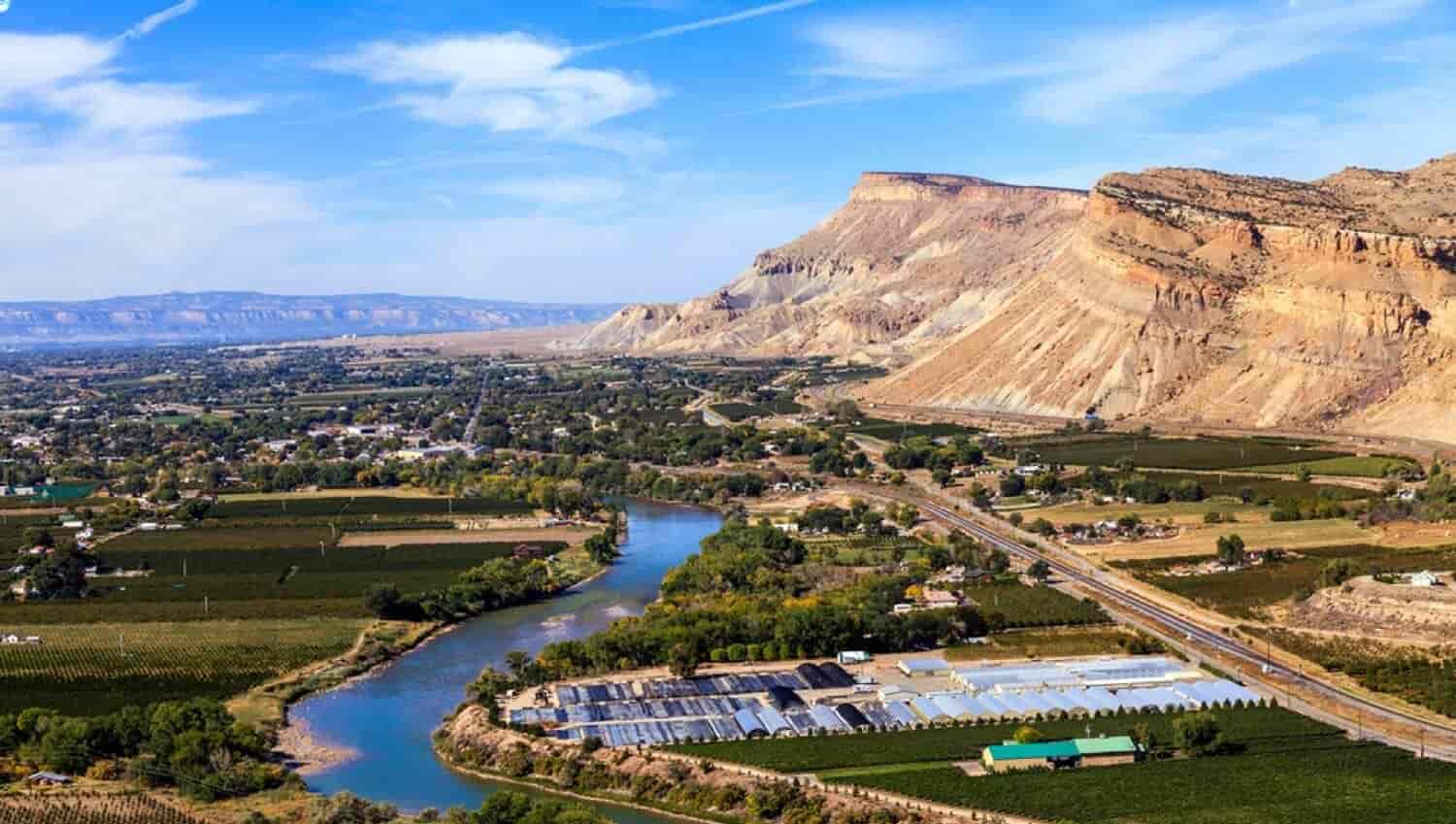
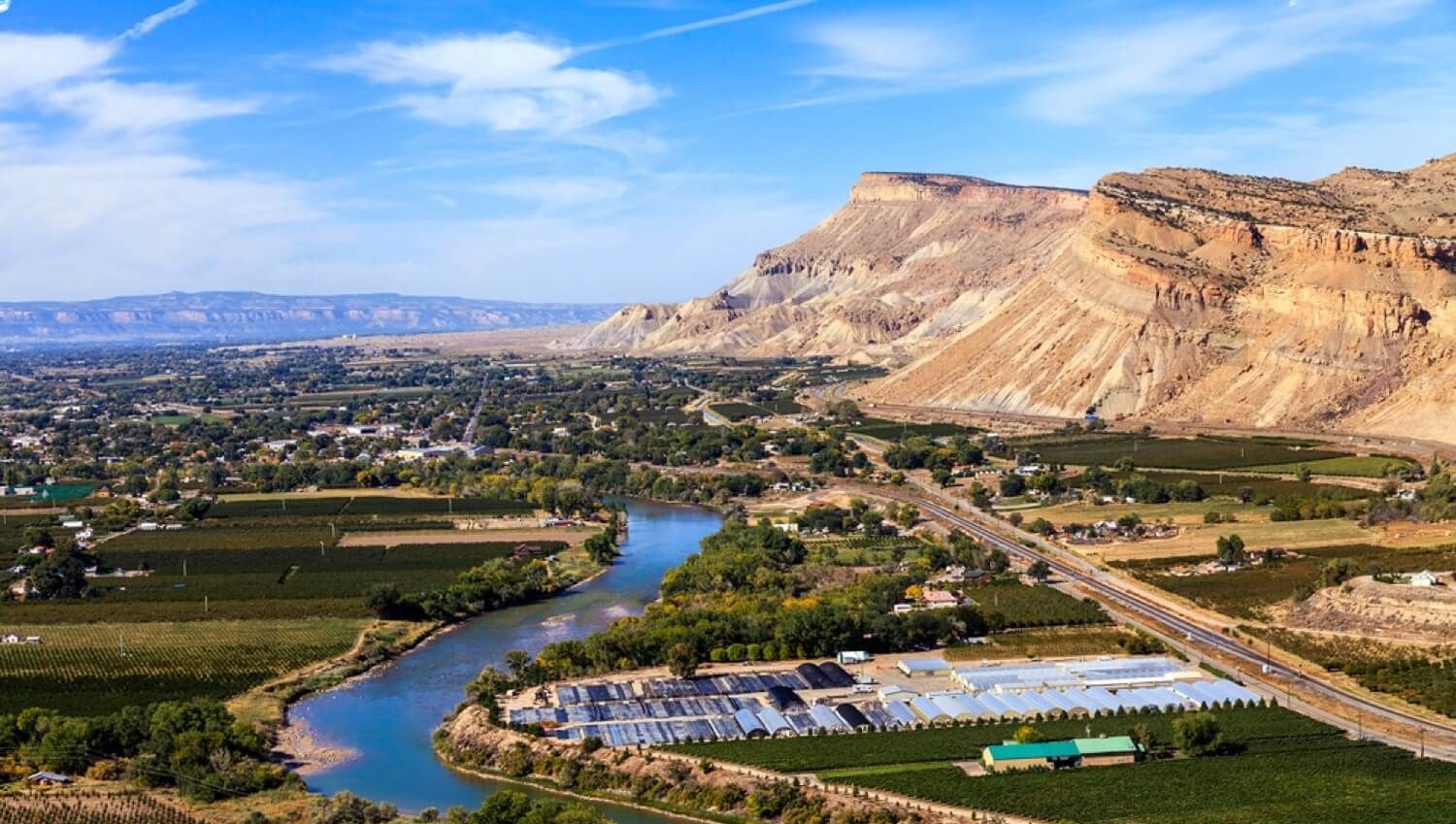
The city itself. Roughly 66,000 people in the Grand Valley at the confluence of the Colorado and Gunnison rivers, at about 4,600 feet, which is low enough that the altitude adjustment most Colorado transplants go through is much gentler. The economy centers on healthcare, with St. Mary’s Medical Center and Community Hospital as major regional employers, along with Colorado Mesa University, energy, agriculture, and a regional airport that makes it the service hub for a large and sparsely populated part of the state.
The setting is not the Colorado of the postcards and that is the point. It is high desert: Colorado National Monument’s red sandstone directly west, the Book Cliffs north, the Grand Mesa southeast, and more than 300 days of sunshine a year. Winters are mild by Colorado standards. Summers are hot and dry.
The honest counterweights:
- The job market is narrower. Outside healthcare, education, and energy, professional depth is limited. If you lose a job here, the local set of comparable alternatives is small.
- It is genuinely far from Denver. Roughly four hours on I-70 in good conditions, and the corridor through Glenwood Canyon and over Vail Pass is subject to closures. This is not a place you commute from or visit the metro casually.
- Air service is regional, which means most longer trips route through Denver or Salt Lake City and cost more.
- Cultural amenities are those of a small city. Real, but small.
Best fit: remote workers and retirees bringing outside income, healthcare professionals, people who want serious outdoor access without mountain-town pricing, and anyone whose Colorado budget was broken by Front Range insurance and tax math.
If you want more depth on the individual neighborhoods and what each area costs, we have a full guide to the best neighborhoods in Grand Junction, and a longer complete guide to moving to Grand Junction that covers utilities, schools, and the logistics of the move itself.
Fruita and Palisade
These two small towns bracket Grand Junction in the Grand Valley, and they are the reason people who move to Mesa County often end up staying. Neither appears on any ranking list we reviewed.
Fruita sits about twelve miles west of Grand Junction at roughly 4,500 feet, and it has become one of western Colorado’s fastest-growing small towns. It is the recognized gateway to Colorado National Monument, whose western entrance is just south of town off Highway 340. It is also a nationally known mountain biking destination, with the North Fruita Desert and Kokopelli trail systems drawing riders from across the country, and it has river access on the Colorado for paddling. The downtown has been genuinely revitalized rather than merely renovated, and the school system is a real draw for families.
What Fruita gives you is a small-town center you can walk, immediate access to world-class recreation, and Grand Junction’s hospitals, airport, and shopping fifteen minutes away. What it costs you is small-town scale: a limited local job market, one grocery-scale retail environment, and the reality that anything specialized is a drive.
Palisade sits about fifteen minutes east of Grand Junction along the Colorado River, with a population around 2,700. It is the center of Colorado’s wine industry, with more than twenty wineries and tasting rooms, and it is known statewide as the Peach Capital of Colorado. The Grand Valley’s combination of elevation, river water, and growing season produces fruit that has genuine reputation attached to it.
Palisade is a specific kind of place and it suits a specific kind of person. It is small, agricultural, walkable in its core, and organized around a seasonal rhythm of harvest and festivals: the Peach Festival, Winefest, the bluegrass festival. Homes range from historic properties in the walkable downtown to orchard and vineyard parcels outside it. If you want a town where you know the people at the tasting room and the farm stand, this is it. If you want anonymity and options, it is not.
A shared practical note for both. Agricultural property in the Grand Valley frequently comes with irrigation water rights, and Colorado water law is its own body of law with real consequences. Shares in a ditch or irrigation company, the associated assessments, and the maintenance obligations that come with them are all things to have a Colorado real estate attorney examine before closing on any parcel with acreage. Do not treat water as a bonus feature on the listing. Treat it as a legal interest that needs review.
We have neighborhood-level guides for both towns: best neighborhoods in Fruita and best neighborhoods in Palisade, plus a complete guide to moving to Palisade.
Montrose, Durango, and the Rest of the Western Slope
Durango is the Western Slope city that does make the lists, and it deserves to. It is a genuinely beautiful small city in the San Juans with a preserved historic downtown, the Durango and Silverton Narrow Gauge Railroad, Fort Lewis College, a strong regional healthcare presence, and outdoor access that is close to unmatched.
It is also expensive, and the Division of Insurance data adds a dimension the lists miss. La Plata County’s average annual homeowners premium is $2,170, with $533 of it attributed to wildfire. That wildfire share is nearly the highest relative position in the released figures and it is roughly eighteen times Denver’s. This is what a true high-wildfire-risk county looks like in the pricing data. If you are buying in or around Durango, particularly on wooded property, the insurance conversation should happen before the offer, not after.
Montrose sits between Grand Junction and the San Juans and is one of the more underrated options in the state. It is the service hub for the Uncompahgre Valley, it has a regional airport with more service than its size suggests because of Telluride traffic, and it offers access to the Black Canyon of the Gunnison and the San Juans at a fraction of resort-town pricing. Housing costs meaningfully less than Durango.
Cañon City, on the Arkansas River below the Royal Gorge, has one of the mildest winter climates in Colorado, which is why it has long attracted retirees. It is also very affordable. The local economy is heavily influenced by state and federal corrections facilities, which is a fact worth knowing rather than a judgment.
The resort towns. Aspen, Vail, Breckenridge, Steamboat, Telluride and Crested Butte are extraordinary places to visit and difficult places to live on a normal income. Summit County’s $3,463 average homeowners premium, the highest in the released Division of Insurance figures, is one small piece of a much larger cost picture that includes some of the most severe housing affordability pressure in the country. Many people who work in these towns live in the down-valley communities and commute, sometimes considerably. That is the actual living arrangement behind the postcard, and it should be understood before anyone plans a move around a ski season.
The general Western Slope trade. You gain space, quiet, cost, and immediate access to landscape that people fly across the world to see. You give up job market depth, air service, medical specialization, and proximity to anything. Whether that trade works depends almost entirely on one question: does your income come from here, or do you bring it with you? For people bringing it with them, the Western Slope is among the best values in the American West. For people who need to earn it locally, it is a much harder calculation.
Altitude, Sun, and What Actually Surprises Transplants
The ranking articles cover attractions. They do not cover the adjustments, and the adjustments are what people actually talk about in their first year.
Altitude is a real physiological adjustment. Denver is a mile up. Many Front Range communities are higher. Most people acclimatize over a period of weeks, but the first stretch commonly involves fatigue, disrupted sleep, headaches, and shortness of breath on exertion that would be trivial at sea level. Hydration needs go up. Alcohol tolerance goes down noticeably. If anyone in your household has a cardiovascular or respiratory condition, altitude is a genuine medical question and belongs in a conversation with their physician before the move rather than after it. Lower-elevation Colorado cities, Grand Junction at around 4,600 feet and Pueblo at around 4,700, involve a much smaller adjustment than the Front Range or the mountains.
The sun is stronger than you expect. Ultraviolet intensity increases with elevation, and Colorado combines that with a high number of clear days. Sunburn happens faster, including in winter and including on cloudy days, and the cumulative exposure is greater than most transplants are used to.
The air is dry, and it affects your things as well as you. Colorado is semi-arid across most of the state. People notice it first in skin and sinuses. It also acts on materials over time: solid wood furniture, musical instruments, and older books and papers respond to sustained low humidity. This is worth planning for regardless of where you store things. Note that a temperature-regulated storage unit addresses temperature, not the dryness of the air, and we say more about that distinction in Section 23.
Snow is not the winter problem people expect. The Front Range gets significant snow but also gets rapid melt-off, because the sun is strong and the air is dry. Many storms clear within a day or two. The bigger winter variables are the mountain passes, which close, and the corridor traffic on I-70, which is not a weather problem so much as a volume problem.
Wind and hail are underrated. The Front Range gets serious downslope wind events, particularly along the foothills. And as the entire middle of this guide has argued, hail is the dominant weather cost in Colorado. Most transplants arrive worried about wildfire and snow. The thing that will most likely damage their property is a hailstorm.
Fire season affects air quality across the state. Smoke from fires burning in Colorado and in neighboring states routinely degrades air quality on the Front Range and the Western Slope for stretches of the summer. This matters for anyone with asthma or another respiratory condition, and it is not confined to the areas where fires are actually burning.
How to Compare Two Colorado Cities Honestly
Here is the process we would use if we were choosing between two Colorado addresses. It takes a few hours and it will tell you more than any ranking article, including this one.
- Start with the local wage for your actual occupation, not the cost-of-living index. A cost-of-living index compares prices. It does not tell you whether local salaries have moved with local prices. The Bureau of Labor Statistics publishes metro-level occupational wage data at no cost, and it will answer the only version of the affordability question that matters to you: what does someone doing my job earn here, against what things cost here. If you are bringing outside income, skip this step and the arbitrage is real. If you will earn locally, this step is the whole analysis.
- Get an actual insurance quote on an actual address. Not a county average, including the ones in this article. Call a carrier or an independent agent with a specific address during the inspection period. Ask three questions: what is the premium, what is the wind and hail deductible, and what wildfire risk score has been assigned to this parcel.
- Pull the itemized property tax bill from the county treasurer. Identify every taxing entity levying against the parcel. If a metropolitan district appears, find out what the levy will be at full build-out and how long the debt runs.
- Look at the roof, seriously. Age, material, impact rating, and claims history on the property. In Colorado this is a recurring cost input, not a maintenance item.
- Check the HOA separately from the district. They are different charges and a property can have both.
- Benchmark rent against HUD Fair Market Rents if you are renting, rather than against a median gross rent figure from a listicle.
- Drive the commute at the actual hour you would drive it. Colorado’s corridor congestion is time-specific and it does not show up in a mapping app’s optimistic estimate on a Tuesday at eleven in the morning.
- Total it monthly. Principal, interest, taxes including any district levy, insurance, HOA, and utilities. Compare that total against the other city’s total. Never compare list prices.
Run that on two addresses and the answer is usually obvious, and it is frequently not the answer the ranking articles would have given you. We have watched this exercise move people from a Front Range new build to an older established suburb, and from the Front Range entirely to the Western Slope, on the strength of numbers that took an afternoon to gather.
What Size Storage Unit a Colorado Move Actually Needs
Most Colorado relocations produce a storage gap somewhere. Closing dates rarely align, mountain and Western Slope inventory moves in ways that do not accommodate a tidy handoff, and a lot of people arrive from lower-elevation states with a household that does not fit a Colorado floor plan. Here is the arithmetic, which is the part no ranking article and very few storage articles bother to publish.
Sizing by household, for a full-contents hold:
- 5x5 (25 sq ft): boxes, seasonal items, a few pieces of small furniture. Roughly a large closet. This is the overflow unit, not the move unit.
- 5x10 (50 sq ft): the contents of a studio or a one-bedroom apartment without large appliances. Also the standard answer for a college student between semesters.
- 10x10 (100 sq ft): a one to two bedroom apartment, or two rooms of a house including major furniture. This is the most commonly rented size and the most commonly under-ordered one.
- 10x15 (150 sq ft): a two to three bedroom home. Furniture, appliances, and boxes with room to walk in.
- 10x20 (200 sq ft): a three to four bedroom home, full contents. Roughly a single-car garage.
- 10x30 (300 sq ft): a four to five bedroom home, or a household plus a vehicle, or a household plus a substantial gear inventory.
Now the Colorado-specific adjustment, and it is not a small one. Colorado households carry more equipment than households almost anywhere else, and if you are moving here you will accumulate it faster than you expect. Budget space accordingly:
- Skis and snowboards: a family of four with skis, poles, boots, and helmets occupies roughly the footprint of a small bookshelf, but the length means it wants wall space rather than shelf space.
- Mountain bikes: plan on roughly 6 to 8 square feet of floor per bike if stored upright and not hung, and more if you keep a repair stand and a parts bin.
- Rafts, kayaks, and paddleboards: a hard-shell kayak runs 10 to 14 feet and needs a unit long enough to accept it without standing it on end. A 10x15 or 10x20 handles this comfortably; a 10x10 usually does not.
- Camping and overlanding kit: tents, bags, pads, stoves, coolers, and a rooftop tent add up to more volume than people estimate, commonly 20 to 30 square feet once it is all in one place.
- Snow removal and yard equipment: a snowblower alone is typically 4 to 6 square feet of floor.
The practical rule we would give someone moving to Colorado: take your household size estimate and go up one size if you have an active outdoor household. The cost difference between a 10x10 and a 10x15 is small relative to the cost of discovering on moving day that your gear does not fit, and relative to the cost of a second unit.
If you want to work it out precisely rather than from these rules of thumb, our storage size calculator works from an item list, and the storage unit size guide walks through what fits in each size with photographs. You can also browse by size directly: small units, medium units, or large units.
One thing we want to be precise about, because Colorado’s climate makes it matter. Our climate-controlled units are temperature-regulated. They hold the space within a moderated temperature range and protect belongings from the extreme heat and cold swings that an unconditioned garage or shed experiences. They do not manage or adjust the humidity level of the air, and we are not going to suggest otherwise. Colorado’s air is dry, and sustained low humidity affects solid wood, instruments, and paper over long periods. If you are storing something where that is a real concern, such as a piano, a violin, or an archival collection, talk to a specialist about what that particular item needs. Temperature regulation is a genuine benefit and it is what we provide. It is not a humidity solution and we would rather tell you that now than have you assume it.
For vehicles, boats, and RVs, which a lot of people acquire within a year of moving to Colorado, we have separate vehicle storage and RV storage options, though availability varies by location.
When You Should Not Rent a Storage Unit in Colorado
We rent storage units. We would still rather you did not rent one in the following five situations, because in each of them storage costs you money without solving your problem.
1. When the honest answer is that you should sell or donate it. Run the arithmetic before you rent. A 10x10 unit held for eighteen months costs more than a great deal of ordinary furniture is worth. If you are storing a sofa you did not love, a dining set that does not fit the new place, and boxes you have not opened since a previous move, the storage bill will exceed the replacement cost and you will still have to deal with the items at the end. Colorado has an active secondhand market and moving to a smaller Front Range floor plan is a natural moment to use it. The test is simple: if you would not pay to ship it across the country, do not pay to store it for a year.
2. When your closing dates actually align. Plenty of people rent a unit as insurance against a gap that never materializes. If you are closing on the sale and the purchase within a few days of each other and your movers can hold the load overnight, you may not need a unit at all. Ask your moving company what they charge for short-term hold on the truck or in their warehouse and compare it against a month of rent plus two extra loading days of your own labor. Sometimes the mover is cheaper and always it is less handling.
3. When what you actually need is a decision, not a unit. This is the most common one and it is worth being blunt about. Storage is very good at postponing a decision about belongings. It is not good at making one. If you are renting a unit because you and a partner cannot agree about what to keep, or because sorting through a parent’s house is emotionally difficult, the unit will still be there in three years and so will the disagreement, and you will have paid for the delay. That is a real reason to rent sometimes, and grief in particular deserves time. Just name it as what it is so you can set an actual end date rather than drifting.
4. When your new place has the space and you have not looked. Colorado homes outside the dense urban core frequently have real garages, and many have basements, which are less common in the parts of the country a lot of transplants come from. Measure the new garage and basement before you sign a storage lease. We have talked to people who rented a unit from out of state, then arrived to find a two-car garage they were not using.
5. When the item needs conditions we do not provide. We said this in the previous section and we will say it again because it is the situation where renting from us would be the wrong call. Our units are temperature-regulated. They do not manage humidity. If you have a fine instrument, an archival paper or photographic collection, wine that needs specific conditions, or anything else where the specification is about the moisture content of the air rather than the temperature, a general-purpose storage unit is the wrong product. Find a specialist facility. We would rather lose the rental than have you store something in a space that does not meet its requirements.
If none of those five describe your situation, then a unit probably is the right tool, and the rest of this section is the part where we tell you where ours are.
Where 10 Federal Storage Actually Operates in Colorado
We are going to be straightforward about this, because a storage company writing a statewide guide has an obvious temptation to imply broader coverage than it has.
Our entire Colorado footprint is in Mesa County, on the Western Slope. We have nine facilities in the Grand Valley. We do not have a location in Denver, Colorado Springs, Fort Collins, Boulder, Pueblo, Greeley, or anywhere else on the Front Range. If you are moving to the Front Range, we are not your storage company and we are not going to pretend otherwise.
If you are moving to the Grand Valley, here is where we are:
- 2462 US-6 & 50, Grand Junction · West side near Mesa Mall and Canyon View Park, and the closest of our facilities for most Fruita residents
- 2793 Riverside Pkwy, Grand Junction · Just off the Colorado River near Colorado Mesa University
- 1462 Colorado Ave, Grand Junction · Near downtown, Colorado Mesa University, and Lincoln Park
- 575 W Gunnison Ave, Grand Junction · Downtown-adjacent
- 2693 US-50, Grand Junction · Southeast side toward Orchard Mesa
We also operate facilities on Sanford Drive, Printer’s Court, and Pipe Court in Grand Junction, and one at 340 W. 3rd St in Palisade, blocks from Main Street. The full current list with pricing and availability is on our Colorado locations page, and you can also browse by community: Grand Junction, Fruita, Orchard Mesa, and Palisade.
Two honest notes on that list. Our Fruita page routes to nearby Grand Junction facilities rather than a location inside Fruita city limits, because we do not have one there. And climate-controlled units are available at select locations rather than all of them, so if temperature regulation matters for what you are storing, check inventory at the specific facility rather than assuming.
Everything is rented online, including the lease and the access code, with month-to-month terms and no long-term contract. That is genuinely useful during a relocation, when you often do not know whether you need the unit for six weeks or six months.
Frequently Asked Questions About the Best Cities in Colorado
There is no single answer, and any article that gives you one is ranking cities on criteria that may not be yours. The more useful framing is whether you are bringing income with you or earning it locally. If you bring outside income, Colorado’s smaller cities and the Western Slope offer the best value in the state. If you will earn locally, Denver and the Front Range metros have the deepest and most resilient job markets, and you are paying for that access.
Among cities of meaningful size, Pueblo generally has the lowest cost of living, followed by Grand Junction and several Western Slope communities. Local wages are correspondingly lower in these markets, so the affordability advantage is largest for people with outside income and smallest for people earning locally.
Colorado has among the highest homeowners insurance costs in the country, and premiums have risen faster here than in most states. Data released by the Colorado Division of Insurance in February 2026, based on a survey of 20 carriers representing 80 percent of the state’s market, found that hail is the largest single contributor to premiums in every county surveyed, accounting for 26 to 54 percent of the total. Wildfire accounted for between 0.9 and 24.6 percent depending on the county. Premiums vary substantially by county and by individual property.
According to the Colorado Division of Insurance survey published in February 2026, hail accounts for a larger share of the average homeowners premium than wildfire in every county examined. In Denver, wildfire accounted for roughly 1 percent of the average premium. Insurers price hail broadly across the state and price wildfire narrowly, targeting higher-risk areas, so wildfire is a much larger share of the premium in high-risk counties than in low-risk ones.
A metropolitan district is a special taxing district formed under Title 32 of the Colorado Revised Statutes to finance infrastructure for a new development. Homeowners inside the district repay the district’s bonds through an additional mill levy collected with their property taxes. Costs vary by district, with reported ranges commonly in the tens of mills, and service plans frequently cap the debt service levy and set a repayment term of up to 40 years. The only accurate figure is the one certified for the specific parcel, which is available from the county treasurer.
Pull the itemized property tax bill for the parcel from the county treasurer’s office or its online property search. Every taxing entity levying against the property is listed there by name. Colorado also requires disclosure to buyers of residential property in metropolitan districts, and the Department of Local Affairs maintains a registry of districts.
The Colorado FAIR Plan is the state’s insurer of last resort, created by House Bill 23-1288 in 2023 and writing policies since 2025. It is available to property owners who have been declined by admitted carriers. Coverage has been reported as capped at $750,000 and is written on an actual cash value rather than replacement cost basis, with a base policy centered on fire and lightning and other perils available as separate endorsements. It is a floor rather than a substitute for standard coverage.
Most people acclimatize to Colorado’s elevation over a period of weeks, commonly experiencing fatigue, sleep disruption, headaches, and shortness of breath during the adjustment. Hydration needs increase and alcohol tolerance typically decreases. Anyone with a cardiovascular or respiratory condition should discuss the move with their physician beforehand. Lower-elevation Colorado cities such as Grand Junction and Pueblo involve a smaller adjustment than Denver, the Front Range, or the mountain communities.
Late spring through early fall is easiest logistically, because mountain passes are open and the I-70 corridor is not subject to winter closures. Summer is peak moving season nationally, so movers cost more and book further out. Late September and October are often a good compromise: mild weather, lower mover demand, and passes still reliably open. Winter moves are entirely possible on the Front Range and the Western Slope but should build in schedule flexibility for storms.
Roughly four hours on I-70 in good conditions, covering about 240 miles. The route runs through Glenwood Canyon and over Vail Pass, both of which are subject to weather closures and to rockfall and construction closures in the canyon. It is not a commutable distance and it should not be treated as a casual drive in winter.
It depends heavily on which part of the state and on your health considerations. The property tax burden is low by national standards, and Colorado offers property tax provisions for qualifying seniors, though the eligibility rules have changed repeatedly in recent legislative sessions and should be confirmed with a county assessor or tax professional. Working against that: homeowners insurance is expensive, altitude is a genuine medical consideration for some conditions, and specialized medical care is concentrated in the Front Range metros. Lower-elevation communities with regional hospitals, such as Grand Junction, Montrose, and Cañon City, are frequently a better fit than mountain towns.
It depends on what you are storing and for how long. Temperature-regulated units protect belongings from the extreme heat and cold swings that occur in an unconditioned garage or shed, which matters for wooden furniture, electronics, photographs, and instruments. It is worth knowing that temperature regulation addresses temperature and does not adjust the humidity of the air. Colorado’s climate is dry, and items that are specifically sensitive to very low humidity, such as fine instruments or archival collections, may need a specialist facility rather than general-purpose storage. Durable items such as tools, outdoor equipment, and metal furnishings are generally fine in a standard drive-up unit.
As a general guide, a 5x10 unit holds a studio or small one-bedroom, a 10x10 holds a one to two bedroom apartment, a 10x15 holds a two to three bedroom home, and a 10x20 holds a three to four bedroom home. Households with significant outdoor gear, such as skis, bikes, kayaks, and camping equipment, commonly need one size larger than the household estimate alone would suggest.
Yes, and during the inspection period rather than after it. In parts of Colorado the issue is not the price of coverage but whether a carrier will write a policy at all, and discovering that after your inspection objection deadline has passed is a difficult position. Ask for the premium, the wind and hail deductible, and the wildfire risk score assigned to the property. As of July 1, 2026, insurers using wildfire risk models in Colorado are required to disclose relevant information about those scores and to provide an appeals process.
Making the Decision
If there is one thing to take from this guide, it is that the Colorado ranking articles are answering a question that is easy to answer instead of the one that will actually determine whether your move works. Population, a mislabeled home value, a crime percentile, and a restaurant recommendation are cheap to produce and pleasant to read. The insurance quote, the itemized tax bill, and the local wage for your occupation are the numbers that decide it.
Colorado is worth the effort. It is one of the genuinely great places to live in the country, and the range of what it offers, from a real city on the plains to high desert on the Western Slope to alpine towns in between, means there is very likely a version of Colorado that fits you specifically. The work is finding which one, and that work is arithmetic more than it is browsing.
Get the quote on the address. Pull the tax bill on the parcel. Look at the roof. Total it monthly and compare totals rather than list prices. Then choose.
And if your move to the Grand Valley leaves you with a gap between one place and the next, we are in Grand Junction, Palisade, and the surrounding Mesa County communities, with month-to-month terms and rentals you can complete online in a few minutes.
About the Author
10 Federal Storage
Our team at 10 Federal Storage has been in the self storage industry for decades. With knowledge gained from multiple universities and in the field, we are well-prepared and excited to assist with your storage needs. When you rent a unit with us, you can feel confident that our seasoned customer service team’s help will make your transition as seamless as possible. Customer satisfaction is our number one priority, and we strive to make your experience exceptional with our automated leasing options, diverse unit sizes, and a strong commitment to sustainability.