

Best Neighborhoods in Durham, NC
by 10 Federal Storage
Published on April 15, 2026
Durham has done something genuinely difficult: it has reinvented itself without losing itself. The city that built its identity on tobacco and textile manufacturing in the early 20th century is now one of the most discussed mid-sized cities in the American Southeast, not just because of its proximity to Duke University and Research Triangle Park, but because of what's happened on its streets, in its restaurants, along its trails, and in the neighborhoods that have drawn creative, educated, and ambitious people from across the country. Durham is now a city of craft breweries and world-class medical research, of historic Black Wall Street legacy and modern innovation campuses, of affordable housing that still exists within walking distance of nationally ranked cultural institutions. That combination is genuinely rare, and it's why people who visit Durham on a weekend trip often come back looking to rent or buy.
But Durham is not a monolith. The city contains neighborhoods that are nearly unrecognizable from one another. Downtown's American Tobacco District has the energy of a converted-industrial urban core. Old West Durham is a walkable, artsy quarter pressed up against Duke's campus with a character entirely its own. Hope Valley, a neighborhood of gracious mid-century homes and a legendary country club, feels like a different era. South Durham's Southpoint corridor is suburban comfort refined to a sharp point. East Durham is a neighborhood in active evolution, with longtime residents, incoming buyers, and investors all watching the same blocks from different angles. Each of these places is compelling for different people, and understanding which one fits you is what this guide is built to do.
What follows are detailed profiles of the six best neighborhoods in Durham for renters and buyers in 2025–2026, with data on home prices, rental costs, safety, walkability, and the specific amenities that define each area. We've also included information on 10 Federal Storage's Durham facility, which serves residents across the city with climate-controlled units and 24/7 access.
Quick Facts: Durham at a Glance
- Population: ~290,000 (city); ~670,000 (Durham-Chapel Hill metro)
- Nickname: "The Bull City"
- Location: Part of the Research Triangle; 20 miles from Raleigh, 12 miles from Chapel Hill; 20 minutes from RDU International Airport
- Climate: Humid subtropical; warm summers, mild winters with occasional ice and snow events
- Primary employers: Duke University, Duke University Health System (one of the largest employers in NC), Research Triangle Park (7,000-acre campus home to 300+ companies including IBM, GSK, Biogen, Credit Suisse), North Carolina Central University, RTI International, UNC Health (via Chapel Hill proximity)
- Median home price: ~$448,000 (October 2025, Triangle MLS/Steadily); homes in Durham typically sell within 20 days, a sign of strong, sustained demand
- Cost of living: Approximately 1.4% below the national average, a notable figure for a city with Durham's cultural infrastructure and employment base
- Most walkable neighborhoods: Downtown Durham / American Tobacco District, Old West Durham, Watts-Hillandale, Trinity Park
- Most affordable neighborhoods: East Durham, Duke Park, Morehead Hill, Lakewood, Alston Avenue
- Up-and-coming neighborhoods: East Durham, Lakewood, Golden Belt District
Quick Facts: Renting in Durham
- Average 1BR rent: ~$1,401/month (city-wide average, Apartments.com/RentCafe); Downtown Durham: $1,625–$1,847/mo for 1BR; most affordable areas under $1,200/mo
- Average 2BR rent: ~$1,624–$1,626/month (city-wide average); Downtown 2BR: $2,000–$2,328/mo
- Average 3BR rent: ~$1,903–$1,915/month (city-wide average)
- Rent vs. national average: Approximately 14% below the U.S. national average, strong value for a city of Durham's institutional and cultural caliber
- Renter vs. owner split: 48% renter-occupied, 52% owner-occupied, much more balanced than most comparably sized cities, reflecting the high student, medical, and research professional population
- Most popular renter neighborhoods: Downtown Durham, South Durham / RTP area, Old West Durham
- Most affordable renter neighborhoods: Duke Park (~$900/mo avg 1BR), Morehead Hill (~$999/mo avg 1BR), East Durham (~$1,000/mo avg 1BR per some sources)
- Year-over-year rent change: Broadly flat to slightly down (~0.4–0.8% change) from prior year; market has stabilized after pandemic-era spike
- Durham-specific note: University and medical calendar rhythms influence rental market timing, spring and summer bring the most new listings; the university academic calendar influences demand near Duke and NCCU
Table of Contents
- Durham Housing & Rental Market Overview
- Downtown Durham / American Tobacco District, Most Vibrant, Most Urban
- Old West Durham, Most Character, Best Walkable Urban Village
- Trinity Park & Watts-Hillandale, Best for Historic Charm & Neighborhood Identity
- Hope Valley, Best Established Neighborhood for Families
- South Durham / Southpoint, Best for Suburban Comfort, Shopping & RTP Access
- East Durham, Best for Affordability & Long-Term Upside
- How to Choose Your Durham Neighborhood
- Self Storage in Durham, 10 Federal Storage
- Frequently Asked Questions About Durham Neighborhoods
DURHAM HOUSING & RENTAL MARKET OVERVIEW
Durham's housing market is competitive by any reasonable standard. The median home sale price reached approximately $448,000 in late 2025, according to Triangle MLS data, a figure that represents steady but not explosive appreciation from pre-pandemic levels, and one that still undercuts comparable university-anchored cities in other states by a meaningful margin. Homes in Durham typically sell within 20 days and regularly receive multiple offers, reflecting the consistent demand generated by Duke University's faculty and staff cycle, Duke Health's ongoing hiring, and the steady flow of Research Triangle Park professionals seeking in-city living. The market is broadly characterized as competitive but not as overheated as it was in 2021–2022, when bidding wars routinely pushed final prices 15–20% above list.
The most important nuance in Durham's housing market is how dramatically prices vary by neighborhood. Downtown Durham condos and historic homes start around $400,000 and extend well past $1 million for premium waterfront or American Tobacco-adjacent units. Old West Durham's walkable bungalows and renovated Craftsmans typically trade in the $400,000–$600,000 range. Hope Valley's established single-family homes average around $475,000. East Durham offers the city's most accessible entry points, with some properties still below $280,000, though that number has moved significantly upward over the past five years as the neighborhood's trajectory has become apparent to more buyers.
The rental market reflects similar geography-driven variation. City-wide averages of $1,401 for a one-bedroom and $1,624 for a two-bedroom, per Apartments.com and RentCafe data, mask a range from under $1,000 in the most affordable east-side neighborhoods to $2,000–$3,000 and above in Downtown Durham's premium new luxury buildings. Durham rents have stabilized after several years of rapid increases, with year-over-year changes running flat to slightly negative in most submarkets as of late 2025. This stabilization, combined with the city's fundamentally strong employment base, makes the current moment a relatively attractive entry point for renters who have been watching the market from the outside.
One practical note for anyone new to Durham: the city is more car-dependent than its urban density and walkability scores suggest. Downtown and Old West Durham are genuinely walkable. The rest of the city, South Durham, East Durham, Watts-Hillandale, requires a vehicle for most daily needs. GoTriangle bus service connects Durham to Chapel Hill, Raleigh, and RTP, and Duke operates its own extensive bus network, but the transit infrastructure is not yet at a level that reliably substitutes for car ownership for most residents.
1. DOWNTOWN DURHAM / AMERICAN TOBACCO DISTRICT, MOST VIBRANT, MOST URBAN
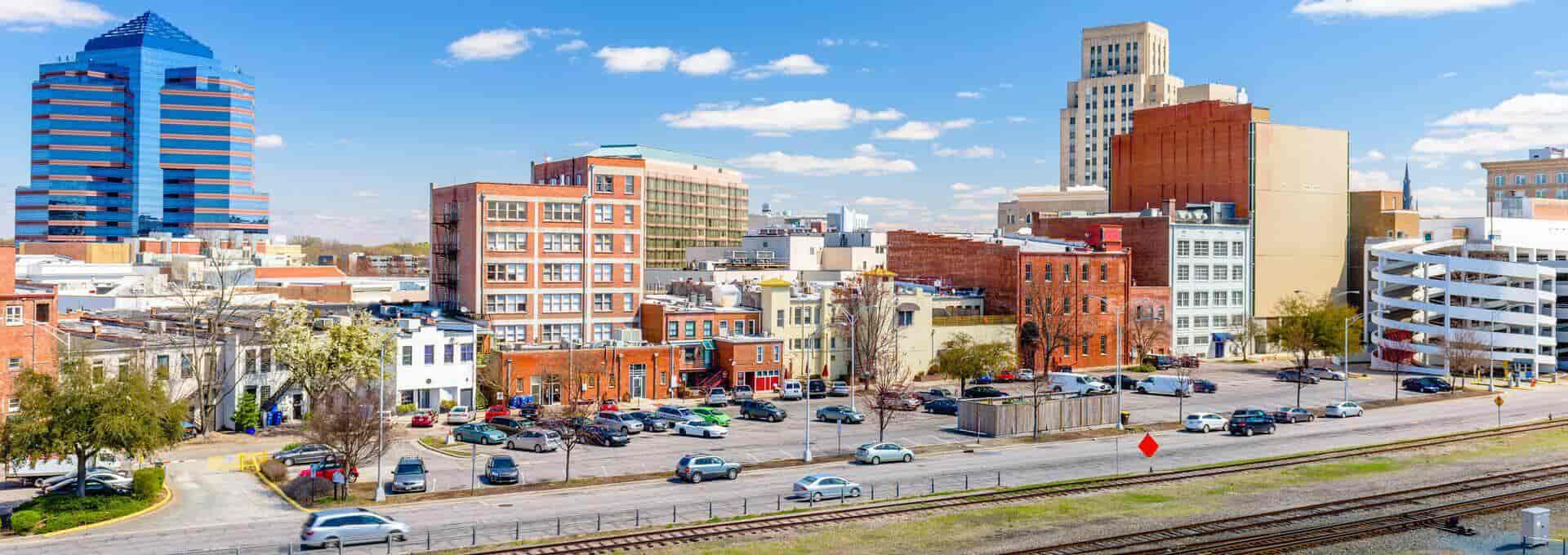
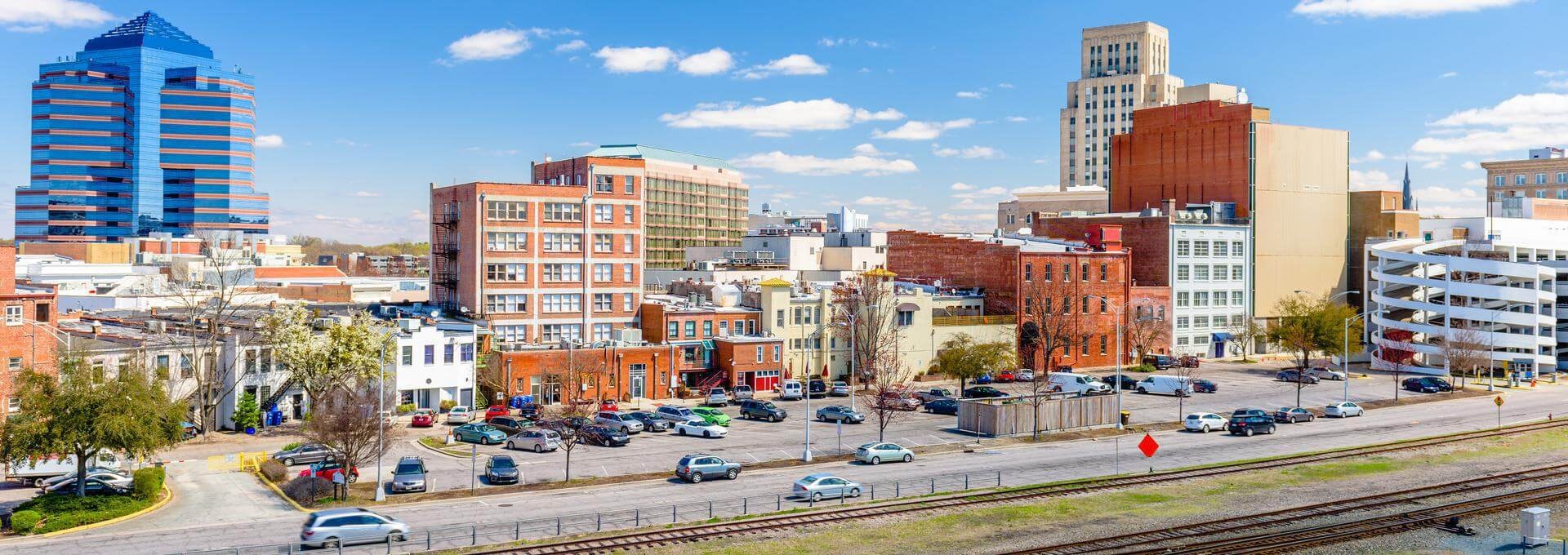
Downtown Durham is the version of the city that gets written up in national publications, and for good reason, it has accomplished something that most post-industrial cities only describe in strategic plans. The former tobacco warehouses and factories that defined Durham's early economy have been physically transformed into some of the most compelling urban environments in the Southeast: the American Tobacco Campus alone contains restaurants, offices, apartments, a boutique hotel, and public gathering spaces within the repurposed shells of buildings that once produced Lucky Strike cigarettes. The Durham Bulls Athletic Park, home to the beloved AAA baseball affiliate immortalized in Bull Durham, sits at the edge of downtown. The Durham Performing Arts Center, consistently ranked among the busiest performing arts venues in the United States, draws Broadway tours and major acts to the heart of the city. The Durham Food Hall, award-winning farm-to-table restaurants, and a craft beverage scene with genuine national recognition complete a picture that requires no embellishment.
For buyers, Downtown Durham represents the premium end of the city's market, and given what it delivers, the premium is defensible. Median home prices in the downtown core sit around $682,500 according to recent transaction data, with luxury waterfront condos and American Tobacco-adjacent units extending well above that. The housing stock is a compelling mix: converted industrial lofts, new high-rise luxury apartments, and historic homes that have been thoughtfully renovated. The renter-to-owner ratio downtown reflects the neighborhood's urban character, approximately 71% of households are renter-occupied, which means rental inventory is more substantial here than elsewhere in the city.
Average one-bedroom rents in Downtown Durham run approximately $1,625 (RentCafe) to $1,847 (Rent.com), with two-bedrooms averaging $2,000–$2,328 depending on the building and vintage. Newer luxury developments push significantly above those averages for premium finishes and upper-floor views. West Village, the City Center District, and American Tobacco-adjacent buildings command the highest rents in the Durham market. For renters willing to pay for walkability, culture, and the most vibrant version of urban Durham life, downtown is an unambiguous answer.
Median Home Price: ~$682,500 (median sale, recent transactions); condos from the mid-$300,000s; luxury units $800,000–$1.5M+ | Average Rent: 1BR: $1,625–$1,847/mo | 2BR: $2,000–$2,328/mo | 3BR: $2,800–$3,859/mo
Safety: Downtown Durham has meaningfully improved its safety profile over the past decade alongside its physical and economic transformation. The American Tobacco Campus and Bulls Athletic Park areas generate consistent foot traffic that supports natural street safety, and the concentrated investment in the corridor has produced visible improvements. Downtown carries higher aggregate crime statistics than Durham's suburban neighborhoods, typical of any active urban commercial core, but the trajectory is positive and residents generally report feeling safe in the revitalized blocks closest to the major amenities. Being aware of specific blocks and time-of-day patterns, as in any city, is the appropriate posture.
Walkability / Transit: Downtown Durham is the city's most walkable neighborhood by a substantial margin, restaurants, bars, the DBAP, DPAC, grocery options, parks, and cultural venues are all accessible on foot. GoTriangle bus service with connections to Raleigh, Chapel Hill, and RTP operates from downtown. Duke's bus network provides free service to campus and hospital areas. Biking is practical for many daily trips within the central corridor. A car remains useful for accessing other parts of Durham but is less essential here than anywhere else in the city.
Top Amenities:
- American Tobacco Campus, Masterfully converted former tobacco factory complex containing restaurants, offices, apartments, boutique hotels, and public spaces; arguably the most iconic urban redevelopment in the Carolinas
- Durham Bulls Athletic Park, Home of the Durham Bulls AAA baseball team; beloved community institution with a season of affordable, family-friendly games from April through September
- Durham Performing Arts Center (DPAC), One of the busiest performing arts venues in the U.S.; hosts Broadway tours, major musical acts, comedy, and performing arts year-round
- Durham Food Hall & award-winning restaurant scene, A culinary scene that consistently draws national recognition; farm-to-table pioneers, James Beard-nominated chefs, and an evolving craft beverage landscape
- Durham Central Park, 5.5-acre park in the heart of downtown hosting the popular Durham Farmers Market twice weekly
- Motorco Music Hall and Fullsteam Brewery, Anchors of the Central Park neighborhood's entertainment corridor; live music and local craft beer in an industrial-chic setting
- Golden Belt Arts District, Adjacent to downtown; a former textile complex housing artist studios, galleries, events, and design-focused businesses
- 21c Museum Hotel & Duke University proximity, Cultural programming and world-class university resources within walking distance or a short drive
Best For: Young professionals who want maximum urban energy and walkability; Duke faculty and hospital staff who prioritize proximity to Duke's medical campus; buyers seeking investment-grade urban real estate with strong long-term appreciation fundamentals; renters who are willing to pay a premium to avoid a car for daily life; anyone moving to Durham from a major urban market who doesn't want to sacrifice city living
Nearest 10 Federal Storage Location:
- 3802 Angier Ave, Durham, NC 27703, Located off I-85 and NC-147 with easy access from downtown Durham; climate-controlled units protect furniture, electronics, wine collections, and sensitive items from Durham's hot, humid summers. Serves downtown residents managing apartment transitions, storing overflow from compact urban units, or securing business inventory.
2. OLD WEST DURHAM, MOST CHARACTER, BEST WALKABLE URBAN VILLAGE
Old West Durham occupies a specific kind of urban space that's increasingly rare in growing Southern cities: a walkable, architecturally distinctive neighborhood that has maintained its character through decades of pressure and change, positioned between Duke University's West Campus and downtown Durham's commercial core. The neighborhood is defined by its stock of early-to-mid 20th century homes, Craftsman bungalows, Tudor cottages, and classic American four-squares sit on tree-lined streets with sidewalks and front porches, and by the Ninth Street corridor that runs through its center. Ninth Street is Old West Durham's Main Street: a walkable strip of independent restaurants, coffee shops, bookstores, a beloved art cinema (the Carolina Theatre), and the kind of small businesses that make a neighborhood feel like its own entity rather than an appendage of something larger.
The neighborhood's proximity to Duke University creates a baseline of educated, culturally engaged residents that defines its character. Graduate students, faculty, medical professionals, and young professionals who've made Durham their long-term home all coexist in a density that feels authentically urban without the freneticism of the downtown core. Ninth Street has been Durham's most consistent neighborhood commercial corridor for decades, the kind of place where the coffee shop knows your order and the bookstore remembers what you bought last time. That sense of continuity is genuinely rare in fast-growing markets and is one of the primary reasons Old West Durham commands a premium in both home prices and rental rates relative to its distance from downtown.
The housing market in Old West Durham reflects all of this. Median sale prices of approximately $417,500, with significant variability depending on renovation status and proximity to Ninth Street. Well-renovated bungalows with original hardwood floors and updated kitchens regularly achieve $500,000–$700,000 in competitive situations. Rental rates run among the highest in the city outside of downtown, Rent.com identifies Old West Durham as one of Durham's most expensive neighborhoods for renters at approximately $1,155 per bedroom in median rent-per-room metrics. For renters who want walkability, architectural character, and neighborhood identity rather than just housing, Old West Durham consistently delivers.
Median Home Price: ~$417,500 (median sale price); well-renovated homes frequently achieve $500,000–$700,000 | Average Rent: 1BR: $1,300–$1,700/mo | 2BR: $1,700–$2,200/mo (limited inventory; market skews toward historic homes and small building rentals)
Safety: Old West Durham earns strong safety ratings and is broadly considered one of Durham's safer in-town neighborhoods. Its active pedestrian culture, Ninth Street commercial activity, and engaged community association contribute to natural street safety. The neighborhood benefits from the proximity of Duke's security presence to the west. Residents consistently report high comfort levels walking the neighborhood at night, particularly on and near Ninth Street.
Walkability / Transit: One of Durham's most walkable neighborhoods, Ninth Street's coffee shops, restaurants, and retail are accessible on foot for most residents. Duke University's West Campus is walkable or bikeable from many parts of Old West Durham, and Duke's free bus service connects the neighborhood to both campuses and Duke Hospital. GoTriangle routes serve the broader corridor. A car is still useful for reaching other parts of Durham but is less essential here than in most of the city.
Top Amenities:
- Ninth Street corridor, Durham's most beloved neighborhood commercial strip; independent coffee shops, restaurants, bakeries, bookstores, and specialty retail that have defined Old West Durham's identity for decades
- The Regulator Bookshop, One of North Carolina's most celebrated independent bookstores; a community institution hosting readings, events, and literary programming on Ninth Street
- Vaguely Reminiscent, Parker & Otis, and the Ninth Street dining scene, An evolving collection of independent restaurants and cafés ranging from neighborhood staples to destination-worthy newcomers
- Duke University West Campus proximity, Walking and biking distance to Duke's academic buildings, libraries, Duke Chapel, the Sarah P. Duke Gardens, and Nasher Museum of Art
- Duke Forest trailhead access, The 7,000-acre Duke Forest, one of the largest urban research forests in the United States, is directly accessible from Old West Durham for hiking, trail running, and nature immersion
- Architectural character, One of Durham's best-preserved collections of early 20th century residential architecture; Craftsman bungalows, Tudor cottages, and American four-squares on shaded streets
- Easy downtown access, A 5–10 minute drive or reasonable bike ride to downtown Durham's entertainment and employment corridors
Best For: Duke faculty, staff, and graduate students who want to live near campus; young professionals who want neighborhood character and walkability over urban density; buyers who value architectural quality and are willing to do renovation work to get it; renters who want a genuine neighborhood rather than a complex; anyone drawn to independent coffee shops, bookstores, and a community that takes culture seriously
Nearest 10 Federal Storage Location:
- 3802 Angier Ave, Durham, NC 27703, Accessible from Old West Durham via downtown Durham or I-85; climate-controlled units suitable for antique furniture, books, artwork, and other items from Old West Durham's historic homes that are sensitive to Durham's summer heat and humidity. Month-to-month leases accommodate the academic calendar rhythms common in this neighborhood.
3. TRINITY PARK & WATTS-HILLANDALE, BEST FOR HISTORIC CHARM & NEIGHBORHOOD IDENTITY
Trinity Park and Watts-Hillandale are twin pillars of Durham's historic neighborhood identity, geographically adjacent, architecturally distinguished, and defined by the kind of authentic neighborhood character that's built over generations rather than planned by developers. Trinity Park, which sits between downtown Durham and Duke University's East Campus, is one of the Triangle's most coveted in-fill residential neighborhoods. The housing stock, a dense concentration of Queen Anne Victorians, Colonial Revivals, and Craftsman bungalows on generous tree-canopied lots, has been meticulously maintained and thoughtfully updated by residents who have a genuine stake in the neighborhood's architectural heritage. The Trinity Park Neighborhood Association is one of Durham's most active and effective community organizations, running an annual home tour that draws visitors from across the region to admire what's there.
Watts-Hillandale, directly adjacent and north of Trinity Park, carries similar bones, tree-lined streets, historic homes, sidewalk infrastructure, with a slightly different character defined by its proximity to the Watts-Hillandale commercial corridor along Hillsborough Road. Restaurants, coffee shops, independent businesses, and the popular Cocoa Cinnamon coffee bar anchor the commercial identity of the corridor. Both neighborhoods consistently rank among Durham's most desirable for in-town living and have seen sustained price appreciation driven by limited supply, strong institutional demand from Duke, and a buyer pool that has consistently prioritized neighborhood quality over commute efficiency.
The median sale price in Trinity Park approaches or exceeds $600,000 for well-maintained historic homes, with premium properties on larger lots commanding more. Watts-Hillandale is somewhat more accessible, with a wider range of price points from the $400,000s into the $700,000s. Rental availability in both neighborhoods is limited, the communities are heavily owner-occupied, but single-family and duplex rentals do appear and command above-average rents given the surroundings. Renters who can secure a unit in either neighborhood tend to stay for extended periods, which contributes to the low turnover and limited inventory that characterizes both markets.
Median Home Price: Trinity Park: $550,000–$800,000+ (premium renovated Victorians and Colonials); Watts-Hillandale: $400,000–$650,000 | Average Rent: 1BR: $1,200–$1,700/mo (limited inventory) | 2BR: $1,600–$2,200/mo | Duplexes and single-family homes: varies significantly
Safety: Trinity Park and Watts-Hillandale are among Durham's safest in-town neighborhoods, with active neighborhood associations, consistent community engagement, and resident-driven safety awareness. Both earn high marks on neighborhood safety assessments. The strong owner-occupancy rates and community cohesion create a natural security environment that sustains itself.
Walkability / Transit: Both neighborhoods offer above-average walkability for Durham. Watts-Hillandale's commercial corridor on Hillsborough Road is directly accessible on foot or by bike for residents in the immediate area. Trinity Park's location between downtown and East Campus provides reasonable biking access to both. Duke's bus network serves the corridor, and GoTriangle routes connect to Raleigh and Chapel Hill. A car is still useful for the broader Durham metro, but neither neighborhood requires one for daily basics in the same way South Durham does.
Top Amenities:
- Trinity Park Historic Architecture, One of the Triangle's finest concentrations of late 19th and early 20th century residential architecture; a living architectural museum maintained by residents who take its preservation seriously
- Trinity Park Neighborhood Association Home Tour, Annual event showcasing the neighborhood's historic homes; a regional draw that reinforces the community's identity and value
- Watts-Hillandale commercial corridor, Hillsborough Road restaurants, coffee shops, and independent businesses serving the neighborhood daily; Cocoa Cinnamon is among Durham's most beloved coffee destinations
- Duke University East Campus proximity, Walking and biking distance to Duke East Campus; East Campus is open to the public and hosts cultural events, athletic programs, and green spaces
- Durham's greenway network connectivity, Access to the American Tobacco Trail and surrounding trail systems within reasonable biking distance
- Downtown Durham walkability, Trinity Park in particular sits within reasonable walking or short biking distance of downtown's dining and entertainment corridor
- Community parks and green space, Multiple neighborhood parks and green corridors within the Trinity Park footprint
Best For: Buyers who prioritize historic architectural quality above all else; established professionals and academics who want a prestigious, stable neighborhood identity; anyone drawn to a strong community association culture and active neighborhood programming; Duke faculty and senior administrators who want to walk to East Campus; buyers seeking a long-term home in a neighborhood with proven price stability and consistent demand
Nearest 10 Federal Storage Location:
- 3802 Angier Ave, Durham, NC 27703, Accessible from Trinity Park and Watts-Hillandale via downtown or I-85; climate-controlled units are particularly valuable for residents managing antique furniture, historic documents, artwork, and other items from Durham's historic homes that require protection from summer heat and humidity
4. HOPE VALLEY, BEST ESTABLISHED NEIGHBORHOOD FOR FAMILIES
Hope Valley occupies a specific and irreplaceable niche in Durham's residential landscape: it is the city's most established family neighborhood, full stop. Built around the Hope Valley Country Club, a golf course and club that has anchored the community's identity since its founding in the 1920s, Hope Valley combines the prestige of generational neighborhood permanence with the convenience of a location that puts the Streets at Southpoint Mall, I-40, and Duke's medical campus all within 10–15 minutes. It's the neighborhood where Durham's established professional families have lived for decades, where the tree canopy is mature enough to provide actual shade, and where the streets feel designed for the way people actually live rather than the way developers imagine they will.
The housing stock in Hope Valley is diverse in scale but consistent in quality. Classic mid-century ranch homes with mature landscaping sit alongside updated Colonials and traditionally styled new-infill construction. The neighborhood encompasses both the Hope Valley Country Club's immediate residential ring, where homes with fairway views and HVCC membership benefits command the highest prices, and a broader Hope Valley area that extends into the surrounding streets with more accessible price points. Median sale prices run around $475,000 for the broader Hope Valley area, though the most desirable golf-course-adjacent blocks regularly achieve $600,000–$900,000+ for larger, well-maintained homes. The Streets at Southpoint, one of the Triangle's best retail destinations, is minutes away, providing the full spectrum of shopping, dining, and everyday convenience without requiring a downtown excursion.
Hope Valley is predominantly owner-occupied, which makes rental availability genuinely limited. When single-family homes do come onto the rental market here, they attract established families, senior Duke/Durham professionals, and others who want a quiet, spacious, established-neighborhood experience at above-average rents. Expect $2,000–$3,000+ per month for a well-maintained single-family rental in Hope Valley, depending on size and location within the neighborhood.
Median Home Price: ~$475,000 (broader Hope Valley area); premier golf-course-adjacent homes $600,000–$900,000+ | Average Rent: Single-family: $2,000–$3,000+/mo (limited availability) | Most households are owner-occupied
Safety: Hope Valley consistently earns the highest safety ratings among Durham neighborhoods. Its owner-occupancy profile, established demographics, active community association, and positioning away from high-traffic commercial corridors contribute to very low crime rates. Niche and similar platforms routinely rank Hope Valley among Durham's safest residential areas. Families with young children consistently cite safety as the primary factor in their Hope Valley decision.
Walkability / Transit: Hope Valley is car-dependent for daily errands, it's a classic suburban neighborhood layout that requires a vehicle for groceries, schools, and most daily needs. The proximity to Southpoint and US-15-501 makes that car dependency manageable: most errands are short drives rather than long hauls. Recreational walking within the neighborhood is pleasant, with mature tree-lined streets providing a genuinely enjoyable environment for morning and evening walks. Duke's bus network is not the primary transit option here; most residents commute by car.
Top Amenities:
- Hope Valley Country Club, Historic golf course and club with tennis courts, pool, dining, and social programming; a central community institution that defines the neighborhood's identity and provides a social infrastructure uncommon in most Durham neighborhoods
- The Streets at Southpoint, One of the Triangle's best retail and dining destinations; approximately 10 minutes away with anchor stores, restaurants, and entertainment options serving the broader south Durham market
- Mature tree canopy and lot sizes, Among Durham's most established landscaping; larger lots than most newer neighborhoods with the kind of tree cover that takes generations to develop
- I-40 and US-15-501 access, Quick connectivity to Chapel Hill (15 minutes), RTP (20 minutes), downtown Durham (10–15 minutes), and Raleigh (25–30 minutes)
- Top-rated Durham schools, Hope Valley feeds into Durham Public Schools' strongest academic clusters; many families augment with the area's private school options (Durham Academy, Cary Academy, etc.)
- American Tobacco Trail access, The 22-mile American Tobacco Trail is accessible from the Southpoint area; one of the Triangle's premier greenway corridors for cycling and running
- Proximity to UNC Chapel Hill, 15–20 minutes to UNC's campus; Hope Valley provides convenient access to both the Duke and UNC academic/medical communities
Best For: Established professional families seeking a quiet, spacious neighborhood with country club amenities; buyers prioritizing school quality and neighborhood safety above urban walkability; Duke Health and Duke University senior staff seeking a prestigious, convenient residential address; buyers who want to be in Durham's established "inner ring" without the density and price of Trinity Park or Old West Durham; retirees who want space, golf, and a neighborhood they can age into comfortably
Nearest 10 Federal Storage Location:
- 3802 Angier Ave, Durham, NC 27703, Accessible from Hope Valley via I-40 or US-15-501; climate-controlled storage is ideal for managing overflow from Hope Valley's larger homes during renovation projects, storing golf equipment and seasonal sporting goods, and handling estate transitions in this ownership-heavy community
5. SOUTH DURHAM / SOUTHPOINT, BEST FOR SUBURBAN COMFORT, SHOPPING & RTP ACCESS
South Durham's Southpoint corridor has become one of the most practical addresses in the Triangle for the specific combination of needs that defines a large segment of the area's incoming population: proximity to Research Triangle Park (20 minutes), easy RDU airport access (15–20 minutes), access to one of the Triangle's best retail centers (The Streets at Southpoint), and new residential development that delivers modern finishes and community amenities at prices that, while higher than East Durham or parts of North Durham, are still competitive with what comparable product would cost in Cary or Morrisville. South Durham is what happens when a major regional employment anchor, in this case, RTP, generates enough professional-class residential demand to build an entire supporting ecosystem of housing, shopping, and services around it.
The neighborhood is anchored by The Streets at Southpoint, a 1.2 million square foot open-air mall that draws shoppers from across Durham County and neighboring counties. Restaurants ranging from chain anchors to local independents cluster around the mall and along the NC-55/Fayetteville Road corridors. Grocery stores, fitness centers, medical offices, and everyday services fill the surrounding commercial fabric in a density that makes South Durham one of the most convenient addresses in Durham for car-dependent errand-running. New residential developments, including master-planned communities like Woodcroft and more recently developed neighborhoods closer to the mall, offer modern homes with pools, community trails, and amenity centers at a price point that serves professional families who have chosen suburb over city.
Renters in South Durham find a market with meaningful apartment community options, Brier Creek-adjacent developments, communities along Fayetteville Road, and newer projects near the Southpoint corridor, at rents that reflect the area's convenience premium. Average one-bedroom rents run approximately $1,450–$1,700 per month; two-bedrooms average $1,700–$2,100. The area also has a substantial inventory of single-family rentals driven by investor activity in the post-pandemic period. South Durham is the neighborhood for renters who are prioritizing a short drive to RTP, easy airport access, and shopping convenience over neighborhood character or walkability.
Median Home Price: ~$375,000–$520,000 (varies significantly by sub-community, vintage, and proximity to Southpoint) | Average Rent: 1BR: $1,450–$1,700/mo | 2BR: $1,700–$2,100/mo | 3BR single-family: $2,000–$2,800/mo
Safety: South Durham consistently earns high safety ratings, the area's primarily suburban character, newer residential development, and professional-class demographics contribute to low crime rates. It is among Durham County's safest residential areas by most metrics. Families consistently rank it highly for child safety and school quality.
Walkability / Transit: South Durham is car-dependent, this is its most significant tradeoff relative to Durham's in-town neighborhoods. The Streets at Southpoint and surrounding commercial areas are designed for automobile access; transit connections are limited. The American Tobacco Trail, accessible near the Southpoint area, provides a meaningful recreational infrastructure asset, but daily life here requires a vehicle. That car dependency is mitigated by the density of nearby amenities, most daily errands are short drives rather than cross-city hauls.
Top Amenities:
- The Streets at Southpoint, 1.2 million sq ft of retail, dining, and entertainment; anchor stores, national restaurants, and specialty retailers make this one of the Triangle's premier shopping destinations
- Research Triangle Park proximity, 20 minutes to RTP, home to 300+ companies and tens of thousands of jobs in tech, pharma, and research; one of the most significant commute advantages in the South Durham market
- RDU International Airport access, 15–20 minutes via I-40; among the shortest airport commutes of any residential neighborhood in the Durham metro
- Woodcroft community trail network, Extensive walking and biking trails through one of South Durham's established master-planned communities; pools and tennis courts for residents
- American Tobacco Trail, 22-mile multi-use trail with access points near the Southpoint area; popular for cycling, running, and recreational use across all skill levels
- Durham Public Schools southern clusters, Including Parkwood Elementary, Lowes Grove Middle, and Hillside High, schools that receive strong academic reviews; augmented by private options including Durham Academy
- Proximity to UNC Chapel Hill and Duke, 15 minutes to UNC; 15 minutes to Duke Medical Center; South Durham serves as a practical residential base for employees of both institutions
Best For: RTP professionals seeking the shortest possible daily commute; families prioritizing suburban comfort, school quality, and shopping convenience over urban character; frequent flyers who value RDU proximity; buyers seeking modern construction and community amenities at a more accessible price than comparable North Raleigh neighborhoods; remote workers who need airport access several times monthly
Nearest 10 Federal Storage Location:
- 3802 Angier Ave, Durham, NC 27703, Accessible from South Durham via I-40 and NC-147; climate-controlled storage serves South Durham families managing overflow from larger suburban homes, professionals storing business inventory, and residents between homes during relocation transitions in this active rental market
6. EAST DURHAM, BEST FOR AFFORDABILITY & LONG-TERM UPSIDE
East Durham is the neighborhood that real estate observers in the Triangle watch most carefully, and for good reason. It offers Durham's most accessible entry prices in a market that has otherwise moved significantly upward, sits adjacent to downtown's growth trajectory in a direction that's historically followed that growth, and has attracted meaningful investment and community-driven revitalization that's changing the neighborhood's trajectory without yet fully repricing it. Median home prices in East Durham remain below $278,000 in some subsections, a figure that hasn't existed in comparable proximity to a major American university in most markets for years, though that number has risen and will continue to rise as the neighborhood's momentum builds.
East Durham's history is deep and complex. It is home to one of North Carolina's most significant African-American cultural and commercial legacies, the Hayti Heritage Center, housed in a former church, preserves and celebrates the history of a community that was one of the most prosperous Black business districts in the American South before urban renewal displaced it in the 1960s. That legacy gives East Durham an authenticity and a rootedness that newer neighborhoods simply don't have, and the community organizations that draw on it, including self-organized neighborhood associations, arts organizations, and small business coalitions, have worked actively to ensure that the neighborhood's revitalization respects and builds upon that history rather than erasing it.
For buyers, East Durham currently represents the best risk-adjusted entry point in the Durham market for buyers with a 5–10 year time horizon. The convergence of downtown's continued westward and eastward expansion, the American Tobacco Trail's influence on adjacent property values, and the broader Research Triangle's sustained population growth all point toward continued appreciation in a neighborhood that is still, by most reasonable comparisons, underpriced relative to its proximity to major employers and cultural institutions. For renters, East Durham provides access to Durham at rents meaningfully below the city average, one-bedrooms can be found in the $900–$1,200 range, with improving neighborhood services and commercial development filling in along key corridors.
Median Home Price: ~$278,000 in most affordable sections; some properties below $200,000; rapidly appreciating areas may be higher | Average Rent: 1BR: $900–$1,300/mo | 2BR: $1,100–$1,600/mo | Entry points exist below the Durham average
Safety: East Durham has historically carried higher crime statistics than Durham's established suburban neighborhoods, a reality that honest prospective residents should understand. The neighborhood has improved meaningfully over the past decade, and specific blocks and corridors vary considerably. Buyers and renters doing due diligence should research specific addresses and street-level conditions rather than relying on neighborhood-level averages alone. The trajectory is positive, but the variation within East Durham is real and matters for quality-of-life decisions.
Walkability / Transit: East Durham's walkability varies significantly by block. The corridors near Angier Avenue and Alston Avenue have improving commercial presence, and GoTriangle bus routes serve the neighborhood with connections to downtown and RTP. The American Tobacco Trail has a key access point in this area, one of the factors most cited by buyers evaluating East Durham's long-term trajectory. A car is still recommended for most residents, but transit connectivity is better here than in South Durham's suburban corridors.
Top Amenities:
- Hayti Heritage Center, A cultural institution housed in a beautifully restored former church; celebrates and preserves the history of Durham's historic Black business and cultural community; hosts concerts, exhibitions, and community events year-round
- American Tobacco Trail access, Direct access to the 22-mile multi-use trail from East Durham; one of the neighborhood's most significant quality-of-life and property value assets
- Downtown Durham proximity, Less than 2 miles from the American Tobacco Campus and downtown core; one of the shortest commutes to downtown of any Durham neighborhood
- NC Central University proximity, NCCU, one of the nation's historically Black universities, is located in East Durham; generates rental demand, cultural programming, and community investment
- 10 Federal Storage Durham, Located at 3802 Angier Ave in East Durham, placing the facility directly within the neighborhood it serves
- Alston Avenue commercial corridor, An evolving corridor with increasing small business, restaurant, and retail investment that local observers consistently identify as an early-stage version of what other Durham corridors looked like before their revitalization
- Artist and creative community, East Durham has attracted a growing number of artists, designers, and creative professionals drawn by affordable live-work space and the neighborhood's authentic character
Best For: First-time buyers seeking maximum appreciation potential at minimum entry cost in the Durham market; investors building long-term rental portfolios in a market with strong fundamentals; renters who need to live in Durham at a price point well below city averages; buyers who understand neighborhood-level real estate cycles and want to position early in one of the Triangle's clearest revitalization stories; NCCU students, faculty, and staff seeking nearby housing
Nearest 10 Federal Storage Location:
- 3802 Angier Ave, Durham, NC 27703, Located directly in East Durham; the most conveniently positioned storage facility for East Durham residents. Climate-controlled units serve renters managing furniture during apartment transitions, buyers holding belongings during renovation of older East Durham homes, and small business owners in the neighborhood's growing entrepreneurial ecosystem.
HOW TO CHOOSE YOUR DURHAM NEIGHBORHOOD
Durham's neighborhoods differ fundamentally enough that your decision should start with an honest conversation about what you're actually optimizing for, not what sounds appealing in the abstract, but what you'll actually use and value on a daily basis.
If your priority is maximum urban energy and walkability, Downtown Durham / American Tobacco District is unambiguous. You'll pay for it, rents and home prices are the city's highest, but you'll get genuine daily walk-everywhere access to a food, entertainment, and cultural scene that rivals cities twice Durham's size. If urban living is what drew you to Durham, don't compromise it to save a few hundred dollars a month.
If your priority is neighborhood character with walkability and Duke proximity, Old West Durham delivers a version of urban life that Downtown can't replicate: smaller, more intimate, architecturally beautiful, and with the Ninth Street corridor providing a genuine neighborhood commercial main street. It's Durham at its most livable.
If your priority is historic prestige and neighborhood permanence, Trinity Park and Watts-Hillandale have no real competition. The architectural quality and community investment in these neighborhoods represent decades of collective decision-making, and the results are worth the premium they command.
If your priority is family infrastructure in an established, quiet setting, Hope Valley is the answer, particularly if golf, country club social life, and mature landscaping are part of how you envision living. The country club membership and the neighborhood's generational stability create a quality of life that newer developments simply can't replicate.
If your priority is suburban convenience, RTP proximity, and modern construction, South Durham's Southpoint corridor is the pragmatic choice. You'll sacrifice neighborhood character and walkability for the most convenient possible commute to the Triangle's largest employment campus and some of the best everyday retail access in Durham County.
If your priority is maximum value and long-term upside, East Durham is the market answer for buyers who can tolerate more near-term variability in exchange for access to a neighborhood that most Triangle professionals expect to appreciate significantly over the next decade. It's not the right answer for everyone, but for buyers who understand the calculus, it's compelling.
SELF STORAGE IN DURHAM, 10 FEDERAL STORAGE
Durham is a city of transitions, Duke students cycling in and out each academic year, medical professionals relocating for research positions, young professionals moving up from starter apartments to first homes, established families downsizing as children leave, and investors managing properties across multiple neighborhoods. All of that movement generates consistent, ongoing storage needs, and 10 Federal Storage's Durham facility is positioned to serve the full spectrum of them.
The facility at 3802 Angier Avenue is located in East Durham with direct access from I-85 and NC-147, two of the primary corridors serving virtually every Durham neighborhood. Climate-controlled units are a meaningful differentiator in Durham: the city's hot, humid summers (regularly above 90°F with high humidity from June through September) can damage wood furniture, electronics, artwork, books, and musical instruments without climate protection. Whether you're managing the contents of a Trinity Park Victorian, storing overflow from a downtown apartment, or holding business inventory as a South Durham entrepreneur, climate control is the standard that protects what matters.
10 Federal Storage, Durham Location
- 3802 Angier Ave, Durham, NC 27703, East Durham, accessible from I-85 and NC-147; serves residents across all Durham neighborhoods including Downtown, Old West Durham, Trinity Park, Watts-Hillandale, Hope Valley, South Durham/Southpoint, and East Durham itself. Climate-controlled units available; ideal for antique furniture, electronics, books, artwork, musical instruments, and any items sensitive to heat and humidity. Fully online rental, reserve your unit, complete your lease, and receive your gate access code without visiting an office. 24/7 access with automated gate entry. Month-to-month leases with no long-term commitment. New customers qualify for up to 2 months free.
Unit sizes range from compact 5x5 for documents, boxes, and small items through large units for complete household contents. Sizes appropriate for everything from a downtown studio's overflow to a Hope Valley family home's seasonal storage needs. View the Durham location and available units here.
WELCOME TO DURHAM
Durham is a city that has earned its reputation through actual transformation rather than municipal marketing. The Bull City has taken its industrial heritage, the tobacco warehouses, the mill buildings, the manufacturing character, and made something genuinely original from it: a mid-sized city with a food scene that draws visitors from Charlotte and DC, a cultural calendar anchored by DPAC and one of the world's great research universities, and a collection of neighborhoods diverse enough to accommodate nearly every version of the life you're trying to build. Whether you're drawn to the walkable urbanism of Old West Durham, the established family environment of Hope Valley, the maximally vibrant American Tobacco District, or the value and upside of East Durham's next chapter, this is a city worth understanding deeply before you decide where within it you want to land.
And wherever you land, 10 Federal Storage at 3802 Angier Ave is positioned to help, with climate-controlled units that protect your belongings through Durham's humid summers, 24/7 automated access, fully online rental, month-to-month leases, and up to 2 months free for new customers.
Find your Durham storage unit and reserve online today.
About 10 Federal Storage, Durham
10 Federal Storage operates a climate-controlled self-storage facility in Durham, NC at 3802 Angier Ave (27703), accessible from I-85 and NC-147 and serving residents across all Durham neighborhoods. Fully online rental, 24/7 automated gate access, and flexible month-to-month leases available. View the Durham location here.
FREQUENTLY ASKED QUESTIONS ABOUT DURHAM NEIGHBORHOODS
East Durham consistently offers the city's most accessible home prices and some of its lowest rental rates, median home prices below $278,000 in some sections and one-bedroom rents available in the $900–$1,200 range. Duke Park, Morehead Hill, and Lakewood also offer more affordable rents than the city average. For buyers specifically, East Durham represents the best combination of price and future appreciation potential in the current market.
Downtown Durham / American Tobacco District for those who want maximum walkability and urban energy. Old West Durham for those who want neighborhood character, proximity to Duke, and a walkable commercial strip with independent shops and restaurants. Both neighborhoods attract the young professional demographic strongly, and the right choice depends on whether you're optimizing for density and nightlife or for the more intimate feel of a walkable neighborhood village.
Durham's safety profile varies considerably by neighborhood, more so than in many comparably sized cities. Downtown, Old West Durham, Trinity Park, Watts-Hillandale, Hope Valley, and South Durham all earn strong safety ratings and are broadly considered safe residential areas. East Durham has historically carried higher crime statistics and requires more location-specific research. The city's overall trajectory on public safety has been positive over the past decade, with sustained investment in community programs alongside traditional policing. Prospective residents should research specific blocks and addresses rather than relying on city-wide statistics, which mask significant neighborhood-level variation.
Competitive but not overheated. The median home price sits around $448,000 with homes typically selling within 20 days and often receiving multiple offers on well-priced, well-maintained properties. Prices are up modestly year-over-year (around 0.8–1.4% in late 2025 data), meaningfully calmer than the 2021–2022 period when prices were moving double-digits annually. The market has the characteristics of a fundamentally strong demand environment, Duke University, Duke Health, and RTP generate a reliable buyer pipeline, without the speculative excess of those earlier years. For buyers who were priced out in 2021–2022, the current moment is more rational.
RTP is approximately 15–25 minutes from most Durham neighborhoods, closer than Raleigh for many of the park's major campuses and much closer than Chapel Hill or Cary for the specific corridors where IBM, GSK, Biogen, and similar companies are based. South Durham's Southpoint corridor offers the most direct commute, typically 15–20 minutes with minimal traffic. East Durham and downtown are 20–30 minutes. RTP's 7,000 acres and 300+ companies represent the single largest employment anchor in the Triangle, and Durham's consistent demand for housing is substantially driven by the professional workforce it generates.
Durham's average rent of approximately $1,401 for a one-bedroom apartment compares favorably against Raleigh (which runs $1,500–$1,700 for comparable units) and Chapel Hill (which runs higher still due to UNC proximity constraints). Durham offers the most diverse neighborhood selection of the three cities at the most competitive overall price point, with the added advantage of the American Tobacco Campus, DPAC, and the broader cultural scene that distinguishes it from Raleigh's more suburban character. For renters who want a city with genuine urban character at a reasonable price within Research Triangle Park commuting distance, Durham is consistently the strongest argument.
About the Author
10 Federal Storage
Our team at 10 Federal Storage has been in the self storage industry for decades. With knowledge gained from multiple universities and in the field, we are well-prepared and excited to assist with your storage needs. When you rent a unit with us, you can feel confident that our seasoned customer service team’s help will make your transition as seamless as possible. Customer satisfaction is our number one priority, and we strive to make your experience exceptional with our automated leasing options, diverse unit sizes, and a strong commitment to sustainability.