
.svg)
Best Neighborhoods in Gibsonville, NC
by 10 Federal Storage
Published on April 16, 2026
Somewhere between Greensboro and the Research Triangle, tucked along the I-40/85 corridor in a fold of land that straddles Guilford and Alamance counties, sits a town that keeps getting quietly discovered. Gibsonville, the self-declared "City of Roses," a nickname earned in 1920 when train passengers noticed the abundance of rose bushes lining the tracks outside their windows, is not a town that advertises itself aggressively. It doesn't need to. Word has traveled on its own, carried by residents relocating from Greensboro's crowded neighborhoods and the Triangle's escalating prices, drawn by something that has become genuinely hard to find in this part of North Carolina: small-town character, genuine community warmth, outstanding parks, a charming Main Street, excellent school systems, and home prices that still offer meaningful value relative to the metro areas on either side.
At roughly 9,300–9,500 residents, Gibsonville is small enough that neighbors still wave. The market at Gibsonville runs Saturday mornings on the town green from June through September. The Gibsonville Garden Railroad, the largest outdoor public garden railroad in North Carolina, is a local institution that draws families and rail enthusiasts from throughout the region. Burke Manor Inn, a historic bed-and-breakfast and event venue on the town's edge, has built a regional reputation for its French cuisine, wine tastings, and cooking classes that would feel at home in a town five times Gibsonville's size. And the Fall Festival each October, the Lighting of the Greens in December, and the summer concert series on the town green anchor a community event calendar that gives the town a year-round pulse of civic life.
What makes Gibsonville particularly interesting for anyone researching a move in 2025–2026 is its positioning between two major employment centers. It sits about 20 miles east of downtown Greensboro, less than 5 miles from Burlington, and approximately 35 miles west of the Research Triangle Park, close enough to any of these employment hubs to make a daily commute viable, but far enough from each that it has maintained its own identity rather than being absorbed into the sprawl of any one metro. Median household income has climbed to approximately $105,000, reflecting a community of well-employed professionals and families who have made a considered choice about where to live, while the cost of living remains roughly 7–10% below the national average. That combination of income and affordability is rare, and it's the clearest signal that Gibsonville has found something genuinely special.
Quick Facts: Gibsonville at a Glance
- Population: ~9,300–9,500 (2024 estimate)
- County: Straddles Guilford County (majority) and Alamance County
- Nickname: The "City of Roses"
- Location: ~20 miles east of Greensboro; ~5 miles east of Burlington; ~35 miles west of Research Triangle Park
- Highway access: I-40/85 (immediately accessible); NC Highway 61 (primary north-south corridor); US Highway 70
- Primary employers: Educational services, healthcare (Cone Health Alamance Regional Medical Center), manufacturing, professional/technical services; major regional employers reachable via I-40/85
- Median household income: ~$105,981 (Data USA, 2023), well above state and national medians
- Median home price: ~$297,000–$350,000 (Census ACS estimate / Movoto listing median, early 2026)
- Cost of living index: ~89.5–93 (approximately 7–10% below the national average of 100)
- Niche ranking: #1 Best Place to Live in Alamance County; one of the best places to live in North Carolina
- School systems: Guilford County Schools (eastern/majority portion) and Alamance-Burlington School System (western portion)
- Elon University proximity: ~3.5–5 miles south; accessible college-town culture and campus resources
Quick Facts: Renting in Gibsonville
- Median gross rent: ~$909/month (city-data.com, 2023 ACS), well below state and national averages
- Typical rent range: 1BR: $750–$1,100/mo; 2BR: $900–$1,300/mo; 3BR single-family: $1,400–$1,800/mo
- Renter-occupied households: Approximately 15–19% of households (strongly owner-dominated market)
- Rental inventory character: Limited apartment community inventory within Gibsonville proper; primarily smaller apartment complexes, duplex/triplex units, and landlord-owned single-family homes; Burlington's market (less than 5 miles) expands available options considerably
- Market trend: Gibsonville's rental market is small and tight; quality single-family rentals move quickly
- Competitive advantage: Rental prices are substantially below comparable suburbs of Greensboro and the Triangle, providing meaningful monthly savings for residents who prioritize value
Table of Contents
- Gibsonville Housing & Rental Market Overview
- Downtown / Main Street, Most Walkable, Most Historic
- Northwest Gibsonville, Best Established Residential Area
- Ashley Woods & Central Gibsonville, Best Established Family Subdivision
- Edinborough, Best for New Construction & Master-Planned Living
- Southeast / US-70 Corridor, Best Entry-Level & Rental Value
- Whitsett & I-40/85 Corridor, Best for Highway Access & Regional Commuting
- How to Choose Your Gibsonville Neighborhood
- Self Storage in Gibsonville, 10 Federal Storage
- Frequently Asked Questions
GIBSONVILLE HOUSING & RENTAL MARKET OVERVIEW
Gibsonville's housing market tells the story of a small town that has been steadily discovered without being dramatically disrupted. The Census Bureau's most recent American Community Survey estimates the median value of owner-occupied homes at approximately $297,000–$301,000, while current listing activity from Movoto shows a median listing price closer to $350,000, reflecting both appreciation over the past few years and the mix of new construction from the Edinborough community and established home sales. Median sale prices have tracked around $344,000, according to Homes.com data, representing a meaningful step up from the census baseline but still a favorable comparison to Greensboro, Burlington, and the Triangle suburbs that compete for the same buyers. Home values have appreciated nearly 100% cumulatively over the past decade while still offering accessible entry points, a combination that makes Gibsonville genuinely interesting both as a lifestyle choice and as a long-term asset.
The market is balanced-to-slow by Wake County standards: homes are spending an average of 65–91 days on market depending on the pricing tier, which gives buyers meaningful time to evaluate without the frantic multiple-offer competition common in Raleigh, Cary, and the peak-demand Triangle suburbs. The highest home values are concentrated in Gibsonville's northwestern quadrant and in the new Edinborough development on the north side of town; the most accessible entry points are in the southeastern corridor near US-70 and in older established sections of the central town. One meaningful advantage relative to comparable small towns: Gibsonville has significantly fewer HOA-governed communities than Triangle suburbs, which gives buyers more flexibility and fewer ongoing fee commitments.
The rental market reflects Gibsonville's owner-dominated character, approximately 81–85% of housing units are owner-occupied, leaving a modest rental inventory concentrated in smaller apartment complexes, historic rental homes on and near Main Street, and a growing townhome sector associated with the newer Edinborough-adjacent developments. Median gross rent runs approximately $909 per month, which is dramatically below national averages and well below comparable Greensboro suburbs. Burlington's rental market, less than 5 miles to the west, effectively expands what's available for Gibsonville-area renters who need apartment-style options, with Lowes Foods, Target, Walmart, and major medical and commercial services all accessible in Burlington within a 10-minute drive. For renters committed specifically to a Gibsonville address, the inventory is tight, quality units move quickly, and the town's growth trajectory means that rental housing that enters the market rarely stays available for long.
1. DOWNTOWN / MAIN STREET, MOST WALKABLE, MOST HISTORIC
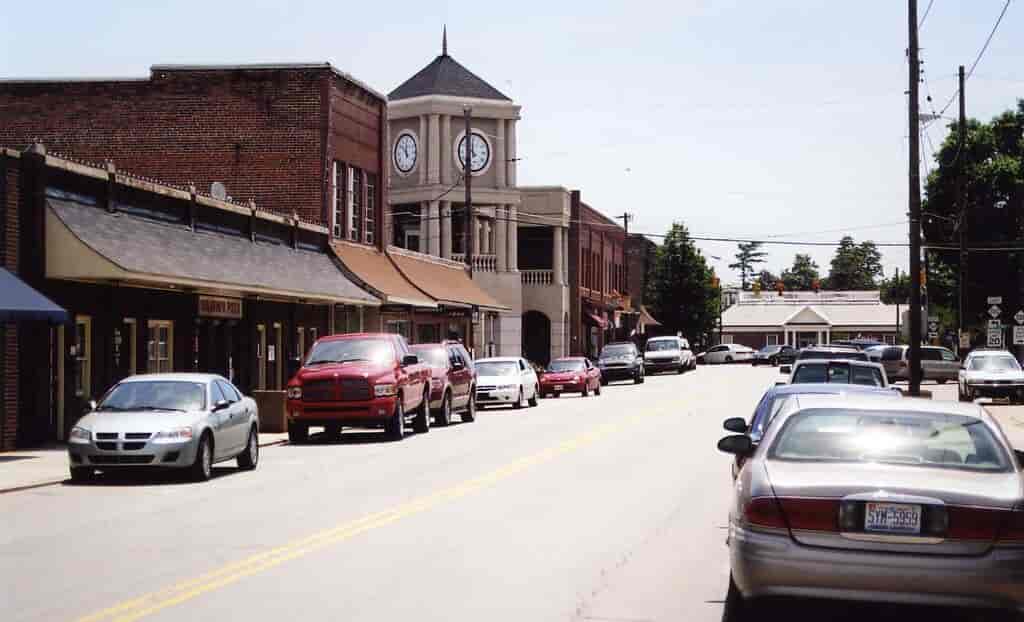
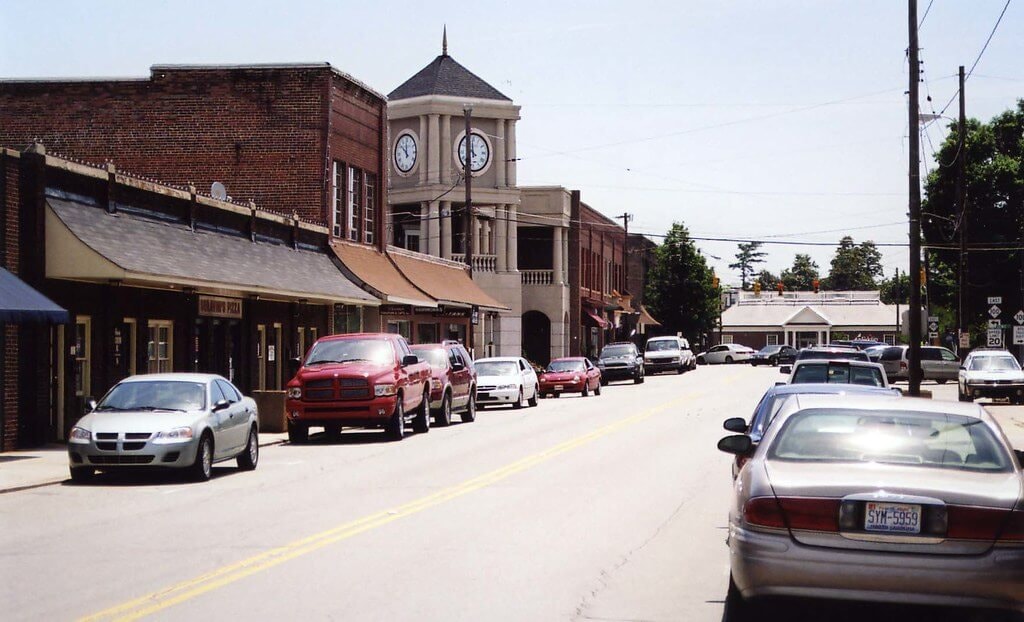
Gibsonville's downtown is the kind of small-town Main Street that urban planners study and suburban communities spend decades trying to replicate. The historic district runs along Main Street with an authenticity that comes from over 150 years of continuous community life, the town was incorporated in 1871, originally as a rough-and-ready gold mining settlement that transformed into an industrial and agricultural center in the early 20th century, before evolving into the charming residential community it is today. The old train depot, recognizable from the era when train passengers coined the "City of Roses" nickname, anchors the district's railroad heritage, and the red caboose that serves as a small welcome exhibit is one of the first things visitors encounter when they arrive on Main Street.
The commercial life of downtown Gibsonville has filled in steadily over the past decade with the kind of independent businesses that make small-town living feel complete. The Gilded Bean serves coffee on Main Street and has become a daily gathering point for residents. Gibsonville Antiques & Collectibles draws shoppers from throughout the region. Pink Lola and Wearology offer boutique women's clothing and accessories. Jack's Barbeque, La Casa Dorada, and Pete's Grill (a local staple since the 1950s) provide dining options with genuine community roots. Toasty Kettlyst Beer Company has built a following as Gibsonville's craft beer destination, hosting live music and food trucks in a setting that channels the town's laid-back community energy. And Burke Manor Inn, the historic bed-and-breakfast and event venue on the edge of the downtown area, has earned a regional reputation for its award-winning French cuisine and cooking classes that would stand out in markets many times Gibsonville's size.
The residential blocks surrounding Main Street include some of the most architecturally distinctive housing in the town, early-20th-century Victorian and craftsman-style bungalows, Queen Anne-influenced homes, and renovated historic properties that carry the character that no new construction can manufacture. Edward G. Murrell Park sits just east of the downtown core, providing playground access, basketball courts, paved walking trails, and picnic shelter within an easy walk of downtown residential streets. The Gibsonville Community Center, directly across from the park, adds a full-size multipurpose gymnasium and year-round programming to a community infrastructure that punches well above its town-size weight.
Median Home Price: $200,000–$320,000 (older and smaller stock in central areas; renovated historic homes command premiums) | Average Rent: 1BR: $750–$950/mo; 2BR: $850–$1,100/mo
Safety: Downtown Gibsonville's commercial core maintains the quiet safety profile characteristic of this type of small-town Main Street environment. Property crime associated with commercial activity is minimal by any comparison standard; the residential blocks surrounding downtown are stable, primarily owner-occupied, and benefit from the natural community surveillance that comes with an engaged, high-home-ownership neighborhood.
Walkability / Transit: Gibsonville's most walkable area by a meaningful margin. Main Street restaurants, shops, the park, and the community center are all accessible on foot from surrounding residential streets. The Market at Gibsonville runs on the town green Saturday mornings and Tuesday evenings through the summer months, a farmers market walkable from downtown addresses. A personal vehicle is still needed for grocery shopping and most commercial errands, with Burlington's full retail cluster less than 5 miles west. Public transit is limited in Gibsonville proper.
Top Amenities:
- Market at Gibsonville, Saturday morning and Tuesday evening farmers market on the town green, running June through September; local produce, baked goods, artisans, and live music within walking distance of downtown homes
- The Gilded Bean, Local coffee shop and Main Street gathering spot; the kind of daily-ritual anchor that defines neighborhood character
- Toasty Kettlyst Beer Company, Craft brewery with live music and food trucks; a community social hub that has contributed meaningfully to downtown Gibsonville's evening energy
- Burke Manor Inn, Award-winning historic B&B and event venue with French cuisine, wine tastings, and cooking classes; a regional culinary destination within the town's footprint
- Edward G. Murrell Park, Central park with playgrounds, basketball courts, paved trails, and picnic facilities adjacent to the downtown residential area
- Gibsonville Garden Railroad, The largest outdoor public garden railroad in North Carolina; a beloved local institution and unique community attraction that draws visitors from throughout the Triad region
- Gibsonville Community Center, Full-size gymnasium, programming, and community resources across from Edward G. Murrell Park
- Fall Festival & Lighting of the Greens, Annual community events that anchor Gibsonville's civic calendar; among the most well-attended small-town community events in Alamance and Guilford counties
Best For: Buyers seeking historic architectural character at accessible prices, residents who value walkability and community life as daily experiences rather than occasional amenities, those who have chosen small-town living intentionally and want to be at its center, retirees and empty nesters who want engagement and proximity to Main Street without the demands of a larger city
Nearest 10 Federal Storage Location:
- 250 Huffine St, Gibsonville, NC 27249, Located minutes from downtown Gibsonville and close to the Gibsonville Garden Railroad and Gibson Park; climate-controlled units available for protecting historic furniture, antiques, and sensitive belongings common to older home renovations in the downtown district
2. NORTHWEST GIBSONVILLE, BEST ESTABLISHED RESIDENTIAL AREA
Ask a data-driven real estate analysis to identify Gibsonville's most desirable residential quadrant and the answer is consistent: the northwestern section of town carries the highest home values, the most sought-after streets, and the strongest reputation among long-term residents as the area where community infrastructure, park access, and residential quality converge most completely. BestNeighborhood.org's analysis of Gibsonville specifically identifies the northwestern quadrant as the town's most desired area, driven by its proximity to Moricle Park, the overall quality of the housing stock, and the combination of established neighborhood feel with good regional access.
The William F. Moricle Recreational Complex is the anchor that makes this area particularly appealing to families. At 30 acres, it is Gibsonville's largest park by a significant margin, with expansive open green space, shaded nature trails, a large modern playground, soccer and baseball fields, tennis courts, a sand volleyball court, and four covered picnic areas including a main sheltered pavilion available for event rental. For families with active children, having a park of this scale and quality within walking or biking distance of home is not a minor convenience, it's an ongoing quality-of-life multiplier that pays dividends in every season.
The residential streets of northwest Gibsonville feature a mix of established single-family homes from the 1980s through the early 2000s, solid construction on well-maintained lots with the mature tree coverage that gives established neighborhoods their character. Home prices here consistently rank among the highest in the town, typically in the $290,000–$420,000 range for larger single-family homes, with the most sought-after properties near the park commanding additional premiums. The area's proximity to NC Highway 61, which provides direct access to Burlington to the south and the I-40/85 corridor, gives northwest Gibsonville residents the commute convenience to match their neighborhood quality.
Median Home Price: $290,000–$420,000 | Average Rent: 1BR: $900–$1,100/mo; 2BR: $1,100–$1,400/mo; 3BR single-family: $1,500–$1,900/mo
Safety: Northwest Gibsonville consistently earns the town's strongest safety marks. The combination of high owner-occupancy rates, active community identity, park adjacency, and stable residential character, with lower traffic volumes than the commercial corridors, produces a neighborhood where residents consistently report feeling safe and connected. The Gibsonville Police Department maintains active patrol coverage throughout this area.
Walkability / Transit: Internal walkability is strong, residents can access Moricle Park, neighborhood parks, and internal neighborhood streets on foot or by bike with ease. A car is still needed for grocery shopping and most daily errands, with Burlington's full commercial cluster less than 5 miles south on NC-61. NC Highway 61 access makes this area practical for commuters heading to Burlington, I-40/85, or either Greensboro or the Triangle corridor.
Top Amenities:
- William F. Moricle Recreational Complex, Gibsonville's signature 30-acre park; baseball and soccer fields, nature trails, tennis courts, sand volleyball, large modern playground, and a main sheltered pavilion; one of the finest community recreational facilities of any town its size in the Piedmont Triad
- NC Highway 61 corridor access, Direct south connection to Burlington, I-40/85, and Elon University; the primary regional commute and service route for northwest Gibsonville residents
- Established tree coverage, Decades of landscape maturity producing the canopy that new construction cannot replicate; a genuine quality-of-life differentiator within the town
- High owner-occupancy character, Stable, primarily owner-occupied neighborhood culture with active community investment in property maintenance and neighborhood identity
- Burlington retail access, Lowes Foods, Target, Walmart, Food Lion, and the Burlington Town Square Mallwithin approximately 5 miles south via NC-61
- Cone Health Alamance Regional Medical Center, Approximately 5–6 miles from northwest Gibsonville via the Burlington corridor; the region's primary hospital and healthcare system
Best For: Families who prioritize park access and outdoor recreational space as a daily lifestyle feature, buyers seeking Gibsonville's highest-quality residential streets and established neighborhood character, move-up buyers who want the most sought-after address in the town, retirees who value greenway and park access without the density of urban living
Nearest 10 Federal Storage Location:
- 250 Huffine St, Gibsonville, NC 27249, Located within Gibsonville and accessible from the northwest residential area; serves families in transition, residents managing renovation overflow, and the seasonal recreational equipment storage that comes with active park-adjacent family living
3. ASHLEY WOODS & CENTRAL GIBSONVILLE, BEST ESTABLISHED FAMILY SUBDIVISION
Ashley Woods is the kind of subdivision that defines middle Gibsonville, an established community of single-family homes that represents the practical, family-oriented version of the city's residential identity. Located in the central section of Gibsonville, Ashley Woods has been home to Gibsonville families for long enough that its streets have the mature tree coverage, the community social fabric, and the settled character that newly platted neighborhoods are still working toward. The Owen Park development, approved as a 130-unit cluster subdivision adjacent to Ashley Woods and accessed from Brookfield Drive, Driftwood Drive, Aspen Avenue, and Ashley Woods Drive, represents the ongoing infill growth that the established neighborhood is accommodating, adding housing supply to the central Gibsonville area while connecting new residents into an already-functioning community ecosystem.
The Courtyards at Ashley Woods, a senior living community within the neighborhood footprint, reflects the multigenerational character that established Gibsonville neighborhoods tend to develop, where residents arrive as young families and age in place across decades. For buyers with school-aged children, the central Gibsonville location provides efficient access to Gibsonville Elementary School (consistently described as one of the area's most highly regarded elementary schools), Eastern Guilford Middle School, and Eastern Guilford High School. The dual county structure of Gibsonville means that some central neighborhoods fall within Guilford County Schools and others in the Alamance-Burlington School System, buyers should verify their specific school assignment when evaluating properties, as both systems have strong academic reputations with slightly different programming emphases.
Central Gibsonville's housing stock spans a range of construction eras, from 1970s and 1980s ranches to newer 1990s and early-2000s two-story homes, with prices that tend to be more accessible than the northwestern premium zone but still reflect Gibsonville's overall appreciation trajectory. The central location provides efficient access to both the downtown Main Street district and to NC Highway 61 for Burlington and I-40/85 commuting.
Median Home Price: $260,000–$370,000 | Average Rent: 1BR: $800–$1,000/mo; 2BR: $950–$1,250/mo; 3BR: $1,300–$1,700/mo
Safety: Ashley Woods and central Gibsonville maintain the strong residential safety profile characteristic of owner-dominated, family-oriented neighborhoods in this part of North Carolina. Active neighbors, high owner-occupancy rates, and a community culture built over decades of residential continuity contribute to a stable, low-crime environment.
Walkability / Transit: Moderate internal walkability, central Gibsonville's positioning means downtown's Main Street amenities and Edward G. Murrell Park are within biking distance for most residents. A car is needed for grocery shopping and most daily commercial needs. School bus service covers Gibsonville Elementary for the district's youngest residents.
Top Amenities:
- Gibsonville Elementary School, Highly regarded elementary school within the Guilford County Schools district; described consistently as one of the area's standout schools for academic performance and community engagement; approximately 0.9 miles from the Edinborough development on NC-61
- Owen Park development adjacency, 130-unit infill subdivision bringing additional residential density and new neighbors into the established Ashley Woods community footprint
- Central Gibsonville positioning, Efficient access to both downtown Main Street and the NC-61/Burlington corridor from a single central base
- Established subdivision infrastructure, Mature streets, sidewalks, and neighborhood amenities built up over decades of residential occupancy
- Edward G. Murrell Park proximity, The central park, community center, and gymnasium are within easy driving or biking distance from most central neighborhood streets
- Elon University access, Approximately 5 miles south via NC-61; college-town cultural programming, events, and the unique energy of a university community accessible as a regional amenity
Best For: Families who want an established, community-oriented neighborhood with good school access and a central location, move-up buyers who want more home per dollar than the northwestern premium zone, longtime Gibsonville residents looking to stay in the community while upgrading their housing, retirees and seniors with family in the area who want to age in an established community
Nearest 10 Federal Storage Location:
- 250 Huffine St, Gibsonville, NC 27249, Convenient from central Gibsonville; serves Ashley Woods and central neighborhood residents with units ranging from small personal storage to full household capacity, well-suited for families transitioning between homes or managing ongoing overflow from active household living
4. EDINBOROUGH, BEST FOR NEW CONSTRUCTION & MASTER-PLANNED LIVING
Edinborough is Gibsonville's biggest growth story of the decade. Located primarily on the west side of NC Highway 61 North, with additional phases on the east side of County Farm Road, this D.R. Horton master-planned community has brought new construction at scale to a town that had relied for years on its existing housing stock and modest infill. The development encompasses multiple product types, single-family ranch and two-story homes through The Estates at Edinborough, townhomes through Edinborough Townes and The Gables, and additional phases still in development, with prices ranging from approximately $237,000 for smaller townhomes to over $400,000 for larger single-family homes at the estates tier. The scale and variety make Edinborough Gibsonville's most significant single community addition in recent memory, and its D.R. Horton backing gives buyers the builder warranty, smart home technology, and design consistency that major production builders deliver.
The appeal of Edinborough for buyers is multidimensional. The homes feature the open-concept layouts, granite countertops, stainless steel appliances, and LED lighting packages that characterize contemporary new construction. Every home includes smart home technology integration. The community's future pool and clubhouse will give residents the resort-style amenities that are increasingly expected in master-planned communities. And the NC Highway 61 location provides excellent regional positioning, Gibsonville Elementary is 0.9 miles away, Elon University is 3.5 miles south, the Alamance Regional Medical Center is 6.1 miles, and the Piedmont Triad International Airport is approximately 27.5 miles west for frequent travelers.
For buyers relocating from higher-cost markets, Edinborough's value proposition is immediately legible: a brand-new D.R. Horton home with modern finishes, smart technology, and community amenities, in a town with a $105,000 median household income, a sub-3% unemployment rate, and a cost of living 10% below the national average. That package, at prices starting well under $300,000 for townhomes, represents a combination that is difficult to find anywhere in the I-40 corridor between Greensboro and the Triangle.
Median Home Price: Townhomes from the $237,000s; single-family homes $310,000–$450,000+ | Average Rent: Very limited rental inventory in new construction communities; townhomes where available $1,400–$1,700/mo
Safety: Edinborough's new construction environment maintains strong safety characteristics, active construction site management transitions quickly to an owner-occupied residential community as phases are completed. The NC-61 North corridor has a favorable safety profile, and D.R. Horton's standard security features (exterior lighting, community layout) contribute to a well-designed residential environment.
Walkability / Transit: Limited external walkability, a car is needed for all daily errands and services. NC Highway 61 provides immediate access south to Burlington and north to Alamance County communities. The location's access to I-40/85 makes it well-positioned for Triangle and Greensboro commuters who need regional flexibility.
Top Amenities:
- D.R. Horton new construction quality, Major national builder delivering granite countertops, stainless steel appliances, open floor plans, LED lighting, and smart home technology as standard features across all product types
- Future community pool and clubhouse, Planned amenities that will give Edinborough residents resort-style gathering and recreation infrastructure as the community matures
- Multiple product types, Townhomes, standard single-family, and estate-tier single-family homes within the same master-planned footprint; options for a range of buyer profiles and budget levels
- Gibsonville Elementary proximity, 0.9 miles; one of the most convenient school commutes available in any new construction community in the Triad
- Elon University access, 3.5 miles south on NC-61; Elon's campus resources, events, and college-town energy are accessible as a genuine local amenity
- Builder warranty protection, D.R. Horton's structural, mechanical, and cosmetic warranty coverage gives buyers protections not available in the resale market
Best For: First-time homebuyers who want new construction at accessible price points in a community with genuine growth momentum, young families who want modern floor plans, smart home technology, and future community amenities, buyers relocating from higher-cost markets who want to maximize square footage and features per dollar, remote workers who prioritize home quality over commute optimization
Nearest 10 Federal Storage Location:
- 250 Huffine St, Gibsonville, NC 27249, Located close to Elon University and easily accessible from the Edinborough corridor; serves Edinborough buyers and residents managing storage during the building and moving process, as well as ongoing overflow from households transitioning into new homes
5. SOUTHEAST / US-70 CORRIDOR, BEST ENTRY-LEVEL & RENTAL VALUE
Gibsonville's southeastern quadrant, oriented along and near US Highway 70, the historic east-west corridor that predates the interstates, represents the town's most accessible price tier and its most active zone for rental housing development. The Hackett Apartments project, approved for 216 units across nine buildings along the southern US-70 border, represents the most significant addition to Gibsonville's rental inventory in recent years, reflecting both the town's overall growth momentum and the market recognition that Gibsonville's price-to-value ratio is attracting a broader range of residents than its historically owner-dominated demographics would suggest. The southeastern area has historically served as the town's most affordable entry point for buyers, with older single-family stock and smaller lot sizes offering prices that appeal to first-time buyers and investors alike.
The US-70 corridor itself provides practical advantages for residents of this part of town. The highway connects east toward Mebane, Graham, and ultimately Durham and the Research Triangle, making southeast Gibsonville one of the better-positioned addresses for residents who commute east while wanting to live in Gibsonville's community environment. The Hartley's Homes townhome development off Burlington Avenue and Cook Road adds another layer of entry-level ownership inventory to the southeastern portion of town, providing 3-bedroom townhomes at price points that give first-time buyers access to ownership without the full commitment of single-family home pricing.
The tradeoff in the southeastern corridor is the same one that comes with any entry-level housing area: older building stock in some sections, a more commercial character along the highway itself, and less of the established neighborhood feel that the northwestern and central areas have developed over decades. The payoff is access to Gibsonville's community identity, school systems, and parks at the most accessible price point the town offers, and for buyers or renters who are starting their Gibsonville story, the southeast corridor provides a practical entry.
Median Home Price: $200,000–$300,000 (older stock and smaller homes) | Average Rent: 1BR: $750–$950/mo; 2BR: $850–$1,100/mo; Townhomes 2BR–3BR: $1,100–$1,500/mo
Safety: The southeastern corridor carries the modestly higher commercial activity typical of any US highway-adjacent zone, with property crime somewhat elevated relative to the purely residential northwestern area. The residential streets that back up to the main highway are quieter and maintain the stability that the owner-occupant community has built over time. As with any area in transition, prospective residents should visit specific streets to form their own assessment.
Walkability / Transit: Better for daily errands than the more purely residential neighborhoods of the northwest, US-70's commercial corridor provides some pedestrian-accessible services. The Alamance County Public Transportation System (ACCESS) provides demand-response service in the broader Burlington metro area, with Gibsonville connections available for residents who qualify. A personal vehicle is essential for most daily needs.
Top Amenities:
- US-70 regional corridor, Historical east-west route connecting east toward Mebane, Graham, Burlington, and ultimately the Research Triangle; provides an alternative to I-40 for off-peak commuting
- Entry-level ownership access, Gibsonville's most accessible home price tier; older single-family stock and newer townhome options provide pathways to ownership for first-time buyers with more modest budgets
- Hartley's Homes townhomes, Entry-level ownership townhomes off Burlington Avenue and Cook Road; an accessible alternative to full single-family home investment for buyers building equity
- Rental inventory growth, Hackett Apartments and adjacent developments are expanding the rental supply in southeastern Gibsonville, improving options for residents who want a Gibsonville address without the ownership commitment
- Gibsonville community access, Despite the more affordable character, southeast residents have the same access to Moricle Park, downtown Main Street, and Gibsonville's community events as any other part of town
- Burlington commercial proximity, US-70 runs directly west to Burlington, providing straightforward access to the full range of commercial, medical, and retail services that the larger city provides
Best For: First-time buyers seeking the most accessible entry point into Gibsonville's housing market, renters who want a Gibsonville address at the lowest available rental cost, investors drawn to the town's appreciation trajectory and rental demand growth, buyers who prioritize Triangle-direction commute access via US-70
Nearest 10 Federal Storage Location:
- 250 Huffine St, Gibsonville, NC 27249, Accessible from the southeastern corridor; serves residents of this area with flexible month-to-month units that work well for the variety of transitional housing situations common among first-time buyers and renters entering the Gibsonville market
6. WHITSETT & I-40/85 CORRIDOR, BEST FOR HIGHWAY ACCESS & REGIONAL COMMUTING
Whitsett is not technically within Gibsonville's town limits, it's an unincorporated community in Guilford County situated between Gibsonville and the I-40/85 interchange, but for anyone researching places to live in the Gibsonville area, Whitsett deserves explicit attention. Its positioning is nearly unique in the Triad-to-Triangle corridor: the immediate proximity to I-40/85 means that residents can reach Greensboro in approximately 25 minutes, Burlington in approximately 10, and Durham/Research Triangle Park in approximately 45 minutes on a clear day. That three-directional accessibility, with home prices still well below comparable communities in Wake or northern Guilford County, has made Whitsett a growing target for households whose work pulls them in multiple regional directions.
The residential character of Whitsett reflects its relatively recent development: primarily newer single-family construction from the 2000s through the present, on lots that tend to be more generous than what the same budget delivers in dense suburban markets, with limited HOA governance compared to planned communities in Cary or Morrisville. The trade-off is less community infrastructure than Gibsonville proper offers, no Main Street equivalent, no town green, no community center, but Gibsonville's downtown, parks, and schools are all within a short drive, effectively making Whitsett an outer ring of the Gibsonville community even while remaining technically unincorporated.
For remote workers, hybrid commuters, and anyone whose professional life requires flexibility across the I-40 corridor, Whitsett's positioning is compelling. It's the kind of address that lets you work at RTP on Tuesday, at a Greensboro client on Thursday, and manage everything in between without committing to either metro area's housing costs. The 27249 ZIP code that covers much of this area has a cost-of-living index that still runs meaningfully below the national average, and the quality of life available within that ZIP, when combined with I-40 accessibility, is the argument that has been attracting steady new residents throughout the early 2020s.
Median Home Price: $280,000–$400,000 (newer construction trending toward higher end) | Average Rent: Limited rental inventory; single-family homes $1,300–$1,700/mo where available
Safety: Whitsett's unincorporated character and lower density produce a quiet, residential safety environment. The area is covered by Guilford County Sheriff's Office patrol rather than Gibsonville's municipal police department. Crime rates in this corridor are low, consistent with other established residential areas in eastern Guilford County.
Walkability / Transit: Minimal. A personal vehicle is essential for all daily life in Whitsett, this is an area defined by car commuting, where the I-40/85 on-ramp matters more than the sidewalk network. The positioning rewards drivers and penalizes those dependent on public transit.
Top Amenities:
- I-40/85 immediate access, The defining amenity of the Whitsett corridor; Greensboro (~25 min), Burlington (~10 min), Durham/RTP (~45 min) all reachable without surface road complexity
- Newer construction housing, Primarily 2000s–present construction with modern systems and layouts at prices below comparable communities in Wake County or northern Guilford County
- Low HOA environment, Many Whitsett-area properties carry minimal or no HOA governance, a meaningful advantage for buyers who value fewer restrictions and reduced ongoing fees
- Gibsonville community proximity, Moricle Park, downtown Main Street, and Gibsonville's full community infrastructure are a short drive east, effectively allowing Whitsett residents to access small-town quality of life without paying Gibsonville municipal taxes
- Piedmont Triad International Airport, Approximately 25–30 miles via I-40 west; significantly closer than from the Triangle suburbs for frequent air travelers
- Elon University access, Approximately 8–10 minutes south via NC-61 or related routes; the college-town energy and campus programming of Elon are accessible as a regional lifestyle amenity
Best For: Remote workers and hybrid commuters who need flexibility across the Greensboro-Triangle-Burlington triangle, buyers who want more home per dollar in a newer-construction environment without committing to either metro area's premium pricing, those who travel frequently via PTI and want to minimize airport drive time, investors attracted to the corridor's growth trajectory and commuter-friendly positioning
Nearest 10 Federal Storage Location:
- 250 Huffine St, Gibsonville, NC 27249, Located in Gibsonville with easy access from the Whitsett/I-40 corridor; serves Whitsett-area residents who need secure storage during relocations, for business equipment and supplies, or for the household overflow that comes with an active commuter lifestyle
HOW TO CHOOSE YOUR GIBSONVILLE NEIGHBORHOOD
Gibsonville is compact enough that no neighborhood puts you far from any other part of town, the entire municipality covers just over 2 square miles, with the surrounding communities of Whitsett, Elon, and Burlington all within 10 minutes. The neighborhood decision here is less about distance and more about character, price point, and which version of Gibsonville's identity matters most to you. Here's how to think through it:
Choose Downtown / Main Street if you came to Gibsonville for its authenticity and you want to live inside it, walking distance from the farmers market, the brewery, the coffee shop, and the town events. Historic architecture, walkable community life, and the social fabric of a genuinely connected small town are what this area delivers. The trade-off is older homes and limited rental options; the reward is being at the center of what makes Gibsonville worth choosing.
Choose Northwest Gibsonville if park access and established residential quality are your top priorities. Moricle Park's 30 acres of athletic fields, nature trails, and community facilities represent a lifestyle asset that most suburban buyers don't find at any price, and the northwestern quadrant puts it within walking distance. This is Gibsonville's highest-value address, justified by what it delivers.
Choose Ashley Woods / Central Gibsonville if you want the established family neighborhood experience, mature streets, community continuity, solid school access, at a price point that's more accessible than the northwestern premium. This is the practical center of Gibsonville's residential identity: not the most expensive, not the most affordable, but consistently solid.
Choose Edinborough if new construction matters to you, modern floor plans, smart home technology, builder warranties, and community amenities that are coming online rather than already built. Edinborough provides the clearest value proposition for buyers who want a D.R. Horton quality home at a price that starts well below what comparable new construction costs in Wake County.
Choose the Southeast / US-70 Corridor if you're entering the Gibsonville market at the most accessible price point available, whether as a first-time buyer, a renter building toward ownership, or an investor drawn to the town's growth trajectory and the expanding rental inventory in this area.
Choose Whitsett / I-40 if your professional life requires flexibility across the Greensboro-Burlington-Triangle corridor and you need immediate interstate access to make it work. Whitsett delivers commuter positioning that no in-town Gibsonville neighborhood can match, at the cost of the walkable community infrastructure that makes the town center special.
SELF STORAGE IN GIBSONVILLE, 10 FEDERAL STORAGE
Gibsonville is a town in active growth, new residents arriving from Greensboro, Burlington, and the Triangle, existing residents moving within the town as families expand or downsize, Elon University students cycling housing each semester, and a steady pipeline of new construction from Edinborough creating the storage-during-building situations that buyers of new homes routinely face. 10 Federal Storage's Gibsonville facility on Huffine Street is positioned to serve all of these needs, minutes from downtown Main Street, close to the Gibsonville Garden Railroad and Gibson Park, and convenient to NC Highway 61 for residents throughout the Gibsonville and Elon corridor.
North Carolina's Piedmont climate, hot, humid summers and variable winters, creates real risk for belongings stored in non-climate-controlled environments. 10 Federal Storage's climate-controlled units maintain stable temperature and humidity year-round, protecting furniture, electronics, documents, art, antiques, and any other sensitive items from the moisture damage that can occur with seasonal temperature swings. The fully online rental process allows residents to reserve, execute a lease, and receive their access code without an office visit, and all leases are month-to-month, providing the flexibility that growing communities need.
10 Federal Storage in Gibsonville
- 250 Huffine St, Gibsonville, NC 27249, Located in Gibsonville close to downtown, the Gibsonville Garden Railroad, and Gibson Park; easy access from NC Highway 61 and the broader Gibsonville and Elon University corridor. Serves residents of Gibsonville, Whitsett, Elon, and the surrounding Alamance and Guilford County communities. Climate-controlled units available to protect belongings from the Piedmont's humidity and seasonal temperature changes. Gated access, video surveillance, fully online rental, and flexible month-to-month leases. Particularly well-suited for Elon University students storing dorm room contents between semesters, families in transition during the Edinborough building process, residents managing renovation overflow in older downtown homes, and businesses managing seasonal inventory. Unit sizes range from compact 5x5 for boxes and personal items to larger configurations for full household moves.
View available units and reserve online today.
WELCOME TO GIBSONVILLE
Gibsonville has figured out something that most communities are still trying to solve: how to be genuinely affordable without sacrificing genuine quality of life. The parks are real, Moricle Park alone would be a selling point for a town three times Gibsonville's size. The community events are consistent and well-attended. The Main Street has the independent businesses and the civic warmth that make a town feel like a town rather than a collection of houses. The schools are strong. The household incomes, and the regional job market that supports them, are as good as anywhere in the Triad. And the prices, whether for a first home in the southeast corridor or a premium address in the northwest, consistently undercut what comparable quality of life costs in Greensboro, Cary, or the Triangle suburbs that compete for the same demographic.
Wherever you land in Gibsonville, in the historic downtown, the park-adjacent northwest, the growing Edinborough community, or the commuter-practical Whitsett corridor, 10 Federal Storage has a Huffine Street facility ready to support your move, your renovation buffer, or your ongoing storage needs, with climate-controlled units, fully online rental, and month-to-month leases that make storage as simple as the rest of Gibsonville living.
Reserve your Gibsonville storage unit online today.
About 10 Federal Storage, Gibsonville
10 Federal Storage operates a self-storage facility in Gibsonville, NC at 250 Huffine St (27249), located minutes from downtown Main Street, Gibsonville Elementary School, the Gibsonville Garden Railroad, and the NC Highway 61 corridor serving Elon University and Burlington. Climate-controlled and standard units available, with 24-hour secure access, video surveillance, and flexible month-to-month leases. Serving Gibsonville, Whitsett, Elon, Burlington, and the surrounding Alamance and Guilford County communities. View all Gibsonville units here.
FREQUENTLY ASKED QUESTIONS ABOUT GIBSONVILLE NEIGHBORHOODS
By most available measures, yes, and particularly for families and professionals who prioritize small-town character without sacrificing regional access or income potential. Niche ranks Gibsonville as the #1 Best Place to Live in Alamance County and consistently places it among the best places to live in North Carolina overall. The community has a median household income of approximately $105,000, reflecting a workforce of well-employed professionals who have made a considered choice to live here, while maintaining a cost of living 7–10% below the national average. The parks are genuinely excellent, the school systems on both sides of the county line have strong reputations, and the community events on the town green create a civic engagement that most similarly-sized towns would envy. The primary limitations are limited public transit and a modest commercial base that requires Burlington or Greensboro for full shopping and dining variety, trade-offs that residents consistently report accepting willingly given what Gibsonville delivers in return.
Gibsonville straddles Guilford County and Alamance County, which means it is served by two different public school systems depending on the specific location of your home. The majority of the town falls within Guilford County Schools, served by Gibsonville Elementary School, Eastern Guilford Middle School, and Eastern Guilford High School. Portions of the town and adjacent Whitsett area fall within the Alamance-Burlington School System. Both systems have strong academic reputations and dedicated community support. Buyers should verify their specific school assignment as part of the property due diligence process, as the county line runs through the town itself and the assignment is not always obvious from the address alone.
Elon University's campus is approximately 3.5–5 miles south of central Gibsonville via NC Highway 61, a drive of under 10 minutes in normal conditions. The university has a student body of approximately 7,000 and a national academic reputation that brings cultural programming, speaker series, athletic events, and a vibrant college-town atmosphere to the surrounding communities. For Gibsonville residents, Elon functions as a regional amenity: access to performing arts events, free public lectures, a Division I athletics environment, and the energy of a college town, without living inside it. Prospective residents who value access to university communities should consider Gibsonville's Elon proximity a meaningful lifestyle asset.
Gibsonville sits at the junction of I-40 and I-85, two of North Carolina's primary east-west interstates, which gives it regional connectivity that its small population might not suggest. Greensboro is approximately 20–25 miles west, a drive of 25–35 minutes depending on traffic and destination within the city. Burlington is under 5 miles west, approximately 10 minutes. The Research Triangle Park area is approximately 45–55 miles east, a drive of 50–65 minutes under normal I-40 conditions. Durham and Chapel Hill are similar distances via I-40. The Burlington I-40/I-85 interchange can experience significant peak-hour congestion that adds 10–20 minutes to Greensboro commutes during morning and evening rush, navigation apps are recommended for anyone optimizing a daily commute in either direction. The upside is that Gibsonville's positioning between two major metros, rather than within either of them, means that commuters gain genuine bidirectional flexibility that most suburban communities can't offer.
Gibsonville's cost of living index runs approximately 89.5–93, or roughly 7–10% below the national average of 100. Housing is the category where this advantage is most pronounced, median home values substantially below comparable Triangle and Triad suburbs, and rental rates well below national averages. Groceries are near national averages, with Burlington's full cluster of Lowes Foods, Target, Walmart, and Food Lion providing competitive retail less than 5 miles away. Property taxes in Guilford County are generally reasonable and below many comparable NC counties. The overall picture is a community where a household earning Gibsonville's median income of approximately $105,000 lives genuinely comfortably, not in a strained stretch to make mortgage or rent work, but with meaningful discretionary capacity that many Triangle and Triad suburbs have squeezed out of comparable incomes.
Gibsonville and Burlington are adjacent and deeply connected, Burlington provides the commercial services, healthcare, and retail that Gibsonville's small footprint can't fully replicate, and the two communities function as natural complements. But they are distinctly different places to live. Burlington is a city of approximately 55,000 with the commercial density, traffic, and urban energy that comes with that scale. Gibsonville is a small town of under 10,000 where neighbors wave, the farmers market is on the town green, and the community events feel genuinely intimate. Residents who choose Gibsonville over Burlington are making a specific choice about community character, they want the small town, not the city, and are willing to drive 5 minutes to Burlington for the grocery store in exchange for the quality of neighborhood life that Gibsonville delivers. Graham, the Alamance County seat, is a separate community entirely, with its own character and commercial core, approximately 7–10 miles southwest of Gibsonville via NC-61 and NC-87.
About the Author
10 Federal Storage
Our team at 10 Federal Storage has been in the self storage industry for decades. With knowledge gained from multiple universities and in the field, we are well-prepared and excited to assist with your storage needs. When you rent a unit with us, you can feel confident that our seasoned customer service team’s help will make your transition as seamless as possible. Customer satisfaction is our number one priority, and we strive to make your experience exceptional with our automated leasing options, diverse unit sizes, and a strong commitment to sustainability.