
Best Neighborhoods in Jefferson City, MO
by 10 Federal Storage
Published on April 1, 2026
Jefferson City, "Jeff City" to everyone who lives there, is one of America's most underrated state capitals. Perched on a bluff overlooking the Missouri River at the geographic heart of Missouri, it pairs a genuinely magnificent capitol building with Victorian residential neighborhoods, a riverfront park system anchored by the Katy Trail, a growing dining scene, and housing prices that seem almost impossible to believe for a capital city with this much architectural and natural character. Trip Advisor has called the Missouri State Capitol's interior the most beautiful of any state capitol in the nation, and the city that surrounds it, while compact at roughly 45,000 residents, carries a civic pride and quality of life that consistently surprises people who arrive with modest expectations.
Jefferson City is not a large city, but it is a layered one. The Downtown and Capitol District delivers the walkable, historically rich urban neighborhood experience anchored by the state's seat of government. Old Munichburg, the Southside neighborhood that preserves Jefferson City's German immigrant heritage, is one of Missouri's most distinctive residential and dining enclaves, with brick architecture, seasonal festivals, and neighborhood eateries that draw visitors from across the region. The West Side Missouri Boulevard corridor anchors everyday commercial life and suburban convenience. Southwest Jefferson City represents the city's growth edge, where new construction, strong schools, and family-friendly infrastructure have concentrated. The Eastside offers the most accessible entry-level housing in established, quiet residential streets. And the area around Lincoln University provides the community anchoring energy of a historically Black university campus alongside some of the city's most affordable rental options.
Whether you're relocating for a state government position, arriving for work at Central Bank or Jefferson City Medical Group, transferring to Lincoln University, or simply looking for an affordable mid-Missouri city with genuine character and a low cost of living, this guide profiles the neighborhoods that define Jefferson City in 2025 and 2026, with honest data on housing costs, safety, daily amenities, and who each area suits best. We've included a section on 10 Federal Storage's Jefferson City facility, because every city's moves and transitions deserve a storage option built for them.
Quick Facts: Jefferson City at a Glance
- Population: ~45,000 (city proper); ~75,000 (Cole County)
- Nickname: Jeff City; Missouri's Capital City
- Climate: Humid continental; hot summers (avg. July high ~89°F), cold winters, moderate precipitation
- Primary employers: State of Missouri (largest employer by far), Central Bank, Jefferson City Medical Group, Lincoln University, Unilever, Husch Blackwell, Capital Region Medical Center
- Median home price: ~$185,000–$220,000 (Redfin/Zillow, early 2026), significantly below national average; among the most affordable of any U.S. state capital
- Cost of living: Approximately 9–10% below national average; housing is the primary driver of below-average costs
- Safest neighborhoods: Southwest Jefferson City, Thornfield/Cedar Hill area, established Eastside residential streets
- Most walkable neighborhood: Downtown / Capitol District and the High Street corridor
- Notable distinction: Jefferson City's cost of living makes it one of the most genuinely affordable state capitals in the United States
Quick Facts: Renting in Jefferson City
- Average 1BR rent: ~$642–$800/month
- Average 2BR rent: ~$827/month
- Rent vs. national average: Dramatically below, Jefferson City's average rents are among the lowest of any state capital city in the country
- Most affordable neighborhoods for renters: Near Lincoln University, some Eastside streets, and older Southside properties
- Most active rental areas: Downtown / Capitol District, Old Munichburg, West Side
- Year-over-year rent change: Stable to modestly increasing; the market is less volatile than university towns because state government employment provides consistent baseline demand without the sharp seasonal swings of college cities
- Renter note: Jefferson City's rental inventory is smaller than a college city's, there are fewer large apartment complexes and more single-family rentals, duplexes, and smaller buildings. This creates a more relationship-based rental market where networking with property managers and local contacts can surface options before they're widely advertised
Table of Contents
- Jefferson City Housing & Rental Market Overview
- Downtown / Capitol District, Most Walkable, Most Historic
- Old Munichburg / Southside, Most Character, Best Dining & Community Culture
- West Side / Missouri Boulevard Corridor, Best Everyday Convenience
- Southwest Jefferson City, Best for Families & New Construction
- Eastside / Historic Residential, Best Established Neighborhood Value
- Near Lincoln University / North Side, Best for Campus Life & Affordability
- How to Choose Your Jefferson City Neighborhood
- Self Storage in Jefferson City, 10 Federal Storage
- Frequently Asked Questions
JEFFERSON CITY HOUSING & RENTAL MARKET OVERVIEW
Jefferson City's housing market offers affordability that puts most comparable cities to shame. The median home sale price sits around $185,000–$220,000 as of early 2026, a figure that represents exceptional value not just in Missouri terms but nationally, particularly when measured against the quality of the housing stock (substantial Victorian-era homes, well-built mid-century construction, and solid newer development) and the quality of life the city offers. Cole County's effective property tax rate runs approximately 0.9–1.1% of assessed value, on a $220,000 home, that's roughly $1,980–$2,420 per year, or $165–$200 per month. By comparison to virtually any coastal market or larger Midwestern metro, that combination is extraordinary.
The rental market is equally affordable. Average one-bedroom rents run approximately $642–$800 per month, based on Apartment Finder and ApartmentList data, dramatically below both the national median and the rental levels in Columbia, 30 miles to the north. The rental inventory skews toward older buildings, single-family homes converted to rentals, duplexes, and smaller apartment buildings rather than large modern apartment complexes. This creates a more personalized rental market: fewer online aggregators and automated applications, more direct relationships with individual landlords. The upside is lower rents, more negotiating flexibility, and access to properties with genuine character (a 1920s bungalow in Old Munichburg at $650/month is not a hypothetical). The tradeoff is that finding a rental requires more proactive networking and may involve touring properties before they appear on national listing platforms.
The state government's dominance as an employer creates a housing market that is notably stable relative to similar-sized cities. Government employment doesn't cycle through layoffs and expansions the way private-sector industries do, which means Jefferson City's housing demand is unusually steady. That stability is a feature for buyers: the city's appreciation trajectory is gradual rather than volatile, and the risk of a sudden demand collapse, which has affected cities built on single cyclical industries, is minimal. For first-time buyers particularly, Jefferson City offers the opportunity to purchase a well-maintained, character-filled home at a price point that allows comfortable debt service on a reasonable income.
Jefferson City is car-dependent for most daily activities outside the downtown core. US-50, US-54, and US-63 frame the city's geography and are the primary arteries for getting between neighborhoods. A short drive on any of these routes typically covers most daily needs. The downtown and Capitol District is the exception, the compact grid of High Street and surrounding blocks is genuinely walkable and bikeable for residents who live in the neighborhood. The Katy Trail, accessed via a bridge across the Missouri River, provides one of the finest long-distance recreational cycling and running corridors in the country.
1. DOWNTOWN / CAPITOL DISTRICT, MOST WALKABLE, MOST HISTORIC
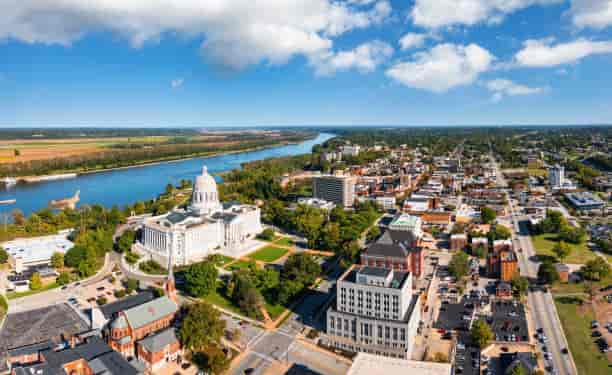
To understand Jefferson City's downtown, start with the view. The Missouri State Capitol sits on a limestone bluff above the river, its dome visible from miles in every direction, its dome rivaling the U.S. Capitol in scale and surpassing it, by many accounts, in interior beauty. Murals by N.C. Wyeth, Frank Brangwyn, and Alexander Calder line the rotunda and chambers. Free tours operate throughout the week. Chez Monet Patisserie, a French-inspired bakery and café operating inside the Capitol building, is the only place in America where you can have a croissant next to a Wyeth mural on a Tuesday morning. That is not a selling point you can manufacture. It is simply what Jefferson City is.
Below the Capitol, the Downtown and Capitol District occupies a compact grid anchored by High Street, Jefferson City's primary commercial corridor. The streetscape has been through cycles of disinvestment and revitalization, and the current trajectory is positive: new restaurants, law offices, government buildings, boutique retail, and locally owned businesses have steadily reclaimed the blocks surrounding the Capitol complex. Jefferson Landing, the state historic site on the riverfront, anchors the area's northern edge with museums, historical exhibits, and river views that constitute one of Missouri's most underappreciated public spaces. The Grand Café, two blocks from the Missouri River and adjacent to the state Capitol, offers upscale American cuisine that would hold its own in any larger city's restaurant scene.
For renters, the downtown corridor offers a mix of older apartment buildings, historic renovated properties, and occasional new construction, generally at Jefferson City's most accessible rents for a neighborhood with this level of amenity access and walkability. One-bedroom options in older buildings close to the Capitol regularly come available in the $500–$750 range. For buyers, the Capitol District offers downtown condos, historic homes on Capitol Avenue and adjacent streets, and the opportunity to live within walking distance of the seat of Missouri's government, an address with genuine civic character that is available at prices well below comparable historic downtown neighborhoods in larger cities.
Median Home Price: $140,000–$320,000 (wide range based on condition; historic properties can command significant premiums after renovation) | Average Rent: 1BR: $550–$900/mo | 2BR: $750–$1,100/mo
Safety: The downtown corridor experiences the typical elevated property crime of any small-city commercial district, vehicle break-ins and petty theft in high-traffic areas. Violent crime rates are low overall for Jefferson City. The blocks immediately around the Capitol and the riverfront are well-maintained and heavily visited. Apartment List notes that when renting east of the Capitol in the older downtown blocks, prospective tenants should inspect properties carefully, as some areas in the flood-history zones saw building quality impacts from the 1993 flood and subsequent flooding events. The Capitol Avenue Historic District and the western downtown blocks present the best combination of historic character and building condition.
Walkability / Transit: Jefferson City's most walkable neighborhood. The Capitol, Governor's Mansion, Missouri State Museum, Jefferson Landing, High Street restaurants and shops, and the Missouri River overlook are all accessible on foot from downtown addresses. Biking is viable for most daily neighborhood needs. The Katy Trail access point, via a bridge crossing the Missouri River, puts one of America's great long-distance recreational trails within biking distance of downtown apartments.
Top Amenities:
- Missouri State Capitol, The city's defining landmark; free public tours of its spectacular interior are available throughout the week; named by Trip Advisor as the most beautiful state capitol interior in the nation
- Jefferson Landing State Historic Site, Riverfront museum campus with Missouri history exhibits, the Lewis & Clark mural, and river views; one of Missouri's most underappreciated public destinations
- The Grand Café, Upscale American cuisine two blocks from the Missouri River; one of Jefferson City's finest dining experiences and a reliable downtown anchor
- Chez Monet Patisserie, French-inspired bakery and café inside the Missouri State Capitol; baked goods and sandwiches with an irreplaceable setting
- High Street commercial corridor, Jeff City's primary downtown dining, retail, and business strip, with locally owned options that continue to grow
- Missouri Governor's Mansion, One of America's finest gubernatorial residences; tours available to the public
- Ellis-Porter Riverside Park, Amphitheater, river views, aquatic center, ballfields, and major concert programming along the Missouri River; renovated in 2021
- Katy Trail access, Via the Missouri River bridge; the 240-mile trail from St. Charles to Clinton is one of America's greatest rail-trail conversions, and Jefferson City sits at its heart
Best For: State government employees, legislative staff, lawyers, lobbyists, and professionals who work in and around the Capitol complex; anyone who values walkable historic urban living; renters who want maximum amenity access at minimum cost; history enthusiasts; empty nesters drawn by civic character and riverfront access
Nearest 10 Federal Storage Location:
- 2601 Industrial Dr, Jefferson City, MO 65109, Located on the west side of the city with convenient access from US-50 and US-54. Downtown residents can reach the facility in approximately 10–12 minutes. Well-suited for Capitol District residents managing the logistics of smaller downtown living spaces, historic home renovation overflow, or government employees on assignment rotations who need flexible short-term storage.
2. OLD MUNICHBURG / SOUTHSIDE, MOST CHARACTER, BEST DINING & COMMUNITY CULTURE
Old Munichburg is Jefferson City's most distinctive neighborhood, and it is one of the most authentic expressions of German immigrant community heritage still visible in mid-Missouri. The neighborhood, occupying the Southside of Jefferson City south of the downtown grid, takes its name from the waves of German immigrants who settled here in the 1800s, bringing with them brewing traditions, stone-and-brick construction techniques, and a community culture that remains tangible in the neighborhood's architecture and institutions well over a century later. The brick facades, narrow lots, front stoops, and street-level commercial buildings that define Munichburg's visual character are the product of that heritage, and they give the neighborhood a density and authenticity that newer Jefferson City neighborhoods cannot replicate.
Today, Old Munichburg functions as Jefferson City's culinary and cultural neighborhood. The concentration of neighborhood eateries, seasonal festivals, and community gathering spots in Munichburg is disproportionate to its size. The annual Oktoberfest celebration draws visitors from across mid-Missouri, honoring the neighborhood's German heritage with food, beer, and live entertainment. Local restaurants and bars on Dunklin Street and the surrounding blocks reflect both the heritage and the contemporary local food culture, a combination that makes Munichburg a genuine dining destination rather than just a historic curiosity. The neighborhood has benefited from a steady stream of renovation investment, with older properties being thoughtfully restored to their original character while being updated for modern living.
Rental options in Old Munichburg include everything from studio apartments in converted historic commercial buildings to single-family rentals in the neighborhood's craftsman and vernacular brick homes. The renovation of historic properties, like the studio apartment in a restored Art Deco building on W. Dunklin featured in Jefferson City listings, represents the kind of character-rich rental option that is simply unavailable in neighborhoods built in the last 30 years. Rents are affordable, generally in line with Jefferson City's city-wide average, with older unrenovated properties running at the low end and carefully restored units commanding modest premiums. For buyers, Munichburg offers some of Jefferson City's most distinctive housing stock at prices that remain accessible relative to the architectural character on offer.
Median Home Price: $130,000–$260,000 (older housing stock; renovated properties can run higher) | Average Rent: 1BR: $550–$850/mo | 2BR: $700–$1,000/mo
Safety: Old Munichburg is an established, community-oriented neighborhood with an active identity and neighborhood culture. Like any neighborhood with older housing stock and a mix of property conditions, some blocks present more variation in maintenance than others. The neighborhood's active community events and gathering culture contribute to the informal social monitoring that characterizes safe, invested residential areas. Residents generally describe feeling comfortable in and around the neighborhood, particularly around the active commercial strips and during the well-attended seasonal festivals.
Walkability / Transit: Walkable within the Munichburg commercial core for dining, local errands, and neighborhood gathering. The downtown and Capitol District are accessible by bike or a short drive north. Car-dependent for most regional errands. The neighborhood's compact, street-oriented design makes it more pedestrian-friendly than Jefferson City's more suburban western corridors.
Top Amenities:
- Munichburg Oktoberfest, Annual fall festival celebrating the neighborhood's German heritage with food, beer, and community; one of Jefferson City's most attended annual events
- Dunklin Street dining corridor, The neighborhood's concentration of locally owned restaurants, bars, and cafés represents Jefferson City's most distinctive dining district outside of High Street downtown
- Historic German-immigrant architecture, The brick facades, narrow lots, and street-level commercial buildings constitute one of mid-Missouri's best-preserved 19th-century neighborhood streetscapes
- Proximity to downtown, The Capitol District and High Street are a short drive or long walk north; Munichburg residents enjoy the character and affordability of the Southside with easy access to downtown's civic amenities
- Jefferson City Cemetery and historic sites, Southside historic resources provide additional context for the neighborhood's long history
- Missouri State Penitentiary, The historic former prison, now an entertainment and events venue offering tours, ghost tours, concerts, and escape room experiences; a unique mid-Missouri destination adjacent to the Southside
Best For: History and architecture enthusiasts, food lovers who want a dining-rich neighborhood, renters who want character-rich older housing at affordable prices, buyers looking for renovation opportunities with strong neighborhood bones, anyone who values authentic community identity over new-construction uniformity
Nearest 10 Federal Storage Location:
- 2601 Industrial Dr, Jefferson City, MO 65109, Accessible from the Southside via US-50 west. Climate-controlled units are particularly valuable for Munichburg residents managing older homes, wood furniture, documents, and antiques benefit significantly from climate regulation in Missouri's humid summers.
3. WEST SIDE / MISSOURI BOULEVARD CORRIDOR, BEST EVERYDAY CONVENIENCE
The West Side and Missouri Boulevard corridor is Jefferson City's commercial and practical spine. Missouri Boulevard, running west from downtown through the city's most commercially developed zone, is where you find the grocery stores, big box retailers, national restaurant chains, fitness centers, pharmacies, and everyday services that power the logistics of daily life. Jefferson City residents across the city use the Missouri Boulevard corridor for routine errands, and the West Side neighborhoods that surround it offer the most direct access to that infrastructure. If you're evaluating a Jefferson City neighborhood on the basis of "where do I grocery shop and how far is it?" the West Side gives you the shortest answer.
The West Side neighborhoods are primarily residential in character, offering a mix of mid-century single-family homes, ranch-style construction, and some newer development. The housing stock here is more uniform than in Old Munichburg or the Capitol District, fewer architectural surprises in either direction. What you get instead is solid, functional residential living at Jefferson City's most accessible price points, with commercial amenities immediately at hand and quick access to US-50 and US-54 for regional travel. For renters, the West Side offers apartment options in both older buildings and some newer complexes, generally at rates at or slightly above the Jefferson City average due to the convenience premium.
The Binder Park area on the West Side's edge, now officially renamed Jefferson Memorial Park, represents one of Jefferson City's most significant quality-of-life assets. At 645 acres, it is the city's largest park by a wide margin, incorporating a lake for boating, fishing, and camping, an acclaimed family aquatic center, two treehouse-themed playgrounds that draw families from across the region, multiple trails, and the Memorial Park Family Aquatic Center. The park's scale transforms what might otherwise be a purely utilitarian commercial-adjacent residential zone into a genuinely livable neighborhood with exceptional recreational infrastructure. Concerts, events, and family programming at Jefferson Memorial Park are among the most consistent draws for West Side residents throughout the year.
Median Home Price: $165,000–$280,000 (mix of mid-century and newer construction; range depends on exact location and proximity to commercial corridors) | Average Rent: 1BR: $600–$900/mo | 2BR: $800–$1,100/mo
Safety: The West Side residential neighborhoods are generally safe, reflecting the character of an established middle-income residential zone. The Missouri Boulevard commercial corridor itself carries the typical property crime exposure of a busy retail strip, vehicle break-ins in parking lots, occasional retail theft, but the residential streets away from the commercial spine maintain low crime rates. Residents describe the West Side as comfortable and predictable in the best sense.
Walkability / Transit: The Missouri Boulevard commercial corridor is driveable-convenient rather than walkable, the suburban retail format requires a car for most errands, though residents who live close to the corridor can walk to some destinations. Jefferson Memorial Park's trail system provides outstanding pedestrian and cycling recreation within the neighborhood. Go COMO bus service in Jefferson City is limited compared to Columbia; a car is strongly recommended for most West Side daily needs.
Top Amenities:
- Jefferson Memorial Park (formerly Binder Park), 645-acre park with a boating and fishing lake, camping, two treehouse playgrounds, the Memorial Park Family Aquatic Center, miles of trails, and extensive community event programming; the city's most significant recreational asset
- Missouri Boulevard retail corridor, Grocery stores (including Natural Grocers for health-conscious shoppers), Target, national dining chains, fitness centers, pharmacies, and every category of everyday retail within easy driving distance
- Runge Conservation Nature Center, Missouri Department of Conservation nature center with free exhibits on Missouri's native ecosystems, wildlife, and conservation; family-friendly and genuinely educational
- Quick highway access, US-50 and US-54 provide direct connections to downtown Jefferson City, the airport, and regional destinations; the West Side's highway adjacency is a practical commuting advantage
- Country Club of Missouri, Private golf club serving the West Side corridor; a social anchor for the area's established residential community
Best For: Families who prioritize park access and commercial convenience, buyers who want solid housing at accessible prices without renovation complexity, renters who value proximity to retail and everyday services, state government employees who commute to the Capitol and want a straightforward suburban living option
Nearest 10 Federal Storage Location:
- 2601 Industrial Dr, Jefferson City, MO 65109, Located on Industrial Drive off the West Side corridor; this is the most convenient 10 Federal location for West Side residents, with easy access from US-50 and US-54. Drive-up and climate-controlled units available for household goods, recreational equipment from Jefferson Memorial Park activities, and business inventory.
4. SOUTHWEST JEFFERSON CITY, BEST FOR FAMILIES & NEW CONSTRUCTION
Southwest Jefferson City has absorbed the bulk of the city's residential development activity over the past decade, and the results are visible in the newer subdivisions, expanding commercial infrastructure, and family-oriented community programming that define the area. This is where Jefferson City families who are buying their first or second home, and who want newer construction, highly rated schools, and the kind of neighborhood infrastructure that comes with HOA governance and active community investment, are primarily choosing to live. The combination of new-construction quality, good schools, and a growing commercial base has made Southwest Jefferson City the city's most consistently in-demand residential zone for buyers with a family focus.
The Southwest corridor's neighborhoods range from established subdivisions built in the 1990s and 2000s to new development pushing toward the city's southern and western edges. Cedar Hill, Deer Park, and the areas along South Country Club Drive offer varying price points within the broader southwest zone, from entry-level townhomes in the $180,000s to estate-style properties at the high end of Jefferson City's market. Homes.com reports estate homes in neighborhoods like Meadows By The Club at the city's extreme western edge selling from around $900,000 to $2.5 million, a range that illustrates the full spectrum of Southwest Jefferson City's housing options, from starter homes to luxury estates.
Schools are a primary driver of Southwest Jefferson City's family demand. Jefferson City High School, which serves much of the southwest corridor, is nationally recognized for academic programs and scholarship offerings. Parents who research school quality as part of their neighborhood decision consistently rank southwest Jefferson City schools among the city's strongest, and that reputation is a self-reinforcing driver of property values and neighborhood stability. The Jefferson City School District as a whole has earned strong reviews for its college preparation pipeline and extracurricular programming.
Median Home Price: $185,000–$380,000 (broad range across the corridor; Cedar Hill and Deer Park areas); estate properties to $2.5M+ at the high end | Average Rent: 1BR: $650–$950/mo | 2BR: $850–$1,200/mo
Safety: Southwest Jefferson City is one of the city's safest residential areas. Newer construction, active HOA governance, strong owner-occupancy rates, and higher median household incomes all contribute to low crime rates. Families consistently identify the southwest corridor as their safety-conscious first choice within Jefferson City's neighborhoods.
Walkability / Transit: Car-dependent. Southwest Jefferson City was developed in the modern suburban format, oriented toward automotive access rather than pedestrian infrastructure. South Country Club Drive and the surrounding commercial strips provide driving-convenience access to retail and services. Jefferson Memorial Park and its trail network are accessible from the western edge of the corridor. A car is essential for daily life in this area.
Top Amenities:
- Jefferson City High School, Nationally recognized for academic programs and scholarship availability; one of Missouri's most highly rated public high schools and a primary draw for families choosing the southwest corridor
- South Country Club Drive commercial corridor, Grocery stores, big box retail, national chains, fitness facilities, and everyday services convenient to most southwest Jefferson City neighborhoods
- Jefferson Memorial Park proximity, The city's 645-acre flagship park, including the aquatic center, lake, and trail system, is accessible from the west end of the southwest corridor
- Country Club of Missouri, Private golf and social club serving the southwest community
- Capital Area Active Transportation Plan trail network, Jefferson City's Greenway Trail System, connecting most of the city's 20 parks, has been expanding, with the Capital Area Active Transportation Plan (adopted 2024) identifying investment priorities that will continue to improve connectivity for southwest corridor residents
- Multiple parks and green spaces, The southwest corridor is well-served by neighborhood parks, athletic fields, and recreational programming as part of Jefferson City's 20-park system
Best For: Families with school-age children who prioritize educational quality, buyers seeking newer construction with HOA infrastructure, professionals who want a traditional suburban lifestyle with easy highway access, move-up buyers from starter homes in the Capitol District or Eastside
Nearest 10 Federal Storage Location:
- 2601 Industrial Dr, Jefferson City, MO 65109, Accessible from the southwest corridor via US-50 east or US-54 north. Useful for southwest families storing seasonal recreational equipment, managing garage overflow from newer construction, or handling the storage logistics of move-up purchases.
5. EASTSIDE / HISTORIC RESIDENTIAL, BEST ESTABLISHED NEIGHBORHOOD VALUE
Jefferson City's Eastside neighborhoods, the established residential streets east of the Capitol and downtown grid, running toward the US-50 and US-54 interchange, represent the most traditional residential fabric of the city: mid-century ranch homes, older two-story frame construction, established tree canopies, and the quiet street-level character of neighborhoods that have been continuously occupied by working families for decades. This is the Jefferson City that longtime residents grew up in and often return to, comfortable, functional, affordable, and genuinely unpretentious in the best Midwestern sense.
The Eastside's housing stock is primarily mid-century construction, with some older early-20th-century homes mixed in closer to downtown. The architectural variety is more modest than Old Munichburg's German-heritage brick character or Old Southwest's Craftsman inventory, but the construction quality and lot sizes are solid, and the prices reflect the reality of an established residential neighborhood without a premium attached to walkability, prestige, or new-construction finishes. First-time homebuyers consistently find their strongest value-for-money options on the Eastside, where a well-maintained 1950s or 1960s ranch home with a good-sized lot can often be purchased for under $160,000–$180,000.
One important practical note for Eastside renters and buyers, repeated in multiple sources: properties in the lower-lying areas close to downtown's eastern edge carry historical flood exposure from the 1993 Missouri River flood and subsequent high-water events. While most properties in the Eastside residential areas are not in the active flood plain, buyers and renters should research specific addresses for FEMA flood zone classification before committing. Properties on higher-elevation streets east of the Capitol, away from the river-adjacent lower blocks, present no elevated flood risk.
The Eastside's proximity to the Capitol, downtown, and the Missouri State Penitentiary, now an events venue, gives it a front-row relationship with some of Jefferson City's most interesting civic and cultural assets. Ellis-Porter Riverside Park, renovated in 2021 and now home to an amphitheater drawing country music and touring acts, is accessible from the Eastside via a short drive. McKay Park and the Greenway Trail System provide local green space and trail connectivity.
Median Home Price: $120,000–$225,000 (one of Jefferson City's most accessible ownership markets) | Average Rent: 1BR: $500–$750/mo | 2BR: $650–$950/mo
Safety: The Eastside residential neighborhoods maintain an overall safe profile, reflecting their character as established working-family residential areas. Some blocks closer to the older commercial areas east of downtown have higher variation in property conditions and corresponding crime data. Residents who research specific street-level conditions, rather than relying on broad neighborhood averages, consistently find safe, quiet residential streets throughout the Eastside corridor. The Jefferson City Police Department maintains neighborhood policing presence throughout the area.
Walkability / Transit: Variable. Blocks closest to the Capitol and downtown are within a reasonable walk or short bike ride of downtown amenities. Further east, car dependence increases. The Greenway Trail System provides recreational non-motorized connectivity to parks throughout the city. McKay Park and Ellis-Porter Riverside Park are accessible by a short drive.
Top Amenities:
- Ellis-Porter Riverside Park, Renovated in 2021; the Missouri River-front amphitheater, aquatic center, ballfields, and river views make this one of Jefferson City's most beloved community spaces; country music and touring acts perform here regularly
- Missouri State Penitentiary, The historic former prison a short drive away now offers history tours, ghost tours, concerts, and events; a unique Missouri attraction and a reliable source of community entertainment for Eastside residents
- McKay Park, Local Eastside green space for recreation, dog walking, and community gathering
- Jefferson City Greenway Trail System, The city's trail network connecting 20 parks is accessible from Eastside neighborhoods and continues to be expanded under the Capital Area Active Transportation Plan
- Downtown and Capitol District access, Walking distance from many Eastside streets to the Capitol, High Street dining, Jefferson Landing, and the Missouri River overlook
- Capitol Avenue Historic District, The grand Victorian streetscape of Capitol Avenue begins at the Eastside's western edge, offering a visual connection to Jefferson City's architectural heritage
Best For: First-time homebuyers seeking Jefferson City's best value, renters who want the city's lowest rents in established residential settings, longtime Jefferson City residents who value traditional neighborhood character, buyers willing to invest in renovation for significant value upside, state government employees who want close proximity to work
Nearest 10 Federal Storage Location:
- 2601 Industrial Dr, Jefferson City, MO 65109, Located on Industrial Drive, which connects via US-50 and US-54 from the Eastside in approximately 10–15 minutes. A practical choice for Eastside homeowners managing renovation projects, first-time buyers bridging the gap between old and new housing, or renters between leases.
6. NEAR LINCOLN UNIVERSITY / NORTH SIDE, BEST FOR CAMPUS LIFE & AFFORDABILITY
Lincoln University occupies a unique and important place in Jefferson City's identity. Founded in 1866 by Black Civil War veterans of the 62nd and 65th United States Colored Troops, who pooled their own enlistment bonuses to establish an institution of higher education for freed people in Missouri, Lincoln University carries a founding story that is among the most extraordinary in American higher education. Today it is a public HBCU (Historically Black College and University) with approximately 2,500 students, offering a range of undergraduate and graduate programs and providing a campus energy and community culture that is distinctly its own within Jefferson City's residential fabric.
The neighborhoods surrounding Lincoln University occupy the north side of Jefferson City, between the campus and the Missouri River to the north. The housing stock is a mix of older residential buildings, smaller apartment complexes serving the student population, and established residential streets with affordable single-family homes. For renters, the near-campus area offers Jefferson City's most accessible rental prices, one-bedroom apartments and rooms in shared housing regularly come available in the $400–$650 range for the most affordable options, paired with the energy and programming of an active college campus. For buyers, the near-Lincoln University corridor offers the lowest entry-level prices in the city for single-family homes, with many properties under $100,000–$130,000 in need of renovation alongside well-maintained options in the $140,000–$190,000 range.
The campus itself is a significant quality-of-life asset for neighborhood residents. Lincoln University's stadium, athletic events, cultural programming, public lecture series, and the broader community of students and faculty create the social vitality that university neighborhoods generate wherever they exist. The university's Arts and Sciences building, the Scruggs University Center, and the athletic facilities are all accessible to the community. Jefferson City's employment in state government and healthcare creates stable demand for Lincoln University graduates, and the university's growing enrollment reflects a positive trajectory for the near-campus neighborhood.
One consideration for prospective North Side renters and buyers: the proximity to the Missouri River means flood history matters more here than in most other Jefferson City neighborhoods. Properties very close to the river or in mapped flood zones should be evaluated carefully for flood zone classification, current flood insurance costs, and historical flood data. Higher-elevation streets away from the river present no elevated risk, but due diligence on specific addresses is warranted.
Median Home Price: $95,000–$190,000 (Jefferson City's most accessible ownership market) | Average Rent: 1BR: $450–$700/mo | 2BR: $600–$850/mo
Safety: The near-Lincoln University and North Side area has variable safety data across sub-sections. The campus environment itself maintains a strong safety focus, and Lincoln University Police work in coordination with Jefferson City Police. The residential areas immediately surrounding campus are established neighborhoods with long community histories. Blocks further north toward the river and in older commercial transitional areas have higher variation in property conditions. Prospective residents should research specific street addresses rather than rely on broad neighborhood-level generalizations when evaluating safety.
Walkability / Transit: The campus is walkable and bikeable for students and nearby residents. The Missouri River and Katy Trail access via the river bridge are within a reasonable bike ride. Downtown Jefferson City is a short drive south. Car recommended for most daily errands away from campus.
Top Amenities:
- Lincoln University campus, Public HBCU with a founding story that is among the most significant in American higher education; athletic events, cultural programming, and academic resources open to the broader community
- Missouri River access & Katy Trail, The North Side's proximity to the Missouri River provides natural recreation access and connection to the Katy Trail via the river bridge, one of Missouri's finest outdoor assets
- Ellis-Porter Riverside Park, River-front park with amphitheater, aquatic center, and community events; accessible from the North Side via a short drive or longer walk along the river corridor
- Jefferson City proximity, The Capitol, downtown dining and cultural amenities, and the full sweep of Jefferson City's civic life are a short drive from the near-campus neighborhood
- Affordable proximity to state government employment, The near-Lincoln University area provides Jefferson City's most cost-effective combination of affordable housing and short commuting distance to Capitol complex jobs
Best For: Lincoln University students, faculty, and staff; buyers seeking Jefferson City's absolute lowest entry-level prices; renters on tight budgets who want to minimize housing costs while living in Missouri's capital city; people drawn to HBCU campus culture and community; investors in renovation-opportunity properties
Nearest 10 Federal Storage Location:
- 2601 Industrial Dr, Jefferson City, MO 65109, Accessible from the North Side via US-54 south. Particularly useful for Lincoln University students storing dorm and apartment furnishings during summer and academic transitions, and for North Side residents in the process of home renovation or relocation.
HOW TO CHOOSE YOUR JEFFERSON CITY NEIGHBORHOOD
Jefferson City is a compact city where no neighborhood is more than 15–20 minutes from any other, so the neighborhood decision here is less about commute management and more about identifying the lifestyle and housing format that fits your life. A quick decision framework:
If walkability, civic character, and proximity to work at the Capitol matter most, the Downtown / Capitol District is the clear choice. There is no other Jefferson City neighborhood where you can walk to work at the seat of Missouri's government, eat a croissant inside a building decorated by N.C. Wyeth, and have dinner by the Missouri River on the same day.
If neighborhood character and dining culture are priorities, Old Munichburg delivers the most authentic, distinctive residential experience in Jefferson City. The German heritage architecture, Oktoberfest culture, and neighborhood dining scene are genuinely unique and cannot be replicated in newer development.
If everyday convenience and park access are paramount, the West Side and Missouri Boulevard corridor gives you the most frictionless daily life, grocery stores, Jefferson Memorial Park, fitness centers, and all the commercial infrastructure of a modern suburb, at Jefferson City's practical price point.
If school quality and new construction are non-negotiable, Southwest Jefferson City is the answer. Jefferson City High School's academic reputation is a primary draw, and the southwest corridor's newer housing stock and HOA infrastructure serve families who want a turnkey suburban living experience.
If value and first-time homeownership are the goal, the Eastside offers Jefferson City's best combination of accessible prices, established residential character, and proximity to downtown employment. Do your flood-zone homework on specific addresses, but the price-to-quality opportunity here is significant.
If affordability and campus energy are priorities, the near-Lincoln University North Side provides Jefferson City's lowest rents and home prices alongside the cultural vitality of an active HBCU campus with a founding story worth knowing.
SELF STORAGE IN JEFFERSON CITY, 10 FEDERAL STORAGE
Jefferson City is a city of transitions. State government employees rotate through assignments and relocate on political cycles. Lincoln University students move in and out each academic year. Families buying their first home, often in older neighborhoods with renovation projects ahead, need temporary storage while work is completed. Military families pass through with PCS orders. And the city's compact geography means that a single well-positioned storage facility can serve every neighborhood with minimal additional driving time.
10 Federal Storage's Jefferson City location on Industrial Drive is positioned on the city's west side with direct access from US-50 and US-54, the two primary east-west and north-south arteries that connect all of Jefferson City's neighborhoods. The facility offers fully online rental, meaning you can reserve a unit, sign your lease, and receive your gate access code without visiting an office or filling out paperwork in person. Climate-controlled units are available and specifically important in Jefferson City's climate: Missouri's hot, humid summers (regularly above 90°F) and cold, icy winters create conditions that can damage wooden furniture, electronics, musical instruments, documents, and clothing stored in a non-climate-controlled environment.
10 Federal Storage in Jefferson City
- 2601 Industrial Dr, Jefferson City, MO 65109, Located on Industrial Drive off the West Side corridor, with easy US-50 and US-54 access. Serves all Jefferson City neighborhoods. Climate-controlled units protect against Missouri's seasonal extremes. Unit sizes range from compact 5x5 for boxes and small items up to large units for full household contents. Drive-up and indoor access available. Particularly well-suited for: state government employees on assignment rotations or between housing situations; Lincoln University students storing belongings during semester breaks or housing transitions; Jefferson City families managing renovation overflow in older homes; military families with flexible short-term storage needs; businesses managing records, inventory, or equipment.
All leases are month-to-month. 24/7 access available. New customers qualify for promotional rates. View the Jefferson City location and available units here.
WELCOME TO JEFFERSON CITY
Jefferson City rewards the residents who take it on its own terms. This is not a large city, and it does not pretend to be one. What it is, the seat of government of a major American state, perched above the Missouri River with a Capitol building that is genuinely extraordinary, historic neighborhoods that carry real character, access to the Katy Trail, parks that punch far above their weight class, and a cost of living that makes quality homeownership accessible to people who would be priced out of most comparable cities, is genuinely special in ways that don't always fit neatly into a listicle or a ranking.
Whether you're drawn to the civic gravitas of the Capitol District, the German-heritage character of Old Munichburg, the family-friendly infrastructure of Southwest Jefferson City, the practical convenience of the West Side, the first-time-buyer value of the Eastside, or the campus energy of the Lincoln University neighborhood, Jefferson City has a version of itself that fits most lifestyles and most budgets. And wherever you land, 10 Federal Storage at 2601 Industrial Drive is here to support your move and your storage needs, with fully online rental, climate-controlled units, 24/7 access, and month-to-month leases built for a city that knows how to welcome people who are still figuring out where to put their roots down.
Find your Jefferson City storage unit and reserve online today.
About 10 Federal Storage, Jefferson City, MO
10 Federal Storage operates a self-storage facility in Jefferson City, MO at 2601 Industrial Dr, Jefferson City, MO 65109, located on the west side of the city with direct access from US-50 and US-54, serving all Jefferson City neighborhoods. Climate-controlled units, drive-up access, 24/7 gate access, and fully online rental available. Month-to-month leases with no long-term commitment required. View the Jefferson City location and available units here.
FREQUENTLY ASKED QUESTIONS ABOUT JEFFERSON CITY NEIGHBORHOODS
For renters, the area near Lincoln University and the North Side offers Jefferson City's lowest average rents, one-bedroom options in older buildings and shared housing regularly come available in the $450–$650 range. The Eastside also provides affordable rental options in established residential settings. For buyers, the near-campus North Side corridor and parts of the Eastside offer Jefferson City's most accessible entry-level purchase prices, with single-family homes available under $130,000 in some conditions.
It is specifically well-designed for state government employment. The Capitol complex, state office buildings, and associated law firms and lobbying operations are all concentrated in the downtown corridor and accessible within a short commute from virtually any Jefferson City neighborhood. The cost of living advantage, roughly 9–10% below national average, with housing prices dramatically below what comparable positions would support in most state capitals, means state government salaries go substantially further in Jefferson City than they would in Austin, Sacramento, Albany, or Boston. The city's stability, low cost of living, and civic identity make it an excellent base for state government career paths.
Jefferson City sits on the Missouri River, and the 1993 Mississippi and Missouri River floods were historically significant events that affected parts of the city. The lower-lying areas east of the Capitol near the river and the North Side areas closest to the water carry historical flood exposure. Buyers and renters considering properties in these zones should research specific addresses for FEMA flood zone classification, obtain current flood insurance quotes, and review the property's historical flood documentation. Higher-elevation areas of the city, Southwest Jefferson City, West Side residential streets, the Capitol bluff area, and most of Old Munichburg, are generally outside active flood zones. The Southwest Jefferson City corridor specifically benefits from being away from the river corridor.
Southwest Jefferson City is the top choice for families who prioritize school quality, newer construction, and HOA community infrastructure. Jefferson City High School's academic reputation is a specific draw. The West Side / Missouri Boulevard corridor is a strong alternative for families who want the convenience of immediate commercial access and Jefferson Memorial Park's recreation assets. Old Munichburg is a compelling choice for families who value neighborhood character and community culture alongside reasonable prices.
The two cities serve genuinely different lifestyles, and they are only 30 miles apart on US-63, close enough that some residents commute between them. Columbia offers significantly more cultural programming, a much larger dining and bar scene, the energy and amenities of a major research university, and a more diverse employer base in healthcare and tech. Jefferson City offers substantially lower home prices, a more intimate civic identity anchored by its role as the state capital, exceptional outdoor recreation access via the Katy Trail and Missouri River, and a quality of life that many residents describe as quieter and more community-oriented. Families focused on affordability and civic stability often prefer Jefferson City; young professionals, academics, and culture-seekers tend to prefer Columbia. Both cities offer quality of life that is genuinely underappreciated nationally.
Jefferson City's outdoor recreation assets are among the best of any city its size in the Midwest. The Katy Trail, the 240-mile rail-trail conversion running from St. Charles to Clinton, passes through Jefferson City, accessible via a pedestrian and cycling bridge across the Missouri River. Jefferson Memorial Park's 645-acre campus includes a lake for boating, fishing, and camping, plus the Greenway Trail System connecting the city's 20 parks. Ellis-Porter Riverside Park provides river-front recreation. The city's Capital Area Active Transportation Plan (adopted 2024) is investing in bicycle infrastructure, greenways, and pedestrian improvements that will continue to expand active transportation options. The proximity of the Ozarks and Lake of the Ozarks, approximately 30–45 minutes south, adds water recreation, float trips, and additional trail access to the regional menu.
About the Author
10 Federal Storage
Our team at 10 Federal Storage has been in the self storage industry for decades. With knowledge gained from multiple universities and in the field, we are well-prepared and excited to assist with your storage needs. When you rent a unit with us, you can feel confident that our seasoned customer service team’s help will make your transition as seamless as possible. Customer satisfaction is our number one priority, and we strive to make your experience exceptional with our automated leasing options, diverse unit sizes, and a strong commitment to sustainability.