
.svg)
Craft Room Ideas: Layout, Organization, and Setup for Serious Crafters
by 10 Federal Storage
Published on May 19, 2026
There comes a point in every crafter’s life when the supplies stop fitting in a closet. Fabric bins migrate from the closet to under the bed. The dining table becomes “the cutting table” between meals. Yarn lives in baskets in the living room. Eventually, you do what every serious crafter eventually does: you decide to convert a room into a real, dedicated craft space.
This guide covers craft room ideas that actually work for working crafters: layout principles, in-room storage and organization strategies, lighting and workspace design, decor, and the practical question that always comes up, where do the supplies and displaced furniture go when one room can’t hold it all?
Table of Contents
- Craft Room Layout Ideas
- Workspace and Surface Ideas
- In-Room Storage and Organization Ideas
- Lighting and Ambiance Ideas
- Craft Room Decor and Personality
- The Double Storage Problem
- Active Workspace vs. Archive Storage
- Supply Climate Sensitivity Guide
- The Seasonal Rotation
- Frequently Asked Questions
Craft Room Layout Ideas
The best craft room layouts are built around your primary craft, not all your crafts equally. Designing for everything ends in a room that’s mediocre at all of it.
- Quilters and sewists. Build around a large cutting table in the center (so you can walk all four sides) plus a dedicated machine table along a wall. Pressing station nearby. Fabric storage on shelves or in cubbies along the longest wall.
- Paper crafters and scrapbookers. Build around a large flat work surface with paper storage directly above and below. Cutting machines on a side counter. Vertical paper organizers within reach.
- Painters. Built around an easel near the best light source, with a side cart for active palette and brushes. Canvas storage flat or vertical. Cleanup station with a sink if possible, or near the door if not.
- Multi-craft hybrids. Pick the craft you do most as the room’s anchor; treat the others as guests. A folding table or convertible workspace handles the secondary crafts.
- U-shape or L-shape workstation. Whatever the craft, a workstation that wraps around you (rather than a single linear desk) puts more tools in arm’s reach without standing up.
- Designate an in-progress zone. A bookshelf, set of cubbies, or basket where unfinished projects can live without taking over the main workspace.
Workspace and Surface Ideas
Counter space is sacred. Anything you can get off the work surface buys back capacity.
- An IKEA-style desk + filing cabinet base. Long, flat, and customizable. A solid butcher block or laminate top across two cabinets gives you a 5–6 foot work surface with built-in storage underneath.
- A standing-height cutting table. 36 inches tall instead of 30. Saves your back during long cutting sessions and prevents the hunched-over fatigue that ends a session early.
- A folding wall-mounted table. Drops down when you need it, folds up when you don’t. Perfect for occasional larger projects in a tight room.
- A second small table for the machine. Keeps the cutting and assembly surface clear when you’re sewing or running a die-cut machine.
- A rolling cart. A small cart with two or three tiers becomes a portable supply station. Pull it next to whatever surface you’re using.
- Self-healing cutting mat. 24x36 or larger if you have the surface for it. Lasts years and protects your work surface forever.
In-Room Storage and Organization Ideas
The single best craft room principle: vertical storage saves you.
- Pegboards. Hung above the workstation, holding scissors, rulers, rotary cutters, brushes, and frequently-used tools. Every tool visible, none on the work surface.
- Wire grids for ribbon and thread. Spools on dowels, thread on cones, ribbon on rods. Vertical storage you can see at a glance.
- Wall-mounted bins for paper and small supplies. Magazine files or labeled bins on a wall rail, paper sorted by color or size.
- Clear bins for fabric, with labels. Sorted by color, type, or project. Stacked on shelves with labels facing out.
- Closed cabinets for backstock. Things you don’t use weekly, bulk paper, backup adhesives, extra cutting mats. Out of sight, not out of mind.
- Drawer dividers and small-parts organizers. For beads, embellishments, buttons. Compartmented organizers keep small things from becoming a mixing bowl.
- Open shelves for things you use constantly. Active project supplies, current paint palette, the WIP. If you reach for it every day, it should be visible.
- A “junk drawer” you accept. Every craft room ends up with one. Designate it instead of pretending it doesn’t exist.
Lighting and Ambiance Ideas
Lighting matters in a craft room more than almost anywhere else in the house. You’re color-matching, threading needles, reading patterns, and doing detail work. Bad light makes all of it harder.
- Natural light first. If you have a window, position your primary workstation to use it. North-facing windows give the most consistent light throughout the day.
- Cool overhead lighting. Daylight-temperature LED bulbs (5000K–6500K) for accurate color matching. Standard 2700K warm bulbs distort fabric and paint colors.
- Layered task lighting. A swing-arm lamp at the cutting table, a clamp light near the machine, a small lamp by the WIP shelf. Each work zone gets its own light.
- Dimmable accent lighting. String lights, a small floor lamp, or wall sconces for ambiance when you’re in the room but not actively crafting.
- A daylight lamp on a movable arm. For close-up detail work. The kind photographers and surgeons use, balanced color, glare-free, and adjustable.
Craft Room Decor and Personality
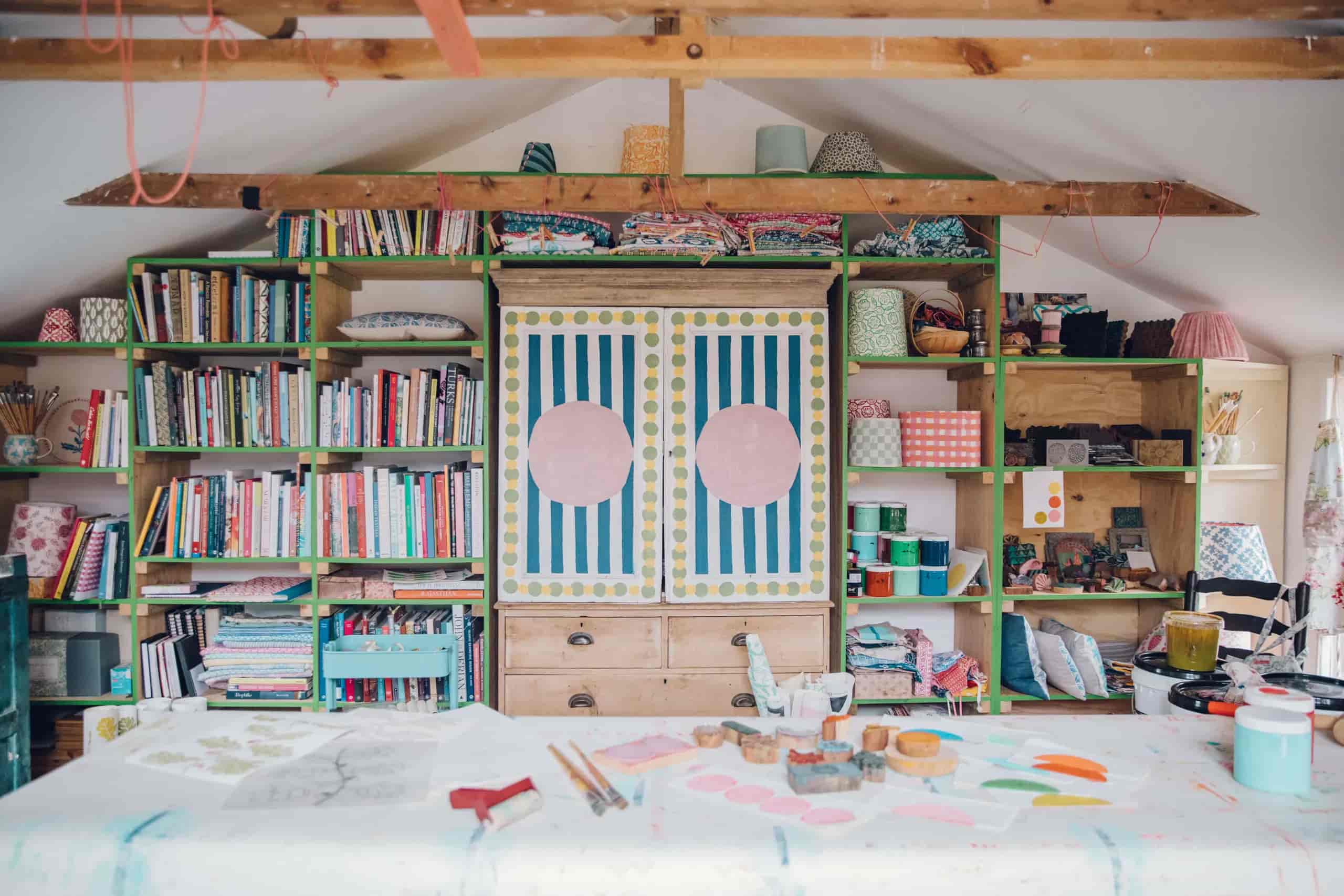
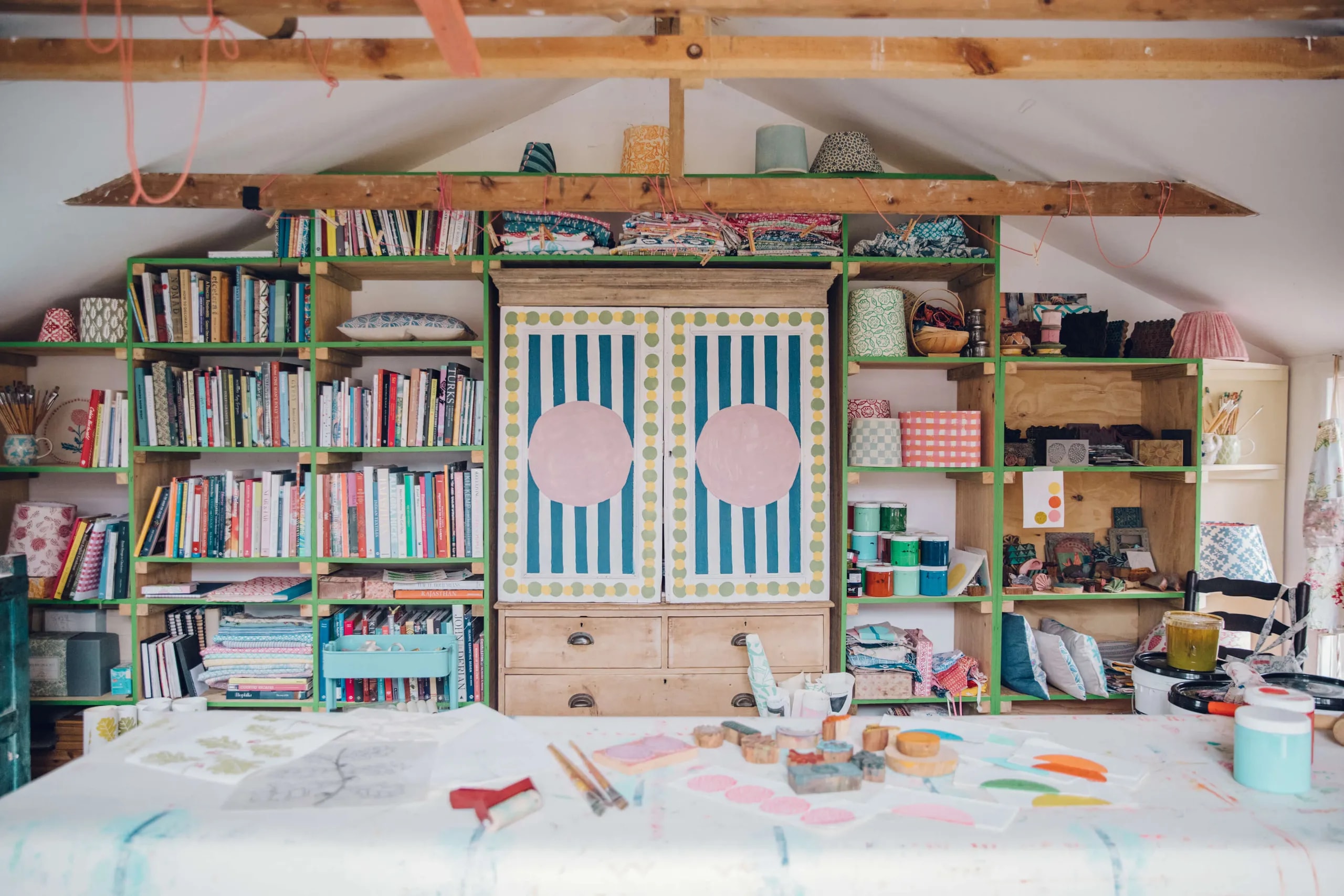
A craft room can be functional and beautiful at the same time. The trick is letting your supplies double as decor.
- Color-organized supplies as visual interest. A wall of fabric sorted by rainbow color order, yarn in glass jars by hue, paper in vertical organizers by shade. Storage that looks intentional.
- Display finished projects. Frame a quilt block, hang a finished embroidery, set out a finished piece of pottery. Your work belongs in your space.
- A vision board or inspiration wall. Cork or fabric panel where you pin patterns, sketches, magazine clippings, and color palettes you love.
- Plants. A few low-light plants (pothos, snake plant, ZZ plant) soften the room and improve the air. Skip anything that drops leaves on fabric.
- A comfortable extra chair. For a friend or family member who keeps you company while you work. Crafting is more fun with someone in the room.
- Personal touches. A favorite mug at the workstation, a small speaker for music or podcasts, a candle. The room should feel like yours, not a workshop someone else uses.
The Double Storage Problem
Here’s the part of craft room planning that nobody tells you upfront. Setting up the room is actually a storage problem twice over.
Storage problem one: the room had stuff in it before. Most craft room conversions start with a guest bedroom, a formal dining room, a home office, or a kid’s bedroom that just emptied. Whatever it was, it had a guest bed, a dining set, an office desk, exercise equipment, or other furniture. None of it disappears just because you’ve decided the room’s new identity.
Storage problem two: the supplies themselves are too many. Even with a dedicated room, most crafters have more supplies than fit comfortably in one room. Holiday-specific materials, project-based stockpiles, fabric collections from twenty years of quilting, paper stocks for a year of card-making. All of it competing for surface area in the same space where you need to actually work.
The solution to both is the same: split what stays in the room from what doesn’t need to be there full-time.
Active Workspace vs. Archive Storage
In the craft room, your active workspace. Current projects. Tools you reach for weekly. The fabric, yarn, paper, and supplies you’re actively using this month. A working stash of consumables.
In offsite storage, your archive. Seasonal supplies (Christmas crafts in summer, Halloween crafts in spring), large fabric and yarn collections you’re not using right now, finished pieces waiting for a home, bulk consumables that don’t need to be at arm’s reach, and the displaced furniture from the converted room.
This is how you avoid the most common mistake: jamming the new craft room so full of supplies that you can’t actually work in it. A craft room should be a workshop, not a warehouse.
Supply Climate Sensitivity Guide
Craft supplies are surprisingly fragile. Fabric, paper, paint, and natural fibers are especially sensitive to the environment they’re stored in. A quick reference:
- Fabric & yarn, Climate control strongly recommended. Without it: mildew, color fade, fiber weakening, and moth damage.
- Paper & cardstock, Climate control required. Without it: warping, yellowing, and cutting machine feed problems.
- Acrylic paints & glues, Climate control required. Without it: freezing damage, separation, and degraded adhesion.
- Beads & embellishments, Climate control optional. Some plastics yellow in extreme heat.
- Sewing & die-cut machines, Climate control required. Without it: rust, electronic damage, and plastic warping.
- Metal tools & hardware, Climate control recommended. Rust is the main risk in humid units.
- Finished projects, Climate control required. Without it: permanent damage to your work.
For an offsite archive that holds supplies you care about, climate control isn’t optional, it’s the difference between supplies that last and supplies that get ruined.
The Seasonal Rotation
The best part of having an offsite archive is the rotation rhythm it creates. A few times a year, you swap things in and out:
- October: Pull out the Christmas crafting supplies, return the Halloween stuff.
- February: Spring stamps and pastel papers come in, winter stuff goes out.
- June: Summer projects and patriotic supplies come in, anything heavy comes out.
You can build this around your own craft calendar. The point is that the craft room never feels overcrowded, because at any given time, only the supplies you’re actually using are in it.
Build the Craft Room You Can Actually Work In
The room becomes a workshop. The storage becomes an archive. Together, they give you something most crafters never quite manage: a space where everything you own is accounted for, accessible when you need it, and safe when you don’t.
Frequently Asked Questions
Build around your primary craft, not all crafts equally. Use a central work surface big enough to actually work on, vertical storage for supplies, and a designated “in-progress” zone for unfinished projects. U-shape or L-shape workstations are usually more functional than a single linear desk.
Natural light first, supplemented with daylight-temperature LED bulbs (5000K–6500K) overhead for accurate color matching, plus layered task lighting at each work zone. A daylight lamp on a movable arm is invaluable for close-up detail work.
Use closed cabinets for backstock and rarely-used supplies; reserve open shelves and pegboards for things you use weekly. Color-organize supplies that stay visible, a rainbow-sorted fabric wall reads as decor, not clutter. Keep work surfaces clear by storing tools vertically.
Offsite storage works well as a long-term archive: seasonal supplies, large fabric and yarn stashes, finished pieces, bulk consumables, and the displaced furniture from the converted room. Keep an active working stash in the room and rotate seasonally.
Yes, with the right conditions: climate-controlled space, breathable containers (cotton bags or breathable storage boxes for long-term), and moth deterrents like cedar blocks. Avoid direct sunlight, which fades colors permanently.
Acrylic and water-based paints will permanently separate or thicken if frozen. Oil-based paints are slightly more tolerant but still benefit from stable temperatures. Climate-controlled storage eliminates the risk.
Most craft room conversions fit in a 10x10 unit, enough for a guest bedroom’s worth of displaced furniture plus 15–20 bins of seasonal and archive craft supplies. Long-time crafters with large fabric stashes may want a 10x15.
In its original case, in a climate-controlled space, with humidity control. If you’ve lost the original case, wrap the machine in a breathable fabric cover (not plastic, which traps moisture) and store upright.
About the Author
10 Federal Storage
Our team at 10 Federal Storage has been in the self storage industry for decades. With knowledge gained from multiple universities and in the field, we are well-prepared and excited to assist with your storage needs. When you rent a unit with us, you can feel confident that our seasoned customer service team’s help will make your transition as seamless as possible. Customer satisfaction is our number one priority, and we strive to make your experience exceptional with our automated leasing options, diverse unit sizes, and a strong commitment to sustainability.