
.svg)
Gaming Room Ideas: Setup, Lighting, Layout, and How to Actually Build One
by 10 Federal Storage
Published on May 19, 2026
Every gaming setup starts with a question: where is this going to live?
For some people, it’s a corner of the living room with a TV, a console, and an understanding partner. For others, it’s a battlestation in the home office. But the real dream, the one that shows up on r/battlestations, is a dedicated room. A space with the right lighting, the right desk, the right chair, room for a wheel rig or a flight stick or a VR setup, soundproofed enough that you can yell at teammates without waking the kids.
This guide pulls together gaming room ideas that actually deliver the setup you’re picturing: layout principles, lighting and acoustic strategies, console vs. PC vs. hybrid layouts, gear and decor that elevates the space, and the practical question every conversion runs into, what to do with everything that was in the room before.
Table of Contents
- Gaming Room Layout Ideas
- Lighting Ideas for Gaming Rooms
- Desk and Battlestation Setup Ideas
- Console, PC, or Both?
- Sound and Acoustic Treatment
- Decor and Aesthetic Ideas
- The Conversion Reality: What Was in the Room Before?
- A Storage Strategy for Room Conversions
- Storage Size Guide for Conversions
- Frequently Asked Questions
Gaming Room Layout Ideas
A great gaming room layout starts with one decision: where the screens go. Everything else builds around that.
- Long wall, desk centered. The classic battlestation. Desk against the longest wall, chair facing it, room behind for cable management and accessories. Works in almost any rectangular room.
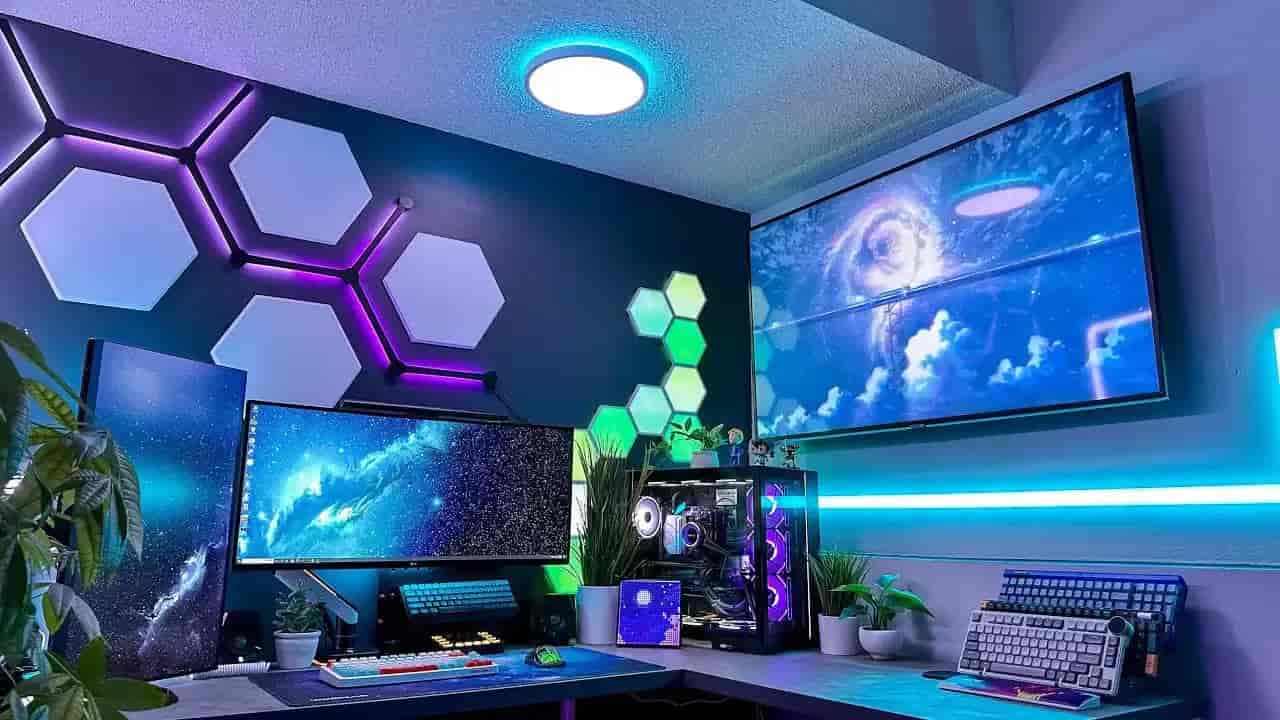
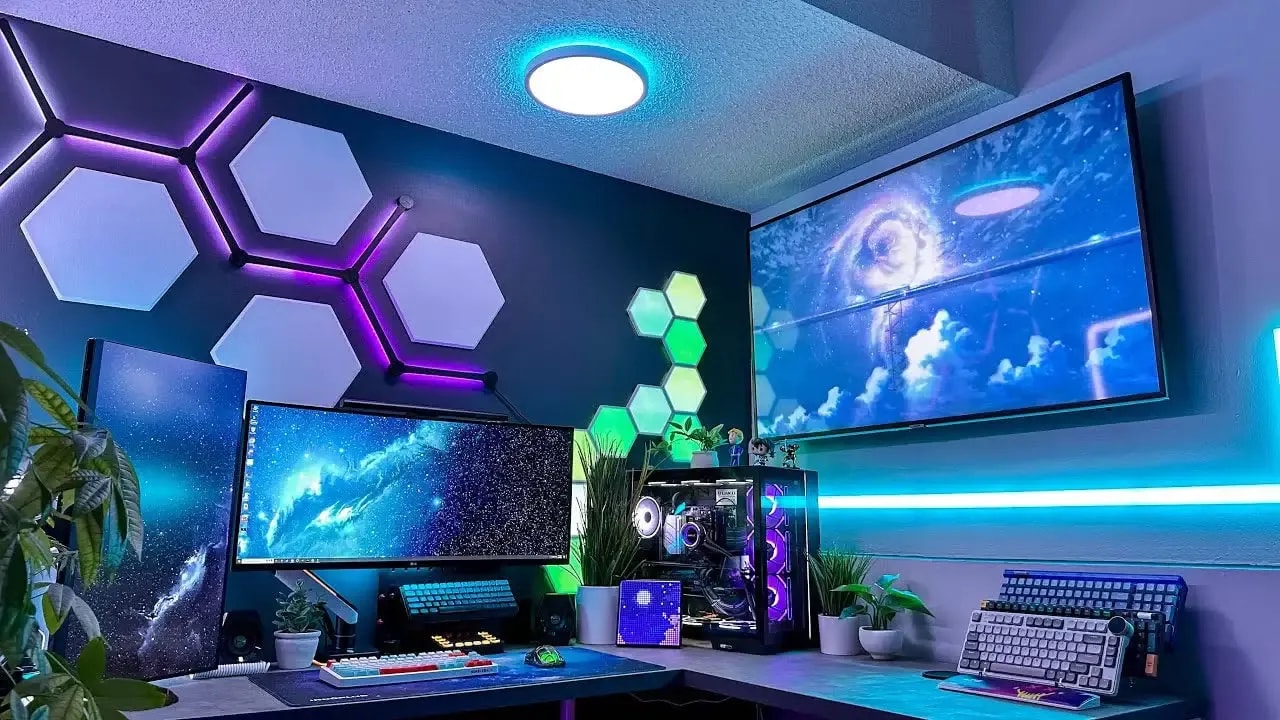
- Corner setup. Maximizes wall space and gives an L-shaped desk room to spread out gear. Good when you have two crafts going (PC and console, or gaming and streaming).
- Two-zone layout. One zone for PC gaming at a desk, one zone for couch console gaming with a TV. Backs to each other or separated by a rug.
- Sim rig island. If a racing or flight rig is the centerpiece, put it in the middle of the room facing a TV or monitor wall. Walk-around access matters.
- Streaming-ready setup. Desk facing the room with a clean backdrop behind you, lights positioned out of camera frame, mic on a boom arm. The room becomes a small studio.
Measure twice. Gaming desks have gotten enormous, some standing desks hit 70+ inches, and not every wall accommodates them.
Lighting Ideas for Gaming Rooms
Lighting is what separates a finished gaming room from a desk in a spare room. Three principles:
- Layer your lighting. Ambient lighting (LED strips, smart bulbs, color-changing lamps), task lighting (a desk lamp for keyboard and notes), and accent lighting (a single statement piece like a backlit shelf or neon sign). Each layer does a different job.
- Bias lighting behind the monitor. A simple LED strip stuck to the back of your monitor reduces eye strain and adds production value. Warm white is the safest pick if you don’t want RGB.
- Skip overhead lighting during gameplay. Standard ceiling fixtures create screen glare and wash out monitor color. Use them for entering and cleaning the room; turn them off when you sit down.
- RGB if you want it, calmly. Color-changing lights look great in moderation. Picking a two-color palette (blue + magenta, green + amber) and sticking to it ages better than full-rainbow chaos.
- Smart control. A single button or voice command that drops the room into “gaming mode” (overheads off, accents on, bias on) is one of the most-used features people add.
- Natural light management. Blackout curtains or shades for daytime sessions. Sun glare on a monitor at 2 p.m. is the fastest way to ruin a good setup.
Desk and Battlestation Setup Ideas
The desk is where you’ll actually spend your time. A few principles that consistently produce great setups:
- Buy or build a deep desk. 30 inches deep minimum. Standard 24-inch desks force your monitor too close and leave no room for a keyboard tray, mousepad, and accessories.
- Monitor arms over monitor stands. Free up desk surface, get the monitor at proper eye height, and make multi-monitor setups dramatically cleaner.
- Cable management is a one-time investment. Cable tray under the desk, velcro straps on bundles, labels on cables you swap. Two hours of effort once saves you decades of frustration.
- A great chair beats a great desk. If you have to choose, prioritize the chair. You’ll spend hundreds of hours in it.
- Keyboard tray or large desk pad. Something to define the typing zone and protect the desk surface. Cloth desk mats also dampen mouse and keyboard sound.
- A second screen. Even a vertical secondary monitor for Discord, music, or stream chat changes how you use the space.
- Headphone hook. Under the desk, on the monitor arm, on the wall. Anywhere except “on top of the desk.”
Console, PC, or Both?
The decision shapes the room. Some quick principles:
- PC-first rooms revolve around the desk. The chair faces the monitors; everything else is decoration. Best for competitive gaming, streaming, productivity, and people who play primarily at a keyboard.
- Console-first rooms revolve around the TV and couch. Coffee table for controllers, cabinet for consoles, ambient lighting around the screen. Best for couch co-op, family gaming, and games designed for controller.
- Hybrid rooms split the space. Desk on one wall, TV and couch on the opposite wall, or a swiveling chair between them. This is the best-of-both-worlds approach, but it needs more square footage.
- Sim or VR rooms have specific requirements. Sim rigs need walk-around space and a wall to mount or face. VR needs clear floor area, usually 6x6 feet minimum, with no fragile decor in arm-swing range.
Sound and Acoustic Treatment
The difference between “sounds fine” and “sounds professional” usually comes down to acoustic treatment, not gear.
- Acoustic panels behind you and on the wall opposite the mic. Absorbs the reflections that make your voice sound boxy on Discord and stream.
- A thick rug on hard floors. Reduces footstep echo and absorbs low-end resonance.
- Heavy curtains. Even blackout curtains pull double duty as sound absorption.
- A bookshelf as a diffuser. Irregular surfaces full of books and small objects scatter sound naturally.
- Headphones for late-night sessions. The simplest soundproofing is wearing closed-back headphones so housemates don’t hear gunfire at 1 a.m.
- Weatherstripping on the door. A surprising amount of sound leaks under and around standard interior doors. Stripping cuts that significantly.
Decor and Aesthetic Ideas
The best gaming rooms feel personal, not generic. A few ways to get there:
- Pick a vibe. Cyberpunk neon, minimalist Scandinavian, retro arcade, dark academia. A clear aesthetic frames every other decision.
- Framed game art. Officially licensed prints, alternative art posters, or fan prints. Better than mass-produced posters and treats games as the art they are.
- A collectibles shelf. Floating shelves with figures, controllers, or memorabilia. Edit ruthlessly, ten meaningful pieces beats fifty random ones.
- Plants. A snake plant or pothos in the corner softens a setup that’s otherwise all electronics and metal.
- Floor pillows or beanbag for couch co-op. Even in a PC-first room, a casual seat for friends matters.
- Hidden cable runs. Cable raceways, in-wall conduit, or under-desk trays. The cleaner the cabling, the more premium the room feels.
The Conversion Reality: What Was in the Room Before?
If you’re getting serious about the dream gaming room, you’ve already realized the catch: that room is currently something else. A guest room. A formal dining room nobody uses. A finished basement with a couch and a treadmill. A home office that’s about to become hybrid-only.
Converting the room is the easy part. Dealing with what’s currently in it is where most plans stall out. A typical conversion might mean finding a new home for:
- A guest bed, dresser, and nightstands
- A dining table and 6 chairs you used twice last year
- A treadmill or exercise bike
- Bookshelves and a personal library
- A sofa and recliner from the den
- An office desk, chair, and filing cabinets
You have four options for each item: keep it in the house somewhere, sell it, donate it, or store it. The first option fills your garage and creates new problems. The second and third are permanent decisions, and most people aren’t actually ready to give away the guest bed Grandma sleeps in twice a year, or the dining set they spent two paychecks on.
Storage is what makes the math work. The stuff that doesn’t fit your current life but isn’t ready to leave permanently goes somewhere safe, leaves your house alone, and waits.
A Storage Strategy for Room Conversions
A guest bed that lives in a hot garage for three years comes out smelling like a basement and held together by hope. Furniture stored well comes out looking the way it went in. A few principles:
- Disassemble what comes apart. Bed frames, dining tables, desks, bookshelves. Flat-packed takes a fraction of the space and is far less likely to get damaged. Bag the hardware in a labeled ziplock and tape it to the largest piece.
- Wrap upholstered pieces in breathable cotton, not plastic. Plastic traps moisture against fabric and grows mildew.
- Cover wood with moving blankets. Wood needs to breathe. Plastic wrap on a wood dresser in a humid space is how you get warped drawers and mold.
- Stack carefully. Heavy on bottom, light on top. Glass surfaces upright against a wall.
- Climate control is worth it. Solid wood, upholstery, mattresses, books, and anything with adhesives all benefit from steady temperature and humidity. The small upcharge protects expensive furniture from the storage environment itself.
- Leave airflow. A unit packed wall-to-wall with no airflow grows musty faster than one with breathing room.
Storage Size Guide for Conversions
For a typical room conversion, here’s a rough guide based on what you’re displacing:
- 5x10, Holds small bedroom contents: bed, dresser, nightstands, a few bins. Best for converting a small spare bedroom.
- 10x10, Fits a guest room plus extras: bed, dresser, dining table with chairs, sofa, bookshelves. Best for converting a guest room or formal dining room.
- 10x15, Holds large bedroom or finished room contents: full bedroom set, sofa, dining set, exercise equipment. Best for larger conversions, basement spaces, or multiple rooms’ worth.
- 10x20, Stores basement or large room contents, or a major reconfigure with multiple rooms of furniture. Best for whole-floor renovations or households doing multiple conversions at once.
If you’re not sure, size up slightly. The cost difference between a 10x10 and a 10x15 is usually small, and pulling things in and out is far easier when there’s a center aisle.
Build the Gaming Room You Actually Want
The best gaming rooms aren’t built in a weekend, they evolve. Climate-controlled storage gives you a place for what was in the room before, so you can build the space you want without making permanent decisions you might regret later.
Frequently Asked Questions
A comfortable chair, a deep desk (30+ inches), proper monitor positioning, layered lighting (ambient + task + accent), and acoustic treatment for the wall behind you. Most of these are inexpensive compared to the gaming gear itself.
For a desk-only PC setup, 100 square feet (10x10) works. For a hybrid with both desk and couch console gaming, plan for 150 square feet or more. VR setups need at least 6x6 feet of clear floor space within the room.
Three layers: ambient (LED strips or smart bulbs for room mood), task (a desk lamp for keyboard and notes), and accent (a backlit shelf, neon sign, or single statement light). Bias lighting behind the monitor reduces eye strain. Avoid overhead lights during gameplay, they cause screen glare.
Acoustic panels behind you and on the wall opposite your microphone. A thick rug on hard floors. Heavy curtains. A bookshelf full of books. These four changes can completely transform how your room sounds on Discord or stream.
You have four options: keep in the house, sell, donate, or store. Most people end up storing furniture they’ll want back later, guest beds, dining sets, sentimental pieces. A 10x10 climate-controlled unit fits a typical converted room’s contents.
Yes, but only in a climate-controlled unit. Temperature swings and humidity kill electronic components over time. If you’re storing a TV, gaming console, or any device with capacitors, climate control is essential. Remove any lithium-ion batteries first.
Most people use storage during room conversions for 2–5 years before reassessing. Storage rentals are month-to-month, so you’re not locked in. Some keep furniture stored indefinitely as “next house” contents.
A 10x10 climate-controlled unit might cost $1,500–$2,500 a year. If your stored furniture is worth more than that to replace, storage is cheaper. Sentimental items, custom pieces, and high-quality furniture almost always favor storage.
About the Author
10 Federal Storage
Our team at 10 Federal Storage has been in the self storage industry for decades. With knowledge gained from multiple universities and in the field, we are well-prepared and excited to assist with your storage needs. When you rent a unit with us, you can feel confident that our seasoned customer service team’s help will make your transition as seamless as possible. Customer satisfaction is our number one priority, and we strive to make your experience exceptional with our automated leasing options, diverse unit sizes, and a strong commitment to sustainability.