
.svg)
How to Pack Plates for Moving: A Step-by-Step Guide
by 10 Federal Storage
Published on July 1, 2026
Plates are the part of a move almost everyone dreads packing, and for good reason. They’re flat, heavy, and crack the moment they’re stacked wrong, which is how a single badly packed box turns a full set into a bag of shards before the truck even leaves the driveway. The encouraging part: broken plates are almost always a packing problem, not bad luck. Pack them the way professional movers do, and the same method protects the rest of your dishes, from bowls to glasses to serving pieces, and everything arrives intact.
This guide walks through the full method, the right materials, the box that actually protects fragile pieces, and the plate-packing technique most people get backward.
Table of Contents
- What You’ll Need
- Choosing the Right Box
- How to Pack Plates
- How to Pack Bowls
- How to Pack Glasses and Stemware
- How to Pack Serving Dishes and Platters
- Labeling and Loading
- Common Mistakes to Avoid
- What to Do With Plates You’re Not Unpacking Right Away
- Frequently Asked Questions
What You’ll Need
Gather your supplies before you wrap a single plate. Stopping mid-box to hunt for tape is how corners get cut.
- Dish-pack boxes (also called dish barrels), double-walled and far sturdier than a standard moving box.
- Clean packing paper, newsprint without ink.
- Small and medium boxes for lighter, less fragile pieces.
- Bubble wrap for stemware and anything irreplaceable.
- Cell dividers or glass-pack inserts for cups and glasses.
- Packing tape and a permanent marker.
One quick warning on newspaper: the ink transfers onto glazed and painted surfaces and is a headache to scrub off. Spend a few dollars on clean packing paper instead.
Choosing the Right Box
Not all boxes are equal here. Dish-pack boxes are double-walled, which gives fragile loads the crush resistance a single-wall box can’t. If you’re only moving everyday dishware, a sturdy small or medium box will do, but reserve the dish packs for anything you’d be upset to lose.
Whatever you use, keep the box small. Plates are deceptively heavy, and an overpacked box is both hard to carry and more likely to fail at the bottom. A good rule: if you can’t lift it comfortably, take a few plates out until you can. Aim to stay under about 45 pounds per box.
How to Pack Plates
This is the step where most breakage happens, and it comes down to one counterintuitive move: plates travel on their edge, not stacked flat.
- Line the bottom of the box with two to three inches of crumpled paper.
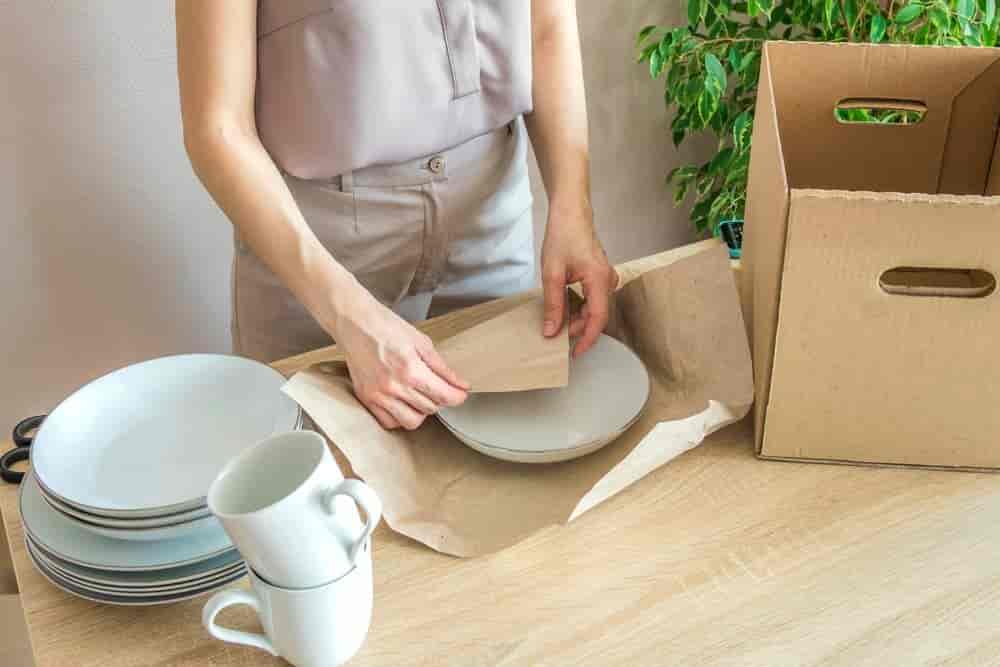
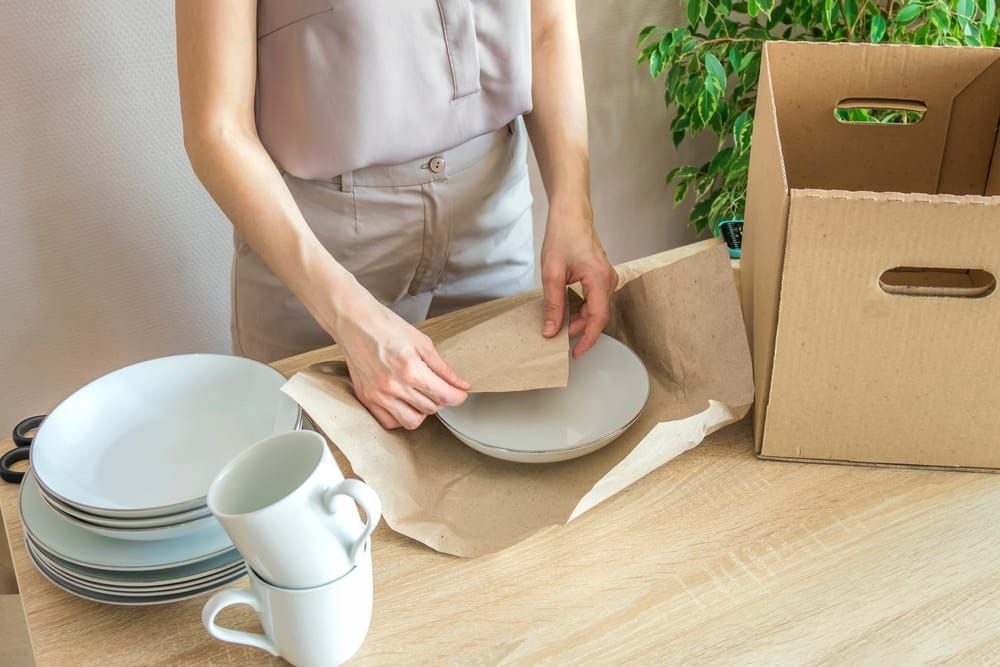
- Wrap each plate individually in packing paper, then stack three or four and wrap the whole bundle together.
- Load the bundles vertically, on edge, like records in a crate, rather than lying flat.
- Fill every remaining gap with crumpled paper so nothing shifts in transit.
Why on edge? A plate is strongest across its rim and weakest across its face. Stacked flat, the plates at the bottom take the full downward weight of everything above and crack. Stood on edge, that pressure runs along the strongest axis, and the whole stack holds.
How to Pack Bowls
Bowls are more forgiving than plates but follow the same logic. Wrap each one individually, then nest two or three together with a sheet of paper between each. Place the nested bundles on edge where the shape allows, cushion the gaps, and keep heavier bowls toward the bottom of the box.
How to Pack Glasses and Stemware
Glasses are fragile in a different way, thin walls and, for stemware, a vulnerable neck.
- Stuff a piece of crumpled paper inside each glass first; it supports the walls from within.
- Wrap from the rim outward, rolling the glass in paper until fully cushioned.
- For wine glasses and anything with a stem, add a layer of bubble wrap around the stem specifically.
- Use cell-divider boxes so glasses can’t knock against each other, and pack them standing upright.
How to Pack Serving Dishes and Platters
Large platters behave like oversized plates: wrap them well and stand them on edge against the side of the box. Heavy serving bowls and casserole dishes should be wrapped individually and placed toward the bottom. Lids get wrapped separately, never packed sitting loose on their dish.
Labeling and Loading
How a box is marked determines how it gets handled.
- Write FRAGILE and THIS SIDE UP on at least two sides of every box of plates.
- Note the contents so the box lands in the right room at the new place.
- When loading the truck, plate and dish boxes ride on top of heavier, sturdier boxes and furniture, never underneath them.
Common Mistakes to Avoid
- Stacking plates flat. The single most common cause of cracked dinnerware.
- Reusing thin grocery or liquor boxes for fragile loads, they aren’t built for the weight.
- Wrapping in newspaper and transferring ink onto your plates.
- Leaving air gaps. Empty space lets pieces shift and collide. Fill it.
- Overpacking by weight. A box that’s too heavy is a box that fails.
- Skipping orientation labels, so a careful packing job gets stacked upside down anyway.
What to Do With Plates You’re Not Unpacking Right Away
Not every plate needs to land in the new kitchen on day one. Fine china, holiday and seasonal sets, and the overflow from combining two households often sit boxed for weeks, sometimes because the move-out and move-in dates don’t line up, sometimes because you’re staging the old place to sell and need the counters clear.
That’s exactly the gap a storage unit is built for. Keeping the plates and dishes you don’t need daily in a 10 Federal Storage unit gets them safely out of the way without crowding the new kitchen, and a climate-controlled unit keeps them in a stable environment while you settle in at your own pace. When you’re ready for the holiday set, it’s wrapped, boxed, and waiting.
Need a Place for the Plates You’re Not Unpacking Yet?
A careful packing job deserves a place to land. Whether you need a spot for the china you’re not unpacking yet or room for everything in between move-out and move-in, 10 Federal Storage offers clean, secure, climate-controlled units to bridge the gap. Browse available sizes, check pricing, and reserve online to lock in current rates.
Frequently Asked Questions
Wrap each plate individually, bundle them in stacks of three or four, and load them on their edge rather than flat. Plates are far stronger across the rim than across the face, so standing them vertically lets them resist the pressure of a packed box instead of cracking under it.
A double-walled dish-pack box (dish barrel) offers the most protection. For everyday plates, a sturdy small or medium box works, just keep it small enough to stay under about 45 pounds when full.
Yes, and it’s a smart way to save on supplies and pack two things at once. Dish towels, hand towels, and cloth napkins make excellent padding between wrapped pieces. Just don’t rely on them alone for very fragile items, pair them with paper or bubble wrap.
Fewer than you’d think. Weight is the limit, not space, aim for a box you can lift comfortably, usually one or two place settings’ worth of plates plus padding per small box.
Avoid it. Newspaper ink transfers onto glazed and painted surfaces and is difficult to clean off. Clean packing paper costs little and prevents the problem entirely.
Cushion the inside of the bowl with paper, wrap from the rim outward, and add bubble wrap around the stem. Pack them upright in a cell-divider box so they can’t shift into one another.
About the Author
10 Federal Storage
Our team at 10 Federal Storage has been in the self storage industry for decades. With knowledge gained from multiple universities and in the field, we are well-prepared and excited to assist with your storage needs. When you rent a unit with us, you can feel confident that our seasoned customer service team’s help will make your transition as seamless as possible. Customer satisfaction is our number one priority, and we strive to make your experience exceptional with our automated leasing options, diverse unit sizes, and a strong commitment to sustainability.