


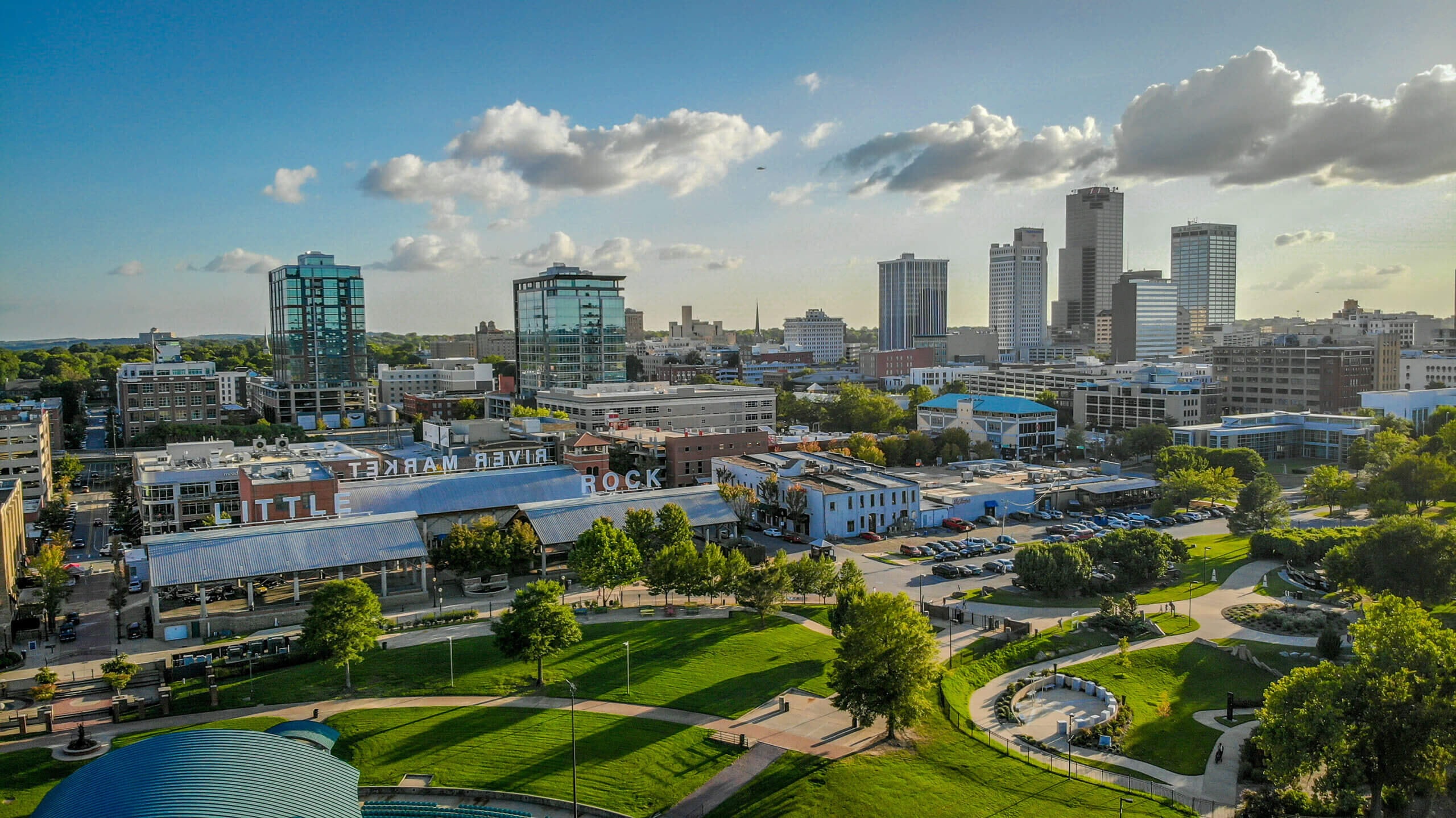
Best Cities to Live in Arkansas in 2026
by 10 Federal Storage
Published on September 8, 2026
If you have spent an evening reading “best places to live in Arkansas” guides, you have probably noticed that they all name roughly the same eight cities, describe each one in four friendly sentences, and attach a population number and a median home price. What almost none of them do is tell you where those numbers came from, when they were last checked, or what actually changes about your monthly budget when you cross a county line in this state.
That gap matters more in Arkansas than it does in most states. Arkansas is not one housing market. It is at least four, and the spread between them is enormous: a median home in Bentonville costs roughly three times a median home in Fort Smith, two hours away by car. The state cut its top individual income tax rate again in 2026. It has a property tax provision, Amendment 79, that quietly rewards people who stay put and quietly penalizes people who buy, and almost no relocation guide mentions it. And the widely repeated claim that Northwest Arkansas will pay you $10,000 to move there has not been true for several years, while three other Arkansas cities do currently run open relocation incentive programs that nobody writes about.
This guide covers the cities most people are actually choosing between, with figures traced to the U.S. Census Bureau and the Arkansas Department of Finance and Administration rather than to other blog posts. It also does something the ranking guides do not: it corrects three specific published errors by name, including a population figure that is off by a factor of ten and a median income figure that understates reality by more than $65,000.
We will also be direct about one thing up front. We are a storage operator, and we have seven facilities in Arkansas, all of them in the Central Arkansas metro. We do not operate in Northwest Arkansas, which is where several of the best cities in this guide are. You will find a storage section near the end, it is clearly marked, and it says plainly where we can help and where we cannot. Everything before it is written for the person choosing a city, not for the person renting a unit.
Table of Contents
- What “Best” Actually Means When You Compare Arkansas Cities
- Corrections to the Guides Currently Ranking for This Query
- Arkansas Has Four Housing Markets, Not One
- The Tax Picture: Low Income Tax, High Sales Tax
- Amendment 79: The Property Tax Rule That Changes Your Buying Math
- Bentonville: Highest Incomes and Highest Prices in the State
- Rogers and Springdale: The Northwest Arkansas Middle
- Fayetteville: The College Town That Became a City
- Bella Vista, Centerton, and Lowell: The Northwest Arkansas Edge
- Little Rock: The Capital and the Geographic Center
- North Little Rock, Sherwood, and Maumelle: Across the River
- Benton and Bryant: Saline County and the School District Draw
- Jacksonville: Little Rock Air Force Base and the PCS Move
- Conway: Three Colleges and the I-40 Commuter Corridor
- Jonesboro: The Northeast Arkansas Regional Hub
- Fort Smith: The Border City With an Open Relocation Incentive
- Hot Springs and Eureka Springs: The Tourism Economies
- Texarkana and West Memphis: Small Cities Paying People to Arrive
- Which Arkansas Relocation Incentives Are Actually Open Right Now
- Severe Weather, Flood Risk, and Radon: The Layer Nobody Ranks On
- How to Read Arkansas School Ratings Without Being Misled
- What Your Commute Actually Buys You in Each Metro
- Budgeting the Move Itself
- Sizing Storage for an Arkansas Relocation
- When Renting Storage in Arkansas Is the Wrong Call
- Where 10 Federal Storage Actually Operates in Arkansas
- Frequently Asked Questions
- Choosing Your Arkansas City
What “Best” Actually Means When You Compare Arkansas Cities
Every ranked list of Arkansas cities is really a ranked list of whatever the author decided to weight. The Chamber of Commerce methodology that put Conway at number one scored cities on employment, housing cost, commute and poverty, education, and health outcomes. A list built around outdoor recreation would put Eureka Springs and Hot Springs near the top and Springdale near the bottom. A list built around median household income would be a list of Benton County suburbs. None of these is wrong. They are answering different questions.
So instead of handing you another ranking, this guide organizes cities by the tradeoff each one actually asks you to make. In Arkansas those tradeoffs are unusually clean, because the state's regions differ so sharply from one another.
There are five variables that do most of the work when people compare Arkansas cities honestly:
- Housing cost relative to local income. This is the single most useful number, and it is the one most guides get wrong by quoting a home price without the income that supports it. A $428,500 median home is expensive in the abstract and reasonable against a $112,792 median household income. Those two Bentonville figures belong in the same sentence, and they almost never are.
- Whether the job market is concentrated or diversified. Northwest Arkansas is anchored by three enormous employers and their supplier ecosystems. Little Rock is anchored by state government, healthcare, and finance. Jonesboro is anchored by a university and agriculture. A concentrated market is excellent while it is growing and uncomfortable if your industry is not the one anchoring it.
- The commute you are actually signing up for. Arkansas commutes are short by national standards, which means the difference between a 19-minute city and a 35-minute city is proportionally larger here than it would be in Atlanta.
- School district, which in Arkansas frequently does not match city boundaries. This trips up more relocating families than anything else on the list, and Section 21 covers how to check it properly.
- Risk exposure. Tornado corridor, flood zone, and radon zone are all real and all geographically specific within Arkansas. They are also completely absent from every guide currently ranking for this query.
What we deliberately do not weight heavily is anything self-reported and unaudited. City "grades" from consumer review sites are built partly on resident surveys, and resident surveys tell you how people feel about where they already chose to live. That is interesting. It is not a forecast of how you will feel.
Corrections to the Guides Currently Ranking for This Query
We fetched and read the pages currently ranking for “best places to live in Arkansas” before writing this one. Several contain errors significant enough to send a reader to the wrong city. Because a vague warning is useless, here they are by name and by number, so you can check them yourself.
The eXp Realty guide misstates Bentonville's median household income by more than $65,000
The eXp Realty page “Here Are the 13 Best Places to Live in Arkansas,” published in June 2023 and still ranking, lists Bentonville with a median income of $45,592 and a median home price of $275,000. Census Bureau QuickFacts for Bentonville city, drawn from the 2020–2024 American Community Survey, reports median household income of $112,792 and a median value of owner-occupied housing units of $428,500.
The direction of that error matters. The published figures make Bentonville look like an affordable city with modest incomes. It is in fact the highest-income and highest-cost city on the list. A reader budgeting a move on those numbers would arrive to find homes priced roughly $150,000 above what they planned for. The same page lists Bryant with a median income of $76,000, which would put a Little Rock suburb above Bentonville. It does not.
The same guide overstates Lowell's population by roughly a factor of ten
The eXp page lists Lowell, Arkansas at a population of 113,000 with a median home price of $415,000. Lowell recorded 9,839 residents in the 2020 Census, and later estimates put it in the twelve-thousand range. It is a small Benton County bedroom community best known as the headquarters of the trucking company J.B. Hunt. At 113,000 it would be the second-largest city in Arkansas, ahead of Fayetteville and Fort Smith. It is not close.
This is worth flagging beyond the arithmetic, because a reader who trusts it will badly misjudge what Lowell offers. A town of ten thousand and a city of a hundred thousand are different products. One has a regional hospital and a mall. The other has neither, and its residents drive to Rogers and Springdale for both.
The same guide places two universities in the wrong cities
In its Little Rock entry, the eXp page states that Little Rock is a college town home to the University of Arkansas and Arkansas State University. The University of Arkansas flagship campus is in Fayetteville, roughly 190 miles northwest of Little Rock. Arkansas State University's main campus is in Jonesboro, roughly 130 miles northeast. Little Rock does have higher education, including the University of Arkansas at Little Rock and the University of Arkansas for Medical Sciences, but those are distinct institutions and the distinction is exactly what a relocating student or faculty member needs to get right.
Nearly every guide describes the Northwest Arkansas cash incentive in the present tense
This is the most consequential error of the set because it is the one people act on. Section 19 covers it in full, but the short version is that the “Life Works Here” $10,000 relocation incentive run by the Northwest Arkansas Council closed to new applications after roughly a year of operation. Three other Arkansas cities do currently run relocation incentive programs. None of them are in Northwest Arkansas, and none of them appear in the guides ranking for this query.
We are not making a point about eXp Realty specifically. Their page has held a top position for years and has been widely copied, which is how a wrong population figure propagates. The general lesson is that a relocation guide with no cited sources and no visible update date should be treated as a starting point for your own checking, including this one. Every figure below is traceable, and we say where it came from.
Arkansas Has Four Housing Markets, Not One
The statistic people repeat about Arkansas is that it has one of the lowest costs of living in the country. That is true statewide and it is close to useless for a person choosing a city, because the statewide figure averages together markets that behave nothing alike.
Think of the state as four distinct regions with four distinct price and growth profiles.
Northwest Arkansas: expensive, fast, and still accelerating
The Fayetteville-Springdale-Rogers metro reached 605,615 residents in 2024, up from 549,960 in 2020, which is the fastest sustained growth in the state and put the metro among the faster-growing in the nation. Benton County alone went from 286,621 to 321,566 over the same window. Washington County went from 246,779 to 266,184.
This region has the state's highest incomes, its highest home prices, its most educated workforce, and its most competitive housing inventory. If you are coming from a coastal metro it will still feel inexpensive. If you are coming from elsewhere in Arkansas it will feel like a different state.
Central Arkansas: stable, affordable, and quietly flat
Pulaski County, which contains Little Rock, North Little Rock, Sherwood, Maumelle, and Jacksonville, held essentially steady between 2020 and 2024, moving from 399,286 to 401,209. That is close to zero net growth over four years while Benton County added nearly 35,000 people.
Flat is not the same as declining, and it has a real upside: Central Arkansas is where you find the state's genuine bargains in housing, alongside its most complete set of urban amenities. The suburban ring is where the actual growth is happening. Saline County, home to Benton and Bryant, went from 123,820 to 131,252 in the same period, and Faulkner County, home to Conway, went from 123,820 to 131,611.
Northeast and River Valley Arkansas: regional hubs at low cost
The Jonesboro metro grew modestly to 138,152 in 2024. The Fort Smith metro reached 232,848, up only slightly from 227,222 in 2020. These are the state's affordable regional centers: each anchors a large rural catchment, each has a hospital system and a university or college, and each offers housing at a fraction of Northwest Arkansas pricing.
South and Southeast Arkansas: cheapest and shrinking
The southern third of the state, including Texarkana, El Dorado, Pine Bluff, and the Delta counties, has the lowest housing costs in Arkansas and has been losing population for decades. This is where the relocation incentive programs are, and that is not a coincidence. It is also where the cost-of-living statistic that flatters the whole state comes from.
The practical takeaway is that when a guide tells you Arkansas housing costs 20 percent less than the national average, it is describing a blend of a fast-appreciating Benton County market and a declining Delta market. Neither of those is the city you are moving to.
The Tax Picture: Low Income Tax, High Sales Tax
Arkansas has spent more than a decade cutting its individual income tax, and the cuts have been large enough that any guide written before 2026 is describing a different state. This section is descriptive, not advisory. Rates change, sometimes retroactively, and your situation depends on facts this article cannot see. Confirm anything here with the Arkansas Department of Finance and Administration or a tax professional before you build a budget on it.
Income tax has been cut repeatedly, most recently in 2026
In a special session in May 2026, the legislature reduced the state's top individual income tax rate to 3.7 percent, applied retroactively to the beginning of that tax year, and reduced the top corporate rate as well. That was the fourth individual income tax reduction in roughly four years. The governor has publicly described eventual elimination of the individual income tax as a goal, which is a statement of intent rather than a schedule, and it should be read that way.
The structure matters as much as the top rate. Arkansas uses a graduated table for lower and middle incomes with a zero-percent bracket at the bottom, and a separate two-tier table above a higher threshold, with a bracket adjustment that smooths the transition between them. What that means practically is that Arkansas's effective rate on a moderate income is meaningfully lower than the headline rate suggests. It also means that the arithmetic is not intuitive, and that a paycheck estimate you find on a general calculator may not reflect the current tables.
Two other features are worth knowing. Arkansas does not tax Social Security income. And assets held longer than a year receive favorable treatment on the gain, while short-held assets do not.
Sales tax is where Arkansas takes it back
This is the part the relocation guides skip, and it is the part that will show up in your actual monthly spending. Arkansas has one of the highest combined state and local sales tax rates in the country. The statewide rate is 6.5 percent, and local add-ons vary by county and city, averaging near 3 percent on top of it. Sales taxes are the single largest source of state and local tax revenue in Arkansas, well ahead of income tax.
If you are moving from a state with no sales tax and a high income tax, or the reverse, this flips your budget in ways a simple income comparison will not capture. A household that spends heavily on taxable goods can lose most of the income tax advantage at the register. A household that saves aggressively keeps it. Neither pattern is better. They are just different, and you should know which one you are.
The combined rate also varies enough between Arkansas cities to be worth checking specifically for the city you are considering, rather than assuming the state average applies.
Property tax is low in national terms
Effective property tax in Arkansas runs well under one percent of an owner-occupied home's value on average, which places it among the lower-burden states. But the average conceals a rule that changes the math substantially depending on whether you are buying or already own, and that rule gets its own section.
Amendment 79: The Property Tax Rule That Changes Your Buying Math
No guide currently ranking for “best places to live in Arkansas” mentions Amendment 79. It is the most important property tax provision in the state and it directly affects anyone buying a home here. As with the previous section, treat this as an orientation to what exists, not as advice, and verify the specifics with your county assessor.
Amendment 79, adopted by Arkansas voters in 2000 and modified several times since, does three things that matter to a relocating buyer.
It provides a flat homestead credit against your tax bill
Owner-occupied primary residences qualify for a credit applied directly against the property tax owed. It is a reduction in the tax itself, not in assessed value, which means it is worth the same regardless of your local millage rate. You have to file for it with your county assessor, and you do not have to refile every year unless you move.
Here we have to flag a genuine disagreement rather than pick a number. The credit amount has been raised more than once in recent legislative cycles, and Arkansas county assessor and treasurer offices are currently publishing different figures for it. Pulaski County, which covers Little Rock, publishes one amount. Benton County publishes a higher one. Statewide guidance published at different times shows a progression through several values.
We are not going to resolve that for you, because the number that governs your bill is the one your county is actually applying in the year you are billed. Call your county assessor's office, ask what the current homestead credit is for the tax year in question, and ask what the filing deadline is. That is a five-minute call and it is worth several hundred dollars a year.
It caps how fast your taxable value can rise, and the cap resets when you buy
This is the part that changes buying math. Under Amendment 79, the taxable assessed value of a homestead can rise by no more than 5 percent per year as a result of county reappraisal. Other real property, including commercial, agricultural, and vacant land, is capped at 10 percent per year. The caps do not apply to new construction, substantial improvements, or newly discovered property, all of which are assessed at full value.
The consequence is that a long-term owner in an appreciating market can be paying tax on an assessed value well below what their house would sell for, because the cap has been suppressing annual increases for years. When the property sells, that protection ends. Arkansas law provides that when a person sells real property, the assessor assesses it at the statutory percentage of appraised value at the next assessment date after transfer of title, and the new owner is not entitled to claim the limitation until a later assessment date.
Practically: the property tax the seller was paying is not the property tax you will pay. In a fast-appreciating market like Benton County, the gap can be substantial. Ask for the actual current tax bill on any property you are seriously considering, then ask the county assessor what it will be reassessed at after transfer. Do not budget from the listing sheet's tax line, which frequently shows the seller's protected number.
It freezes assessed value for owners who are 65 or older or who are disabled
Homeowners who qualify for the homestead credit and who are either 65 or older or disabled at any age can have their taxable assessed value frozen at the level established at the next assessment date after they qualify. This is a separate application from the homestead credit itself, filed with the county assessor.
Two cautions worth stating plainly. The freeze locks assessed value, not the tax bill, so a millage increase voted by a city, county, or school district can still raise what you owe. And the freeze is built on top of whatever assessed value is in place when you qualify, so if that underlying value is wrong, the error gets locked in with it. Arkansas allows assessment appeals through the county Board of Equalization, generally with a summer deadline that varies by county.
If you are relocating to Arkansas at or near retirement age, the interaction between the credit, the freeze, and the reset-on-sale rule is worth an hour with a local tax professional or a direct conversation with the assessor in the county you are targeting. It is the kind of thing that is straightforward to set up correctly and annoying to fix later.
Bentonville: Highest Incomes and Highest Prices in the State
Bentonville is the city most people mean when they say Arkansas has changed. Census QuickFacts, drawing on the 2020–2024 American Community Survey and population estimates through July 2025, gives a profile that looks nothing like the rest of the state:
- Population: 63,057 estimated for July 2025, up from 54,164 in the 2020 Census and 35,301 in 2010. That is 16.3 percent growth in five years on top of a decade that added more than half again the city's size.
- Median household income: $112,792 in 2024 dollars.
- Median value of owner-occupied housing: $428,500.
- Median gross rent: $1,344.
- Bachelor's degree or higher: 55.3 percent of adults 25 and over.
- Mean travel time to work: 19.0 minutes.
- Persons in poverty: 5.2 percent.
- Owner-occupied housing rate: 50.4 percent, which is unusually low and tells you how much of the city is recent arrivals renting first.
What that adds up to: a city with coastal-metro incomes, near-coastal housing prices by regional standards, a genuinely short commute, and half its housing stock rented. The 19-minute commute is the number that surprises people. Bentonville has grown enormously without acquiring the traffic that usually comes with it, because the growth has been distributed across a polycentric metro rather than concentrated on a single downtown core.
The employment base is the reason for all of it. Walmart's corporate headquarters sits here, and the supplier offices that cluster around a retailer of that size constitute an entire white-collar economy on their own. Add the cultural infrastructure that Walton family philanthropy has built, most visibly the Crystal Bridges Museum of American Art, and Bentonville has amenities that a city of 63,000 has no business having.
Who Bentonville actually suits: two-income professional households, people whose employer is in the Walmart supplier ecosystem, and anyone whose priority ranking puts amenities and schools above housing cost. Who it does not: a single-income household earning near the state median, which will find the housing math genuinely difficult, and anyone hoping to find the cheap Arkansas they read about.
Rogers and Springdale: The Northwest Arkansas Middle
If Bentonville is the premium tier of Northwest Arkansas, Rogers and Springdale are where most of the region actually lives. Springdale counted roughly 88,000 residents in recent American Community Survey estimates, making it the state's fourth-largest city. Rogers sits just below it.
The two cities are genuinely different despite sitting adjacent on the I-49 corridor.
Rogers reads as the more suburban and more affluent of the pair, with newer residential development, extensive retail, and access to Beaver Lake and the Hobbs State Park conservation area on its eastern side. It shares the Bentonville amenity ecosystem at a modest discount and has absorbed a large share of the region's family-oriented growth.
Springdale is the region's industrial and logistics heart. Tyson Foods is headquartered here, and the poultry processing and transportation economy built around it gives Springdale a workforce profile unlike its neighbors: younger, more likely to be foreign-born, and more likely to work in production and logistics than in a corporate office. Springdale has one of the largest Marshallese communities in the continental United States, and the cultural life of the city reflects that in a way no ranked list captures.
Springdale is also the affordability entry point for Northwest Arkansas. For a household that wants access to the region's job market without Bentonville's housing costs, this is the practical answer. The tradeoff is a longer commute to Bentonville-area employers and a school district that serves a larger and more economically varied student population.
Worth knowing about both: the Razorback Regional Greenway, a paved multi-use trail running roughly 37 miles through the metro, connects Bentonville, Rogers, Springdale, and Fayetteville. It is the piece of regional infrastructure that residents mention first, and it is genuinely unusual for a metro of this size. The region also maintains hundreds of miles of mountain biking trail, which is a lifestyle draw with real economic weight behind it.
Fayetteville: The College Town That Became a City
Fayetteville is the second-largest city in Arkansas, at roughly 99,000 residents in recent American Community Survey estimates, and it is the answer most often given when someone asks which Arkansas city has the best quality of life.
The University of Arkansas flagship campus is here, and it shapes the city completely. That produces the things people like about college towns: a dense and walkable downtown around Dickson Street, a live music and arts calendar that runs year round, a farmers market with genuine regional reputation, an unusually good restaurant scene for the population, and a public that skews young and educated. It also produces the things people find harder: a rental market that reprices around the academic calendar, game-day traffic that reorganizes the city several Saturdays a year, and a substantial student population that makes neighborhood selection matter more than it would elsewhere.
Geographically Fayetteville sits at the southern end of the Northwest Arkansas corridor, in the Ozark foothills. It gets the region's most varied terrain, its best trail access, and a summer that runs a few degrees milder than the Arkansas Delta.
Where the honest caution belongs: Fayetteville is not the affordability play that older guides suggest. Housing costs have risen with the rest of the corridor, and student demand keeps a floor under rents. If your reason for choosing Fayetteville is that it is cheaper than Bentonville, verify that against current listings rather than a 2023 blog post. The reason to choose Fayetteville is that you want the cultural density and the terrain, both of which it delivers better than any other city in the state.
Bella Vista, Centerton, and Lowell: The Northwest Arkansas Edge
Three smaller Benton County communities show up on nearly every ranked list, usually with thin descriptions and, in at least one case, badly wrong numbers.
Bella Vista sits at the Missouri line and began life as a planned recreational and retirement community. It is built around a chain of lakes and golf courses, and its housing stock and demographics still reflect that origin, though it has been steadily attracting younger families priced out of Bentonville. Its appeal is straightforward: lake and trail access, a quieter pace, and lower density than anywhere else in the corridor. Its constraint is equally straightforward, in that much of it is governed by a property owners association with assessments and rules that a buyer should read carefully before closing rather than after.
Centerton is the fastest-growing of the three and functions as Bentonville's western expansion. It is where a large share of the corridor's new single-family construction is going. Buying new construction in Centerton is the most common way households get into the Bentonville school and job orbit at a price they can carry. The tradeoff is the one that always comes with fast-growing edge suburbs: infrastructure and retail arrive after the rooftops do, and you spend a few years driving to things.
Lowell is small. It recorded 9,839 residents in the 2020 Census and later estimates place it in the twelve-thousand range. As noted in Section 2, at least one widely-read guide lists it at 113,000, which would make it the second-largest city in the state. It is a compact bedroom community, notable mainly as the headquarters of J.B. Hunt, positioned centrally enough in the corridor that residents can reach Rogers, Springdale, and Bentonville quickly. If you want a short commute to several employment centers at once and do not need a city around you, Lowell does that well. If you want walkable amenities, it does not have them.
Siloam Springs deserves a mention alongside these. It sits on the Oklahoma line, roughly half an hour west of the main corridor, and it is a genuinely distinct place: a small city built around John Brown University with a preserved historic downtown, a whitewater park on Sager Creek, and a slower texture than anywhere in the I-49 corridor. It trades corridor access for character and gets a fair deal on the exchange.
Little Rock: The Capital and the Geographic Center
Little Rock is the largest city in Arkansas at roughly 203,000 residents, the state capital, and the center of a metro that has been remarkably stable while Northwest Arkansas boomed. Pulaski County held nearly flat from 2020 to 2024, moving from 399,286 to 401,209.
That stability is the whole story, and how you read it determines whether Little Rock belongs on your list.
The negative read is that a flat metro is a metro without momentum. The positive read, and the one that matters more for most relocating households, is that Little Rock offers the amenity set of a real city at prices that reflect zero speculative pressure. You get a genuine downtown, a river trail system that includes the Big Dam Bridge, the Clinton Presidential Center, a functioning arts and restaurant economy, and a major medical complex, all without paying for growth you have not benefited from yet.
The employment base is diversified in a way Northwest Arkansas's is not: state government, a large healthcare sector including Arkansas Children's Hospital, Baptist Health, and CHI St. Vincent, finance, law, and higher education through UA Little Rock and the University of Arkansas for Medical Sciences. If your career is in any of those fields, Little Rock is the strongest market in the state for it.
Little Rock is also the city where neighborhood selection matters most. The city spans genuinely different living environments, from the walkable Heights and historic Hillcrest to the master-planned Chenal Valley corridor in West Little Rock to the downtown River Market District. Crime statistics vary sharply across those areas, and a city-wide number tells you almost nothing about a specific address. We have covered this in depth in our guide to the best neighborhoods in Little Rock, AR, and if Little Rock is on your list, read that before you read another ranked city list.
For the mechanics of an actual move, including utilities, schools, and registration, our complete guide to moving to Little Rock covers the sequence.
North Little Rock, Sherwood, and Maumelle: Across the River
Three Pulaski County cities sit north of the Arkansas River and function as part of the same daily economy as Little Rock while offering different products.
North Little Rock is a city of roughly 65,000 with its own downtown, its own school district, and a distinct identity that residents defend. The Argenta Arts District along Main Street has been building deliberate momentum for more than a decade: galleries, independent restaurants, music venues, a farmers market, and a creative-economy population that gets urban texture at lower price points than the Little Rock side of the river. For young professionals and creative workers, Argenta is one of the better values in the state.
Sherwood is the quieter suburban option of the three, oriented toward families and toward the corridor running north toward Jacksonville. It offers conventional suburban housing at Central Arkansas prices, which is to say considerably less than equivalent stock in Benton County.
Maumelle is a planned community northwest of North Little Rock, and it is unlike anything else in the metro. It was master-planned from the start, which shows in the street layout, the parks, and the consistency of the housing stock. Maumelle has repeatedly appeared at or near the top of Arkansas safest-city rankings and maintains a higher ratio of law enforcement to residents than most Arkansas municipalities. Comparative safety data does vary by methodology, and different indices place it differently against national benchmarks, but the consistent finding is that it runs materially safer than the Arkansas average, particularly for violent crime.
Maumelle's tradeoff is that it is a residential product rather than a city with a downtown. You leave it for most things. Our guide to the best neighborhoods in Maumelle, AR breaks down which parts of the city suit which household.
Benton and Bryant: Saline County and the School District Draw
Saline County, southwest of Little Rock along Interstate 30, is where Central Arkansas's growth actually is. The county went from 123,820 residents in 2020 to 131,252 in 2024 while the county containing Little Rock stayed flat. Two cities account for most of that.
Benton is the county seat and one of the larger cities in Central Arkansas, with a population above 36,000. It has something most Arkansas cities of its size demolished decades ago: an intact historic downtown of original brick storefronts around Market and South streets, still occupied. The Royal Theatre has operated since 1920. The Gann Museum of Saline County occupies what is understood to be the only building in the world constructed entirely of bauxite, which is the mineral that built the local economy in the first place.
Benton's cost of living runs meaningfully below the national average, its schools are well regarded, and the commute to Little Rock via I-30 is manageable. It is a pragmatic choice that people often make for the numbers and then stay for the community. Our guide to the best neighborhoods in Benton and our complete guide to moving to Benton both go deeper.
Bryant sits adjacent, closer to Little Rock, and it is one of the fastest-growing cities in the state. The primary driver is the Bryant School District, which is consistently among the higher-rated districts in Arkansas and is explicitly the reason a large share of residents chose the city. Bryant offers some of the state's most affordable new construction, the Hurricane Lake corridor for lakefront and fishing access, and a 20 to 25 minute run into Little Rock via I-30.
Bryant does not have a marquee downtown or a famous landmark, and it is not trying to. What it has is a school district, new housing at a price that works, and a population that chose it deliberately. Our guide to the best neighborhoods in Bryant, AR covers which subdivisions suit which priorities.
If schools are your top-ranked variable and Northwest Arkansas prices do not work for your household, Saline County is the strongest answer in the state.
Jacksonville: Little Rock Air Force Base and the PCS Move
Jacksonville is a city of roughly 30,000 about fifteen miles northeast of Little Rock, and it exists in its current form because of Little Rock Air Force Base. Nearly seventy years of that relationship has shaped the city's economy, its housing stock, and its culture in ways that make it genuinely different from the rest of the metro.
For a military family arriving on a PCS, that history is a practical advantage. Rental inventory is calibrated to Basic Allowance for Housing rates and to family needs. Lease structures accommodate deployment and short-notice orders. Neighbors understand military timelines because most of them have lived on them. On-base housing through the installation is worth evaluating alongside the local market, and the housing office can provide current availability and BAH comparisons.
Jacksonville is also the most affordable city in the Little Rock metro by a wide margin. A one-bedroom apartment that would run substantially more in Little Rock rents for a fraction of it here.
The honest caution: Jacksonville's city-wide crime statistics run above national benchmarks for both violent and property crime, which means neighborhood selection matters more here than in most of the metro. The base-adjacent corridors and the established residential neighborhoods of Indian Hills and Lakewood consistently show better safety profiles than the city-wide average. That is not a reason to skip Jacksonville. It is a reason to look at specific streets rather than at a city average, which is good practice everywhere and necessary here.
Our guide to the best neighborhoods in Jacksonville, AR maps that out, and the complete guide to moving to Jacksonville covers the logistics for both military and civilian arrivals.
Conway: Three Colleges and the I-40 Commuter Corridor
Conway is roughly thirty miles northwest of Little Rock on Interstate 40, and it topped the Chamber of Commerce ranking of Arkansas cities on a methodology weighting employment, housing, quality of life, education, and health. Faulkner County, which contains it, grew from 123,820 to 131,611 residents between 2020 and 2024.
What distinguishes Conway is that it holds three higher education institutions in a city of around 65,000: the University of Central Arkansas, Hendrix College, and Central Baptist College. That density produces a younger and more educated population than a city of its size would otherwise have, along with the cultural programming that follows colleges around.
The economic base extends past education into technology and corporate operations, and Conway has spent two decades marketing itself as a technology corridor with meaningful results. Housing costs run below Little Rock for comparable stock, the schools are well regarded, and there is a great deal of parkland relative to population.
The tradeoff is the commute. Conway works beautifully if you work in Conway. If you work in Little Rock, you are signing up for a daily I-40 run of roughly forty minutes each way in good conditions, which is long by Arkansas standards and unremarkable by national ones. Whether that is acceptable is a personal calculation, but it should be a deliberate one rather than a surprise. Conway also has a thinner dining and entertainment scene than Little Rock, which residents solve by driving in, which puts more miles on the same corridor.
Jonesboro: The Northeast Arkansas Regional Hub
Jonesboro is the fifth-largest city in Arkansas at roughly 80,000 residents and the unquestioned center of the northeast quarter of the state. Its metro reached 138,152 in 2024.
Arkansas State University's main campus anchors the city, and the combination of a large university, a regional medical center, agriculture, and manufacturing produces an economy that is diversified for a city this size. Jonesboro serves a rural catchment stretching across the Arkansas Delta and into the Missouri Bootheel, which means it supports retail, healthcare, and services well beyond what its own population would justify.
Housing is genuinely affordable, particularly measured against Northwest Arkansas. The city is roughly an hour from Memphis, which gives residents access to a major airport and a large metro's entertainment and medical options without living in it.
What Jonesboro asks of you: it is geographically isolated from the rest of Arkansas. Little Rock is more than two hours away. Northwest Arkansas is most of a day. If your extended family or professional network is in Central or Northwest Arkansas, Jonesboro will feel further than the map suggests. The flat Delta terrain is also a genuine change for anyone drawn to Arkansas by images of the Ozarks. Those are two different states, and Jonesboro is firmly in the flat one.
Fort Smith: The Border City With an Open Relocation Incentive
Fort Smith sits on the Oklahoma border and is the third-largest city in Arkansas at roughly 90,000 residents. Its metro reached 232,848 in 2024, up only modestly from 227,222 in 2020.
The case for Fort Smith is cost. It is one of the most affordable places in the state to buy a house, and it is a real city, with a hospital system, an airport, a historic downtown tied to its frontier and federal-court history, and a manufacturing and logistics employment base. Fort Chaffee adds a military dimension. The city has invested substantially in downtown revitalization and in the Arkansas College of Osteopathic Medicine, which is the kind of anchor institution that changes a mid-size city's trajectory over twenty years.
Fort Smith also runs one of the state's active relocation incentive programs, which is covered in Section 19.
The honest read: Fort Smith has not grown quickly, and its economy has been in transition from a manufacturing base that shrank. That is precisely why housing is cheap. If you are buying primarily as shelter and secondarily as an investment, that math works well. If you are counting on appreciation to build equity on a five-year horizon, Northwest Arkansas has been the better bet and Fort Smith has not. Both of those are legitimate strategies. They are just different, and the guides that list Fort Smith next to Bentonville without noting the difference are not helping you choose.
Hot Springs and Eureka Springs: The Tourism Economies
Two Arkansas cities are built on tourism, and both appear on ranked lists for reasons that deserve a caveat.
Hot Springs wraps around Hot Springs National Park, which is the only national park located inside a city in the United States. The bathhouse row, the thermal springs, the surrounding lakes, and Oaklawn racing and gaming give a city of roughly 38,000 an amenity density far beyond its size. It draws retirees heavily, housing is affordable, and lake property is available at prices that would be impossible in most states. The Hot Springs metro has been the slowest-growing in Arkansas, which is generally attributed to its older population profile.
Eureka Springs is much smaller and much stranger, in the good sense. Its entire downtown is listed on the National Register of Historic Places, it is built into a hillside with almost no flat ground, and it has an arts and hospitality culture unlike anywhere else in the state.
The caveat that applies to both: tourism economies produce seasonal, service-weighted employment. That is fine if you are retired, remote, self-employed, or bringing your own income. It is a genuine constraint if you need a conventional local job with a conventional local salary. Housing in a tourism town also competes with short-term rental demand, which can price long-term renters out of the exact neighborhoods that make the town appealing. Check the long-term rental market specifically, not the listings you see on travel sites.
Texarkana and West Memphis: Small Cities Paying People to Arrive
Texarkana straddles the Texas and Arkansas state line, which produces a genuinely unusual situation: two municipal governments, two sets of state tax rules, and a federal courthouse sitting on the boundary. For a household, the Texas-or-Arkansas side decision has real tax consequences, since Texas levies no individual income tax and Arkansas does, while property tax treatment runs the other direction. That is a question for a tax professional familiar with both states, and it is a genuine reason to get advice before choosing a side of the line.
The Arkansas side is a regional hub for commerce, healthcare, and transportation with housing costs among the lowest in the state. Texarkana runs an active relocation incentive program.
West Memphis sits directly across the Mississippi River from Memphis, Tennessee, and functions largely as part of that metro's economy. It is a major freight and logistics node, sitting at the intersection of two interstates and a river port. It also runs an active relocation incentive program.
Neither city appears on quality-of-life rankings, and neither is going to. Both are in the part of Arkansas that has been losing population, both have economic challenges that are well documented, and we are not going to pretend otherwise. What they offer is the lowest cost of entry in the state plus, currently, cash to arrive. For a remote worker whose income does not depend on the local economy, that combination is worth evaluating on its own terms rather than dismissing because a ranked list did not mention it.
Which Arkansas Relocation Incentives Are Actually Open Right Now
Search “what city in Arkansas will pay you to move there” and the top results will tell you about Northwest Arkansas. That answer is several years out of date, and it is the most actionable error in the current SERP.
What actually happened with “Life Works Here”
In November 2020, the Northwest Arkansas Council launched an incentive-based relocation campaign offering $10,000 in cash plus either a bicycle or an annual membership to a regional arts institution, funded philanthropically by the Walton Family Foundation. It targeted workers in STEM fields, creative professionals, and entrepreneurs willing to relocate to Benton or Washington counties.
The response was extraordinary. The first round alone drew more than 26,000 applications from over 115 countries and all 50 states, and total applications eventually exceeded 67,000. The program operated for roughly a year and awarded incentives to about 100 people before closing.
The Northwest Arkansas Council has since been explicit that the application process for the talent incentive has ended, while the broader “Life Works Here” marketing campaign continues. Little Rock also ran an incentive program in recent years that has been discontinued.
The program largely accomplished what it set out to do, which was less about the hundred recipients and more about national awareness of a region most of the country could not previously place on a map. But it is closed, and a guide that describes it in the present tense is sending readers to fill out an application that does not exist.
Where the open programs are
The Arkansas cities currently running relocation incentive programs, mostly aimed at remote workers, are Texarkana, West Memphis, and Fort Smith. These are smaller markets in the parts of the state that have been losing population, which is exactly why they are the ones paying.
A few practical notes before you get excited:
- Terms and amounts change, and programs open and close. Verify directly with the sponsoring organization before you make any decision based on one. Do not rely on this article, and do not rely on the article that told you Northwest Arkansas was still paying.
- These programs typically carry residency commitments. The Northwest Arkansas program required recipients to relocate within six months and remain at least a year for full benefits. Expect similar structures elsewhere.
- Relocation incentive payments may have tax consequences. We are not going to tell you what they are, because that depends on the program structure and your situation. Ask a tax professional before you count the money.
- An incentive is not a reason to choose a city. A one-time payment is worth a fraction of what you will spend on housing over even a few years. If the city works for you, the incentive is a bonus. If it does not, the incentive will not fix that.
Severe Weather, Flood Risk, and Radon: The Layer Nobody Ranks On
Not one guide currently ranking for this query addresses natural hazard exposure, and all three of these vary meaningfully within Arkansas. None of them should stop you from moving here. All of them should inform which specific property you buy.
Severe weather and tornadoes
Arkansas sits in an active severe weather corridor, with the primary season running roughly from March through May and a secondary peak in late autumn. This is a statewide condition rather than a city-specific one, and it is a normal part of life here that residents plan around rather than worry about.
The practical questions to ask about a specific property are whether it has a safe room or storm shelter, whether the community has public shelters and where they are, and how the local warning system reaches residents. Many Arkansas counties operate outdoor warning sirens with meaningful coverage gaps, so confirm you have a reliable indoor alerting method as well. Ask about roof age and condition on any home you tour, because hail is a routine occurrence and a roof's history tells you something about what the property has already absorbed.
Flood risk
Arkansas has substantial riverine flood exposure along the Arkansas, White, Mississippi, and Ouachita river systems and their tributaries, plus flash flood risk in the steeper Ozark terrain. Flood risk is intensely property-specific: two houses on the same street can carry different designations.
Check the FEMA Flood Map Service Center for the specific address before you make an offer, not the neighborhood. Understand that a property outside a mapped high-risk zone can still flood, that standard homeowners policies generally do not cover flood damage, and that flood insurance availability and cost are separate questions from whether a lender requires it. Talk to an insurance agent licensed in Arkansas about the specific address. We are not going to quote you a premium, because premiums depend on elevation, construction, and coverage choices that vary property to property.
Radon
This is the one nobody thinks about. The EPA maps counties into radon zones based on predicted indoor screening levels, and a substantial portion of northern Arkansas, including parts of the Ozark region where the geology favors it, falls into the higher-predicted zones. Zone designations are planning tools rather than property-level determinations, and homes in any zone can test high or low.
The response is simple and inexpensive: test. A short-term test kit costs very little, testing is commonly done during a real estate transaction in Arkansas, and mitigation systems are a well-established technology when a test comes back elevated. If you are buying in northern Arkansas and radon has not come up in your inspection conversation, raise it.
How to Read Arkansas School Ratings Without Being Misled
School quality drives more Arkansas relocation decisions than any other single variable, and the way most people research it produces predictable mistakes.
District boundaries do not match city boundaries. This is the big one. In Arkansas it is entirely normal for a house with a given city's mailing address to be zoned to a different district's schools. Bryant, Benton, Little Rock, and the Northwest Arkansas cities all have addresses that fall outside the district their mail suggests. Do not infer the school from the address. Verify the assignment for the specific parcel with the district's enrollment office or the county, in writing, before you sign anything.
Composite letter grades compress things you need separated. A district grade blends achievement level with growth, and those measure different things. A district serving an affluent population can post high achievement with mediocre growth, meaning students arrive prepared and the school adds relatively little. A district serving a lower-income population can post moderate achievement with strong growth, meaning it is doing excellent work with students who started further back. Depending on your child, the second may be the better school. The Arkansas Division of Elementary and Secondary Education publishes report cards that let you look at these components separately, and looking at them separately is the entire point.
District averages hide school-level variation. A large district can contain both its state's strongest elementary school and one of its weakest. Your child attends a specific building, not a district average.
Programs matter more than ratings for some students. Whether a district has the AP course you need, a functioning special education program for your child's specific requirements, a gifted program, career and technical pathways, or the sport or arts program your kid cares about will affect their experience far more than a letter grade. These are questions to ask a person, by phone, not questions to answer from a website.
One Arkansas-specific note: the state has an active school choice framework, and the rules governing transfers between districts change with some regularity. If you are considering a house partly on the assumption you can transfer into a neighboring district, confirm the current rules and the current capacity at the receiving district before you buy. Assumptions about school choice have burned relocating families here.
What Your Commute Actually Buys You in Each Metro
Arkansas commutes are short. Bentonville's mean travel time to work is 19.0 minutes, and most Arkansas cities cluster in the high teens to mid twenties. The national mean runs meaningfully higher.
That has a consequence people moving from larger metros consistently underestimate: in Arkansas, buying more house by driving further does not work the way it does elsewhere.
In a metro with a 35-minute baseline commute, adding fifteen minutes to reach cheaper housing is a 43 percent increase in an already-tolerated burden, and people do it routinely. In a metro with a 19-minute baseline, adding fifteen minutes nearly doubles your commute, and the daily experience of it is qualitatively different. Households who make that trade in Arkansas frequently reverse it within a couple of years.
How this plays out by region:
- Northwest Arkansas is polycentric, with employment distributed across four cities along the I-49 corridor rather than concentrated downtown. That is why the metro has grown so fast without commutes deteriorating. It also means your commute depends heavily on which specific employer you have, not on which city you live in. Someone in Centerton working in Bentonville has a short drive. Someone in Centerton working in Fayetteville does not.
- Central Arkansas is genuinely radial, with Little Rock at the center. Commutes from Benton, Bryant, Sherwood, Maumelle, and Jacksonville run roughly 20 to 30 minutes, and I-30 and I-40 both back up at predictable times. The river crossings are the pinch points, and a North Little Rock or Maumelle resident working in west Little Rock is crossing one twice a day.
- Conway is the outlier at roughly 40 minutes each way to Little Rock. Treat that as a real cost.
- Jonesboro and Fort Smith are compact single-center cities where nearly everything is within fifteen minutes. This is an underrated quality-of-life feature and it is the thing residents of both cities cite most often.
Before committing to a city, drive your actual prospective commute at your actual departure time on a weekday. Not on a Saturday, and not according to a mapping app's optimistic estimate. This takes one morning and it prevents a category of regret that no amount of research substitutes for.
Budgeting the Move Itself
The city comparison is the interesting part. The move is the expensive part, and it is where people underbudget.
Arkansas's geography creates a specific problem: the state's two major population centers are roughly 190 miles apart, and the cities you may be choosing between are far enough from each other that a house-hunting trip is a real undertaking. If you are relocating from out of state and considering both Northwest and Central Arkansas, you are effectively evaluating two separate markets.
The cost categories that tend to get missed:
- The gap between leases or closings. This is the big one, and it is why storage enters the conversation at all. Arkansas closing timelines and lease start dates rarely line up cleanly, and a two to six week gap is common. Everything you own has to be somewhere during it.
- Truck size, which people consistently underestimate. A three-bedroom house does not fit in the truck people think it fits in, and a second trip across the state is expensive. Our moving truck size guide works through the actual capacities.
- Utility deposits and connection fees for electric, gas, water, and internet, which in Arkansas can involve multiple providers depending on the city.
- Vehicle registration and any required assessment, which in Arkansas involves the county assessor as well as the revenue office, and which has deadlines after you establish residency.
- The reassessed property tax discussed in Section 5, which will not match the seller's number.
- Replacing what does not travel. If you are coming from a cold climate, some of what you own is not going to be useful here. If you are coming from an apartment to a house, you will be buying yard equipment you have never owned.
Our moving cost calculator will get you a working estimate, and our moving tips cover sequencing. Build in a contingency. Every relocation has one surprise, and having budgeted for it converts a crisis into an inconvenience.
Sizing Storage for an Arkansas Relocation
Almost every Arkansas relocation produces a gap. Your lease ends before your closing, or your closing lands three weeks before the sellers vacate, or you are moving from Fort Smith to Bentonville and want to rent for six months before committing to a purchase in a market you do not know yet. That last one is a genuinely good idea, and it is the scenario that most often puts a household's furniture in a unit.
Here is the arithmetic, which is the part storage companies rarely publish.
What each size actually holds
- 5x5 (25 square feet): a closet's worth. Seasonal decorations, a few boxes, a bicycle, luggage. Not furniture.
- 5x10 (50 square feet): the contents of a studio or a single furnished bedroom. A mattress set on edge, a dresser, a small sofa, and roughly fifteen to twenty boxes.
- 10x10 (100 square feet): a one-bedroom apartment, or the major furniture from a two-bedroom with the boxes stacked to the ceiling. This is the most commonly rented size and it is the right answer more often than people expect.
- 10x15 (150 square feet): a two-bedroom apartment or a small two-bedroom house, including appliances.
- 10x20 (200 square feet): a three-bedroom house. Roughly the footprint of a single-car garage. This is the size that handles a standard family relocation.
- 10x30 (300 square feet): a four or five bedroom house, or a three-bedroom house plus a vehicle, boat, or a workshop's worth of equipment.
The two adjustments people miss
Stacking height is not free. A 10x20 unit gives you 200 square feet of floor, but usable volume depends on how high you are willing to stack and how much aisle you leave. If you need to reach anything during the storage period, you lose roughly a third of the floor to access. If you are sealing it and not opening it until move-in day, you can pack wall to wall and size down.
Garage contents are the variable that breaks the estimate. Households size their unit off bedroom count and then discover the garage. Lawn equipment, tools, a workbench, bicycles, sports equipment, and outdoor furniture routinely consume 50 to 100 square feet on their own. In Arkansas this matters more than it does in an apartment-dense market, because more households here have garages and use them.
Our storage size calculator will work through your actual inventory, and the storage unit size guide walks through each size with a room-by-room breakdown. You can also browse small units, medium units, or large units directly.
On climate control, and what it does and does not do
Arkansas summers are hot, and interior temperatures in an unconditioned metal building can climb well above outdoor air temperature during a July afternoon. Sustained heat at that level is hard on a specific and fairly short list of things: vinyl records and magnetic media, candles and anything wax-based, some electronics, certain adhesives, and finished wood furniture, which expands and contracts with temperature swings.
We want to be precise about what our climate-controlled units do, because the industry is frequently imprecise about it. Our climate-controlled units are temperature-regulated. They hold the space within a moderate temperature band and protect stored items against extremes. They do not actively manage or dehumidify humidity, and we are not going to tell you they do. If you are storing something for which a specific humidity range is a genuine requirement, such as certain musical instruments or archival material, that is a specialized storage question and a general self-storage unit of any kind is not the right answer.
For the great majority of what people store during a move, temperature regulation is the meaningful variable and drive-up access is the convenience variable. Our page on climate-controlled storage explains the distinction in more detail, and what kind of storage do I need works through the decision. Our storage tips cover packing and loading.
When Renting Storage in Arkansas Is the Wrong Call
We sell storage. We would still rather you not rent a unit you do not need, because the most expensive storage unit is the one somebody keeps paying for out of inertia. Here are the situations where the honest answer is no.
You are moving into a house with a garage and an attic. This is the most common unnecessary rental we see in Arkansas. Households moving from an apartment to a single-family home rent a unit for the transition, move in, and then never fully unload it, because the house absorbed everything and the unit became the place where the ambiguous boxes live. If your new place has meaningfully more storage than your old one, you very likely need the unit for the two weeks of the transition and not for the eighteen months that follow. Set a calendar reminder for sixty days out and make an actual decision.
The gap between your lease and your closing is under a week. A short gap is usually cheaper to solve with a portable container, a friend's garage, or leaving the load on the truck for an extra day than with a monthly rental, an admin fee, and a lock. Run both numbers before you assume the unit is the answer.
You are storing things you have already decided to get rid of. If a box has not been opened since your last move, storing it across a state line is paying rent on a decision you have already made. Arkansas has an active secondhand market, particularly in the Northwest Arkansas corridor where the population turns over quickly and demand for used furniture is constant. Selling before the move is usually more profitable and always cheaper than moving and storing.
The annual cost is approaching the replacement cost. Multiply the monthly rate by twelve and compare it to what it would cost to replace the contents. For a unit full of a college apartment's furniture, that comparison frequently favors replacement, and it is not close. This math does not apply to anything irreplaceable, sentimental, or genuinely valuable, which is most of why people store things. But it applies more often than people run it.
You are storing a vehicle you have stopped driving. Storing a car you have not driven in a year is renting space for a decision you are avoiding. That is a legitimate choice if the car is a project or has family meaning, and we store plenty of those. It is not a legitimate choice if you are simply not ready to sell.
If you read that list and none of it applies, a unit is probably genuinely useful to you. If two or three of them landed, you might save yourself several hundred dollars by not calling us.
Where 10 Federal Storage Actually Operates in Arkansas
Here is the part where we are specific rather than vague, because a storage company claiming to serve a whole state when it does not is exactly the kind of thing this article has spent 10,000 words complaining about.
All seven of our Arkansas facilities are in the Central Arkansas metro. We do not have a location in Northwest Arkansas. If you are moving to Bentonville, Rogers, Springdale, Fayetteville, Bella Vista, Centerton, or Siloam Springs, we cannot help you with storage there, and you should look at operators with a presence in that corridor. The same applies to Jonesboro, Fort Smith, Conway, Hot Springs, and Texarkana.
Where we can help is the Little Rock metro, which is also the region with the state's most affordable housing and its most stable market. Our Arkansas locations:
- North Little Rock, Counts Massie Road: 8007 Counts Massie Rd. Our highest-rated Arkansas property and the closest to the Maumelle side of the metro. See units and pricing.
- North Little Rock, Spriggs Road: 103 Spriggs Rd, convenient to the corridor running north toward Sherwood and Jacksonville. See units and pricing.
- North Little Rock, Remount Road: 6140 Remount Rd, minutes from downtown Little Rock via the Arkansas River bridges. See units and pricing.
- Benton, Alcoa Road: 6910 Alcoa Rd, on the corridor that connects Benton and Bryant, with easy access from I-30 and Highway 5. See units and pricing.
- Benton, Salem Road: 3530 Salem Rd, serving the western side of Benton. See all Benton locations.
- Bryant, Prickett Road: 1626 Prickett Road, in the middle of Saline County's fastest-growing residential area. See units and pricing.
- Jacksonville, Northgate Drive: 503 Northgate Drive, roughly a mile and a half from the center of Jacksonville and the closest option to Little Rock Air Force Base. See units and pricing.
We also maintain location pages for Little Rock, Maumelle, and Sherwood that route to the nearest of the facilities above, since we do not have a building inside those city limits.
Every one of these rents entirely online, with month-to-month leases, no office visit, electronic gate access, and 24/7 access. For a relocating household the month-to-month structure is the part that matters, because relocation timelines change and a twelve-month commitment on a transitional need is how people end up storing things for three years.
Browse all 10 Federal Storage locations in Arkansas and check current availability.
Frequently Asked Questions About the Best Cities in Arkansas
There is no single answer, because the state's cities differ so sharply that the right one depends entirely on what you are optimizing for. Bentonville has the highest incomes and the strongest amenities but the state's highest housing costs. Little Rock offers the most complete urban amenity set at the lowest price relative to what you get. Bryant and Benton lead on schools relative to cost. Fayetteville leads on culture and terrain. Fort Smith and Jonesboro lead on affordability among real cities. Choose the variable that matters most to your household and the city follows from it.
Growth is concentrated in Northwest Arkansas. The Fayetteville-Springdale-Rogers metro reached 605,615 residents in 2024, up from 549,960 in 2020, and Benton County alone added roughly 35,000 people over that period. Bentonville itself grew 16.3 percent between April 2020 and July 2025 according to Census Bureau estimates. Centerton and other Benton County suburbs have grown proportionally faster from smaller bases.
Compared to the national average, yes, but the statewide figure averages together markets that behave very differently. Housing in Bentonville is expensive by any regional standard. Housing in Fort Smith, Jonesboro, and Texarkana is genuinely inexpensive. Arkansas also has one of the highest combined state and local sales tax rates in the country, with a 6.5 percent state rate plus local add-ons, which offsets part of its low income tax for households that spend heavily on taxable goods.
As of this writing, Texarkana, West Memphis, and Fort Smith run relocation incentive programs, mostly aimed at remote workers. The widely cited Northwest Arkansas “Life Works Here” program, which offered $10,000, closed to new applications after roughly a year of operation and about 100 awards. Many guides still describe it as active. Verify current terms directly with the sponsoring organization before making any decision, since these programs open and close.
Arkansas Constitutional Amendment 79 provides a credit applied directly against the property tax bill on an owner-occupied primary residence, claimed by filing with your county assessor. The credit amount has been increased more than once in recent legislative cycles and Arkansas counties currently publish differing figures. Contact your county assessor's office for the amount and filing deadline that apply to your property and tax year, and consult a tax professional for anything affecting your specific situation.
Very likely, and often upward. Amendment 79 caps annual increases in a homestead's taxable assessed value at 5 percent, which means long-term owners can be paying tax on a value well below market. Arkansas law provides that the property is reassessed after a transfer of title and that the new owner cannot claim the limitation immediately. The seller's current tax bill is therefore not a reliable guide to yours. Ask the county assessor what the property will be reassessed at after transfer.
Northwest Arkansas has higher incomes, faster growth, more competitive housing, and stronger amenity investment. Central Arkansas has substantially lower housing costs, a more diversified employment base, a real urban core, and a flat market with no speculative pressure. If your career is in the Walmart supplier ecosystem or you prioritize growth and amenities, Northwest Arkansas. If your career is in government, healthcare, finance, or law, or you prioritize housing value, Central Arkansas.
Yes. Arkansas sits in an active severe weather corridor with a primary season running roughly March through May and a secondary autumn peak. This is a statewide condition that residents plan around rather than a reason to avoid particular cities. When evaluating a property, ask about safe room or shelter access, roof age and condition, and how local warning systems reach residents indoors.
It is worth doing, particularly in the northern part of the state. The EPA assigns counties to radon zones based on predicted indoor levels, and portions of northern Arkansas fall into higher-predicted zones. Zone designations are planning tools rather than property-level findings, so any individual home can test high or low regardless of zone. Short-term test kits are inexpensive, radon testing is commonly included in Arkansas real estate transactions, and mitigation is well-established when a test comes back elevated.
Frequently not. It is common in Arkansas for a home with one city's mailing address to be zoned to a different district's schools. Never infer a school assignment from an address or a listing. Verify the assignment for the specific parcel directly with the district's enrollment office or the county before signing a purchase agreement or a lease.
It depends on distance, household size, and how much you move yourself, so we are not going to quote a figure that would be wrong for most readers. The categories people underbudget are the gap between lease end and closing, truck size, utility deposits with multiple providers, vehicle registration and assessment, and the reassessed property tax on a purchased home. A moving cost calculator will get you a working estimate, and building in a contingency for one surprise is realistic planning rather than pessimism.
As a general guide, a 10x10 unit holds roughly a one-bedroom apartment, a 10x15 holds a two-bedroom, and a 10x20 holds a three-bedroom house and is about the footprint of a single-car garage. Two adjustments matter: leave aisle space if you need access during the storage period, which costs roughly a third of the floor, and account separately for garage contents, since lawn equipment, tools, and outdoor gear routinely take 50 to 100 square feet that bedroom-count estimates miss.
It depends on what you are storing. Arkansas summers are hot, and interior temperatures in an unconditioned building can rise well above outdoor air temperature, which is hard on records and magnetic media, wax-based items, some electronics, certain adhesives, and finished wood furniture. Climate-controlled units at 10 Federal Storage are temperature-regulated and protect stored belongings against temperature extremes. They do not actively manage humidity. Items that require a specific maintained humidity range need specialized storage rather than a general self-storage unit.
Maumelle consistently appears at or near the top of Arkansas safest-city rankings and maintains a higher ratio of law enforcement personnel to residents than most Arkansas municipalities. Comparative crime data varies by methodology and different indices place cities differently against national benchmarks, so treat any single ranking cautiously. The more useful practice in any Arkansas city is to evaluate specific neighborhoods rather than city-wide averages, since variation within cities is often larger than variation between them.
Choosing Your Arkansas City
If you take one thing from this guide, take this: the phrase “Arkansas is affordable” is true about the state and unhelpful about any city in it. Bentonville and Fort Smith are 150 miles and roughly $290,000 in median home value apart. They are both Arkansas. The guides that list them next to each other with four sentences apiece are not lying to you, but they are not helping you either.
What actually decides this is narrower and more personal than a ranked list can accommodate. Where is your job, or can you bring it with you? What does your household earn, and what does that buy in each of the four Arkansas markets? Which district will your children actually attend, verified in writing? What does the commute feel like on a Tuesday morning rather than on a map? And what will the property tax be after reassessment, not what is the seller paying now?
Answer those five and the city usually names itself.
When you have chosen and the logistics begin, the gap between leaving one place and settling into the next is the part that catches people out. If your move lands anywhere in the Little Rock metro, we have seven facilities across North Little Rock, Benton, Bryant, and Jacksonville, all rentable online in a few minutes with month-to-month terms and no office visit.
Find a 10 Federal Storage location in Central Arkansas and check availability.
About the Author
10 Federal Storage
Our team at 10 Federal Storage has been in the self storage industry for decades. With knowledge gained from multiple universities and in the field, we are well-prepared and excited to assist with your storage needs. When you rent a unit with us, you can feel confident that our seasoned customer service team’s help will make your transition as seamless as possible. Customer satisfaction is our number one priority, and we strive to make your experience exceptional with our automated leasing options, diverse unit sizes, and a strong commitment to sustainability.