


Best Cities to Live in Missouri in 2026
by 10 Federal Storage
Published on September 8, 2026
If you search for the best cities to live in Missouri, you will get a ranked list within about four seconds, and it will be close to useless for deciding where to actually move. The lists are built from composite index scores. The scores are built mostly from median household income, median home value, and reported crime. Rank the state that way and you get a top ten that is almost entirely wealthy suburbs of one metro area, sorted roughly by how expensive they are.
That is a real problem, because most people searching this phrase came to Missouri for the opposite reason. Missouri is one of the more affordable states in the country to own a home in, and the affordability is the draw. A ranking whose top ten averages roughly twice the statewide median home value is answering a question nobody asked.
This guide is built the other direction. It starts with what living in a Missouri city actually costs you every year, including the two tax mechanisms that surprise out-of-state movers most, then works through fourteen cities across all four corners of the state and describes who each one genuinely fits. Along the way it corrects three checkable errors in the ranking currently sitting near the top of this search result, because those errors are a good illustration of what composite scoring does to a state like this one.
A warning about what this guide does not do. It does not name a single best city, because that answer depends on whether you have school-age children, whether you own a boat, whether you are over 62, and which county you land in. It also does not publish a property tax estimate for any specific address, because Missouri property tax rates are set annually by overlapping school, fire, library, road, and municipal districts, and a number that looks authoritative here would be wrong by the time you closed on a house. Where the honest answer is "call the county assessor," this guide says so.
10 Federal Storage operates two facilities in Missouri, in Columbia and Jefferson City. Both cities appear in this guide because both belong in it on the merits. The storage discussion is held back until the last fifth of the post, and one section is devoted entirely to the situations where renting a unit in Missouri would be a waste of your money.
Table of Contents
- What Best Actually Means in Missouri and Why Most Rankings Answer a Different Question
- The St. Louis County Problem: How Missouri’s Most-Read Rankings Get Built
- Three Ranking Errors You Can Check Yourself in Missouri’s Top Search Results
- How Missouri Property Tax Actually Works and Why Median Home Value Tells You Almost Nothing
- The Missouri Personal Property Tax Out-of-State Movers Never See Coming
- Missouri’s Senior Property Tax Freeze Is a County Decision, Not a State One
- What Missouri’s 2025 Capital Gains Exemption Changed
- Weather, Rivers, and Risk: The Geography Missouri Rankings Leave Out
- Columbia: Mid-Missouri’s University Anchor
- Springfield: The Ozarks’ Working Metro
- Lee’s Summit: The Kansas City Suburb That Grew Into a City
- Blue Springs: The Less Expensive Eastern Jackson County Option
- Liberty: North of the River in Clay County
- O’Fallon and St. Charles: The Interstate 70 Growth Corridor
- Kirkwood and Webster Groves: Inner-Ring St. Louis Worth the Price
- Jefferson City: The State Capital the Rankings Skip
- Nixa and Ozark: The Christian County School District Draw
- Cape Girardeau: Southeast Missouri’s Regional Hub
- Rolla: A Small City With an Engineering School Attached
- Kansas City and St. Louis: Why Rankings Bury Them and When They Are Still Right
- Matching a Missouri City to Your Actual Situation
- Questions to Ask Before You Commit to a Missouri Market
- What Missouri Housing Stock Means for the Things You Own
- Storage and a Missouri Move: The Sizing Arithmetic
- When You Should Not Rent a Storage Unit in Missouri
- Our Two Missouri Locations
- Frequently Asked Questions About the Best Cities to Live in Missouri
- Choosing Your Missouri City
What Best Actually Means in Missouri and Why Most Rankings Answer a Different Question
Every ranking of Missouri cities you will find in a search result is built the same way. The publisher picks a set of measurable variables, usually some combination of median household income, median home value, unemployment rate, reported crime per capita, commute time, educational attainment, poverty rate, and health insurance coverage. Each city gets a rank on each variable. The ranks get averaged. The lowest average wins.
Nothing about that is dishonest. The methodology is usually published, the data usually comes from the Census Bureau and the FBI, and the arithmetic is straightforward. The problem is what the method rewards. Averaging ranks across income and home value means a place scores well by being wealthy, and it scores well twice, because high incomes and high home values travel together. Add educational attainment, health insurance coverage, and poverty rate, all three of which also track income, and you have five of nine variables measuring roughly the same thing.
What comes out the other end is a wealth ranking wearing a livability label. That is fine if you are shopping for the most affluent zip code your budget allows. It is close to worthless if you are trying to figure out whether you can afford to raise two children on a single income in Missouri, which is a much more common reason to be reading this.
The question this guide answers instead
A useful version of this question has three parts, and none of them is a score.
- What does the year actually cost here? Not the purchase price of the house. The property tax bill, the annual personal property tax on your vehicles, the utility load in a state with genuinely hot summers and genuinely cold winters, and the commute.
- What is the daily experience of the place? What is within a fifteen-minute drive, what is not, what the housing stock actually looks like, and what happens on a Tuesday in February rather than a Saturday in June.
- Who does it fit? A city that is excellent for a research scientist with a toddler can be a poor fit for a retiree, a remote worker, or a tradesperson with a work trailer. Rankings collapse all of those people into one reader.
The sections that follow work through the money first, because the money is where Missouri differs most from the states people move here from, and then through the cities.
The St. Louis County Problem: How Missouri’s Most-Read Rankings Get Built
Run the composite-score method on Missouri and something specific happens. St. Louis County contains an unusually large number of very small, very affluent, separately incorporated municipalities. Ladue, Glendale, Des Peres, Olivette, Clayton, Town and Country, Crestwood, Brentwood, Richmond Heights, Shrewsbury, Sunset Hills, and Warson Woods are all their own cities with their own city halls, and most of them have fewer than 20,000 residents. Several have fewer than 10,000.
That municipal fragmentation is a historical artifact of how St. Louis County incorporated, and it has a mechanical consequence for rankings. When you rank incorporated places by average household wealth, a county full of small wealthy incorporated places sweeps the board. It is not that those suburbs are bad places. Several of them are genuinely excellent. It is that their dominance of the list is a function of St. Louis County's municipal boundaries rather than a finding about Missouri.
The result is that a reader in Springfield, Joplin, Cape Girardeau, St. Joseph, Columbia, or anywhere in the Kansas City metro opens a list titled "best places to live in Missouri" and finds that the entire top ten sits within about a thirty-mile radius on the far eastern edge of the state. Two thirds of Missouri's land area and a large share of its population produce zero entries.
Why this matters for your search
If you are relocating to Missouri for a job, the job has a location. You are usually not choosing among all 126 incorporated Missouri places over 5,000 people. You are choosing among the neighborhoods and suburbs within a tolerable commute of one specific building. A statewide ranking dominated by one metro's inner-ring suburbs cannot help with that.
This guide organizes by region and by fit instead. Each city section below says plainly who the place suits and who should look elsewhere.
Three Ranking Errors You Can Check Yourself in Missouri’s Top Search Results
The HomeSnacks ranking of the ten best places to live in Missouri is one of the most widely read non-aggregator results for this search. It is transparent about its method, it publishes its full data table, and that transparency is exactly what makes the following three problems checkable. Every number below is HomeSnacks’ own published figure, and you can verify each one on the live page.
Error one: the top ten costs twice the state median, and the page says so
HomeSnacks reports that the median home across its ten best places to live in Missouri runs $528,886, against a statewide median of $263,040. Its number two city, Ladue, carries a median home value of $1,331,344, which the page itself notes is more than four times the state median. Town and Country, at number ten, comes in above $1.1 million.
That is not a hidden flaw. It is stated in the article’s own frequently asked questions. But it means the list is recommending, as the best places to live in one of the most affordable states in the country, a set of places that are individually among the least affordable in it. A reader who came to this search because Missouri housing is cheap is being handed the exceptions.
Error two: three different cities share one impossible crime figure
This is the one worth checking yourself. In the HomeSnacks ranked table, Wildwood (ranked 50), Valley Park (ranked 70), and Black Jack (ranked 74) are each listed with a total crime rate of exactly 29,873 per 100,000 residents.
Three separate cities in three separate counties producing an identical crime rate to the unit is not a coincidence. It is a duplicated placeholder value. And the number itself is not plausible: 29,873 crimes per 100,000 residents would mean roughly thirty percent of the population is recorded as a crime victim in a single year. For Wildwood in particular, a low-density, affluent, west St. Louis County city that other sections of the same site describe as safe, the figure contradicts the site’s own characterization.
The practical consequence is that three cities are being penalized in a safety-weighted ranking by a number that is not real. Wildwood lands at 50 rather than considerably higher. If you dismissed Wildwood because of a crime statistic, dismiss the statistic instead.
Error three: retail districts are counted as resident crime
Reported crime is measured per resident, but crime is committed where people are, not where people sleep. In a small city with a large regional shopping district, that mismatch is severe.
Look at what HomeSnacks’ own table shows. Des Peres, ranked third best place to live in Missouri, carries a total crime rate of 4,264 per 100,000. Richmond Heights shows 7,637. Shrewsbury shows 10,117. Maplewood shows 7,283. Brentwood shows 3,978. Every one of those is a small St. Louis County city with a major retail concentration, and every one of them posts a higher reported crime rate than Columbia at 2,702 or Lee’s Summit at 2,476.
Des Peres has roughly 9,000 residents and contains a regional shopping mall. Every shoplifting report generated by tens of thousands of non-resident shoppers is divided by those 9,000 residents. The resulting rate says almost nothing about the safety of the residential streets. That the same ranking placed Des Peres third overall despite that figure shows the composite is absorbing a distortion it does not explain.
A fourth thing worth knowing
Not an error, but a limitation: some of the unemployment figures driving these rankings come from American Community Survey estimates for places of six to nine thousand people, where the margin of error is large relative to the estimate itself. HomeSnacks lists Glendale at 0.3 percent unemployment and Odessa at 0.0 percent. Neither is a measurement of a real labor market. They are small-sample artifacts, and they carry the same weight in the composite as a figure for a city of 100,000.
None of this means the underlying data sources are bad. Census and FBI data are the best available. It means composite ranking at the incorporated-place level, in a state with St. Louis County’s municipal structure, produces output that needs to be read carefully rather than acted on directly.
How Missouri Property Tax Actually Works and Why Median Home Value Tells You Almost Nothing
Here is the single most useful thing to understand before comparing Missouri cities, and no ranking page covers it.
Missouri does not tax your home on its market value. Under Section 137.115 of the Revised Statutes of Missouri, residential real property is assessed at nineteen percent of its true value in money. The tax rate is then applied to that assessed value, not to the market value. A home the market would price at $300,000 carries an assessed value of $57,000 for tax purposes.
The rate applied to that assessed value is not one rate. It is the sum of levies set independently each year by every taxing district the property sits inside: the school district, the county, the city, the fire protection district, the library district, the road district, the ambulance district, the community college district, and sometimes more. Two houses of identical value on opposite sides of a fire district boundary can carry meaningfully different annual bills.
Why this breaks the rankings
Because the school district levy is usually the largest single component, and because school district boundaries do not follow city boundaries, the relationship between "median home value in this city" and "what you will pay in tax" is loose. Comparing cities by median home value, as every composite ranking does, tells you what houses cost. It does not tell you what holding one costs.
Two practical consequences worth carrying into a house search:
- Get the actual bill for the actual parcel. Missouri county assessor and collector offices publish parcel-level tax history online. The prior year’s bill for the specific address you are considering is a real number. Any estimate built from a city-wide average is not.
- Ask what happens at the next reassessment. Missouri reassesses real property on a two-year cycle, in odd-numbered years. A house purchased shortly before a reassessment can see its assessed value move toward the price you just paid.
One protection worth knowing about
Section 137.115 was amended so that before a county assessor may increase the assessed valuation of residential real property by more than fifteen percent since the last assessment, excluding increases from new construction or improvements, the assessor must conduct a physical inspection of the property. The assessor must also notify the owner in writing and provide information about the owner’s rights regarding that inspection. This applies in every Missouri county.
If you receive a large increase notice, that statutory language is worth reading before you decide whether to appeal. Assessment appeals in Missouri run first through the county Board of Equalization and then, if needed, to the State Tax Commission, and both have filing deadlines.
This section is general background, not tax advice, and it does not cover every situation. Levy rates, appeal deadlines, and reassessment practice vary by county and change year to year. Confirm anything that will affect a purchase with the county assessor’s office for that county and with a tax professional.
The Missouri Personal Property Tax Out-of-State Movers Never See Coming
This is the section that would have saved a lot of people a bad November. Missouri charges an annual tax on tangible personal property, and for most households that means an annual tax bill on every vehicle they own. Not a registration fee. A property tax, billed by the county collector, due at the end of the year.
Under Section 137.075, anyone owning or holding tangible personal property on the first day of January is liable for taxes on it for that year. Under Section 137.115, the assessor annually assesses personal property at thirty-three and one-third percent of its true value in money as of January first. Section 137.080 defines what counts, and the practical answer is close to anything with a motor or a hull.
What gets taxed
- Cars, trucks, and motorcycles. The most common line on a Missouri personal property bill, and the one that surprises people arriving from states that charge only a flat registration fee.
- Boats and personal watercraft. A relevant cost in a state with the Lake of the Ozarks, Table Rock, Truman, Stockton, and Mark Twain lakes.
- Recreational vehicles and trailers. Including utility trailers and boat trailers, which people routinely forget they own.
- Farm machinery, aircraft, and manufactured homes used as dwellings. Manufactured homes are handled specially: the tax appears on the owner’s personal property statement unless the home has been converted to real property, in which case it moves to the real estate bill.
- Business equipment and inventory. A separate and often larger consideration for anyone relocating a business, and one worth raising with an accountant before the move rather than after.
One narrow but genuinely useful exception: Section 137.115 assesses motor vehicles that are eligible for and registered as historic motor vehicles at five percent rather than thirty-three and one-third. Aircraft at least twenty-five years old used solely for noncommercial purposes and flown under fifty hours per year fall in the same category. If you are moving a collector car to Missouri, the historic registration question is worth asking about early.
The calendar, which is where people get caught
The Missouri personal property cycle runs on a long delay, and each step has its own date.
- January 1. Your liability is fixed by what you own on this date. Selling a car in February does not remove it from that year’s bill. Buying one in February does not add it.
- January through March 1. You file a declaration listing your taxable personal property with the county assessor. Forms typically go out in early January. Most counties now accept online filing.
- November. The county collector mails the tax bill.
- December 31. Payment is due. Missouri collectors treat the postmark as the payment date, and late payment accrues interest and penalties.
Missing the declaration deadline carries its own penalty, separate from late payment. Under Section 137.345, failure to deliver the required list by March 1 results in a penalty added to the tax bill, scaled by the assessed value of the unreported property. County assessor offices commonly describe that penalty as ranging from $15 to $105. The statute allows the assessor to waive it in a limited set of circumstances, including where the taxpayer was in military service outside the state, filed timely but in the wrong county, lost records to fire or flood, or can show the list was mailed on time by postmark.
The City of St. Louis runs on a different schedule from the rest of the state. Declarations there are due April 1, and a late declaration draws a ten percent assessment penalty rather than the flat-dollar penalty used elsewhere. If you are moving into the city rather than the county, use the city’s dates.
Three things that follow from all this
First, do not assume your registration renewal covers it. Missouri requires a paid personal property tax receipt, or a certified statement of non-assessment for new residents, to renew license plates. People discover the tax at the license office, which is the worst time to discover it.
Second, the tax follows ownership, not location. Parking a boat, camper, or trailer somewhere other than your driveway does not remove it from your declaration. If you owned it on January 1 and it has a taxable situs in Missouri, it belongs on the list. Storing a vehicle is a space decision, not a tax strategy, and anyone who tells you otherwise is wrong.
Third, the reporting net is wider than most people realize. The State Tax Commission’s assessor guidance notes that assessors may consult Department of Revenue vehicle registration records to check that personal property has been properly reported, and that operators of certain facilities, including manufactured home parks, marinas, and aircraft hangars, may be required to report property owned by others that is located at their facility.
This is a general description of how the tax works and not advice about your situation. Assessment practice, penalty administration, and waiver availability vary by county. Direct specific questions to the assessor and collector in the county you are moving to, or to a tax professional.
Missouri’s Senior Property Tax Freeze Is a County Decision, Not a State One
If you are considering Missouri for retirement, this is the geography that matters most, and it appears in none of the rankings.
Senate Bill 190, signed in 2023 and codified at Section 137.1050 of the Revised Statutes of Missouri, created a property tax freeze for older homeowners. Senate Bill 756, signed in July 2024, amended it. Together they let an eligible senior’s real property tax on a primary residence be frozen at the level of the year they qualify, so subsequent reassessment-driven increases do not flow through to their bill.
The critical detail is the one the rankings cannot capture: the freeze is a county opt-in. The state authorized it. Each county decides by ordinance whether to adopt it. Two identical retirees with identical houses, thirty miles apart on opposite sides of a county line, can have entirely different long-run property tax trajectories based on a decision made by a county commission.
The general shape of eligibility
In counties that have adopted the program, the statutory requirements are consistent:
- Age 62 or older. The original bill tied eligibility to Social Security retirement eligibility. SB 756 replaced that with a straightforward age threshold, which broadened it considerably, including for retired teachers, police officers, and firefighters whose pensions had complicated the earlier test.
- Owner of record, or holder of a legal or equitable interest. Homes held in trust are often accepted, though counties vary in what documentation they want to see.
- Personally liable for the property taxes on that homestead.
- Primary residence only. Vacation homes, second homes, and rental property do not qualify.
There is no income limit and no asset test on this freeze, which distinguishes it from Missouri’s separate Property Tax Credit Claim, sometimes called the circuit breaker, which does have income thresholds and is aimed at lower-income seniors and people with disabilities. The two are different programs and are not mutually exclusive.
What to actually do about it
Application windows, base-year rules, renewal requirements, and documentation standards all vary by county, and several counties adopted the program later than others, which affects what base year applies. Some counties require an annual reapplication. Missing a window generally forfeits the freeze for that tax year.
The right move is narrow and specific: before committing to a Missouri county in retirement, call that county’s assessor or collector and ask whether the county has adopted Section 137.1050, what the current application window is, and whether reapplication is annual. That is a two-minute phone call that can matter more to a thirty-year retirement budget than anything in a composite ranking.
Two related points, both worth raising with a financial professional rather than settling from an article. Missouri does not tax Social Security benefits, and it has significantly expanded the exemption for public pension income. Both materially affect what a retirement dollar buys here, and both have conditions this guide is not the right place to enumerate.
What Missouri’s 2025 Capital Gains Exemption Changed
In July 2025, Governor Mike Kehoe signed House Bill 594. Under it, individuals may deduct one hundred percent of income reported as capital gain for federal income tax purposes when determining Missouri adjusted gross income, effective for tax years beginning on or after January 1, 2025. The Missouri Department of Revenue has described the state as the first in the nation to fully exempt capital gains for individual filers.
The bill also contains a trigger for corporations. Corporations become eligible for the same one hundred percent subtraction beginning in the tax year following the year in which Missouri’s top individual income tax rate falls to 4.5 percent or lower. The Department of Revenue noted the top individual rate for 2025 was 4.7 percent, so the corporate subtraction was not available for that year.
Why this belongs in a guide about where to live
Because it changes a calculation people make when choosing a state, and because it applies to real estate. The deduction covers gains reported federally, which includes gains on the sale of stock, of a business, and of property. For someone weighing a move to Missouri who expects a significant liquidity event, the state-level treatment is now different from what it was two years ago and different from most states.
Three cautions, none of which the celebratory coverage tends to lead with:
- Federal capital gains tax is unaffected. This is a state-level deduction only. Federal rates, holding-period rules, and the net investment income tax all continue to apply exactly as before.
- Retirement account distributions are a different category. Distributions from tax-deferred retirement accounts are generally taxed as ordinary income rather than as capital gains, so this deduction does not change their Missouri treatment.
- Tax law moves. The corporate trigger depends on a future rate reduction that depends on future revenue, and Missouri’s income tax structure has been under active legislative attention. Anything here should be confirmed against current Department of Revenue guidance.
This is a description of a change in state law, not tax planning advice, and nothing here should be relied on for a transaction. If a capital gains event is part of why you are considering Missouri, that is a conversation for a CPA or tax attorney licensed in the state, before the transaction rather than after.
Weather, Rivers, and Risk: The Geography Missouri Rankings Leave Out
Composite rankings score crime and commute time. None of them score the two physical facts that shape life in Missouri most: the weather is genuinely four-season and occasionally violent, and two of North America’s largest rivers run through the state.
The seasonal swing is real
Missouri sits at the meeting point of continental and subtropical air masses. Summers are hot and heavy. Winters bring hard freezes, ice storms, and periodic significant snow, with the northern half of the state getting appreciably more winter than the southern. The practical consequences show up in your budget as a genuine summer cooling load and a genuine winter heating load in the same house, and in your garage as a need to store patio furniture, lawn equipment, and recreational gear for months at a stretch.
They also show up in what happens to belongings kept in an uninsulated attic, garage, or outbuilding. Repeated large temperature swings are hard on wood furniture, on musical instruments, on adhesives and finishes, and on electronics. That is a real reason people in Missouri use temperature-regulated storage, and it is worth understanding the actual mechanism rather than a marketing version of it.
Severe weather
Missouri sits within the broader corridor of the country that experiences frequent severe thunderstorms and tornadoes, with the peak season running roughly from March into June and a secondary autumn uptick. This is not a reason to avoid the state, and it is not evenly distributed within it, but it does mean a few things are worth checking on any specific house: whether it has a basement or a designated shelter space, how the county runs its warning system, and what the insurer says about wind and hail deductibles, which in Missouri are frequently separate from and higher than the standard deductible.
Water
The Missouri River crosses the state west to east through Kansas City, Jefferson City, Columbia’s southern edge, and St. Charles before joining the Mississippi north of St. Louis. The Mississippi forms the entire eastern border. Both have produced major flood events within living memory, and both have extensive floodplain that is developed in places.
The specific thing to do is concrete. For any address you are seriously considering, check the FEMA flood map for that parcel, ask the seller or listing agent directly whether the property has ever flooded, and get a flood insurance quote before you are under contract rather than during the option period. Flood is excluded from standard homeowners policies. A property outside a mapped high-risk zone can still flood, and a policy for a lower-risk zone is usually inexpensive relative to the exposure.
Insurance and flood risk questions should go to a licensed insurance agent and to the relevant county or municipal floodplain administrator. This guide is not a substitute for either.
Columbia: Mid-Missouri’s University Anchor
Columbia is the most consistently defensible answer to this question, and it is the one city that shows up on almost every list built by almost every method, including lists whose methods disagree with each other.
It sits in Boone County almost exactly halfway between Kansas City and St. Louis on Interstate 70, with a population around 128,500 in recent Census estimates and continued growth beyond that. It is the fastest-growing municipality in the state and has added something close to forty percent to its population since 2000. It is also one of the most educated cities of its size in the country, with roughly half of adults holding a bachelor’s degree and about a quarter holding an advanced degree.
What actually drives it
Three institutions, and the concentration matters. The University of Missouri is the flagship campus of the state system. MU Health Care runs the region’s academic medical center. Stephens College and Columbia College add two more student populations. The result is an economy anchored in education and healthcare, which is unusually recession-resistant, and a labor market that behaves more like a much larger city’s.
The trade-off is the one that always comes with a university town. Roughly a third of the housing stock is oriented toward students, rents follow the academic calendar rather than the ordinary market, and August and May are chaotic in a way that permanent residents plan around.
Who it fits
- Healthcare and academic professionals, for the obvious reason that the jobs are here and are not concentrated in one employer that could leave.
- Families who want urban amenities at mid-Missouri prices. Columbia supports a restaurant scene, a genuine live music circuit, and a large parks system that a city of 128,000 usually cannot.
- Remote workers who want a real downtown, a short commute to nothing in particular, and two major airports within two hours by car.
- People who like being outside. The MKT Trail connects downtown to the Katy Trail, the longest developed rail-trail in the country, and Rock Bridge Memorial State Park is inside the city’s southern edge.
Who should look elsewhere
Anyone who needs a major-metro salary, anyone whose industry has no Columbia presence, and anyone who finds a city that empties out every summer disorienting. Columbia’s median household income runs below several suburban options in this guide, which is a real consideration if your work is remote and location-independent in a field that pays on metro scales.
We have written a much longer treatment of the individual neighborhoods, from the Old Southwest to Rock Bridge to the newer subdivisions north of I-70, in our guide to the best neighborhoods in Columbia, MO, and a full relocation walkthrough in the complete guide to moving to Columbia, Missouri.
Springfield: The Ozarks’ Working Metro
Springfield is Missouri’s third-largest city at roughly 170,000 residents, the commercial center of southwest Missouri, and the most consistently underrated entry on any Missouri list. It ranked 95th in the HomeSnacks table discussed earlier, which tells you more about composite scoring than about Springfield.
The reason it scores poorly is arithmetic. Springfield has a genuinely low median household income and a large student population that depresses that figure further, and its reported crime rate reflects a real regional center absorbing activity from a much larger surrounding area. Rank a city on income and per-resident crime and Springfield loses. Live there on a Springfield salary against Springfield housing costs and the picture is different.
What actually drives it
Healthcare is the dominant employer, with two large competing hospital systems anchoring the regional medical market. Missouri State University adds a substantial student and staff population. Bass Pro Shops is headquartered here and its flagship store is a genuine regional attraction. The city is also a distribution hub, sitting on Interstate 44 between St. Louis and Tulsa.
Who it fits
- Anyone whose priority is the Ozarks. Table Rock Lake, Branson, and a large amount of public land are inside an hour. If your weekends involve a boat, a bike, or a trailhead, the geography here is the argument.
- First-time buyers. Springfield remains one of the more attainable metro housing markets in the region, which is the single biggest thing the rankings penalize it for.
- Healthcare workers, for the same reason as Columbia but at larger scale and with two systems competing for staff.
- Small business owners and tradespeople, given the cost of commercial space relative to the metros on either side.
Who should look elsewhere
Anyone who needs frequent air travel, since Springfield-Branson National Airport is convenient but limited compared to Kansas City or St. Louis. Anyone who wants dense walkable urbanism, which Springfield mostly does not have outside a few districts. And anyone whose field simply does not exist here, which is a longer list than in Kansas City or St. Louis.
Lee’s Summit: The Kansas City Suburb That Grew Into a City
At roughly 103,500 residents, Lee’s Summit is no longer a suburb in any meaningful sense. It is one of Missouri’s largest cities in its own right, southeast of Kansas City in Jackson County, and it is the most common answer when someone in the Kansas City metro is asked where a family should move.
The appeal is straightforward and it is not complicated by anything. Lee’s Summit R-7 is a large, well-regarded school district. The historic downtown around the old rail depot is genuinely pleasant and has been actively invested in. Lake Jacomo and Longview Lake sit within the city’s reach, which matters in a metro without much natural water. And the commute into Kansas City is real but manageable.
The honest trade-offs
Lee’s Summit is expensive by Missouri standards, though not by national ones. It is also large and spread out, which means the experience of living there varies enormously between the historic core and the newer subdivisions on the eastern and southern edges. A house twenty minutes apart within the same city can be a completely different daily life.
The commute deserves specific attention. Kansas City metro traffic on US-50 and I-470 during peak hours is a real cost, and the difference between a job in downtown Kansas City and a job in the Northland is forty-five minutes each way. Drive the actual route at the actual hour before committing.
Who it fits
Families with school-age children working anywhere in the southern or eastern half of the Kansas City metro. That is the core case and Lee’s Summit serves it as well as anywhere in the state. It also works well for people who want a large city’s services with a smaller city’s civic scale.
Who should look elsewhere
Anyone working in Johnson County, Kansas, for whom crossing the state line daily makes little sense, and anyone on a tighter budget, for whom Blue Springs or Raymore delivers a substantially similar life for less.
Blue Springs: The Less Expensive Eastern Jackson County Option
Blue Springs sits immediately north of Lee’s Summit with roughly 60,000 residents, and it exists in this guide because it is the honest budget answer to the same question Lee’s Summit answers.
Housing costs less here. The school district is solid. Blue Springs Lake and the surrounding Fleming Park system are immediately accessible, and Fleming Park is one of the larger county parks in the country. The I-70 access into Kansas City is direct, which is both the advantage and the drawback, since I-70 through eastern Jackson County is a heavily trafficked corridor.
Who it fits
- Families priced out of Lee’s Summit who want the same essential arrangement of schools, space, and metro access.
- Commuters to eastern or downtown Kansas City, given the direct interstate connection.
- Anyone with boats or recreational vehicles, given the proximity to Blue Springs Lake and Lake Jacomo. Which is exactly the group that needs to read the personal property tax section above carefully, because a boat, its trailer, and a tow vehicle are three separate taxable items.
Who should look elsewhere
Anyone who wants a walkable historic core, which Blue Springs has less of than Lee’s Summit or Liberty. Anyone whose commute would put them on I-70 westbound at 7:30 in the morning without having tested it first.
Liberty: North of the River in Clay County
Liberty is the Northland answer. Roughly 30,700 residents, Clay County, north of the Missouri River, with a historic courthouse square that is one of the better preserved in the metro and William Jewell College sitting on the hill above it.
The strategic case for the Northland has strengthened considerably. Kansas City International Airport’s new terminal sits on this side of the river, the Northland has absorbed a large share of the metro’s recent growth, and the commute into downtown Kansas City across the river is shorter than most people expect from a map.
Who it fits
People who work at or near the airport, in the northern industrial and logistics corridor, or downtown. Families who want a genuine town square rather than a lifestyle center. Anyone who prefers Clay County’s tax and services profile to Jackson County’s, which is a real consideration in the Kansas City metro and one worth researching at the county level rather than taking on faith.
Who should look elsewhere
Anyone working south of the river in Overland Park or south Kansas City, for whom the river crossing is a daily tax on their time. And anyone who wants the amenity density of Lee’s Summit, which Liberty at less than a third the size does not match.
O’Fallon and St. Charles: The Interstate 70 Growth Corridor
St. Charles County is where the St. Louis metro actually grew, and the two cities that anchor it deserve a joint treatment because most people considering one is considering the other.
St. Charles, roughly 71,500 residents, is the older of the two and has the better historic core by a wide margin. Main Street along the Missouri River is a genuine nineteenth-century commercial street, the first Missouri state capitol is preserved here, and the Katy Trail’s eastern trailhead is in town. It has the texture that newer suburbs spend decades trying to manufacture.
O’Fallon, roughly 93,800 residents, is the larger and newer of the two and is now among Missouri’s biggest cities. It is a well-run, well-parked, thoroughly suburban city built mostly since 1990. What it lacks in historic character it makes up in newer housing stock, newer schools, and a lot of soccer fields.
The corridor case
Both sit on the I-70 and I-64 corridor west of St. Louis, both feed into the Wentzville and Chesterfield employment areas as well as downtown, and both are inside the St. Charles County school districts that drive much of the region’s in-migration. The county has been one of the state’s consistent population winners.
The honest trade-offs
The I-70 commute into St. Louis is the defining constraint, and it is worse than the mileage suggests. The Blanchette Bridge over the Missouri River is a genuine bottleneck. Anyone whose job is in Clayton or downtown should drive that route at rush hour twice, in both directions, before signing anything.
The second trade-off is sprawl. Growth in this corridor has been fast and largely greenfield, which means new construction, wide arterials, and a car-dependent daily pattern. If that is what you want, it is done well here. If it is not, St. Charles’s historic core is the better fit and Kirkwood is a better fit still.
Kirkwood and Webster Groves: Inner-Ring St. Louis Worth the Price
The earlier sections of this guide have been hard on the way rankings over-represent St. Louis County. That criticism is about proportion, not about the places themselves, and two of them earn their reputation for reasons that survive scrutiny.
Kirkwood, roughly 29,400 residents, and Webster Groves, roughly 23,700, are adjacent inner-ring suburbs about fifteen minutes from downtown St. Louis. Both were built along the railroad in the nineteenth century, which is why both have something almost no other St. Louis County municipality has: a real downtown that predates the automobile, at a walkable scale, with an active Amtrak station in Kirkwood’s case.
Why these two and not the higher-ranked ones
Because they are large enough to have their own civic life and diverse enough in housing stock to have an actual entry point. Both contain a range from modest bungalows to substantial older homes, which means a household that is not in the top decile of Missouri incomes can find something. That is not true of Ladue or Town and Country, and it is the practical difference between a suburb you can move to and one you can only aspire to.
Webster Groves also has Webster University and the Repertory Theatre of St. Louis, which gives a city of 23,700 a cultural weight it would not otherwise have.
The honest trade-offs
- Price. Both run well above the Missouri median. You are paying for location, mature trees, and school districts, and the premium is real.
- Old houses. Much of the stock predates 1950. That means character, and it also means knob-and-tube remnants, galvanized supply lines, original windows, unfinished or partially finished basements, and a maintenance budget. Budget for an unusually thorough inspection.
- Small lots and small garages. Inner-ring lots are narrow, garages are frequently detached and sized for a 1940s car, and basements are frequently damp and unsuitable for anything you care about. This is the single most common reason households in these suburbs end up needing space somewhere else.
- Municipal fragmentation. The patchwork of small municipalities in St. Louis County produces genuine confusion about which services, permits, and inspections apply. Verify at the municipal level, not the county level.
Jefferson City: The State Capital the Rankings Skip
Here is a fact that says something about how these lists work. Jefferson City is the capital of Missouri. It does not appear anywhere in the top hundred of the 126-place HomeSnacks ranking discussed earlier. Neither does Kansas City. Neither does St. Louis.
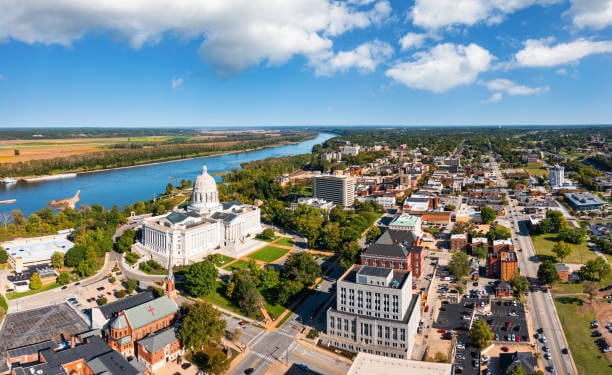
Jefferson City sits on the south bank of the Missouri River in Cole County, with roughly 43,000 residents, about thirty miles south of Columbia. Its economy is unlike any other city in this guide, and that difference is the whole case for it.
What actually drives it
State government. The Capitol, the Supreme Court of Missouri, and the headquarters of most state departments are here, which produces something rare: an employment base that does not follow the business cycle. In a recession, state government does not lay off the way manufacturing or retail does. Lincoln University, a historically Black land-grant university, adds a second institutional anchor. There is also a meaningful manufacturing presence and a regional medical center.
The result is one of the more stable local labor markets in Missouri, paired with housing costs well below the statewide suburban markets and a location within an hour of Columbia and roughly two hours of both major metros.
Who it fits
- State employees and anyone in the orbit of state government, including lobbying, association work, and the legal and accounting practices that serve it.
- People who want stability over upside. Jefferson City will not boom. It also does not crater.
- Anyone who wants river and lake access without resort pricing. The Missouri River is at the city’s edge, Binder Lake is minutes away, and the Lake of the Ozarks is a reasonable weekend drive.
- Households on one income, for whom the gap between Jefferson City housing costs and St. Louis County housing costs is the difference between owning and renting.
Who should look elsewhere
Anyone in a field with no local presence, which is most private-sector specialties. Anyone who needs a large job market to change employers without changing cities. And anyone who wants nightlife, since the legislature is in session part of the year and the city is quieter than its capital status suggests the rest of it.
Our detailed neighborhood breakdown is in the guide to the best neighborhoods in Jefferson City, MO, and the full relocation walkthrough is in the complete guide to moving to Jefferson City, Missouri.
Nixa and Ozark: The Christian County School District Draw
Immediately south of Springfield, in Christian County, sit two cities that have been among the fastest-growing in Missouri for two decades. Nixa runs roughly 24,800 residents and Ozark roughly 22,400, and they have grown for one dominant reason: the school districts.
Both Nixa and Ozark public school districts have strong regional reputations, and the pattern is the familiar one where families who work in Springfield choose to live in the districts to the south. Christian County has consistently been one of Missouri’s fastest-growing counties as a result.
What you get and what you give up
You get newer housing stock at prices below the Kansas City and St. Louis suburban markets, a short commute up US-65 or Highway 160 into Springfield, and the Ozarks immediately south. You give up walkability, since both cities are built around highway corridors, and you accept that growth this fast strains roads and schools before it strains anything else.
The commute is the thing to verify. Both are genuinely close to Springfield, but US-65 northbound in the morning carries the entire county, and the practical difference between living in Ozark and living in south Springfield is larger at 7:45 a.m. than it looks on a map.
Who it fits
Families with school-age children working in Springfield. That is the case, it is a strong one, and the population growth confirms that a lot of people have reached the same conclusion.
Who should look elsewhere
Anyone without children in the school system, who is largely paying a district premium for a service they do not use. Anyone who wants a downtown. Anyone whose work is in north Springfield, where the geography stops making sense.
Cape Girardeau: Southeast Missouri’s Regional Hub
Cape Girardeau, roughly 40,300 residents, sits on the Mississippi River about two hours south of St. Louis and is the commercial, medical, and educational center for a large rural region spanning southeast Missouri, southern Illinois, and western Kentucky.
That regional-hub role is the entire economic story. Two hospital systems serve a catchment far larger than the city itself. Southeast Missouri State University adds a student population. Retail and professional services draw from several counties in three states. A city of 40,000 supports infrastructure sized for a much larger population, which is a genuinely good deal for the people who live in it.
The river
Cape Girardeau’s relationship with the Mississippi is the defining physical fact about it. The downtown floodwall, with its painted murals, is both a civic landmark and a functional piece of infrastructure. Anyone buying here should treat the flood question as a first-order item rather than a footnote, and should get parcel-specific answers rather than city-level ones.
Who it fits
- Healthcare workers, given the concentration of regional medical employment.
- Anyone who wants a small city with real amenities and does not need a metro job market.
- People with family ties across the tri-state region, for whom the location is the point.
Who should look elsewhere
Anyone who needs a diverse job market, anyone who flies frequently, and anyone unwilling to do serious flood diligence on a specific address.
Rolla: A Small City With an Engineering School Attached
Rolla is small, roughly 20,300 residents, and it is in this guide for one specific reason: Missouri University of Science and Technology.
Missouri S&T is one of the country’s established engineering and applied science universities, and its presence gives a small city on Interstate 44 an economic and cultural profile that nothing else its size in Missouri has. There is a technical labor pool, federal and state research activity, and a steady flow of engineering-adjacent employers who located here specifically because of the university.
The surrounding geography is the other half of the appeal. Rolla sits in the northern Ozarks near the Mark Twain National Forest, with the Meramec and Gasconade rivers nearby. Float trips, caves, and public land are all local rather than a weekend expedition.
Who it fits
Engineers and technical professionals whose employer is here or who work remotely and want Ozark access with a university town’s amenities. Academics. Families who want a small city where the school system benefits from a highly educated parent population.
Who should look elsewhere
Nearly everyone else, honestly. Rolla is a narrow fit. If your work is not technical, not remote, and not university-adjacent, the job market here is thin, and that is the plain truth rather than a hedge.
Kansas City and St. Louis: Why Rankings Bury Them and When They Are Still Right
Missouri’s two major cities finish near the bottom of composite rankings, and it is worth being precise about why, because the reason is largely structural rather than evaluative.
Large central cities contain the full range of a region’s conditions inside one boundary. They contain the wealthiest neighborhoods and the poorest ones, the concentrated employment and the concentrated need. A suburb of 9,000 contains one condition. When you average a city’s statistics, you flatten enormous internal variation into a single mediocre-looking number, and then you rank that number against places that have no internal variation to flatten. The central city loses every time, in every state, regardless of merit.
Both cities also absorb the region’s reported crime in the numerator while counting only their own residents in the denominator, the same distortion described earlier for retail suburbs, at much larger scale.
When Kansas City is the right answer
When you want a real city. Kansas City has a genuine cultural infrastructure that its suburbs do not: the Nelson-Atkins Museum, the Kauffman Center, the jazz history in the 18th and Vine district, a nationally serious food scene, and both major-league franchises. The streetcar has made downtown and the River Market meaningfully walkable. Neighborhoods like Brookside, Waldo, and the Crossroads offer urban living at prices that would be impossible in a coastal metro.
It is also a legitimately strong market for engineering, architecture, animal health, logistics, and increasingly technology. If your career benefits from a deep metro labor market, that is a real argument no suburb answers.
When St. Louis is the right answer
When institutional density matters to you. Washington University and Saint Louis University, BJC HealthCare, the Danforth Plant Science Center, and one of the country’s significant biotech and plant science clusters are all here. Forest Park is larger than Central Park and its major institutions, including the Saint Louis Art Museum and the Saint Louis Zoo, are free. The housing stock in neighborhoods like the Central West End, Tower Grove, and Shaw is architecturally remarkable and priced well below equivalent stock anywhere on either coast.
The honest caveats for both
Conditions vary enormously by neighborhood in both cities, more than in any suburb in this guide, and neighborhood-level research is not optional. Both have city-specific tax considerations, including earnings taxes, that suburban residents do not face and that should be confirmed directly with the city rather than assumed. Both have older housing stock with the maintenance profile that implies.
What is not true is that either is unlivable or that the rankings have measured them fairly. They have measured something, and it is not the experience of living in a good neighborhood in either city.
Matching a Missouri City to Your Actual Situation
Rankings produce one order for every reader. Here is the same set of cities sorted by the question you are actually asking.
- You work in healthcare. Springfield first, for two competing systems and the largest regional market outside the metros. Then Columbia, for academic medicine. Then Cape Girardeau, for regional-hub concentration at a small-city cost of living.
- You have young children and one clear priority is schools. Lee’s Summit in the Kansas City metro, Nixa or Ozark near Springfield, St. Charles County for the St. Louis side, Kirkwood or Webster Groves if the budget reaches. Verify current district boundaries against the specific address rather than the city.
- You are buying your first house on a normal income. Springfield, Blue Springs, Jefferson City, Cape Girardeau. All four put ownership within reach of a median household in a way the top of most Missouri rankings does not.
- You work remotely and can live anywhere. Columbia, for airport access in both directions and a real downtown. Rolla, if you want the Ozarks and do not need a local job market. Kansas City or St. Louis proper, if you want a city and can buy urban housing stock at Missouri prices.
- You are retiring. Start with the county, not the city. Confirm whether the county has adopted the senior freeze under Section 137.1050, then choose the city inside it. Jefferson City, Springfield, and Cape Girardeau all pair reasonable costs with real medical infrastructure, which is the pairing that matters most at that stage.
- Your weekends are on the water. Springfield or Ozark for Table Rock, Blue Springs for the Jackson County lakes, Jefferson City for the Lake of the Ozarks. Read the personal property tax section before you buy the boat, not after.
- You run a business or work a trade with equipment. Springfield and Jefferson City offer the best combination of commercial space cost and highway access. Both metros offer the deepest customer base. Business personal property is taxed separately and is worth an accountant’s attention before the move.
- You want a walkable historic downtown. St. Charles, Kirkwood, Webster Groves, Liberty, Columbia. There are five real answers in Missouri and those are them.
Questions to Ask Before You Commit to a Missouri Market
Every question below has a specific person who can answer it, and every one of them is worth more than a ranking.
Ask the county assessor or collector
- What was the actual real property tax bill on this parcel last year, and the year before?
- When is the next reassessment for this county, and what happened to assessed values in this area at the last one?
- Has this county adopted the senior property tax freeze under Section 137.1050, and if so what is the application window and is reapplication annual?
- What is the personal property declaration deadline here, and how do I file as a new resident who did not own property in Missouri on January 1?
- What do I need in order to get a statement of non-assessment so I can register my vehicles?
Ask the school district
- Which specific attendance zone does this address fall in, at every grade level?
- Are boundaries under review, and has the district grown enough recently to make redistricting likely?
Ask the municipality
- Which city am I actually in? In St. Louis County especially, addresses and municipal boundaries do not reliably match, and it changes your services, permits, and taxes.
- What are the rules on parking a boat, camper, or trailer at a residence? Many Missouri municipalities and nearly all homeowners associations restrict this, and it is the single most common reason people here end up renting outdoor or enclosed vehicle space.
- Is this property in a special taxing district, a community improvement district, or a transportation development district?
Ask an insurance agent
- What is the wind and hail deductible on a policy for this address, and is it a percentage of the dwelling coverage rather than a flat amount?
- What does flood insurance cost here, and what does the FEMA map show for this parcel specifically?
- Does a stored vehicle or a unit’s contents need separate coverage, and what does my current policy already extend to?
Our moving cost calculator and moving tips cover the logistics side of the same process.
What Missouri Housing Stock Means for the Things You Own
This is the part of a relocation nobody plans for, and it is genuinely different in Missouri than in the places people move here from.
Basements are common and highly variable. Most Missouri housing outside the far southern Ozarks has a basement, which sounds like abundant storage and frequently is not. Older basements in inner-ring St. Louis and Kansas City neighborhoods often have stone or unsealed block foundations, floor drains that back up in heavy rain, and mechanical equipment eating the usable footprint. Newer subdivision basements are better but are often finished into living space, which converts storage into square footage. Ask about water intrusion history directly, and look at the bottom two feet of the walls.
Garages are smaller than the listing suggests. A two-car garage in a house built in 1955 was sized for two 1955 cars. A modern crossover plus a workbench plus lawn equipment does not fit in the same volume. This is most acute in exactly the walkable older suburbs this guide recommends.
You will own outdoor equipment you did not own before. A Missouri yard in a four-season climate requires a mower, and often a trimmer, a blower, a snow shovel or blower, and hoses that have to come inside before the first hard freeze. People arriving from apartments or from milder climates consistently underestimate this.
Seasonal rotation is real here. Patio furniture, grills, bicycles, and lake gear come out in April and go away in October. Winter coats, boots, and holiday decorations do the opposite. In a climate with a genuine winter and a genuine summer, a meaningful fraction of what a household owns is out of use for half the year at a time.
Temperature swings are hard on some belongings. Wood furniture, instruments, artwork, photographs, vinyl records, and electronics do not do well through repeated cycles between a hot attic in July and a freezing garage in January. That is a property of the climate rather than a sales pitch, and it is the honest argument for keeping certain categories of belongings somewhere temperature-regulated rather than in an outbuilding.
Our storage tips library covers packing and organization for most of these categories in more depth.
Storage and a Missouri Move: The Sizing Arithmetic
If a Missouri move does put you in the position of needing space temporarily, the useful question is how much, and that is arithmetic rather than guesswork.
The three situations that actually generate the need
- The closing gap. You sell in one state and buy in Missouri, and the dates do not line up. This is the most common case and it is usually a one to three month need.
- The rent-first year. Sensible households moving to an unfamiliar metro rent for a year before buying, which means a smaller interim home than the one they left and the one they will end up in.
- The vehicle that has nowhere to go. A boat, camper, or work trailer arriving at a house whose HOA or municipality prohibits parking it in the driveway. In Missouri this is common enough to be predictable.
Rough sizing by household
- A studio or one-bedroom apartment’s contents: generally a 5x10, which is about the footprint of a single-car garage bay cut in half.
- A two-bedroom home: generally a 10x10, holding furnishings from two bedrooms plus a living room and kitchen.
- A three-bedroom home: generally a 10x15 to 10x20. A 10x20 is roughly the footprint of a standard one-car garage and takes most of a three-bedroom house including appliances.
- A four-bedroom home or a household with large equipment: generally a 10x25 or larger.
- Seasonal overflow only: a 5x5 handles holiday decorations, off-season clothing, and camping gear without much strain.
Two adjustments worth making. Size up one step if you are storing appliances, since a refrigerator, washer, and dryer consume more floor area than people picture. Size up if you need to reach things during the rental, because a unit packed wall to wall to the ceiling is a unit you cannot get into without unloading it.
Our storage unit size guide walks each size in detail, and the storage size calculator works from your actual inventory instead of a category. If a truck is part of the plan, the moving truck size guide covers that arithmetic separately.
You can browse small units, medium units, or large units directly. For a boat, camper, or work trailer, our vehicle storage, RV storage, and boat storage pages cover the options, and business storage covers inventory, tools, and equipment.
When You Should Not Rent a Storage Unit in Missouri
We rent storage for a living, and we would still rather you not rent a unit you do not need. Here are five situations where the honest answer is to skip it.
You are moving into a house with a dry, usable basement. This is the big one in Missouri, and it is why this section leads with it. Most Missouri housing has a basement, and a dry basement with a working sump and no water history is free storage you have already paid for. Before renting anything, walk your own basement with a tape measure. A lot of people rent a unit they could have avoided entirely by spending a Saturday on shelving.
You are storing things you have already decided to get rid of. A storage unit is not a decision. It is a delay, and it is a delay with a monthly price. If the honest answer about a piece of furniture is that you will never use it again, the move is the moment to sell it, donate it, or dispose of it. Paying rent for years to avoid an afternoon of decisions is the most expensive way to handle it. Missouri has an active secondhand market in every city in this guide, and moving season is when it is busiest.
The gap between your closing dates is under two weeks. Most moving companies offer short-term storage in transit as part of the move, and a portable container left on site can be cheaper and considerably less work than loading a truck, unloading into a unit, and doing the whole thing again in ten days. Get that quote before you assume a unit is the answer.
You are storing it for tax reasons. To be direct, because this comes up specifically in Missouri: moving a boat, camper, or vehicle into a storage unit does not remove it from your personal property declaration. Liability attaches to what you own on January 1. Storage is a space solution and a security solution. It is not a tax solution, and anyone suggesting otherwise is giving you bad information.
The unit would cost more than the contents are worth. Run the number. A modest unit at a typical Missouri rate costs several hundred dollars a year, and more over two or three. Compare that honestly against what it would cost to replace the contents if you needed them again. For a lot of household goods, especially older mass-market furniture and outgrown children’s equipment, replacement is cheaper than long-term rent. That math favors us in the short term and favors you in the long term, and the long term is the one that matters.
Frequently Asked Questions About the Best Cities to Live in Missouri
There is no single answer, and any list that gives you one is ranking by a formula rather than by fit. Columbia is the most consistently defensible choice across the widest range of situations, given its stable education and healthcare economy and its central location. But Lee’s Summit is a better answer for a family working in Kansas City, Springfield is a better answer on a first-time buyer’s budget, and Jefferson City is a better answer for anyone whose work touches state government.
Among cities large enough to have a real job market, Springfield, Jefferson City, and Cape Girardeau consistently offer the lowest combination of housing cost and living cost. Missouri as a whole runs below the national average on cost of living, and the affordability gap between its mid-sized cities and its wealthiest suburbs is very large.
Yes. Missouri assesses an annual tax on tangible personal property, including vehicles, and liability is based on what you own on January 1 of that year. Personal property is assessed at thirty-three and one-third percent of its true value, you file a declaration with your county assessor, and the county collector bills you later in the year. Deadlines and administration vary by county, so confirm the specifics with the assessor in the county you live in.
Yes. Boats, personal watercraft, recreational vehicles, and trailers are all tangible personal property in Missouri and are generally subject to the annual personal property tax alongside cars and trucks. A boat, its trailer, and the vehicle that tows it are three separate items. Where you keep them does not change that, since liability is based on ownership as of January 1. Contact your county assessor for how your specific items should be reported.
It has real advantages, including a low cost of living, no state tax on Social Security benefits, and a senior property tax freeze available to homeowners aged 62 and older. The important detail is that the freeze is adopted county by county rather than statewide, so whether it is available to you depends on which county you settle in. Confirm adoption status and application deadlines with that county’s assessor or collector, and discuss your overall situation with a financial professional.
Because St. Louis County contains an unusually large number of small, separately incorporated, affluent municipalities, and because most rankings score cities heavily on income and home value. When you rank incorporated places by wealth, a county full of small wealthy incorporated places dominates the result. It is a consequence of municipal boundaries rather than a finding about where Missourians live well.
Columbia is the fastest-growing municipality in the state, having added roughly forty percent to its population since 2000. At the county level, St. Charles County near St. Louis and Christian County south of Springfield have both been among Missouri’s consistent growth leaders.
It depends on the specific parcel, and there is no reliable city-wide shortcut. Missouri assesses residential real property at nineteen percent of market value, then applies the combined levies of every taxing district the property sits in, including school, county, municipal, fire, library, and road districts. Because school district boundaries do not follow city boundaries, two similar homes in the same city can carry different bills. Look up the prior year’s actual bill for the address through the county assessor or collector.
It is one of the strongest all-around options in the state. It combines a stable economy anchored by the University of Missouri and MU Health Care, one of the highest levels of educational attainment for a city its size in the country, a real downtown, extensive trail access, and a central location roughly two hours from both Kansas City and St. Louis. The main trade-offs are a housing market shaped by the academic calendar and a median household income below several suburban markets.
It suits people who value stability. State government provides an employment base that does not follow the business cycle the way private-sector-dependent economies do, housing costs are well below the state’s suburban markets, and it sits within an hour of Columbia. The trade-off is a smaller and less varied job market, so it works best when your work connects to state government, healthcare, education, or manufacturing.
Be careful with published safety rankings, because reported crime is measured per resident while crime occurs where people gather. Small cities containing large retail districts show inflated rates that say little about their residential streets, and at least one widely read Missouri ranking currently lists three different cities with an identical and implausible crime figure. For a specific address, look at the local police department’s own reporting rather than a statewide composite score.
Missouri consistently runs below the national average, with housing the largest source of the gap. That advantage is smallest in the wealthiest St. Louis and Kansas City suburbs and largest in the mid-sized cities and smaller markets. Because published cost-of-living indexes are updated on their own schedules and use differing baskets, treat any single figure as approximate.
Columbia is the strongest general answer, given its central location between both major airports, a genuine downtown, and amenities beyond what its size would normally support. Kansas City and St. Louis proper are strong if you want urban housing stock at Missouri prices. Rolla and Springfield both work well if outdoor access in the Ozarks is a priority.
Yes. Missouri lies within the broader region of the country that sees frequent severe thunderstorms and tornadoes, with peak activity typically from March into June and a smaller autumn increase. Risk is not uniform across the state. When evaluating a specific home, ask about basement or shelter space, how the county handles warnings, and whether the insurance policy carries a separate wind and hail deductible.
As a general starting point, a one-bedroom apartment’s contents typically fit a 5x10, a two-bedroom home a 10x10, and a three-bedroom home a 10x15 to 10x20. Size up one step if you are storing major appliances or if you will need to reach items during the rental. Our storage size calculator produces a closer estimate from your actual inventory.
Our Jefferson City facility at 2601 Industrial Drive offers climate-controlled indoor units, which at 10 Federal means the space is temperature-regulated. Our Columbia facility at 6101 Paris Rd offers drive-up units only and does not have climate-controlled units. If you are storing items sensitive to temperature swings, Jefferson City is the location to look at.
Choosing Your Missouri City
The most useful thing you can do with a list of the best cities to live in Missouri is stop treating it as a ranking and start treating it as a shortlist to investigate.
The variables that will actually determine whether you are happy here are not in any composite score. They are the school attendance zone for your specific address, the previous year’s tax bill on your specific parcel, whether your county adopted the senior freeze, what your commute looks like at 7:45 on a Tuesday rather than at noon on a Sunday, and whether the basement stays dry in a May thunderstorm. All five of those are knowable before you commit, and all five require a phone call rather than a search result.
Missouri rewards that kind of diligence more than most states, because the variation between counties is unusually large and because the state’s two tax mechanisms most likely to surprise you are both administered locally. Do the county-level homework and the state is a genuinely good deal. Skip it and the surprises show up in November.
If a move to mid-Missouri is in your near future and you need space for part of it, we are in Columbia and Jefferson City, month to month, rented entirely online.
About the Author
10 Federal Storage
Our team at 10 Federal Storage has been in the self storage industry for decades. With knowledge gained from multiple universities and in the field, we are well-prepared and excited to assist with your storage needs. When you rent a unit with us, you can feel confident that our seasoned customer service team’s help will make your transition as seamless as possible. Customer satisfaction is our number one priority, and we strive to make your experience exceptional with our automated leasing options, diverse unit sizes, and a strong commitment to sustainability.