
.svg)
How Much Does Car Storage Cost? A Complete Price Breakdown
by 10 Federal Storage
Published on August 20, 2026
Search for the cost of car storage and you will get a number within about four seconds. Somewhere between $50 and $450 a month, depending on which page you land on. That number is not wrong, exactly. It is just answering a narrower question than the one you asked.
What you actually want to know is what the car costs you while it sits. That is a different figure, and it is reliably larger than the rent, because a stored vehicle keeps generating obligations that a stored couch does not. Most facilities require the vehicle to stay currently registered and currently insured for the entire time it is on the property, which means the two expenses you were probably hoping to cancel are the two you contractually cannot. Storage units are generally not powered, so the battery plan you read about elsewhere does not apply. And in some states, the sales tax treatment of a parking or vehicle storage space is not the same as the sales tax treatment of a regular storage unit.
None of that appears in the guides currently ranking for this query. They price the rent, list four factors that affect the rent, and finish. This guide prices the whole thing: the monthly rate by storage type, the fees that are not in the advertised rate, the rate increase almost nobody budgets for, the registration and insurance you have to maintain, the one-time preparation spend, what it costs to get the car running again, and three worked twelve–month totals so you can see where the money actually goes.
It also argues, in two places, that you should not rent a storage space at all. There is a break-even point where selling the car and buying a replacement later is straightforwardly cheaper, and there is a category of vehicle where paying to store it is close to indefensible. Both are covered below, before we get anywhere near a recommendation.
Table of Contents
- How Much Does It Cost to Store a Car? The Short Answer
- Why the Published Numbers Disagree With Each Other
- Outdoor Parking Spaces and What They Cost
- Covered Parking and What It Costs
- Enclosed Drive-Up Units and What They Cost
- Climate-Controlled Vehicle Storage and What It Adds
- Why Vehicle Storage Costs More Than Regular Storage of the Same Size
- How Your Vehicle’s Size Changes the Price
- Why Location Moves the Price More Than Anything Else
- Move-In Costs That Are Not in the Advertised Rate
- The Rate Increase Almost Nobody Budgets For
- Why Sales Tax on Vehicle Storage Can Work Differently
- What It Costs to Keep the Car Registered While It Sits
- What Insurance Costs While the Car Is Stored
- The Plate Surrender Trap That Costs More Than It Saves
- One-Time Preparation Costs Before the Car Goes In
- The Battery Problem in an Unpowered Unit
- What It Costs to Bring the Car Back Out
- The Real Twelve-Month Cost, Worked Three Ways
- Storing Versus Selling: How to Run the Break-Even
- Cheaper Alternatives You Should Price First
- How to Lower Your Car Storage Bill
- What Size Unit Your Car Needs and What That Costs
- When Car Storage Is Not Worth Paying For
- Frequently Asked Questions About Car Storage Costs
- Storing a Car With 10 Federal Storage
How Much Does It Cost to Store a Car? The Short Answer
Across the United States, monthly car storage rates published by national operators and marketplaces fall roughly between $20 and $500. The middle of that distribution, what a typical person storing a typical sedan in a typical suburb actually pays, lands somewhere around $100 to $200 a month.
That is a wide band, and the width is not evasion. It reflects four variables that genuinely move the number by multiples rather than percentages:
- Storage type. An uncovered outdoor space and an enclosed climate-controlled unit are different products at different price points. This is the largest single factor, and the gap between the cheapest and most expensive type is frequently three to five times.
- Metro area. The same enclosed unit costs dramatically more in coastal California or New York City than in Tennessee or Texas. Published operator data shows minimum rates in some markets sitting below $30 while other markets start above $140.
- Vehicle length. A motorcycle, a compact car, a crew-cab pickup and a cargo van need three or four different space sizes, and price scales with the footprint.
- Timing. Vehicle storage demand is seasonal and unit availability is finite. The same space quoted in February and in June is often not quoted at the same price.
Here is the part the rate alone does not tell you. Take a mid-range enclosed unit at roughly $175 a month. Over a year that is $2,100 in rent. Add the registration you have to keep current, the insurance you have to keep active, the administrative fee and required lock at move-in, a first rate increase that in this industry commonly arrives before month twelve, the preparation you do before the car goes in, and the work needed to get it running again when you come back. The twelve-month figure is realistically closer to $2,800 to $3,400 depending on your state, your vehicle and your insurer.
That is a meaningfully different number from $175, and it is the number you should be comparing against your alternatives. Sections 10 through 19 build it line by line.
Why the Published Numbers Disagree With Each Other
If you read three car storage cost guides you will get three incompatible sets of numbers, and this is worth understanding before you anchor on any of them.
Extra Space Storage publishes a national range running from roughly $17 to $700 a month. Elsewhere on the same page it gives outdoor storage as $70 to $100, covered storage as $20 to $100, and indoor storage as $150 to $270. Those figures do not sit comfortably together: the published covered range starts well below the published outdoor range, on a page that also states covered parking costs more than outdoor parking. A separate table on the same page puts average outdoor cost for a compact car at $105, which is above the top of the stated outdoor range.
Neighbor, the peer-to-peer marketplace, gives a $200 monthly average and an outdoor range of $17 to $100, a covered range of $50 to $200, and an indoor range of $150 to $270, the indoor figure matching Extra Space exactly, which suggests a shared upstream source rather than two independent measurements. RecNation, whose numbers come from its own Texas facilities, reports a much tighter $65 to $272. Yelp's cost page, last substantially updated in 2022, gives $50 to $400.
There are three honest reasons for the spread, and one less honest one:
- Different products bundled under one label. "Car storage" covers an uncovered gravel space and a conditioned indoor unit. Any national average across both is a number describing nothing in particular.
- Different market baskets. An operator concentrated in Texas and an operator concentrated in California will report genuinely different averages while both are accurate.
- Promotional versus standing rates. Advertised rates frequently reflect a move-in discount. The rate you pay in month eight is a different number, for reasons covered in Section 11.
- Ranges chosen to be unfalsifiable. A $17 to $700 range cannot be wrong. It also cannot help you budget.
The practical takeaway is that no national average is a substitute for pulling live pricing in your own ZIP code for the specific space type you need. Use published ranges to understand the shape of the market and to sanity-check a quote. Do not use them to build a budget.
Outdoor Parking Spaces and What They Cost
An outdoor space is an assigned parking spot inside a facility's fenced and gated lot, usually on asphalt, concrete or compacted gravel. There is no roof and no walls. What you are buying is a secured perimeter, cameras, lighting, gate-code access and a legal place to leave a vehicle that is not your driveway or the street.
Published ranges cluster between roughly $20 and $150 a month, with most suburban markets landing in the $45 to $110 band. It is consistently the cheapest way to store a vehicle at a commercial facility, often by a factor of two or three against an enclosed unit of comparable length.
The cost logic is simple. The operator is renting you striped pavement. There is no building, no roll-up door, no roof to maintain and no interior square footage that could otherwise have been subdivided into smaller, higher-yielding units. That efficiency is passed through.
What an outdoor space is genuinely good for:
- A vehicle that already lives outdoors. If the car currently sits in a driveway year-round, an outdoor space is not a downgrade in exposure. It is the same exposure with a fence around it.
- Short gaps. Two months between a home sale and a closing, or a single deployment cycle, rarely justifies enclosed pricing.
- Oversized vehicles. Crew-cab pickups, work vans and anything with a roof rack avoid the door-height problem entirely.
- Frequent access. Pulling into a marked space is faster than maneuvering into a unit, which matters if you are visiting weekly.
What you are accepting: sun exposure that degrades clear coat and interior plastics over months, full weather exposure including hail, tree sap and bird droppings, and a vehicle that is visible rather than out of sight. A quality breathable car cover mitigates a meaningful share of this for well under a hundred dollars, and is discussed in Section 16.
One planning note specific to outdoor spaces: they are sold by length, and the length that matters is your vehicle's actual bumper-to-bumper measurement including a hitch, spare carrier or ladder rack. Manufacturer specifications do not include aftermarket additions.
Covered Parking and What It Costs
Covered parking is an outdoor space with a roof over it and open sides, structurally a carport. It sits between uncovered parking and an enclosed unit in both protection and price.
Published ranges run roughly $50 to $200 a month, typically landing 25 to 60 percent above an uncovered space in the same lot. The premium buys the single most valuable increment of protection per dollar in vehicle storage: direct overhead sun and precipitation are the primary drivers of paint oxidation, dashboard cracking and seal degradation, and a roof addresses both.
It is worth being clear about what covered parking does not do. The sides are open, so wind-driven rain still reaches the vehicle, dust and pollen accumulate, and the car remains visible from outside the structure. Temperature swings are barely moderated, a covered space in a Texas August is cooler than direct sun but is not conditioned in any sense.
Covered parking is the value pick for a specific reader: someone storing a car with paint worth protecting, for six months or more, in a high-sun market, who cannot justify enclosed pricing. In practice it is most compelling in the Sun Belt and least compelling in mild coastal climates where the sun load is lower.
One availability caveat that affects your search more than your budget: covered vehicle parking is significantly less common than either uncovered spaces or enclosed units, because it requires purpose-built structures that many facilities never installed. 10 Federal Storage facilities offer uncovered parking spaces and enclosed drive-up units; covered parking is not part of our standard offering. If covered is your target, expect a narrower set of options in most markets and verify availability before you build a budget around it.
Enclosed Drive-Up Units and What They Cost
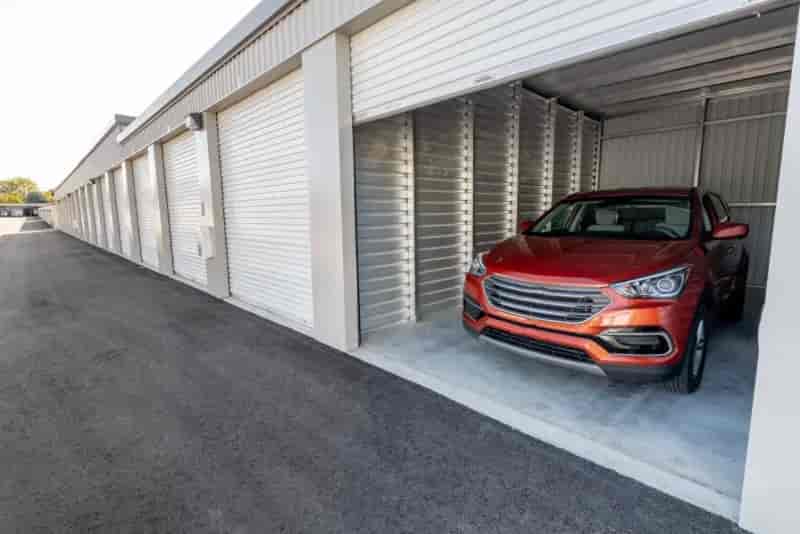
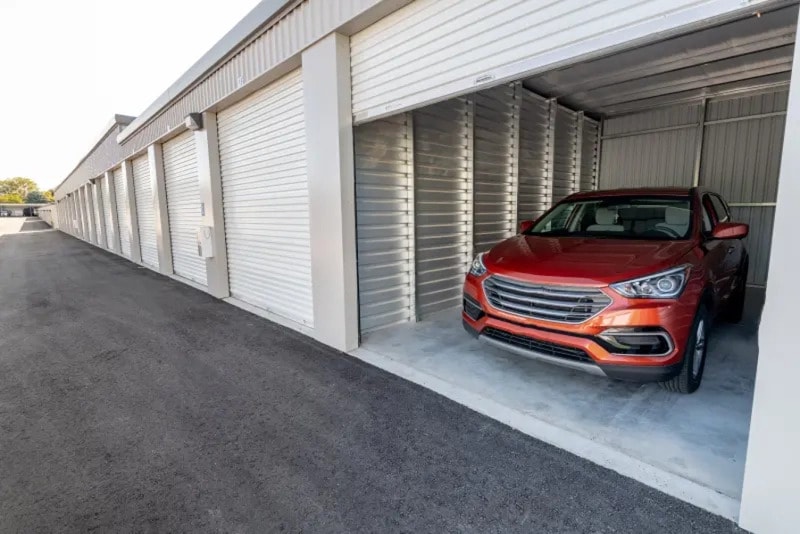
An enclosed drive-up unit is a standard storage unit with a roll-up door, sized to take a vehicle. Four walls, a roof, a concrete floor and a door you lock. The vehicle is out of the weather, out of direct sun and out of sight.
Published ranges run roughly $100 to $300 a month for non-conditioned enclosed units, with $150 to $270 appearing repeatedly across national sources as the working band. A 10x20, the most common size for a sedan or small SUV, is often quoted between $130 and $220 in suburban markets and considerably higher in dense metros.
The premium over an outdoor space is substantial, and it is worth understanding what it actually buys, because the marketing tends to blur it:
- Elimination of sun exposure. This is the single largest protective difference. Ultraviolet degradation of clear coat, dashboard material and rubber seals stops being a factor.
- Elimination of precipitation and hail contact. Relevant almost everywhere, and disproportionately valuable in hail-prone markets across the Plains and Southeast.
- Concealment. A vehicle behind a door is not a vehicle someone browses past. For collector cars this matters more than any environmental factor.
- Working room. A 10x20 holds a sedan plus the wheels, parts, covers and tooling that tend to accompany a project car. An outdoor space holds a car.
The constraint that catches people is door opening height, not interior ceiling height. Lifted trucks, high-roof vans and anything wearing a roof box or light bar can clear the ceiling comfortably and still fail at the door. Measure the door opening before you rent, not the unit.
For a full comparison of the two sizes most commonly rented for vehicles, our breakdown of 10x15 versus 10x20 storage units covers the dimensional and pricing differences in detail.
Climate-Controlled Vehicle Storage and What It Adds
Climate-controlled storage adds a premium on top of an enclosed unit, commonly quoted at $25 to $50 more per month, though in some markets and some size classes the gap runs wider.
Here is where the industry gets loose with language, and where a cost guide owes you precision, because you are being asked to pay a premium for a capability.
A climate-controlled unit is temperature-regulated. It holds the interior within a moderate band rather than tracking outdoor extremes, which is a real and worthwhile thing when the alternative is a metal box in a Texas July or a Wisconsin January. Temperature cycling is genuinely hard on rubber seals, adhesives, electronics and fluids, and removing the extremes removes that stress.
What temperature regulation does not do is actively manage the moisture content of the air inside the unit. Those are different mechanical systems, and a facility offering the first is not thereby offering the second. 10 Federal Storage's climate-controlled units are temperature-regulated, and we would rather tell you that plainly than let you infer a capability and pay for it. If moisture in the air is your specific concern for a specific vehicle, that is a question to put directly to any operator you are evaluating, and you should be skeptical of a vague answer.
When the premium is defensible:
- Collector, classic and low-production vehicles where the interior, trim and finish are expensive or effectively impossible to replace.
- Storage beyond roughly a year, where cumulative temperature cycling has time to do measurable work on seals and electronics.
- Extreme-climate markets where the summer or winter delta between outdoor and regulated temperature is largest.
- Vehicles with sensitive electronics or modern multi-stage finishes that tolerate heat cycling poorly.
When it is probably overkill: a daily driver going away for three months, a vehicle that has spent its whole life outdoors, or any car in a mild climate for a short stay. Paying a conditioning premium to protect a fifteen-year-old commuter from a temperate autumn is spending real money against a hypothetical.
Why Vehicle Storage Costs More Than Regular Storage of the Same Size
A recurring surprise: a 10x20 rented for household goods and a 10x20 rented for a car are frequently not the same price, and the vehicle version is usually higher. The footprint is identical, so the difference looks arbitrary. It is not.
Vehicle-capable units are built differently. A unit that has to swallow a car needs a wider door opening and greater door height than a unit that has to swallow boxes. Wider openings mean larger roll-up door assemblies and different structural spans, and taller clearances mean the building itself is taller. That construction cost is amortized across fewer units, because a building designed with tall, wide-door bays yields less rentable square footage per acre than one packed with conventional units.
Drive aisles have to be wider. Backing a crew-cab pickup into a bay requires turning room that a hand truck does not. Site layouts that accommodate vehicles surrender rentable land to pavement.
Vehicle units are less interchangeable. A conventional 10x20 can be rented to anyone. A vehicle bay is competing for a narrower slice of demand, which means it can sit vacant longer, and vacancy risk is priced in.
The operational profile is different. Vehicles bring fluid-leak risk, move-out complications when a car will not start, and requirements around registration and operability that a box does not generate. Facilities carry administrative overhead for vehicle tenants that they do not carry for standard tenants.
None of that means you are being overcharged. It means the two products cost different amounts to build and operate, and when you compare a vehicle quote to the household-goods rate you saw advertised for the same dimensions, you are comparing two things that are not the same thing.
The practical implication for budgeting: when you pull rates, filter for vehicle-capable spaces specifically. A general size search will show you rates you cannot actually get for a car.
How Your Vehicle’s Size Changes the Price
Space is sold by footprint, so the length of your vehicle sets the floor on what you can spend. The step between size classes is typically 20 to 40 percent, which makes getting the size right one of the more consequential decisions in the whole exercise.
Measure the vehicle bumper to bumper, including anything projecting past the bumpers, a hitch receiver, a spare tire carrier, a bike rack, a ladder rack. Then add roughly five feet of working room. That buffer is the difference between backing in comfortably and folding a mirror every visit.
- Motorcycle or scooter (6–8 ft): a 5x10 enclosed unit handles one bike with room for a helmet, cover and stand. A 10x10 takes two comfortably. This is among the cheapest vehicle storage there is, frequently in the $50 to $110 range.
- Compact car (14–15 ft): a 10x15 enclosed unit, or a standard outdoor space. Published indoor averages around $150; outdoor materially less.
- Sedan or small SUV (15–17 ft): a 10x20 enclosed, or a standard outdoor space. This is the most commonly rented vehicle size and the one most national averages are implicitly describing. Published indoor averages cluster near $185.
- Full-size SUV or minivan (17–18 ft): a 10x20 at absolute minimum, and a 10x25 if you want to open a door inside the unit.
- Standard-cab pickup (18–19 ft): a 10x20 to 10x30 depending on bed length. Published indoor averages for this class run above $225.
- Crew-cab, long-bed pickup (20–23 ft): a 10x30 enclosed, or a longer outdoor space. Frequently the point at which outdoor becomes the only sensible economics.
- Cargo or work van (18–24 ft): a 10x30, with door opening height checked carefully for high-roof models.
- Two vehicles together: 20x20 or larger, and worth pricing against two separate spaces, the combined unit is not automatically cheaper.
The costly mistake in both directions: undersizing means you cannot open a door, cannot walk around the car, and will scrape something eventually. Oversizing means paying a 30 percent premium every month for air. Measure, add five feet, then buy the smallest space that clears it.
Why Location Moves the Price More Than Anything Else
Storage rates are a function of land values and local demand, and both vary far more between metros than any product feature varies within one.
Published operator data makes the spread concrete. Minimum monthly vehicle storage rates run below $30 in markets like Memphis, Chicago and Houston, while Irvine starts above $140 and Brooklyn above $115. Maximum rates in the same dataset range from around $104 in Memphis to $571 in Miami. That is not a product difference. It is a real estate difference.
Three forces drive it:
- Land cost per square foot. Vehicle storage is land-intensive and low-density. In markets where an acre is expensive, the arithmetic of devoting that acre to parked cars is punishing, and the rate reflects it.
- Local housing stock. Where garages are scarce or small, and where basements are uncommon, home garages fill with household overflow and vehicles get displaced. That pushes vehicle storage demand up independent of population.
- Regulatory pressure. Municipalities and homeowners associations that restrict driveway and street parking generate storage demand directly. Neighborhoods with strict rules reliably support higher nearby storage rates.
There is a practical arbitrage here that is worth real money. Storage pricing falls off sharply with distance from a metro core, often faster than most people expect. If the vehicle is going to sit for six months or a year and you do not need weekly access, a facility twenty or thirty minutes further out can cut the rate substantially. On a twelve-month store, a $60 monthly difference is $720, which comfortably justifies a longer drive twice a year.
The inverse also holds: if you need the car every other weekend, do not chase the cheapest rate two counties away. Fuel and time will consume the savings, and you will resent it by month three.
Move-In Costs That Are Not in the Advertised Rate
The advertised monthly rate is one line on a move-in invoice that usually has several. None of these are unusual or improper, they are standard across the industry, but they are rarely in the headline number, and together they routinely add $50 to $150 to what leaves your account on day one.
- Administrative or setup fee. A one-time charge for opening the lease, commonly in the $10 to $30 range. Nearly universal.
- Lock. Many facilities require a specific lock type, particularly disc locks for roll-up doors, and sell it at move-in. Budget $10 to $25. If you can bring your own compliant lock, ask first.
- Protection plan or tenant insurance. Frequently required at checkout rather than optional. This is the line that most often surprises vehicle tenants, and it deserves its own scrutiny, see below.
- Security deposit. Less common than it used to be, but still present at some operators, typically $50 to $100 and refundable at move-out.
- First month, unprorated. Vehicle storage is generally billed monthly with no proration. A three-week stay is a full month's rent, sometimes two if it straddles a billing date.
The protection plan detail that matters specifically for vehicles. Storage protection plans are written for stored property, and vehicles are commonly excluded from coverage on the reasoning that a car is covered by an auto policy. So you may find yourself required to purchase a protection plan at checkout that does not, in fact, cover the vehicle you are storing. That is not a scam, the plan covers the other contents of the unit, and the exclusion is disclosed, but it means the protection line on your invoice and the protection on your car are two separate questions. Ask the operator directly whether vehicles are covered, and ask your auto insurer what applies while the car is parked and undriven.
Promotional pricing. First-month-free, half-off-first-month and dollar-first-month offers are genuinely common and genuinely worth taking. Just be precise with yourself about what they are: a discount on month one, not a discount on your average monthly cost. A $1 first month on a $180 unit saves you $179 over a twelve-month store, which is a real 8 percent, not the 100 percent the banner implies.
The Rate Increase Almost Nobody Budgets For
This is the largest gap between what people budget and what they pay, and it is barely mentioned in the guides currently ranking for this query. As an operator, we would rather you hear it from us with the mechanics explained than discover it on a statement.
Self-storage leases, including vehicle storage leases, are month-to-month. There is no fixed term, which means there is also no rate locked for a term. Operators across the industry use what is called an existing-customer rate increase, adjusting the rent of a current tenant, typically toward prevailing market rates, some months after move-in.
The practice is well documented in industry literature. Revenue-management specialists describe a widely used cadence sometimes called the "7-11 rule": a first increase around seven months after move-in, then further increases roughly every eleven months. Other analyses put the first increase in the three-to-six-month window with subsequent adjustments every six to twelve months. Before roughly 2015 most operators raised rents about once a year in the 8 to 12 percent range; revenue-management software has since made increases more frequent and more variable, and the modern cadence differs by operator, market and unit type. There is no universal number, and anyone quoting you one precisely is guessing.
The reason the practice persists is behavioral rather than mysterious. Moving out of storage is genuinely inconvenient, and with a vehicle it means arranging transport, finding another space and doing it on a deadline. Industry data shows average length of stay rising, from roughly 15.8 months in mid-2022 to about 17.5 months by late 2024, which is the industry's own evidence that most tenants absorb increases rather than relocate.
What to actually do with this information:
- Budget above the quoted rate for any stay beyond six months. Assume the rate you are quoted is not the rate you pay in month ten.
- Ask directly, before signing, how rate adjustments are handled and what notice is given. Notice requirements vary by state and by operator. A straight answer is a good signal.
- Read the notice when it arrives. Increases are communicated in advance. The tenants most upset by them are usually the ones who did not open the email.
- Know that the increase is not always final. A tenant who calls and asks is sometimes accommodated, particularly a long-tenured one paying on time.
- Compare against current street rates periodically. If your in-place rate has drifted above what the same facility is advertising to new tenants, that is worth a phone call.
For a short store, three or four months between a move or a deployment, this is mostly academic. For a store measured in years, it is the single biggest reason the twelve-month total in Section 19 exceeds twelve times the quoted rate.
Why Sales Tax on Vehicle Storage Can Work Differently
This section is unusual for a storage cost guide, and it is here because it is the kind of thing that quietly changes your bill by several percent and appears in none of the competing pages.
Sales tax treatment of storage rent is set at the state level, and, this is the part that surprises people, a state does not necessarily tax a vehicle parking or storage space the same way it taxes a conventional self-storage unit. The two can sit under different statutory provisions, which means a legislative change to one does not automatically carry across to the other.
Florida is the clearest illustration. Legislation repealed the state sales tax on commercial rent, including self-storage units, for rental periods beginning on or after October 1, 2025. But the tax on rentals of parking and storage spaces for motor vehicles, boats and aircraft sits in a separate section of the Florida statutes and was not part of that repeal. Florida Department of Revenue guidance issued around the change confirms that parking, docking, tie-down and vehicle storage charges remain taxable, with the applicable county discretionary surtax on top. The practical result is that in the same Florida facility, in the same month, a unit full of household goods and a space holding a car can be treated differently for sales tax purposes.
Other states reach their own conclusions, and several tax storage rent generally while others do not tax it at all. The rules also change, the Florida example is itself a change that took effect recently, and rates, surtaxes and effective dates move independently of one another.
What to do with this, stated carefully: do not attempt to compute your own tax liability from a blog post, including this one. Ask the facility for a full quote showing rent, fees and any applicable tax as separate lines before you sign, so you are comparing complete numbers between operators rather than pre-tax rent at one and post-tax rent at another. If you are storing a vehicle as part of a business, or storing several, the treatment is worth a conversation with a tax professional or with your state's revenue department directly. The Florida Department of Revenue publishes current guidance on parking and vehicle storage charges, and equivalent agencies in other states do the same.
Nothing here is tax advice, and none of it should be read as a statement of what you owe. It is a prompt to ask a question that most people storing a car never think to ask.
What It Costs to Keep the Car Registered While It Sits
Here is the constraint that reorganizes the entire budget, and that no competing cost guide connects.
Most storage facilities require a stored vehicle to be currently registered, and require proof of it. That is our requirement at 10 Federal Storage and it is standard across the industry. The reasoning is practical: an unregistered vehicle on a commercial property creates disposal and lien complications that operators have learned to avoid.
So the obvious cost-saving move, letting registration lapse on a car that is not being driven, is generally not available to you while the car is in commercial storage. Registration renewal, and in many states the associated property tax or inspection requirement, continues on its normal cycle. Depending on your state and vehicle, that is anywhere from a modest annual fee to several hundred dollars a year, and it belongs in your storage budget because storage is the reason you are paying it.
Several states do offer a non-operational or planned non-operation registration status for vehicles that will not be driven. California's Planned Non-Operation program is the best-known example: the California DMV defines PNO as a declaration that the vehicle will not be driven, towed, stored or parked on public roads or highways for the entire registration year, filed in place of renewing registration, with filing windows before and after the expiration date and penalties for filing late. Similar mechanisms exist in some other states under different names, and many states have nothing equivalent at all.
Note the trap in that definition, though. A non-operational status is a declaration that the vehicle is off public roads. It is not a declaration that the vehicle is unregistered in a way a storage facility will accept, and the two purposes can conflict directly. Read your lease and ask the operator before assuming a non-op filing is compatible with your storage agreement.
The honest summary: if the car is going into commercial storage, plan on carrying registration for the whole period. If avoiding registration cost is a primary motivation for storing the car, storage at a facility is probably the wrong instrument, and Sections 20 and 24 are the relevant reading.
Requirements, fee schedules and available statuses vary by state and change. Your state's motor vehicle agency is the authority on what applies to you, and the facility's leasing terms are the authority on what they will accept.
What Insurance Costs While the Car Is Stored
The second obligation that survives storage, and the second one people assume they can cancel.
Facilities generally require proof of insurance on a stored vehicle, ours included. So the car stays insured, and insurance stays in your monthly storage budget.
What you can often do is change what you are paying for. A vehicle that is not being driven is not exposed to collision risk in the way a driven vehicle is, and many owners reduce coverage to something closer to comprehensive-only for the storage period. Comprehensive coverage is the part that responds to theft, fire, vandalism, falling objects and weather, the risks that actually apply to a parked car. Reductions of this kind can meaningfully lower the premium, and the savings over a long store are not trivial.
Three constraints determine whether that option is open to you:
- A loan or lease closes it off. If there is a lienholder on the title, the lender almost always requires comprehensive and collision coverage for the life of the loan, and may specify maximum deductibles. Reducing coverage on a financed vehicle can violate your loan terms. If you are still making payments, assume full coverage continues.
- The facility's requirement may specify a coverage type. Proof of insurance is not always the same as proof of any insurance. Confirm what your operator actually requires before you call your agent.
- Your state's requirements do not pause. Liability requirements attach to registered vehicles in most states regardless of whether the car moves, which is the subject of the next section and is the single most expensive mistake available in this whole exercise.
The right sequence is unglamorous but it works: confirm the facility's insurance requirement in writing, confirm your lienholder's requirement if you have one, then call your insurer and describe the situation specifically, the vehicle is going into commercial storage, will not be driven, and must remain insured. Ask what coverage changes are available and what they save. Ask explicitly whether any coverage is reduced or suspended while a vehicle is in long-term storage, because some policies treat stored vehicles differently and you want to know that before you need to make a claim rather than after.
Premium figures are not something a blog post can usefully quote for you. Rates vary by carrier, state, vehicle and driving record, and a number printed here would be wrong for most readers. Your agent can price the actual change in a phone call.
The Plate Surrender Trap That Costs More Than It Saves
This one is specific, it is expensive, and we have never seen it covered in a car storage cost guide. It matters most in states with continuous-coverage enforcement, and North Carolina, where 10 Federal Storage is headquartered and operates more than thirty locations, is among the strictest.
North Carolina requires liability insurance to remain in force for the entire time a license plate is issued to a vehicle. Not while the vehicle is driven. While the plate exists. A car parked in a storage unit, untouched for a year, is covered by this rule exactly as a daily driver is.
The enforcement mechanism is automated. When coverage is cancelled, the insurer is required to notify the state electronically. The North Carolina Division of Motor Vehicles then issues a liability insurance termination notice to the registered owner, who has ten days from the date on the notice to respond, either by demonstrating continuous coverage through the appropriate form filed by their agent, or by surrendering the plate. Fail to respond in time and the registration is subject to revocation, with civil penalties that escalate for repeat lapses within a three-year window, plus a restoration fee at the time of the next registration renewal.
NCDMV's own published guidance is unambiguous on the sequence: do not cancel insurance until after the license plate has been surrendered.
Now put that beside a storage decision. Someone stores a car for a year and, reasonably enough, cancels the insurance on a vehicle nobody is driving. The plate is still in a drawer at home. The insurer notifies the state. The notice arrives, possibly at an address the owner has moved away from. Ten days pass. What began as a plan to save a few hundred dollars in premium becomes civil penalties, a restoration fee, a revoked registration and, usually the largest cost of all, a documented coverage lapse that carriers price into premiums for years afterward.
And note the compounding problem: surrendering the plate to cancel insurance legally would put you out of compliance with the storage facility's requirement that the stored vehicle be currently registered. In North Carolina the two requirements point in opposite directions, and the resolution is almost always to keep both the registration and the coverage active for the duration of the store.
Other states enforce continuous coverage differently, and some do not enforce it at all. The general lesson holds regardless: before you cancel insurance on a stored vehicle, check your state's rule on plates and continuous coverage. Your state's motor vehicle agency publishes the sequence and the penalty schedule, and it is a ten-minute check against a mistake that runs into the hundreds. If you are in North Carolina, NCDMV's vehicle insurance requirements page is the authoritative source.
One-Time Preparation Costs Before the Car Goes In
Preparation is a real line item, and it scales with how long the car is sitting. For a month between moves, most of it is skippable. Past three months it becomes the difference between a car that starts and a car that gets towed to a shop.
Typical one-time costs, most of them modest individually and meaningful together:
- Oil and filter change ($40–$120). Used oil carries acidic combustion byproducts that sit against engine internals for the whole store. This is the highest-value item on the list for stays past a few months.
- Fuel stabilizer and a full tank ($10 for the additive, plus the fuel). A full tank leaves less air space for condensation, and stabilizer slows fuel degradation. Add it before the final drive so it circulates.
- A wash and dry before storage ($15–$60). Bird droppings, tree sap and road salt etch paint the longer they sit. Salt-belt vehicles going into winter storage should not skip this.
- Breathable car cover ($40–$200). A proper cover, not a tarp, tarps trap moisture against paint and their grommets scratch as they move. Most valuable for outdoor and covered spaces; still worthwhile enclosed.
- Wheel chocks ($15–$40). You want these because you should release the parking brake rather than leave pads clamped against rotors for months.
- Tire inflation to the upper end of specification (free to $5). Reduces flat-spotting as pressure bleeds down over the store.
- Pest deterrents ($10–$30). Steel wool for the exhaust tip, and a thorough interior cleanout of food and wrappers. The most common cause of expensive rodent damage in stored cars is a wrapper under a seat.
- Battery handling ($0–$120). Covered in the next section, because it is more complicated than the other guides suggest.
Realistically, budget $100 to $250 for a straightforward preparation on a daily driver going away for six to twelve months, and more if the car is valuable enough that you are also paying someone else to do it. Spread across a twelve-month store, that is $8 to $20 a month, small next to rent, but it is real money and it belongs in the comparison.
Our full walkthrough of how to store a car long term covers the sequence in detail, and winterizing a car for storage covers the cold-climate additions.
The Battery Problem in an Unpowered Unit
Nearly every car storage guide gives the same advice: connect a battery tender or trickle charger and the battery will be fine. That advice assumes something that is usually false.
Storage units are generally not powered. There is no outlet in the unit. Ours are not powered, and this is typical rather than unusual across the industry, facilities are not wired to supply electricity to individual bays, and running an extension cord from a common area is not permitted anywhere we know of, for fire-safety reasons that are entirely reasonable.
So the tender advice is inapplicable in most storage scenarios, and the actual options are these:
- Disconnect the negative terminal (free). The standard approach and adequate for most stays. It stops the slow parasitic drain from clocks, alarms and control modules. Note that on many modern vehicles this also resets settings and may require re-entering a radio code.
- Remove the battery entirely (free, plus a little effort). Take it home and keep it maintained where there is power. The best option for stays beyond a few months, and it also removes any chance of a slow leak damaging anything in the unit.
- Accept the loss and replace it later ($120–$300). Sometimes the rational choice on an old battery that was near end of life anyway. Just budget for it rather than being surprised.
- Solar maintainers. Marketed for exactly this problem, but they need light, which an enclosed unit does not have. Only relevant for outdoor spaces, and only where the facility permits them.
The cost implication is straightforward: a lead-acid battery left connected in an unpowered unit for six to twelve months is frequently unrecoverable, and a replacement is $120 to $300 installed. Removing it takes fifteen minutes and costs nothing. This is the single highest return-on-effort item in the entire storage process, and it is routinely mishandled because people follow advice written as though every unit had an outlet.
If a powered unit is genuinely essential for your vehicle, some collector owners want a tender running continuously, that is a specialty product, it is not standard self-storage, and it prices accordingly. Ask specifically rather than assuming.
What It Costs to Bring the Car Back Out
The exit costs are the ones nobody budgets, because at move-in nobody is thinking about move-out. They are not large individually. They are consistently larger than zero, which is what most people implicitly assume.
- Battery reinstallation or replacement ($0–$300). Covered above. This is the most common exit expense by a wide margin.
- Fresh fuel or fuel system attention ($0–$200). A stabilized full tank usually comes back fine within a year. Beyond that, or without stabilizer, degraded fuel can mean a drain and refill.
- Tire attention ($0–$800). Tires lose pressure over a long sit and can develop flat spots. Most resolve after driving; some do not. Tires that were already aged going in may need replacing, and rubber degrades on a calendar regardless of mileage.
- Brake surface rust ($0–$400). Surface rust on rotors is normal after a long sit and usually wears off within a few stops. Pads that were left clamped against rotors can bond, which is why the parking brake should be released and chocks used instead.
- Fluids and a general inspection ($75–$250). Worth doing before the car returns to regular use after a long store. Coolant, brake fluid and belts all age on a calendar.
- Registration, inspection or emissions catch-up (varies widely). If anything expired during the store, it has to be brought current before the car is legal to drive.
- Towing, if it will not start ($75–$250). Worth noting because facilities generally require stored vehicles to be operable, and a car that will not move creates a problem at move-out that is yours to solve.
A reasonable planning figure for a well-prepared car after six to twelve months is $150 to $400. A poorly prepared car after two years can run well past $1,000, and the difference between those two outcomes is almost entirely the $100 to $250 of preparation described in Section 16. Preparation is not a nice-to-have. It is the cheapest insurance in this entire process.
The Real Twelve-Month Cost, Worked Three Ways
Here is the arithmetic no competing page publishes. Three scenarios, twelve months each, built from the components above. Every figure is an illustration using mid-range published rates, your market, vehicle and insurer will move them, but the structure is what matters, and the structure holds everywhere.
Scenario A, Sedan in an outdoor space, suburban market. A paid-off commuter stored during a twelve-month overseas assignment.
- Rent at $75/month, with one mid-year increase to $85: about $960
- Administrative fee and lock: $40
- Preparation, basic: $120
- Insurance, reduced coverage on a paid-off car: $360 (illustrative)
- Registration renewal, one cycle: $120 (varies widely by state)
- Exit costs, battery removed and reinstalled: $100
- Twelve-month total: roughly $1,700, about $142 a month against a $75 quoted rate
Scenario B, Small SUV in an enclosed 10x20, mid-size metro. A financed second vehicle stored during an extended work relocation.
- Rent at $175/month, with a first increase at month seven to $195: about $2,220
- Administrative fee, lock and required protection plan: $180
- Preparation, thorough: $220
- Insurance, full coverage retained because of the lienholder: $1,000 (illustrative)
- Registration and inspection: $150
- Exit costs including new battery and fluids: $350
- Twelve-month total: roughly $4,100, about $342 a month against a $175 quoted rate
Scenario C, Classic car in a climate-controlled enclosed unit, Sun Belt metro. A collector vehicle in long-term preservation.
- Rent at $240/month including the conditioning premium, one increase to $265: about $3,020
- Administrative fee, lock and protection plan: $180
- Preparation, including professional detail and quality cover: $450
- Specialty collector insurance: $600 (illustrative; often cheaper than standard coverage for limited-use vehicles)
- Registration: $120
- Exit costs, conservative: $250
- Twelve-month total: roughly $4,620, about $385 a month against a $240 quoted rate
The pattern across all three: the true monthly cost runs roughly 1.6 to 2.0 times the quoted rent. Not because anyone is hiding anything, but because rent is one component of an obligation with five or six components. If you budget the quoted rate and nothing else, you will be short by 60 to 100 percent, every time.
Use these as a template rather than a forecast. Substitute your actual quoted rate, your actual insurance figure from your agent, and your actual registration cost from your state, and you will have a number worth making a decision on, which is exactly what Section 20 does with it.
Storing Versus Selling: How to Run the Break-Even
For a meaningful share of people searching for car storage costs, the correct answer is that they should sell the car. We would rather say that plainly than sell a unit to someone the math does not support.
The comparison is between two paths. Path one: pay to store the vehicle and get it back. Path two: sell it now, and buy a comparable replacement when you need one again. Path two is not free, you lose the specific car, you pay transaction costs twice, and you accept market risk on the repurchase, but it is frequently cheaper, and the gap is often larger than people expect.
Run it in four steps:
- Establish the all-in storage cost for your actual period, using the Section 19 structure. Not the quoted rent. The full obligation.
- Estimate depreciation over the same period. A stored car still loses value with age, though a stored car loses less than a driven one because mileage stops accruing. For a mainstream vehicle a few years old, several hundred to a couple of thousand dollars a year is a reasonable planning assumption. Check current valuation guides for your specific vehicle rather than guessing.
- Add the two together. That sum is the true cost of having this specific car available when you return.
- Compare it against the round-trip cost of selling and rebuying, the spread between what you would sell for today and what a comparable replacement would cost later, plus sales tax, title and registration on the repurchase, plus your time.
The rough shape of the answer:
- Storing usually wins for stays under about six months, for vehicles that are hard to replace or would be expensive to reacquire, for anything with genuine sentimental or collector value, and for vehicles that are appreciating rather than depreciating.
- Selling usually wins for common, readily available vehicles worth less than roughly $6,000 to $8,000, for stays beyond eighteen months, and for any case where storage cost over the period approaches a substantial fraction of the car's value.
Work an example. A twelve-year-old commuter worth $4,000, stored twenty-four months in an enclosed unit. All-in storage at even $250 a month is $6,000, more than the car is worth, before counting the depreciation it accrues while sitting. Selling it and buying a comparable replacement in two years is straightforwardly the better financial decision, and it is not close.
Invert the facts and the answer inverts. A well-kept enthusiast car with a limited production run, stored eighteen months during a deployment, may cost $5,000 all-in to store and be effectively impossible to replace at any sensible price. Store it.
The decision genuinely turns on the specific vehicle, and the point of running the arithmetic is that most people never do, they assume storage is the default and only price the rent. Price the whole thing, then decide.
Cheaper Alternatives You Should Price First
Commercial storage is one option among several, and for some situations it is not the best one. Price these before committing, because a few of them are free.
- A friend or family member's garage or driveway. Often free or nominal, and the most underused option there is. The considerations are relational rather than financial: agree a duration up front, put it in writing even informally, confirm the arrangement does not violate their HOA rules, and confirm with your insurer that coverage is unaffected by where the car sits.
- Your own driveway, if the obstacle is a rule rather than space. Worth checking whether your HOA actually prohibits what you think it does. Covenants are frequently misremembered, and enforcement is frequently inconsistent. A one-time variance request costs nothing but an email.
- Peer-to-peer storage marketplaces. Platforms listing private driveways and garages typically price below commercial facilities, and for a low-value vehicle in a short store they are worth pricing. The trade-offs are real: less consistent security, more variable access terms, and a host relationship rather than a commercial lease. Compare like for like rather than assuming cheaper is better.
- Long-term airport or municipal parking for stays measured in weeks rather than months. Rarely competitive past a month, and there is no weather protection at all, but for a three-week absence it can beat an unprorated full month of storage rent.
- Dealership or specialist storage programs. Some dealers and marque specialists offer storage for their own customers, occasionally bundled with maintenance. Usually a premium product, but worth asking about for collector vehicles where the service package has independent value.
- Selling and rebuying. Covered in Section 20, and for a large minority of readers it is the correct answer.
Where commercial storage genuinely wins is on the combination of secured perimeter, gated access control, cameras, a formal lease, defined access hours and the ability to walk away with thirty days' notice. If those things matter for your vehicle, and for anything valuable, financed or irreplaceable they generally do, the premium over a friend's driveway is buying something specific. If they do not matter much for your situation, be honest about that and take the cheaper option.
How to Lower Your Car Storage Bill
Assuming you have decided storage is right, these are the levers that actually move the number, roughly in order of impact.
- Choose the cheapest space type your vehicle genuinely warrants. The gap between outdoor and enclosed is the largest single variable available to you, frequently two to three times. A car that has lived outdoors its whole life does not suddenly require an enclosed unit because it is being stored.
- Look further from the metro core. Rates fall with distance faster than most people expect. If you do not need frequent access, thirty minutes out can save $50 to $100 a month.
- Buy the smallest space that fits with five feet to spare. One size class up is typically 20 to 40 percent more, every month, forever.
- Take the move-in promotion, but price the standing rate. Compare facilities on month-thirteen rent, not month-one rent. The best promotion attached to the highest standing rate is not a deal.
- Ask about autopay and prepayment discounts. Autopay discounts of a few percent are common and often not volunteered. Some operators discount prepaid terms; if you are certain of your duration, that is worth asking about.
- Time the rental outside peak season. Demand and pricing generally peak in late spring and summer. If your timing is flexible by a few weeks, it can be worth real money.
- Review coverage with your insurer rather than assuming the driven-car premium has to continue. Constraints in Section 14 apply, but where the option exists the savings are among the larger ones available.
- Prepare the car properly. A hundred and fifty dollars of preparation routinely prevents four hundred dollars of exit costs. This is the best-returning spend in the process.
- Get quoted totals, not rates. Ask for rent, fees, required protection and any applicable tax as separate lines, from every operator you are comparing. Operators quote differently, and a lower rate with higher required add-ons is common.
- Set a calendar reminder for month six. Check your in-place rate against what the facility is currently advertising, and call if there is a meaningful gap. This is a five-minute task that occasionally saves several hundred dollars.
- Do not pay for a capability you do not need. Conditioning, premium access hours and specialty features all price in. Match the product to the vehicle rather than to anxiety.
What Size Unit Your Car Needs and What That Costs
Sizing is where the cost question becomes a decision you can actually act on, so here is the process end to end.
Step one: measure. Bumper to bumper, including hitch, spare carrier, bike rack or ladder rack. Write the number down. Manufacturer specifications are close but exclude aftermarket additions, and aftermarket additions are exactly what cause problems at the door.
Step two: add five feet. This is working room, the space to open a door, walk around the front, and back in without a spotter. Skipping it is the most common sizing mistake.
Step three: check the door opening, not the ceiling. For enclosed units, the constraint is the roll-up door's clear opening height and width. Lifted trucks, high-roof vans and roof-mounted cargo boxes fail here regularly on vehicles that would have fit inside comfortably.
Step four: match to a space.
- 5x10 enclosed: one motorcycle with gear. The cheapest vehicle storage available.
- 10x15 enclosed: compact cars. Fits, but tight for opening doors.
- 10x20 enclosed: most sedans and small SUVs. The workhorse size, and the one to default to if you are between options.
- 10x25 to 10x30 enclosed: full-size SUVs, pickups, work vans.
- Outdoor space: any length, sold by footprint, no door constraint. Always the cheaper option at equivalent length.
Our storage unit size guide covers unit dimensions across the full range, and our vehicle storage page covers the specific requirements that apply to a stored car, registration, proof of insurance, operability and no fluid leaks, which are worth reading before you book rather than at the gate.
When you are ready to see actual numbers rather than national ranges, live pricing and availability for large units suitable for vehicles are shown for each of our facilities, so you can compare a real quote in your own market against the framework in this guide.
When Car Storage Is Not Worth Paying For
We rent vehicle storage, so treat this section as coming from an interested party, and note that we are arguing against our own product in five specific cases, because in each of them the money does not work.
- The car is worth less than about a year of all-in storage cost. If the true monthly figure from Section 19 multiplied by your intended duration approaches or exceeds the vehicle's market value, you are spending more to preserve the asset than the asset is worth. This is the clearest case, and it is more common than you would think, because people anchor on the quoted rent rather than the all-in cost.
- You have a free driveway or garage available and are storing out of habit. If a relative's driveway is genuinely available, the vehicle is not especially valuable, and the neighborhood permits it, paying for a commercial space is buying security you may not need. Confirm the insurance position and take the free option.
- The gap is measured in weeks. Vehicle storage is billed monthly without proration. A three-week gap costs a full month, and possibly two if it crosses a billing date. For short gaps, look at long-term parking, a friend's driveway or simply leaving the car where it is.
- You are storing to avoid a decision. A surprising number of stored vehicles are stored because the owner has not decided what to do with them. Storage converts an unresolved decision into a recurring monthly charge, and the charge compounds while the decision does not get made. If you have been storing a car for more than a year with no defined return date, the honest question is not where to store it more cheaply.
- The vehicle is not operable. Facilities generally require stored vehicles to run and to be free of fluid leaks, ours included. A non-running project car is usually not eligible for standard vehicle storage, and attempting it creates a serious problem at move-out. That requires a different arrangement.
If none of those describe your situation, storage is likely the right call, and the rest of this guide should get you to a realistic budget. If one of them does, the most useful thing this page can do is save you the monthly charge.
Frequently Asked Questions About Car Storage Costs
Most people pay somewhere between $100 and $200 a month, with the national range running from roughly $20 for a basic outdoor space in an inexpensive market to $500 or more for a conditioned enclosed unit in a major metro. The largest factors are storage type, metro area and vehicle length. Registration, insurance, move-in fees and preparation typically bring the true monthly cost to between 1.6 and 2 times the rent.
It depends on the vehicle and the duration. Indoor enclosed storage eliminates sun and precipitation exposure and keeps the car out of sight, which is worth the premium for collector vehicles, cars with finishes you are protecting, and stays beyond a year. For a daily driver going away for a few months in a mild climate, an outdoor space at half the price is usually adequate.
A 10x20 fits most sedans and small SUVs and is the most commonly rented size. Compact cars fit a 10x15. Full-size pickups generally need a 10x30. Measure your vehicle bumper to bumper including anything projecting past the bumpers, then add about five feet of working room.
Most storage facilities require stored vehicles to be currently registered and will ask for proof, so plan on maintaining registration for the full storage period. Some states offer a non-operational registration status for vehicles kept off public roads, but that status may not satisfy a facility's requirements. Check your lease terms and your state motor vehicle agency before making a change.
Facilities generally require proof of insurance on a stored vehicle. You may be able to reduce coverage while the car is not being driven, though a lienholder on a financed vehicle will normally require full coverage to continue. Ask your insurer what coverage applies to a vehicle in long-term storage, since some policies treat stored vehicles differently.
Generally no, for two reasons. Facilities usually require proof of insurance as a condition of the lease, and several states require continuous liability coverage for as long as a license plate is issued to a vehicle, regardless of whether it is driven. In those states, cancelling coverage without first surrendering the plate can trigger civil penalties and a registration revocation. Check your state motor vehicle agency's rules before changing anything.
Usually yes. Vehicle-capable units need wider door openings, greater height and wider drive aisles, which makes them more expensive to build and reduces how much rentable space a site yields. They also serve a narrower pool of renters. When comparing quotes, filter for vehicle-capable spaces specifically.
The advertised rate for a new rental is generally set by market conditions rather than by negotiation, but there is more flexibility than people assume around promotions, autopay discounts and prepaid terms. It is always worth asking what discounts apply. Existing tenants who receive a rate adjustment can also reasonably call and ask about it.
Storage leases are month-to-month, so rates can be adjusted with notice. Rate increases for existing customers are a standard practice across the self-storage industry, and industry literature describes a first increase commonly landing somewhere between three and seven months after move-in, with further adjustments after that. Cadence varies by operator and market. Ask how adjustments are handled and what notice you will receive before you sign.
Often. A friend or relative's driveway, a peer-to-peer storage marketplace, or simply resolving an HOA restriction can all cost less. Commercial facilities are buying you a gated perimeter, cameras, access control and a formal lease. Whether that premium is worth paying depends on the value of the vehicle and how long it is sitting.
Generally not, because storage units are typically not powered and there is no outlet in the unit. The practical alternatives are disconnecting the negative battery terminal or removing the battery entirely and maintaining it at home. Removal is the better option for stays beyond a few months.
Around $100 to $250 for a thorough preparation on an ordinary vehicle: an oil change, fuel stabilizer and a full tank, a wash, a breathable cover, wheel chocks and pest deterrents. That spend routinely prevents several hundred dollars of problems when the car comes back out.
Sometimes. Some operators discount prepaid terms, though many do not, since month-to-month is the industry norm. It is worth asking directly. Be cautious about prepaying a long term unless you are confident about the duration, since refund policies vary.
An uncovered outdoor space at a facility outside the metro core, sized no larger than the vehicle needs, rented outside peak season with a move-in promotion applied. For a vehicle that already lives outdoors and is not especially valuable, this is frequently a third of what an enclosed conditioned unit would cost.
Storing a Car With 10 Federal Storage
If you have worked through the numbers and storage is the right answer, here is what renting with us looks like and where our pricing sits in the framework above.
We offer two vehicle storage products: assigned uncovered parking spaces inside the gated lot, and enclosed drive-up units with roll-up doors. Covered parking is not part of our standard offering. Availability of both types varies by location, so the first step is checking your specific market rather than assuming.
A few things that affect your cost and your experience specifically:
- Month-to-month leases. Store a motorcycle for five winter months and stop. No annual commitment and no term to buy out.
- Nearly all locations offer 24/7 gate access. There is no rental office and no on-site staff, so there are no office hours standing between you and your vehicle.
- Online rental at any hour. Choose the space, sign, and get your gate code without an appointment.
- Wide drive aisles, laid out so a pickup or trailer can be maneuvered without a spotter, which matters, since there is nobody on site to be one.
- Temperature-regulated units where climate control is available, described accurately in Section 6.
- Requirements to know before you book: current registration, proof of insurance, an operable vehicle and no fluid leaks. Maintenance, repairs and washing are not permitted on site.
Live pricing and current move-in offers are shown for each individual space on our facility finder, which is the only way to get a number that is actually true in your market. National averages, including the ones in this guide, are for orientation.
If you want the requirements and preparation guidance in one place before you rent, our vehicle storage page covers sizing, preparation and rental requirements, and our guide to storing a car in a self storage unit answers the eligibility questions that come up most often. General questions are answered in our storage FAQs.
Find vehicle storage near you and see live pricing for your market
About the Author
10 Federal Storage
Our team at 10 Federal Storage has been in the self storage industry for decades. With knowledge gained from multiple universities and in the field, we are well-prepared and excited to assist with your storage needs. When you rent a unit with us, you can feel confident that our seasoned customer service team’s help will make your transition as seamless as possible. Customer satisfaction is our number one priority, and we strive to make your experience exceptional with our automated leasing options, diverse unit sizes, and a strong commitment to sustainability.