

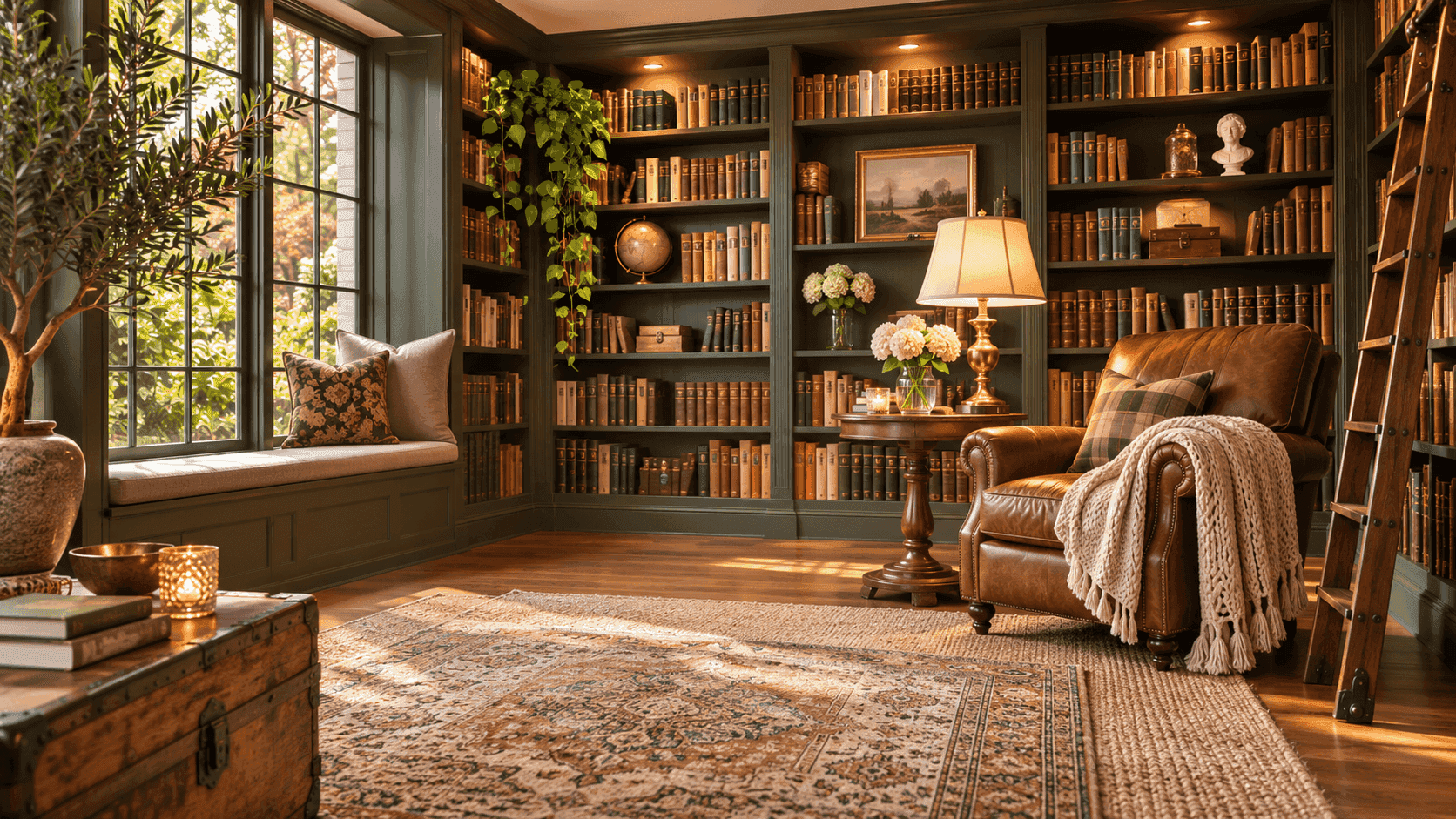
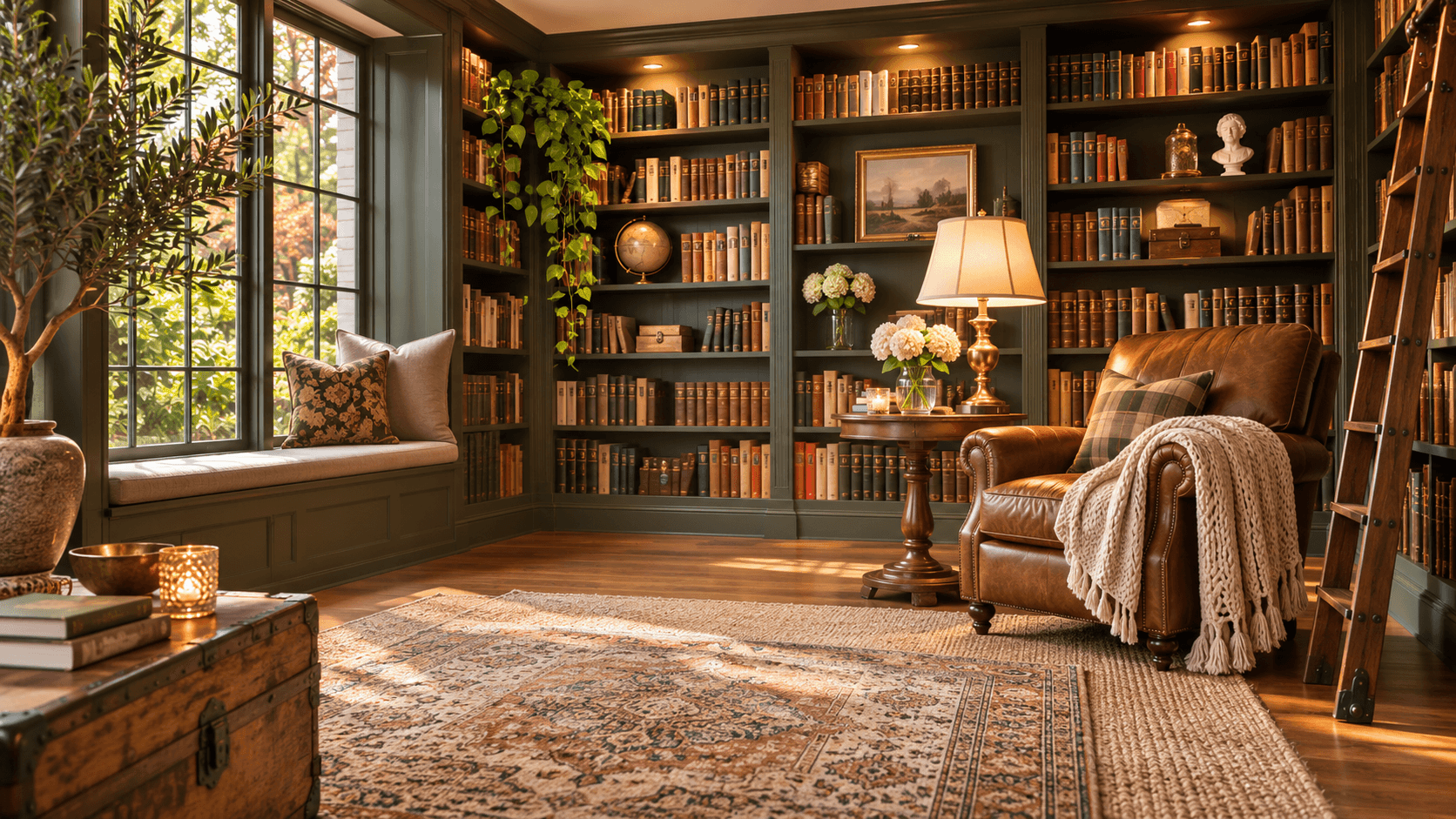
Home Library Ideas: 13 Library Room Designs and the Shelf, Floor, and Light Math Behind Them
by 10 Federal Storage
Published on November 6, 2026
Every home library idea gallery shows the same room: shelves to the ceiling, a rolling ladder, a deep chair under a window. What none of them show is the weight. A single 12-foot wall of full bookshelves holds more than a ton of paper, and the floor under it, especially in the spare bedroom where most home libraries end up, was designed for a lighter load than most people assume.
This guide covers 13 home library and library room ideas, from a full spare-room library to a hallway, a closet, an attic, and a window seat. It attaches the numbers that decide whether each one works: how much shelf your collection needs, what that shelf weighs, how far a shelf can span before it sags, how much light you need to read compared with how much your books can take, and when to bring in a structural engineer.
The sources are the ones libraries, builders, and conservators use rather than other storage blogs: the International Residential Code and International Building Code, library space-planning guidance from OCLC’s WebJunction, a professional engineer’s shelf-deflection tables from the Journal of Light Construction, and preservation leaflets from the Northeast Document Conservation Center (NEDCC).
Two things this guide says plainly that inspiration posts skip. A beautiful library in the wrong room can sag the shelves, the floor, or both. And near the end, we explain when you do not need a storage unit while you build one, which is more often than you might expect from a storage company.
Table of Contents
- Start With a Book Count: How Much Shelf Your Library Needs
- The Weight of a Library: What a Wall of Books Puts on Your Floor
- Where to Put a Home Library: Room-by-Room Ideas
- Shelving That Does Not Sag: Spans, Materials, and Depth
- Built-In Bookshelves or Freestanding Bookcases
- Lighting a Home Library: Bright for Reading, Gentle on Books
- Library Room Design Ideas: Reading Chairs, Window Seats, Ladders, and More
- Organizing and Protecting the Collection
- Frequently Asked Questions About Home Libraries
- Storing Books During a Library Build or Renovation
- When You Do Not Need a Storage Unit for Your Books
- Build the Library Your Floor Can Carry
Start With a Book Count: How Much Shelf Your Library Needs
Most library plans start with furniture. Start with the books instead, because the collection decides how much wall you need, and the wall decides which room can hold it.
Library planners work in linear feet of shelf. OCLC’s WebJunction space-planning guidance designs shelving at about 8 volumes per linear foot, with 25 to 30 percent of each shelf left empty for growth and reshelving. Paperbacks pack tighter than that and art books looser, so the best number is your own: fill one shelf the way you normally would, measure it, and count the books.
Then run the math. Here it is for a 1,200-book collection:
- Books to linear feet: 1,200 books ÷ 8 per foot = 150 linear feet of books.
- Room to grow: 150 ÷ 0.75 = 200 linear feet of shelf, with a quarter of it open.
- Shelf to bookcases: a 36-inch-wide bookcase with seven shelves holds 21 linear feet, so 200 ÷ 21 comes to about 10 bookcases.
- Bookcases to wall: 10 bookcases at 3 feet each need 30 feet of wall.
Thirty feet is most of the usable wall in a 10-by-12-foot room once you subtract a door, a window, and a closet. That is why the room choice comes after the count, not before.
Shelf height and depth by book format
Shelf spacing decides how many shelves fit in a bookcase, and books come in a few predictable sizes:
- Mass-market paperbacks: about 7 inches tall. Plan 8 inches of clear height and 6 inches of depth.
- Trade paperbacks and most hardcovers: roughly 8 to 9 1/2 inches tall. Plan 10 to 11 inches of clear height and 8 to 10 inches of depth.
- Art books, atlases, and oversized volumes: 12 inches and taller. Plan 13 to 15 inches of clear height and 12 inches of depth, or store them flat.
A 10-inch-deep shelf with adjustable spacing handles most collections. NEDCC notes that shelving that is too shallow forces books to overhang the edge, where they get bumped and scuffed, so size each shelf to the deepest books it will hold, not the average.
The Weight of a Library: What a Wall of Books Puts on Your Floor
Books are heavy for their size. Architectural Graphic Standards, a standard reference for architects, puts their weight at about 25 pounds per cubic foot. On the shelf, that works out to roughly 20 to 40 pounds per linear foot, from mixed paperbacks at the low end to textbooks and art books at the top. When civil engineer Harris Hyman weighed his own shelf of engineering texts for a Journal of Light Construction column, it came to about 35 pounds per foot.
Here is what that means for one floor-to-ceiling library wall:
- Shelf length: a 12-foot wall with seven shelves is 84 linear feet of shelf.
- Books: at 25 pounds per foot, 2,100 pounds.
- Shelving: plywood bookcases of that size add roughly 400 pounds by our estimate, depending on material and trim.
- Total: about 2,500 pounds on a strip of floor 12 feet long and 1 foot deep, roughly 200 pounds per square foot under the shelves.
Now compare that with what a house floor is designed for. The International Residential Code (Table R301.5) sets minimum design live loads of 40 pounds per square foot (psf) for most rooms and 30 psf for sleeping rooms. The spare bedroom, the most common place to put a home library, sits in the lighter category. A 10-by-12-foot bedroom at 30 psf is designed for 3,600 pounds of live load spread across the whole room. One library wall puts about 70 percent of that along a single edge.
Commercial code shows how seriously engineers take books. The International Building Code (Table 1607.1) requires library stack rooms to be designed for 150 psf, five times the bedroom figure, because a library designer assumes the shelves will be full.
What this means, and what it does not
This is not a reason to panic, and it is not a structural assessment. Design loads include safety margins. A wall of shelving beside a bearing wall loads the floor very differently from the same shelves in the middle of a long joist span, and a ground-floor room on a concrete slab is a different situation from a wood-framed upper floor. Direction matters too: shelving that runs across the joists spreads its weight over many of them, while shelving that runs parallel to the joists can land most of its load on one or two.
It is a reason to get an answer before you build. Ask a structural engineer to review the plan when:
- The library is on an upper floor or over a garage.
- The shelves will stand mid-span rather than along a bearing wall.
- The floor already bounces, slopes, or squeaks when you cross it.
- You plan more than one full wall, or double-sided shelving in the middle of the room.
- The room is an attic, which Idea 7 below covers.
Where to Put a Home Library: Room-by-Room Ideas
Each idea below names what the space is good at and the constraint that decides whether it works.
Idea 1: The Spare Bedroom Library
The classic version: a whole room, a door that closes, and four walls to fill. It is also, at 30 psf, the room with the lowest floor design load in the living space, so use the weight math above. Put the heaviest shelves along walls near bearing walls where you can, and if the room is upstairs, add the engineer question to the list. A daybed or sleeper chair lets the room still host guests; keep a 3-foot path to it and to the closet.
Idea 2: The Living Room Library Wall
One wall of shelves around a window, fireplace, or television turns the busiest room in the house into a library without giving up a bedroom. Living areas are designed for 40 psf, and ground-floor living rooms often sit on a slab or over a basement. The usual constraint here is light: a west- or south-facing wall can put direct sun on the spines every afternoon, which the lighting section addresses.
Idea 3: The Home Office Library
Reference books within reach of the desk and everything else above. Keep the books you use weekly between knee and shoulder height, and give the desk its own lamp rather than relying on shelf lighting. If the office doubles as a video-call backdrop, the shelf behind the chair is the one to style.
Idea 4: The Hallway or Landing Library
Long hallway walls are rarely used for anything, which makes them good library space. The constraint is width. The IRC sets the minimum residential hallway width at 3 feet, so a 42-inch hallway lined with 10-inch shelves leaves 32 inches. Hallway libraries usually mean shallow shelves, 6 to 8 inches deep for paperbacks, or a wider landing. Check with your building department before building in shelves that would narrow a hallway below 36 inches.
Idea 5: The Under-Stair Library
Open shelves fitted into the triangle under a staircase use space that otherwise holds the vacuum. Never cut or notch the stair stringers to gain a few inches. If you close the space in with a door, the IRC (Section R302.7) requires the enclosed side to be protected with 1/2-inch gypsum board, because a fire in an enclosed under-stair space can burn through the stair above it.
Idea 6: The Closet Library
A walk-in closet with the rod removed becomes a small book room or a reading nook with one chair. Closets are interior, dark, and away from exterior walls, which suits books. Add a switched light at the door, and leave the door open or louvered so the air does not go stale.
Idea 7: The Attic Library
The most romantic location and the one least likely to be structurally ready. IRC Table R301.5 designs uninhabitable attics without storage for 10 psf and attics with limited storage for 20 psf. Even a run of half-height shelves along a knee wall puts far more than that on its footprint. Attics also run much hotter than the rooms below in summer. Our guide to remodeling an attic for storage explains how to find your attic’s actual design load before you put anything heavy up there.
Idea 8: The Basement Library
A basement slab is often the strongest floor in the house, and basements usually have the most open wall. The tradeoffs are water and cold exterior walls. NEDCC recommends keeping books at least 3 inches away from exterior walls, especially in basements, and never storing them directly on the floor. Raise the bottom shelf several inches, keep bookcases off the foundation walls, and solve any dampness before the books go down.
Shelving That Does Not Sag: Spans, Materials, and Depth
Shelves rarely break. They sag. In his Journal of Light Construction column on shelf design, Hyman, a licensed professional engineer, showed that under a full load of books the bending stress in ordinary shelving is far below what the material can take. Stiffness, not strength, decides whether a shelf works. He put the acceptable limit at about 1/32 inch of sag per foot of span, roughly the point where you stop noticing it.
His table of maximum spans for shelves loaded at 35 pounds per linear foot, with sag held to 1/400 of the span:
- 3/4-inch particleboard, 7 1/2 inches deep: 18 inches.
- 3/4-inch plywood, 7 1/2 inches deep: 26 inches.
- 1x10 softwood: 30 inches.
- 1x12 softwood: 32 inches.
- 1x12 hardwood: 37 inches.
- 5/4x10 softwood: 41 inches.
Deeper shelves are somewhat stiffer than the 7 1/2-inch boards in the table, but the pattern holds. A typical flat-pack bookcase with particleboard shelves around 30 inches wide is well past the particleboard figure, which is why those shelves bow under hardcovers. Paperbacks, at a fraction of the weight, give them an easier life. NEDCC adds the second consequence: when shelves bow, the whole unit can become unstable.
Four ways to stop sag, from Hyman’s column and ordinary shop practice:
- Shorten the span. A vertical divider turns one 36-inch shelf into two 18-inch shelves.
- Use a stiffer material. Plywood or solid wood over particleboard, and 5/4 boards for long runs.
- Add a front edge strip. Hyman found that a 1-by-3/4-inch strip glued and screwed to the front edge increases the allowable span by 50 to 75 percent, and support along the back adds about another 25 percent.
- Match the load to the shelf. Heavy books go on short spans and bottom shelves; paperbacks go on the long ones.
Built-In Bookshelves or Freestanding Bookcases
Built-in bookshelves are the look most people picture: floor to ceiling, scribed tight to the walls, with no gaps at the top. They use every inch, the spans can be designed to the books from the start, and they are fastened to the structure by definition. The tradeoffs are cost and permanence. Built-ins stay with the house, and on an exterior wall they also need the air gap NEDCC recommends, which means a ventilated back or a few inches of standoff from the wall.
Freestanding bookcases cost less, move with you, and work for renters. Lined up side by side in matching widths, fastened to each other, and finished with a strip of trim along the top and a baseboard across the bottom, they can pass for built-ins at a fraction of the price.
Anchor every bookcase
Whichever route you take, a tall bookcase full of books is exactly the kind of furniture that tips. The U.S. Consumer Product Safety Commission (CPSC) reported an estimated annual average of 19,400 emergency-department-treated injuries from furniture, television, and appliance tip-overs from 2019 to 2021, and 482 children killed in tip-over incidents from 2000 through 2021. CPSC’s first recommendation is to anchor furniture such as bookcases securely to the wall.
- Fasten into framing, with metal brackets or straps screwed into studs, not drywall anchors alone.
- Check plastic anti-tip kits. CPSC has recalled at least one line of anti-tip kits because its plastic zip ties could become brittle over time.
- Load from the bottom up. Heavy books on low shelves keep the center of gravity down.
- Do not let anyone climb the shelves. A rolling ladder exists for a reason, and Idea 11 covers it.
Lighting a Home Library: Bright for Reading, Gentle on Books
A home library has two lighting jobs that pull in opposite directions. People need a lot of light to read. Books are slowly damaged by it.
On the reading side, Penn State’s energy course materials put comfortable reading and writing at home at about 50 footcandles, compared with 10 to 20 footcandles of general light for living rooms and bedrooms. Fifty footcandles is roughly 540 lux.
On the preservation side, NEDCC explains that light damage is cumulative: what matters is the light level multiplied by the time of exposure. Visible light fades colors, and ultraviolet light weakens, bleaches, and yellows paper. For scale, NEDCC puts standard office lighting at about 400 lux and direct sunlight at about 30,000 lux. A shelf in direct sun is getting more than 50 times the light you need on the page to read comfortably, for hours at a time. Faded spines on one end of a shelf are the first sign.
The way through is to light the reader, not the books:
- Put a task lamp at every chair, positioned to throw light over your shoulder onto the page.
- Keep shelves out of direct sun. Use the walls perpendicular to the windows, or the wall the windows face away from.
- Filter the windows. NEDCC recommends ultraviolet-blocking film and shades on windows and skylights, closed during the brightest part of the day.
- Treat shelf lighting as display lighting. Picture lights and in-shelf strips look wonderful; put them on a dimmer or a timer and turn them off when no one is browsing.
- Choose warm light. NEDCC notes that warm light, around 2800K to 3000K, has long been preferred in museum settings when light levels are kept low.
One design note: dark academia walls and deep wood finishes absorb light, so a dark library needs more task lighting than a white one to reach the same level on the page.
Library Room Design Ideas: Reading Chairs, Window Seats, Ladders, and More
The style choices, whether dark academia, cottage, minimalist, or color-coded rainbow shelves, are personal. The five ideas below are the features that make a library room work regardless of style, with the details that decide whether they are comfortable and safe.
Idea 9: The Reading Chair Zone
A library is a room for reading, so plan the chair before the decor: a chair with real back support, a side table at arm height, and the task lamp from the lighting section. Set the chair so window light comes from the side rather than from behind the page or into your eyes. In a small room, one good chair beats a sofa you will not read on.
Idea 10: The Window Seat Library
Bookcases on both sides of a window with a cushioned seat between them is the most photographed library idea for good reason. Two details matter. The shelves flanking the window are in the sun-exposure zone, so use UV film and keep valued books on the shaded side. And cabinets under the seat sit against an exterior wall; NEDCC recommends periodically opening closed cabinets against exterior walls so air does not stagnate, which argues for open cubbies or vented doors.
Idea 11: The Rolling Ladder Library
A rolling ladder is what makes floor-to-ceiling shelves usable, and it is a real piece of equipment. The rail carries the climber’s full weight, so it needs to be fastened into studs or solid blocking. Ladder makers commonly set rolling ladders at roughly 75 to 80 degrees from the floor, which puts the foot of a ladder on an 8-foot rail roughly 17 to 26 inches out from the shelf face. That is fine in a library room and a problem in a 36-inch hallway. Check the ladder’s weight rating, and keep the floor under it hard or low-pile so the wheels track.
Idea 12: The Hidden Library Behind a Bookcase Door
A bookcase that swings open into a reading room is the most requested library feature on the internet. It is also the most likely to be overloaded: a loaded bookcase door can weigh 300 to 500 pounds or more, beyond some hinge kits’ ratings. Our hidden room ideas guide works through the door-weight math and the safety rules, including a release on the inside that a child can operate.
Idea 13: The Kids’ Library Corner
Low shelves with books turned to face forward let children choose by cover, which is how pre-readers choose. Keep everything within their reach, anchor every unit even if it is short, and put heavy picture books on the bottom. A floor cushion and a lamp they can switch on themselves make the corner theirs.
Organizing and Protecting the Collection
A library that cannot be browsed is a warehouse. Pick a system that matches how you look for books: by genre and then author for fiction, by subject for nonfiction, and a to-be-read shelf at eye level. Color-sorted shelves photograph beautifully and work best for people who remember books by their covers.
Whatever the system, a few shelving rules from NEDCC’s storage and handling leaflet keep books in good condition:
- Leave room. Books should not be packed so tightly that they are damaged coming off the shelf. The 25 to 30 percent of open shelf from the planning section is also what makes reshelving easy.
- Support them upright. Use bookends with smooth surfaces and broad edges. NEDCC notes that thin wire bookends often damage books.
- Shelve by size where you can, because small books cannot support large ones.
- Lay the heaviest books flat, in stacks of two or three, so the text block does not pull away from the binding.
- Never shelve a tall book spine up. If it will not fit upright, adjust the shelf or lay it spine down.
- Take books out by the middle of the spine, or push the neighbors back first. Pulling from the top of the spine tears it.
- Remove pressed flowers, clippings, and old bookmarks. Acidic paper inserts stain the pages around them.
- Keep air moving. Do not block heating or cooling vents with shelving, and keep books off the floor.
Finally, keep a list. A simple spreadsheet with title, author, and shelf location helps you find books, document the collection for insurance, and count linear feet when the shelves eventually need to be emptied.
Storing Books During a Library Build or Renovation
Building a library usually starts by emptying a room: painting, new flooring, built-ins, or reinforcement all go faster with nothing in the way. For most rooms that is a few boxes in a hallway. For a library, it is the heaviest thing in the house moving all at once, and it is worth sizing before you start, whether the books are headed to the garage or to a storage unit.
The packing math uses the same small moving box that suits books best, about 16 by 12 by 12 inches, or roughly 1.3 cubic feet. It holds about 2 linear feet of books, which puts a full box somewhere around 40 to 50 pounds. If a box is hard to lift, take a few books out. For the 1,200-book collection from the planning section:
- Linear feet: 150 linear feet of books.
- Boxes: 150 ÷ 2 = about 75 small boxes.
- Weight: roughly 3,000 to 3,750 pounds, which is worth knowing before you plan how many trips the car can make.
Pack books the way they sit on a shelf, upright on their bottom edges, or flat. Never rest them on the fore-edge or stand them spine up. Put rigid plastic bins or the sturdiest boxes on the bottom of every stack, and keep stacks short. Our guide to packing for long-term storage explains why book boxes should stop at about four high, and how cardboard loses strength the longer it carries a load.
What size unit a library needs
Book boxes fill a unit by weight and stack height long before they fill it by volume. Using small boxes stacked four high, with a 2-foot aisle down one side so you can reach the back:
- 5x5 unit: about 40 boxes, roughly 80 linear feet or 640 books.
- 5x10 unit: about 84 boxes, roughly 168 linear feet or 1,340 books. The 1,200-book example fits here.
- 10x10 unit: the books plus freestanding bookcases, a reading chair, and a desk.
Paper, glue, and cloth bindings do better away from extreme heat. For a library that will spend a summer in storage, a climate-controlled unit, which is temperature-regulated and protects against extreme temperatures, is the safer choice. Whatever unit you choose, set the boxes on pallets so none sit directly on the floor.
To size your own collection, our storage size calculator turns a list of belongings into a recommended unit size, and the unit size guide shows what fits in each. You can browse small units or medium units near you.
When You Do Not Need a Storage Unit for Your Books
We run storage facilities, and for many library projects the honest answer is that you do not need one. Skip the unit when:
- The project takes a weekend. Painting a room or assembling a few bookcases means stacks of books on the bed and in the hallway for two days, not a lease.
- You can work one wall at a time. Empty a wall, build or paint it, reload it, and move on. The books never leave the room.
- The collection is getting smaller. If you are culling, do it before the move, not after paying to store the books you will give away. Library Friends groups, used bookstores, and schools take donations, and every book you pass on is one you do not have to box, lift, or shelve.
- The books are rare or valuable. First editions, signed copies, and antiquarian books belong with an appraiser, a conservator, or a stable interior room of your home during a project. A climate-controlled unit is temperature-regulated, but it is not an archival environment, and collections whose care guidelines call for tightly controlled conditions belong with a specialist.
- You are reading them. Keep a working shelf of current reads and reference books at home. A box in a unit is a long way from the bedside table.
- The real fix is structural. If an engineer says a floor needs reinforcement, the work comes first. Renting a unit while you wait for a plan is money spent on nothing.
Where a unit earns its cost is the larger job: a full room of built-ins, a floor being reinforced or replaced, a move between houses while the new library is built, or a home with no spare room to absorb a ton and a half of books for a few weeks.
Frequently Asked Questions About Home Libraries
How much space do I need for a home library?
It depends on the number of books. Library planning guidance assumes about 8 books per linear foot of shelf, with 25 to 30 percent of the shelf left open for growth. A 1,000-book collection needs about 167 linear feet of shelf, roughly eight 36-inch bookcases with seven shelves each, or about 24 feet of wall.
How deep should bookshelves be for a home library?
About 10 inches deep fits most hardcovers and trade paperbacks. Paperback-only shelves can be 6 to 8 inches deep, and art books, atlases, and other oversized volumes need about 12 inches. Shelves that are too shallow leave books overhanging the edge, where they get bumped and damaged.
How do I keep bookshelves from sagging?
Shorten the span, use a stiffer material, or stiffen the front edge. In a Journal of Light Construction engineering table, 3/4-inch particleboard spanned about 18 inches under a full load of books, compared with about 26 inches for 3/4-inch plywood. A wood strip glued and screwed to the front edge can increase the allowable span by 50 to 75 percent.
Can my floor hold a wall of books?
It depends on the floor, and it is worth checking before you build. A floor-to-ceiling bookshelf wall can weigh about 2,500 pounds. The International Residential Code designs most rooms for 40 pounds per square foot and bedrooms for 30, while library stack rooms in commercial buildings are designed for 150. For upper floors, attics, bouncy floors, or more than one full wall, ask a structural engineer.
Can you put a home library in an attic?
Only if the attic floor was designed or reinforced for it. The International Residential Code designs uninhabitable attics for 10 or 20 pounds per square foot, well below what bookshelves put on the floor beneath them. Attics also get very hot in summer. Confirm the design load with the truss drawings or a structural engineer first.
Is direct sunlight bad for books?
Yes. Light damage is cumulative, and direct sun is roughly 30,000 lux, far brighter than indoor lighting. Visible light fades spines and covers, and ultraviolet light weakens and yellows paper. Keep shelves out of direct sun and consider ultraviolet-filtering window film.
Should books be stored upright or flat?
Most books should stand upright, supported by bookends or by neighboring books of similar size. Very large or heavy books are better stored flat in short stacks of two or three. A book that is too tall for its shelf should lie flat or stand spine down, never spine up.
Do bookcases need to be anchored to the wall?
The U.S. Consumer Product Safety Commission recommends anchoring furniture such as bookcases securely to the wall to prevent tip-overs. Fasten tall bookcases into wall framing with metal brackets or straps, and keep the heaviest books on the lowest shelves.
Build the Library Your Floor Can Carry
The best home libraries look effortless, and they rest on decisions nobody photographs: a book count that set the wall length, a room whose floor can carry the weight, shelves short or stiff enough not to sag, lamps aimed at the reader instead of the spines, and bookcases anchored to the wall. Get those right and the style, the ladder, and the window seat are the easy part.
Count the books first, then pick the room, then build the shelves. If the project needs somewhere to keep the collection while the work happens, a month-to-month unit sized with the math above keeps every box together until the shelves are ready.
About the Author
10 Federal Storage
Our team at 10 Federal Storage has been in the self storage industry for decades. With knowledge gained from multiple universities and in the field, we are well-prepared and excited to assist with your storage needs. When you rent a unit with us, you can feel confident that our seasoned customer service team’s help will make your transition as seamless as possible. Customer satisfaction is our number one priority, and we strive to make your experience exceptional with our automated leasing options, diverse unit sizes, and a strong commitment to sustainability.