


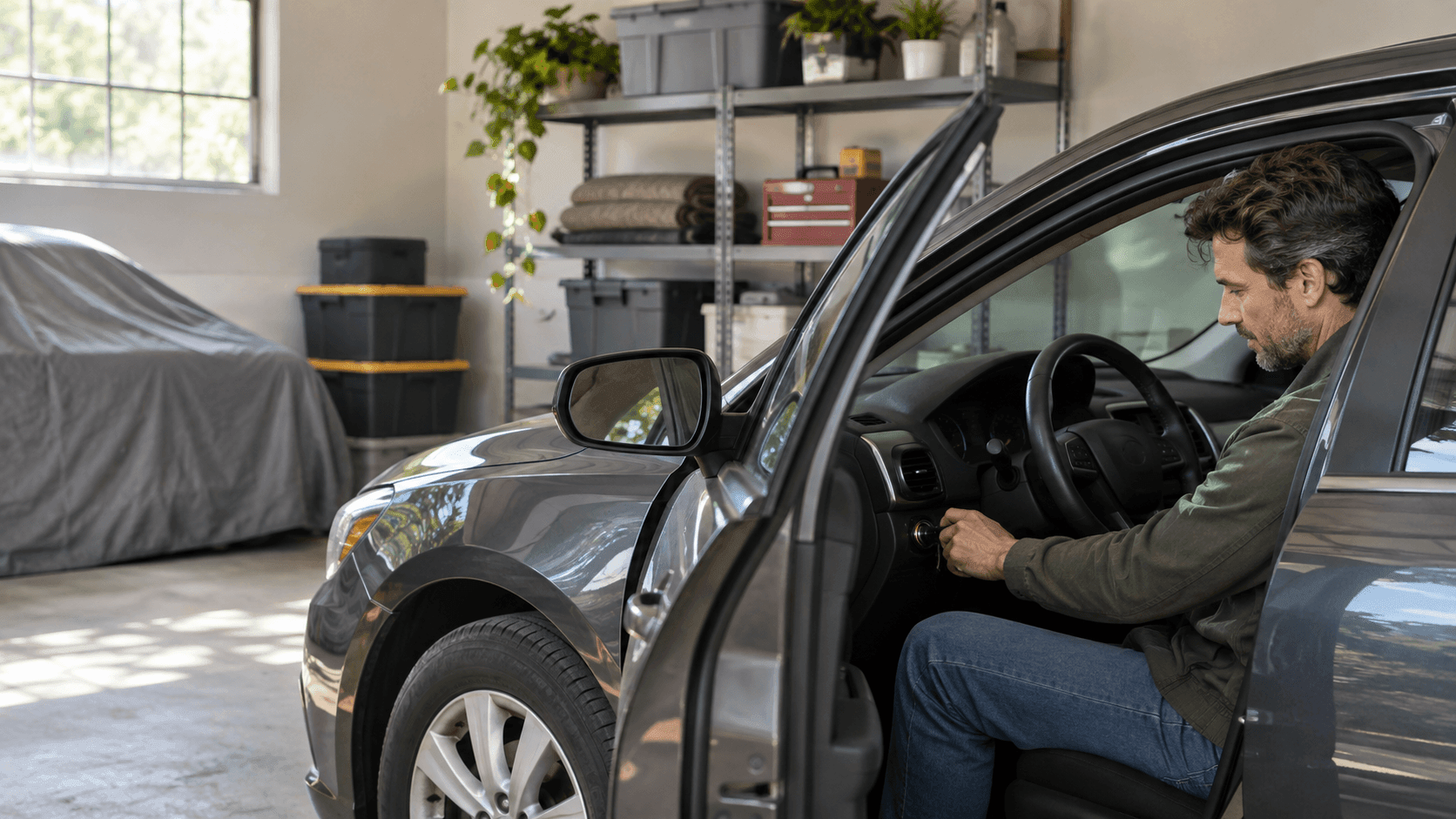
How Often Should You Start Your Car in Storage? Drive It or Leave It Alone?
by 10 Federal Storage
Published on November 6, 2026
The advice you’ll hear most often is to start a stored car every couple of weeks. It’s half right, and the wrong half can cost you a battery. Starting a car and letting it idle for a few minutes doesn’t recharge the battery, and it leaves water and unburned fuel sitting in the engine oil. Do it with the car parked inside an enclosed storage unit and you add a carbon monoxide hazard on top.
The real answer is simpler and a little counterintuitive: either drive the car properly or don’t start it at all. A short start-and-idle is the one option that does more harm than leaving the car alone.
This guide gives you a direct answer first, then the arithmetic behind it: how many days a typical car battery can sit before it needs attention, why a 15-minute drive can’t refill weeks of drain, and what to do instead when you can’t get to the car. It also covers hybrids and electric vehicles, which play by different rules, and it’s honest about the situations where renting storage for a car is the wrong call.
Table of Contents
- The Short Answer: Drive It or Leave It Alone
- Why Starting a Car and Letting It Idle Does More Harm Than Good
- Never Run the Engine Inside a Storage Unit
- The Battery Math: How Long a Parked Car Can Actually Sit
- Why a 15-Minute Drive Every Two Weeks Doesn’t Refill the Battery
- What a Proper Maintenance Drive Looks Like
- A Starting Schedule by How Long the Car Will Be Stored
- If You Can’t Visit: Prepare the Car Instead of Starting It
- Hybrids and Electric Vehicles Follow Different Rules
- Bringing a Stored Car Back on the Road
- Frequently Asked Questions
- Choosing a Storage Space for a Car You Plan to Visit
- When Storage Makes Sense for a Car and When It Doesn’t
- The Bottom Line
The Short Answer: Drive It or Leave It Alone
If you can drive the car, take it out every two to four weeks for a drive of at least 20 minutes, long enough for the temperature gauge to reach normal and stay there for a while. If you can’t drive it, don’t start it at all. Prepare it for storage, disconnect the battery, and leave it until you’re ready to take it out.
Here is how that breaks down by situation:
- Parked for less than two weeks: Nothing special is needed. A healthy battery in a typical car handles a two-week sit without help.
- Parked for two weeks to two months: Either take it for a real drive every two to four weeks, or disconnect the battery and leave it parked. Don’t split the difference with idle-only starts.
- Parked for longer than two months: Do a full storage prep, then leave it. If you visit, visit to check on the car, not to idle it.
- Parked inside an enclosed unit: Never let the engine idle with the car inside, even with the door open. Start it and drive straight out.
The rule underneath all four is that a start without a real drive is worse than no start. The rest of this guide explains why, and gives you the numbers to plan around.
Why Starting a Car and Letting It Idle Does More Harm Than Good
Burning gasoline produces water vapor along with everything else that comes out of the tailpipe. In a warm engine, that moisture leaves with the exhaust. In a cold engine, some of it condenses on cold metal inside the crankcase and the exhaust system, and a little unburned fuel slips past the piston rings into the oil. A thorough drive heats the oil and the exhaust enough to drive both back out. A few minutes of idling doesn’t.
Lake Speed Jr., an oil and fuel specialist at Driven Racing Oil, described the habit of cranking a stored car every couple of weeks and shutting it off after a few minutes as “the worst thing you can do” in an interview with ClassicCars.com. His explanation: a cold engine run briefly picks up fuel dilution, blow-by, and crankcase moisture, and never gets warm enough to evaporate them. That moisture can lead to rust, and combustion byproducts collect in the engine and exhaust.
The battery fares no better. Interstate Batteries’ lab manager, Jeff Barron, puts it plainly: the alternator is not a battery charger. Below roughly 1,000 rpm the alternator is busy running the car’s own electronics, and the battery sees little or nothing. Interstate’s own conclusion is that a routine of starting and idling for a few days running will steadily drain a battery rather than charge it, because the start takes more than the idle puts back.
And the problems that sitting still causes, like flat-spotted tires and rust on brake rotors, aren’t touched by idling at all, because the car never moves.
None of this means a stored car should never run. It means the run has to be a real drive, or it shouldn’t happen.
Never Run the Engine Inside a Storage Unit
A drive-up storage unit is, for practical purposes, a single-car garage with one opening. The Centers for Disease Control and Prevention is unambiguous about engines in spaces like that: never leave the motor running in a vehicle parked in an enclosed or partially enclosed space. The U.S. Department of Housing and Urban Development’s guidance goes further and says never to idle a car in a garage even when the door is open to the outside.
Carbon monoxide has no color and no smell, and the CDC notes that it can cause sudden illness and death. The early symptoms (headache, dizziness, nausea, confusion) are easy to mistake for something else. Other renters may also be working in the units around yours.
So any advice to idle a stored car for 15 or 20 minutes needs a large asterisk when the car lives in an enclosed unit. Here is the routine that keeps the engine out of the box:
- Roll the door all the way up before you get in the car.
- Start the car and drive straight out. No warm-up inside the unit, not even a minute.
- Do any checking with the car outside. If you need the engine running to look at something, pull it fully clear of the unit first.
- Shut the engine off as soon as the car is parked when you bring it back, and close the door only after the engine is off.
- Turn hybrids fully off. A hybrid left in its ready mode can start its gasoline engine on its own with no warning (more on that below).
- Mind the remote start. If your car has remote start, store the fob where it can’t be pressed by accident, or disable the feature using the steps in your owner’s manual.
If anyone feels unwell after the car has been running near the unit, get to fresh air right away and call 911.
The Battery Math: How Long a Parked Car Can Actually Sit
A parked car is never fully off. With the key out and the doors locked, the engine computer holds its memory, the clock keeps time, the alarm watches the doors, and the keyless-entry receiver listens for your fob. That standing load is called key-off or parasitic draw. Battery Tender, which makes battery maintainers, puts normal parasitic draw at about 20 to 50 milliamps (mA), and the automotive trade publication Vehicle Service Pros cites a rule of thumb that it should be under 50 mA once the car’s modules go to sleep.
That sounds tiny, and per hour it is. The question is how long it takes to add up to a problem.
Where “a problem” starts
A battery doesn’t need to be dead to be in trouble. Battery University’s storage guidance is to recharge a lead-acid battery when it falls to about 70 percent state of charge, which reads around 12.4 volts on a 12-volt battery at rest. Battery maker Power-Sonic sets the same 12.4-volt floor and explains why: below it, lead sulfate crystals harden on the plates, and a battery left in a low state of charge for weeks or months can be permanently damaged. So the useful headroom in a fully charged battery is about 30 percent of its capacity, not 100 percent.
The arithmetic
Take a typical 60 amp-hour (Ah) car battery, the example size Battery Tender uses. Thirty percent of 60 Ah is 18 Ah of headroom before you hit the recharge point. Divide that by the daily draw:
- 20 mA draw: 0.48 Ah per day, so about 37 days to reach the 70 percent recharge point.
- 35 mA draw: 0.84 Ah per day, so about 21 days.
- 50 mA draw: 1.2 Ah per day, so about 15 days.
Those figures ignore the battery’s own self-discharge, which shortens every one of them. Power-Sonic notes that self-discharge roughly doubles for every 10°F above 75°F, so a car sitting through a Texas or Georgia summer burns through its margin faster than the same car in a cool garage. An older battery, an aftermarket alarm or dash camera, or a module that doesn’t fully go to sleep all push the numbers down too.
Manufacturers land in the same place
Published guidance clusters right where the arithmetic does. The 2007 Chevrolet Corvette owner’s manual says to remove the negative battery cable if the car won’t be driven for 25 days or more. Toyota’s UK technical team has told owners that a fully charged, healthy 12-volt battery should be fine for around two to four weeks. Polaris tells owners of its vehicles to put the battery on a charger or disconnect it after 30 days unused, and warns that 60 days unused may leave it unable to recharge.
The takeaway is that the battery problem shows up somewhere between two and five weeks for a typical car. That is exactly why “start it every two weeks” became the standard advice. The timing is right. The fix is the part that doesn’t work.
Why a 15-Minute Drive Every Two Weeks Doesn’t Refill the Battery
The most widely repeated version of the advice comes from Edmunds: have someone start the car every two weeks and drive it for about 15 minutes. Battery specialists disagree with the battery part of that. Interstate Batteries says it takes roughly four to eight hours of highway driving to meaningfully charge a car battery, that the alternator won’t take it all the way to full, and that the familiar “drive 30 minutes and you’re fine” rule doesn’t hold up. Their explanation is that once the engine is above about 1,000 rpm, the battery gets “an amp or two” while the alternator handles everything else.
Put those numbers next to the drain from the previous section and the gap is obvious:
- Two weeks of sitting at 30 mA (the middle of the normal 20 to 50 mA range) removes about 10 Ah (0.030 amps × 24 hours × 14 days).
- Refilling 10 Ah at 1 to 2 amps of net charging takes 5 to 10 hours of driving.
- A 15-minute drive at 2 amps puts back about 0.5 Ah, roughly 5 percent of what the two weeks took, before you subtract the energy the start itself used.
Repeat that every two weeks and the battery trends downward, visit after visit, which fits a familiar pattern: the car starts fine the first few times, then one visit it doesn’t.
So who’s right?
Both, about different things. The periodic drive is genuinely good for the car’s mechanical systems. It brings the oil and exhaust up to temperature, moves the tires off their flat spots, scrubs surface rust from the brake rotors, and exercises seals and the transmission. What it can’t do is refill weeks of battery drain.
The practical answer is to treat the battery as its own problem with its own fix:
- Disconnect the negative terminal when you park the car, and reconnect it when you come back to drive. With the key-off draw gone, only the battery’s slow self-discharge remains.
- Take the battery home and keep it on a smart maintainer if the car will sit for months.
- Top it up with a plug-in charger before or after visits if you have somewhere to charge it.
Disconnecting will usually reset the clock and radio presets, and some cars need a short relearn procedure afterward, so check the battery section of your owner’s manual first.
What a Proper Maintenance Drive Looks Like
If you’re going to visit a stored car to drive it, make the drive count. ClassicCars.com’s guidance for owners who choose to run their cars through a winter is that the engine must reach full operating temperature and the car should go out for at least 20 minutes. That lines up with the mechanical reasons above: the goal is heat and motion, not just rotation.
- Check the tires before you leave. The National Highway Traffic Safety Administration says tires lose about 1 psi a month, and cold weather takes more. A tire that was fine when you parked may be noticeably low a few months later.
- Drive for at least 20 minutes, ideally 30, with the temperature gauge at normal for most of it. A short loop around the block doesn’t get there.
- Include some sustained highway-speed driving. Steady higher rpm is where the charging system has the most to spare, and it helps clear moisture from the exhaust.
- Brake firmly a few times once you’re clear of traffic. Rotors that have sat pick up a film of surface rust, and normal braking wipes it off.
- Listen and look. Visits are also your early warning system. A new noise, a warning light, or a drip on the floor of the unit is easier to deal with now than in three months.
- Reset the car for the next sit when you park it: shut the engine off promptly, release the parking brake and chock the wheels, and disconnect the battery again if that’s your plan.
If you get to the car and don’t have time for a real drive, skip the start. Check the tires, look for leaks or signs of pests, and leave. That visit still did its job.
A Starting Schedule by How Long the Car Will Be Stored
How much you need to do depends almost entirely on how long the car will sit. Storage guidance attributed to a GM engineer and published by the Corvette Action Center, an owners’ resource, makes the same point: start the car once a month if that’s practical, and if it isn’t, prepare it according to how long it will be stored. Here is how that plays out in practice.
Up to two weeks
Do nothing special. Park it, lock it, and come back. A healthy battery has the margin for it, and the fuel in the tank is still fresh.
Two weeks to two months
This is the range where people get into trouble with idle starts, because it feels too short to bother with a full storage prep. Pick one of two plans and stick to it. Either drive the car properly every two to four weeks, or disconnect the battery, bring the tires to the pressure on the door placard, and leave the car alone until you need it. Don’t drop in to idle it between those options.
Two to nine months
Do a full storage prep (covered in the next section) and don’t start the car until you take it out for good. The GM guidance for storage of nine months or less is short: change the oil and filter, store the car with a full tank, and disconnect the negative battery cable. Before driving it again, change the oil and filter once more to clear out any moisture that collected in the crankcase, and charge the battery.
Visits are still worthwhile during this stretch, as long as you’re there to look rather than to run the engine. Check for leaks, pests, and tire pressure, and confirm the cover and the lock are intact.
Longer than nine months
Follow the extended-storage procedure in your owner’s manual, and consider having a shop do the prep. For storage beyond 18 months, the GM guidance adds steps like putting a small amount of oil into each cylinder and draining the fuel system. At this length, the car should be treated as laid up, not parked, and its return to the road deserves a proper inspection.
If You Can’t Visit: Prepare the Car Instead of Starting It
For a car you won’t see for months, preparation does everything the periodic start was supposed to do, and does it better. Our long-term car storage checklist walks through every step. These are the ones that replace the need to start the car:
- Change the oil and filter before storage. Used oil carries acidic combustion byproducts that sit against engine internals the whole time the car is parked.
- Deal with the battery. Disconnect the negative terminal, or remove the battery and keep it on a smart maintainer somewhere you can plug it in.
- Release the parking brake and chock the wheels. Pads clamped against rotors for months can stick to them.
- Bring the tires to the placard pressure and check them again at every visit.
- Remove food and trash, and block the exhaust tip with steel wool if pests are a concern. Leave a note on the steering wheel so you remember to pull it out before starting.
- Use a breathable car cover, not a plastic tarp.
The fuel question doesn’t have one answer
Fuel is where published guidance genuinely conflicts. ExxonMobil’s consumer guidance suggests using gasoline within about a month of purchase and, for a vehicle that won’t run for an extended period, draining the tank and running the engine until it stalls. The manufacturer storage instructions reviewed for this post take the opposite approach: fill the tank and add a fuel stabilizer. The GM guidance above calls for a full tank, Polaris specifies a full tank treated with stabilizer, and Firestone Complete Auto Care recommends a full tank to limit moisture in the tank.
For a modern car stored for months, follow your owner’s manual first. If it doesn’t address storage, the full-tank-with-stabilizer approach is the one those instructions describe, and it’s far simpler than draining a fuel system. Add the stabilizer before your last fill-up and drive a few miles so treated fuel reaches the lines and injectors.
Hybrids and Electric Vehicles Follow Different Rules
The idle-versus-drive question looks different when there’s a high-voltage battery in the car, and the right answer comes from the manufacturer rather than from general advice.
Hybrids
Most hybrids still have a conventional 12-volt battery for the electronics, and it’s charged by the high-voltage system only while the car is on. Toyota’s UK team has advised owners whose hybrids aren’t being driven to put the car in its ready mode for about an hour roughly once a week, and notes that the gasoline engine may start on its own during that time and that the car shouldn’t be left unattended.
That advice assumes an open driveway. In an enclosed storage unit, ready mode means an engine that can fire up without warning in a closed space, so it’s off the table there. For a stored hybrid, plan on a real drive instead. Toyota’s Prius manual asks owners to drive the car at least once every several months for at least 30 minutes or 10 miles to keep the hybrid battery healthy, and the 12-volt battery needs the same attention as any other car’s.
Electric vehicles
An EV has no engine to start, so the question becomes how much charge to leave in the battery and whether the car can stay plugged in. Manufacturers differ:
- Tesla recommends leaving the car plugged in during storage. Its Model 3 manual notes the car can lose about 1 percent of charge per day when parked, depending on settings, and its Model S manual warns that a battery left at zero charge for an extended period can be permanently damaged.
- Volvo recommends a 40 to 50 percent state of charge for storage longer than a month, with regular checks of the charge level.
The arithmetic matters here too. An EV that loses a percent a day will go from 50 percent to roughly 20 percent in a month without a charger. If the storage space has no outlet, visits should be about driving the car to a charger, and the storage section of your owner’s manual should set the plan.
Bringing a Stored Car Back on the Road
The first start after a long sit is the one that deserves the most care. Work through this before you turn the key:
- Pull the reminders. Remove the exhaust plug, any cover, and anything you left under the hood.
- Look for pests. Check the engine bay, the air filter box, and the cabin for nests or chewed wiring before you put power to anything.
- Check the battery. Reconnect it and measure the resting voltage if you can. At or below about 12.4 volts, charge it before starting rather than asking the starter to do the work.
- Check the tires. At roughly 1 psi a month plus temperature swings, a car stored over a season can come back well under pressure.
- Check under the car. Note any drips on the floor and check the oil and coolant levels.
- Start it and drive gently. Pull fully out of the unit, let the engine settle for a few seconds, then drive off easy for the first few miles. Expect the brakes to feel slightly rough until the surface rust wears off.
If the car sat for more than a few months, follow the return-to-service steps in the manual too. GM’s guidance calls for a fresh oil and filter change before driving after storage.
Frequently Asked Questions About Starting a Car in Storage
How often should I start my car in storage?
If you can drive it, take it out every two to four weeks for at least 20 minutes, long enough for the engine to reach normal operating temperature. If you can’t drive it, don’t start it at all. Prepare it for storage and disconnect the battery instead. Starting the car and letting it idle without driving tends to do more harm than leaving it alone.
Is it bad to start a car and not drive it?
Usually, yes. A brief idle doesn’t heat the engine enough to clear the water and unburned fuel that a cold start leaves in the oil and exhaust, and it doesn’t put back the battery charge the start used. A real drive or no start at all are both better choices.
How long can a car sit without being started?
For a typical car with normal key-off battery draw, the battery usually needs attention somewhere between two and five weeks, sooner in hot weather or with an older battery. With the battery disconnected and the car properly prepared, it can sit for months. Fuel, tires, and seals each have their own timelines, so longer storage calls for a full prep.
Can I idle my car in a storage unit to charge the battery?
No. Running an engine in an enclosed space risks carbon monoxide poisoning, and the CDC advises never leaving a motor running in an enclosed or partially enclosed space such as a garage. Idling also does very little to recharge a battery. Drive the car out of the unit before doing anything with the engine running.
Should I disconnect my car battery while it’s in storage?
If the car will sit for more than about three to four weeks without being driven, disconnecting the negative terminal is a sound default unless your owner’s manual says otherwise. Expect the clock and radio presets to reset. Keeping the battery on a smart maintainer is the alternative when you have power where the battery is.
Will idling my car for 15 or 20 minutes charge the battery?
Not meaningfully. Battery specialists at Interstate Batteries say the alternator sends the battery only an amp or two even above idle speed, and that fully charging a battery by driving takes hours of highway miles. A plug-in charger is the reliable way to restore a low battery.
Do I need to start an electric car that’s in storage?
No, there’s no engine to run. What matters is the battery’s state of charge and whether the car can stay plugged in. Manufacturers’ storage recommendations differ, so follow the storage section of your owner’s manual.
How long should I drive a stored car when I take it out?
Aim for 20 to 30 minutes, including some steady highway-speed driving, with the engine at normal operating temperature for most of the trip. That exercises the engine, tires, and brakes. It won’t fully recharge a depleted battery, so handle the battery separately.
Choosing a Storage Space for a Car You Plan to Visit
Everything above applies wherever the car is parked. If you’re weighing a facility for vehicle storage, a few details decide how well your plan will work in practice.
- Outdoor space or enclosed unit. 10 Federal Storage offers both outdoor parking spaces and drive-up enclosed units, with availability varying by location. An outdoor space is the more affordable choice and keeps the car out in the open when you start it. An enclosed unit keeps it out of the sun and weather, and calls for the drive-straight-out routine every time.
- No power in the unit. 10 Federal units aren’t powered, so a battery maintainer inside the unit isn’t an option. Plan on disconnecting the battery between visits, or taking it home to charge.
- Access on your schedule. Nearly all 10 Federal locations offer 24/7 gate access, which makes a drive every few weeks realistic: a Saturday-morning loop or an evening run after work, without office hours in the way.
- The right size. Most sedans and small SUVs fit a 10x20 enclosed unit. Measure the car’s full length, then check the door opening height if the vehicle is tall or has a roof rack. The vehicle storage size estimator gives you a starting size.
- Do the prep before you arrive. Oil changes, fluid work, and other maintenance aren’t permitted on site, and stored vehicles need current registration, insurance, and to be operable without leaks.
Leases are month-to-month, so a seasonal car can come out in the spring without an annual commitment.
When Storage Makes Sense for a Car and When It Doesn’t
Storing a car away from home is a good fit for some situations and a poor one for others. It’s worth being clear about both before you rent anything.
It tends to make sense when:
- The car is seasonal and you’ll prep it properly and leave it, like a convertible over winter or a weekend car that sits through the hottest months.
- You’re leaving for months for a deployment, a work assignment, or extended travel, and you’d rather prep the car than sell it.
- You have a second car you’ll actually drive every few weeks but have nowhere to keep it at home, or HOA or street-parking rules won’t let it stay.
It probably doesn’t make sense when:
- The car will only sit for a couple of weeks and it’s allowed to stay where it is. A healthy car needs nothing for that stretch.
- Your plan depends on a battery maintainer running the whole time. Some collector cars and vehicles with unusually high key-off draw really do need constant power. A garage with an outlet serves them better than an unpowered unit.
- It’s an EV going into months of storage and the manufacturer wants it plugged in. Without an outlet, the car’s charge will drift down the whole time it sits.
- The plan is to stop by and idle it. If the visits won’t include real drives, renting a space nearby solves nothing. Prep the car and leave it, wherever it is.
- The car doesn’t run or is leaking fluids. Get it repaired first. Stored vehicles need to be operable and leak-free.
The Bottom Line
The right number of starts for a stored car is either a real drive every two to four weeks or zero. The battery gives you roughly two to five weeks before it needs help, a short drive can’t refill what weeks of sitting take, and an idling engine never belongs inside a closed unit. Handle the battery on its own terms, prep the car for how long it will actually sit, and every visit becomes a check-up instead of a gamble.
About the Author
10 Federal Storage
Our team at 10 Federal Storage has been in the self storage industry for decades. With knowledge gained from multiple universities and in the field, we are well-prepared and excited to assist with your storage needs. When you rent a unit with us, you can feel confident that our seasoned customer service team’s help will make your transition as seamless as possible. Customer satisfaction is our number one priority, and we strive to make your experience exceptional with our automated leasing options, diverse unit sizes, and a strong commitment to sustainability.