

How to Store a Refrigerator When It’s Not in Use: Shutdown, Storage, and a Safe Restart
by 10 Federal Storage
Published on November 6, 2026
A refrigerator that sits unplugged for a few months comes back one of two ways. Either you wipe it out, plug it in, and it hums back to life, or you open the door to a smell you can’t scrub out, find a cracked water line behind it, or listen to a compressor that won’t settle down. The difference is a few hours of preparation and one decision most people get wrong: how long to wait before plugging it back in.
This guide is built on what the manufacturers themselves publish. GE Appliances, Haier, LG, and Whirlpool all issue moving and shutdown instructions, and they don’t agree on everything. Where they differ, on restart wait times especially, you’ll see the full range and what drives it, so you can match the guidance to your own refrigerator.
It covers the two problems behind the most expensive surprises: water trapped in ice maker and dispenser lines when temperatures drop below freezing, and the conflict between the standard advice to leave the doors open and long-standing federal warnings about children trapped in unused refrigerators.
One more thing up front: storing a refrigerator isn’t always worth it. If it’s an aging second fridge, the honest answer may be to recycle it, and we make that case near the end.
Table of Contents
- How to Store a Refrigerator: The Short Version
- Why Stored Refrigerators Fail
- Empty, Unplug, and Defrost Without Damaging the Liner
- Drain the Water Line, Ice Maker, and Filter
- Clean and Dry Every Surface, Including the Parts You Can’t See
- The Door Problem: Airflow Versus Child Safety
- Moving a Refrigerator Without Hurting the Compressor
- Where to Keep It: Garage, Basement, or Storage Unit
- Bringing a Stored Refrigerator Back Into Service
- When Storing a Refrigerator Makes Sense, and When It Doesn’t
- What Size Storage Unit Fits a Refrigerator
- Frequently Asked Questions About Storing a Refrigerator
- The Bottom Line on Storing a Refrigerator
How to Store a Refrigerator: The Short Version
If you need the whole process on one screen, here it is. Each step is explained in the sections that follow.
- Empty it completely. Remove all food, drinks, and ice, plus the ice bin, shelves, and drawers.
- Shut off the water a day early. On models with an ice maker, Whirlpool’s moving instructions call for turning off the water supply at least one day ahead so the last batch of ice can drop.
- Unplug it and defrost with the doors open. Use towels and pans of hot tap water, never sharp tools or boiling water.
- Drain the water system. Disconnect the supply line, empty the ice bin, and remove the water filter. If the refrigerator could see freezing temperatures, GE’s owner’s manuals call for a qualified servicer to drain the water system.
- Empty the defrost drain pan. On models that have one, it sits under the cabinet and collects meltwater.
- Clean with a mild baking soda solution. Wash the liner, gaskets, shelves, and bins, then let everything air-dry with the doors open for at least a full day.
- Move it upright. Handle it from the sides, strap it to an appliance dolly, and keep it standing during transport.
- Store it upright and off the floor. Set it on a pallet or boards, cover it with a breathable cloth, and keep heavy items off the top.
- Prop the doors open and secure them. Hold the doors several inches open with a rigid spacer and a strap so they can’t swing shut, and keep the refrigerator where children can’t get to it.
- Restart it carefully. Follow your manual’s wait time if it was laid down, replace the water filter, flush the dispenser, and throw out the first few batches of ice.
Why Stored Refrigerators Fail
Almost every storage failure traces back to one of four causes. Knowing which one each step prevents makes the rest of this guide easier to follow.
- Trapped moisture and food residue. An unplugged refrigerator with its doors shut is a dark, sealed box at room temperature. Any crumb, spill, or film of water left inside becomes a mold and odor problem. The EPA’s guidance for homeowners puts it plainly: the key to mold control is moisture control, and wet items should be dried within 24 to 48 hours to prevent mold growth.
- Frozen water in the lines. Refrigerators with ice makers and through-the-door dispensers hold water in supply tubing, valves, internal lines, and the filter. GE’s owner’s manuals warn that if the temperature can drop below freezing, the water system should be drained by a qualified servicer to prevent serious property damage from flooding. The damage usually stays hidden until you reconnect the water.
- Displaced compressor oil. The compressor depends on oil that settles at the bottom of the sealed system. Tilt or lay the refrigerator down and that oil can move where it shouldn’t be. LG’s support guidance warns that plugging in before the oil settles can reduce cooling performance or seriously damage the compressor.
- Child entrapment. This isn’t a mechanical failure, but it’s the most serious risk on this list. The U.S. Consumer Product Safety Commission has warned for decades about children trapped and suffocated in unused refrigerators, and current owner’s manuals still carry the warning.
Notice what’s missing: none of these is caused by a refrigerator simply sitting idle. A clean, dry, drained refrigerator stored upright has very little that can go wrong. The work is in getting it to that state.
Empty, Unplug, and Defrost Without Damaging the Liner
Start a day or two before the move. Defrosting and drying take longer than most people expect, and rushing either one is how water ends up sealed inside a closed refrigerator.
Shut down the ice maker first
If your refrigerator makes ice, the shutdown begins a day early. Whirlpool’s moving instructions say to turn off the water supply to the ice maker at least one day ahead, wait for the last load of ice to drop, then switch the ice maker off and disconnect the water line from the back of the cabinet. Empty the ice bin and wash it with the other removable parts.
Empty and unplug
Remove every food item, condiment, and drink, then pull the shelves, crisper drawers, door bins, and anything else that lifts out. Pull the refrigerator straight out from the wall rather than wiggling it side to side. Haier’s moving guidance warns that “walking” a refrigerator can damage the floor and recommends laying down cardboard first. Then unplug it.
Defrost the right way
Frost-free refrigerators usually have little ice to deal with. Manual-defrost freezers, compact models, and older units can carry a thick layer. Leave the doors open, lay towels on the floor and in the bottom of the freezer, and give it time. If you want to speed things up, manufacturer manuals are specific about what is and isn’t safe:
- Pans of hot tap water are fine. GE’s freezer manuals allow pans of hot tap water below 120°F to speed defrosting.
- Boiling water is not. The same GE manuals say not to use boiling water because it can damage the freezer.
- No sharp or metal tools. Ice picks, knives, and metal scrapers can gouge the liner or puncture the cooling tubing behind it. A plastic scraper on frost that has already softened is the limit.
- Go easy on heat. GE’s chest freezer manuals say not to use any electrical device to defrost, while at least one GE refrigerator manual allows a hair dryer but warns that excessive heat can damage the plastic liner. If your manual doesn’t address it, skip the hair dryer and let time do the work.
Empty the drain pan
Many refrigerators route meltwater through a drain tube into a shallow pan under the cabinet, near the compressor. Haier notes that some models have a defrost drain tray that should be emptied, and a drain tube that should be checked, before moving. After a full defrost, that pan may hold the most standing water in the whole appliance. Empty it, wipe it out, and let it dry.
Drain the Water Line, Ice Maker, and Filter
Skip this section if your refrigerator has no ice maker, no dispenser, and no water filter. For everyone else, this is the step that prevents the most expensive storage damage, because a cracked component rarely announces itself until water is flowing through it again.
A refrigerator with a dispenser holds water in more places than the tubing you can see: the supply line at the back, an inlet valve, internal tubing, the ice maker mold, and the filter housing, plus a reservoir on many models. Disconnecting the supply line drains almost none of that.
- Close the supply valve at the wall or under the sink, ideally a day ahead, as described above.
- Disconnect the supply line from the back of the refrigerator with a towel underneath. Cap the end of the house line if the valve is old or doesn’t seal well.
- Empty the ice bin and discard any ice still sitting in the ice maker.
- Remove the water filter. GE’s manuals call for a new filter when the refrigerator goes back into service anyway, and a filter left in place is one more water-filled part.
- Get the internal water out if the refrigerator will see freezing temperatures. GE’s owner’s manuals are direct: if the temperature can drop below freezing, have a qualified servicer drain the water supply system to prevent serious property damage from flooding.
That last point matters most for garages, sheds, outbuildings, and standard storage units in places that freeze. A refrigerator going into a heated basement for a three-month remodel carries far less risk than one spending January in an unheated garage. If you can’t confirm the system is fully drained and the storage spot can freeze, that’s worth a service call, or a storage space that stays above freezing.
Clean and Dry Every Surface, Including the Parts You Can’t See
Cleaning a refrigerator for storage differs from routine cleaning in one way: nothing will be running afterward to keep the inside cold. Whatever you leave behind gets months at room temperature to turn into odor.
Use a mild solution, not harsh cleaners
GE’s owner’s manuals, in their guidance for long vacations and absences, call for cleaning the interior with a baking soda solution: one tablespoon (15 ml) of baking soda per quart (1 liter) of water. A Frigidaire owner’s guide warns against metallic scouring pads, abrasive cleaners, and alkaline solutions on any surface. Both point the same way: gentle, unscented, and thorough beats strong.
Where residue hides
- Door gaskets. The folds of the rubber seal trap crumbs and sticky film. Open each fold and wipe it out.
- Shelf channels and drawer tracks. Spills run into the grooves that shelves slide on.
- Under the crisper drawers. The floor of the fresh food compartment collects drips from produce.
- Door bins and the dispenser area. Residue from bottles and cartons builds up here.
Wash removable shelves and bins by hand in warm, soapy water. The same Frigidaire guide says not to wash removable parts in a dishwasher, so check your manual before you load them. While the refrigerator is pulled out, vacuum the condenser coils at the back or underneath. It isn’t a storage requirement, but you’ll never have easier access.
Dry it longer than seems necessary
Towel-dry every surface, then leave both doors wide open for at least a full day before the move. The EPA’s 24- to 48-hour window for drying wet items is a useful benchmark: nothing inside should be damp by the time the doors are closed for transport.
Skip the scent
Leave perfumed products out. Coffee grounds and scented dryer sheets add odor to a compartment that will hold food again, and anything that masks a smell can also hide the early sign of a problem you’d rather catch. If you want an odor absorber, an open box of baking soda is unscented and harmless. The cleaning and the airflow do the real work.
The Door Problem: Airflow Versus Child Safety
The manufacturer guidance is consistent on this point: an idle refrigerator should not sit with its doors shut. GE’s manuals say to leave the doors open after cleaning for a long absence, and Haier’s guidance says to prop them open so air can circulate inside. Closed doors on an unplugged refrigerator trap whatever moisture remains.
That advice needs a second sentence, though. The U.S. Consumer Product Safety Commission has warned for decades about children who climb into unused refrigerators during play and suffocate. CPSC urges owners to secure or restrict access to refrigerators kept outside the home and to remove the door from any refrigerator being discarded. Current owner’s manuals still print the message that child entrapment and suffocation are not problems of the past.
Modern refrigerators are safer than the latch-handle models that prompted the Refrigerator Safety Act of 1956. Federal rules under that law require household refrigerator doors to open from the inside with no more than 15 pounds of force, which is why today’s doors close with magnetic gaskets instead of latches. Manufacturers still print the entrapment warning anyway, and a stored refrigerator is no place to test whether a frightened small child can manage that push.
How to get airflow without the risk
- Hold the doors open with something rigid. A wood block or spacer a few inches thick works better than a folded towel, which can compress or fall out.
- Strap each door so it can’t swing shut. A ratchet strap or bungee from the handle to a fixed point keeps the spacer in place and the door from closing if it’s bumped.
- Control access. In a garage, basement, or shed, keep the refrigerator behind a locked door or otherwise out of reach of children. A locked storage unit solves most of this on its own.
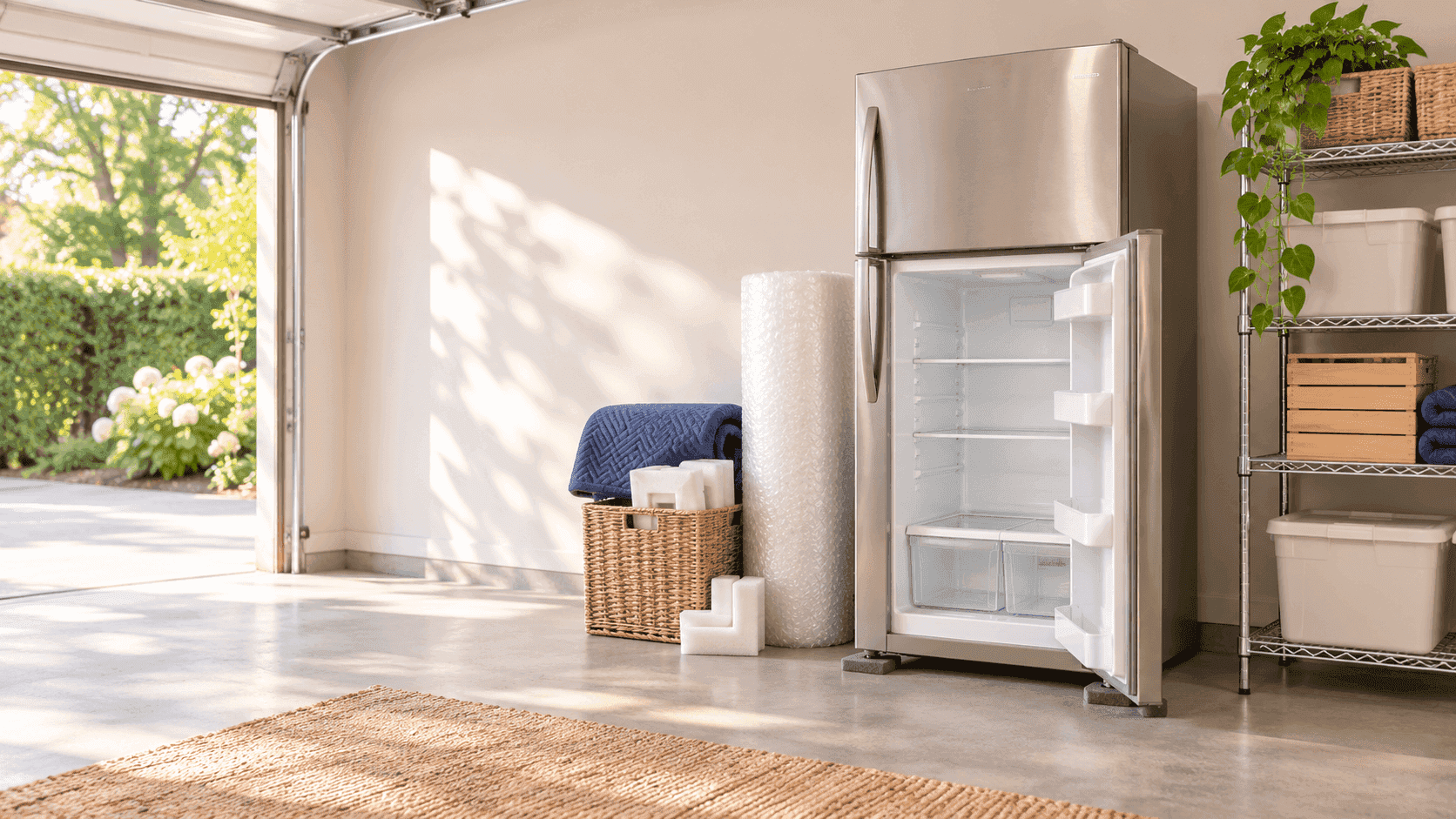
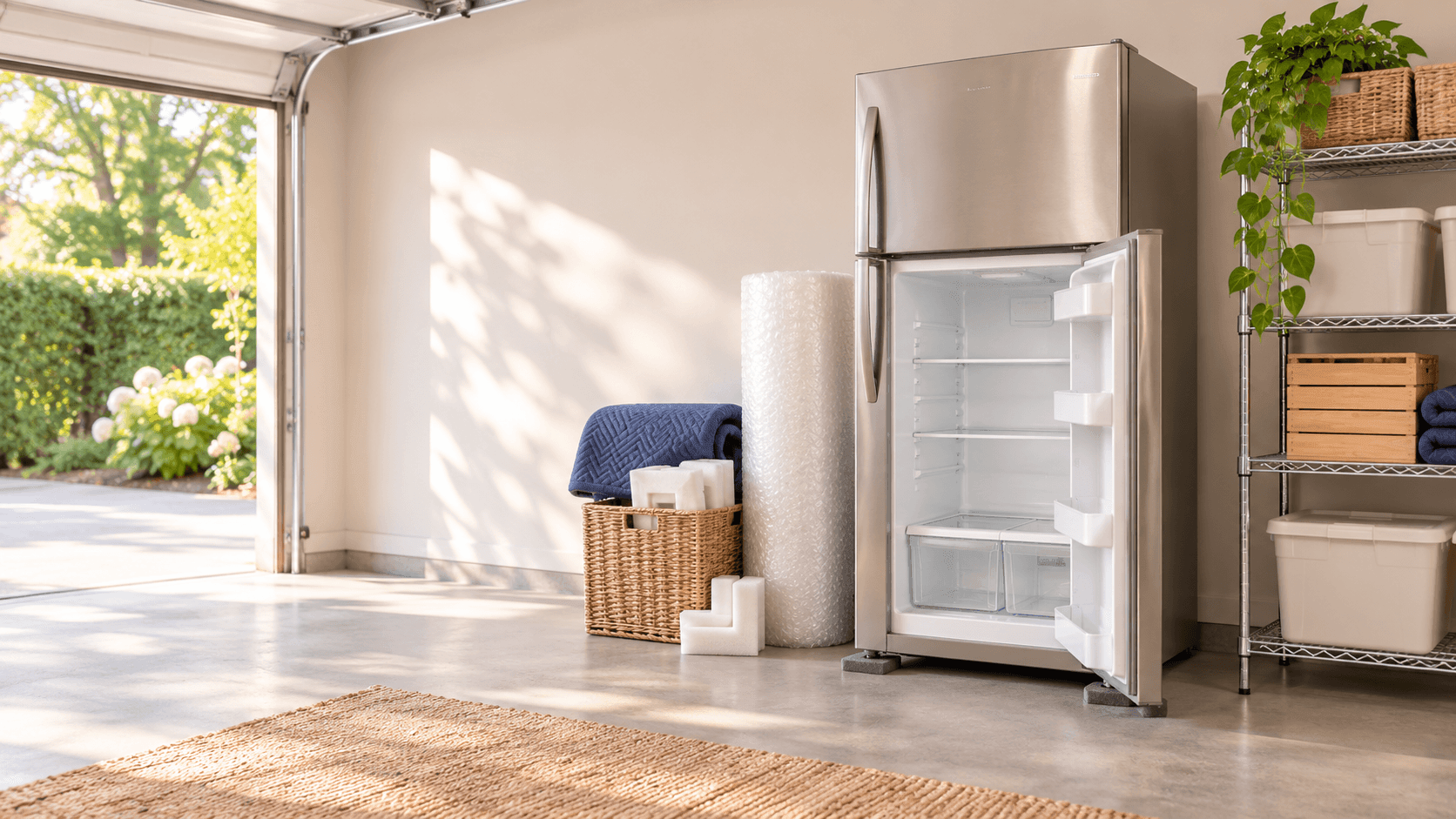
- Consider removing the doors for long garage storage. It eliminates the risk entirely, but on many models the doors carry wiring and dispenser water lines. Follow your owner’s manual’s door removal steps, bag and label the hinge hardware, and store the doors upright beside the cabinet.
- Never store it lying down or wrapped airtight. A refrigerator on its back is easy to climb into, and refrigerator manuals themselves warn that cartons covered with plastic sheets or stretch wrap can become airtight chambers.
Moving a Refrigerator Without Hurting the Compressor
On the basic rule, the manufacturers agree: move the refrigerator upright. GE’s owner’s manuals say to make sure it stays upright during moving and to handle it only from the sides. Haier says to transport it upright and never to lay it on its front or rear.
Before it leaves the house
- Measure the route. Compare the refrigerator’s width and depth against every doorway, hallway, stair turn, and the truck’s door opening. Removing the doors to clear a tight frame is often easier than tilting the cabinet.
- Secure what moves. Whirlpool’s moving steps call for wrapping removable parts and taping them together, then taping the doors closed and the power cord to the back of the cabinet.
- Protect the finish. Wrap the cabinet in moving blankets and run tape or straps over the blankets rather than directly on the doors. Adhesive residue is harder to remove than it looks, and a Maytag owner’s manual warns that rubbing alcohol, flammable fluids, and abrasive cleaners used to remove tape or glue can damage the surface.
- Bring a second person. Owner’s manuals routinely list an excessive weight hazard and call for two or more people to move a refrigerator.
On the dolly and in the truck
Load the appliance dolly from the side of the refrigerator, consistent with GE’s handle-from-the-sides instruction, so you aren’t pressing on the doors or the coils and tubing at the back. Tilt it only as far as needed to roll, strap it to the dolly, and walk it up the ramp. In the truck, stand it upright against a wall or bulkhead and strap it so it can’t tip, slide, or roll.
If it has to go on its side
Sometimes a vehicle or a doorway leaves no choice. Check the owner’s manual first, because some models, built-ins in particular, are meant to stay upright at all times. If laying it down is permitted, LG advises avoiding positions with the compressor facing down and says a slight angle is safer than laying the refrigerator completely flat. Keep the time on its side as short as possible, and write down how long it was there. That number decides how long you wait before plugging it in, which is covered in the restart section below.
Where to Keep It: Garage, Basement, or Storage Unit
Wherever the refrigerator ends up, the same basics apply:
- Upright and level. Store it the way it runs.
- Off the floor. A pallet or a couple of boards keeps the base out of any water that reaches the floor and lets air move underneath.
- Covered with something breathable. An old sheet or moving blanket keeps dust off. Plastic sheeting traps condensation against the finish and, as noted above, creates an entrapment risk.
- Not used as a shelf. Heavy boxes on top can dent the cabinet and make a stack top-heavy.
Garage or shed
Free and convenient, and the riskiest option on this list. A garage or shed exposes the refrigerator to whatever the weather does, which makes the water system steps non-negotiable anywhere it freezes. It’s also the spot most likely to be reached by children, from your household or the neighbors’, so the door precautions matter most here. Rodents and insects find garages easily, and a spotless interior gives them less reason to move in.
Basement
A finished, heated basement is usually a good spot. An unfinished one can be damp or prone to water on the floor, so raise the refrigerator on a pallet and check on it after heavy rain.
Self storage unit
A storage unit takes the refrigerator out of your way and out of reach of children, which is most of the appeal. A few things to know:
- It will be stored empty and unplugged. Storage facilities prohibit perishables, so every bit of food has to come out. At 10 Federal Storage, perishables, flammables, hazardous materials, and illegal items are all prohibited.
- Drive-up access helps. Backing a truck to the unit door saves a long dolly push down an indoor corridor. Availability varies by location.
- Climate control is optional for most refrigerators. The manufacturer storage guidance we reviewed centers on two things: drained water and a clean, dry interior. None of it sets a temperature range for an unplugged, drained refrigerator. A temperature-regulated unit earns its cost if you couldn’t fully drain the water system before winter, since it protects against the freezing temperatures that crack water components, or if you’re storing temperature-sensitive belongings like electronics or wood furniture in the same unit. It won’t dry out a refrigerator that went in damp. That part is up to you before the door closes.
Bringing a Stored Refrigerator Back Into Service
Restarting is where storage jobs most often go wrong, usually because the refrigerator gets plugged in the moment it’s back in the kitchen.
Inspect and clean first
Before it goes back into place, open it up and look. Check for mold spots, musty odor, signs of pests, and damage to the door gaskets or power cord. Wipe the interior again with the same baking soda solution. If a gasket looks cracked or doesn’t seal evenly when the door closes, replace it before loading food.
How long to wait before plugging it in
This is where published guidance genuinely differs. The common thread is that a refrigerator moved upright needs little or no wait, and one that spent time on its side needs time for the compressor oil to settle. How much time depends on the manufacturer:
- LG: If the refrigerator stayed upright, it can be plugged in right away once vibration from the move has stopped. If it was on its side even briefly, wait at least 2 hours.
- GE Appliances and Haier: Stand it upright for as long as it spent on its side. If it was on its side for more than a day, wait 24 hours. If it was tipped only briefly for cleaning or service, a few minutes is enough.
- Some built-in models: Whirlpool’s installation instructions for at least one built-in refrigerator call for a 24-hour wait before plugging in, to avoid compressor failure.
The practical rule: follow your model’s manual if you have it. If you don’t, and the refrigerator was laid down at any point, wait 24 hours upright. It costs you a day and satisfies every recommendation above.
Bring it to temperature before loading food
Plug it in, set the controls, and let it run empty until it’s cold. An inexpensive appliance thermometer takes out the guesswork: the FDA recommends keeping the refrigerator at 40°F or below and the freezer at 0°F. A refrigerator starting warm and empty can take hours to get there, so plan the restart for the day before you need it.
Reconnect the water carefully
- Install a new water filter. GE’s manuals list this as the first step after the water has been shut off.
- Reconnect the supply line and check the connection for drips.
- Flush the system. GE’s instructions call for running about 2 gallons of water through the dispenser, roughly 5 minutes, to clear the line.
- Discard the first few batches of ice.
- Check behind and under the refrigerator over the next day for any sign of a leak, especially if it spent time somewhere that could have frozen.
Finally, before pushing it back into place, lower the leveling legs until they touch the floor and re-engage the anti-tip bracket if your model has one, as GE’s manuals instruct.
When Storing a Refrigerator Makes Sense, and When It Doesn’t
Storing a refrigerator is a good call in some situations and a poor one in others. It’s worth being honest about which is which before you pay to keep one.
When it makes sense
- A kitchen renovation where the refrigerator is going back in once the cabinets and floors are done.
- A gap between homes when closing dates don’t line up and the refrigerator is coming with you.
- A newer or higher-end refrigerator, including built-in and panel-ready models, that would be expensive or slow to replace.
- A matched appliance set you want to keep together for the next kitchen.
When it probably doesn’t
- An aging second refrigerator. ENERGY STAR has repeatedly flagged old garage and basement refrigerators as energy drains, and its own estimates of their annual running cost have ranged from roughly $80 to $110 depending on the refrigerator’s age and local electricity rates. If you’re paying to store one so you can pay to run it later, the math rarely works.
- A refrigerator that already had cooling problems. Storage won’t fix a weak compressor or a slow leak, and a restart after months of sitting idle is not when you want to find out.
- A refrigerator you’ll replace anyway. If the plan is a new one in the next kitchen, sell, donate, or recycle the old one now instead of paying to defer the decision.
- A mini fridge. A compact refrigerator fits in a closet. Renting a unit for one rarely makes sense unless it’s going in with other belongings.
If you’re getting rid of it
A refrigerator usually can’t just go to the curb. Its refrigerant falls under the EPA’s safe disposal requirements under Section 608 of the Clean Air Act, which call for the refrigerant to be recovered before the appliance is scrapped, and the EPA notes that older units can also contain ozone-depleting chemicals in their insulation foam. Many utilities, municipalities, and appliance retailers run pickup or recycling programs that handle this, and some utilities offer a rebate for retiring an old unit. Check with your local utility or solid waste department for what’s available where you live.
What Size Storage Unit Fits a Refrigerator
Refrigerators vary more than people expect. Whirlpool’s sizing guide gives these typical ranges by style:
- Top-freezer: 24–33 inches wide, 61–69 inches tall, 28–35 inches deep.
- Bottom-freezer: 24–33 inches wide, 67–71 inches tall, 27–34 inches deep.
- Side-by-side: 30–36 inches wide, 66–70 inches tall, 29–35 inches deep.
- French door: 29–36 inches wide, 68–72 inches tall, 28–37 inches deep.
Height is almost never the constraint. 10 Federal’s 5x5 and 5x10 units have 8-foot ceilings, so even a 72-inch refrigerator clears by two feet. Floor area and the door opening decide the fit, and propped-open doors add a few inches of depth to the footprint.
The arithmetic for a 5x5
A 5x5 unit is 60 by 60 inches, or 3,600 square inches of floor. A large French door refrigerator at 36 inches wide and 35 inches deep, with its doors propped about 3 inches open, needs roughly 36 by 38 inches: about 1,370 square inches, or 38 percent of the floor. A 30-inch top-freezer model about 31 inches deep needs closer to 1,020 square inches, about 28 percent. Either way, a 5x5 holds a refrigerator plus some boxes. Add a washer and dryer and you’ve run out of room.
The arithmetic for a 5x10
A 5x10 is 60 by 120 inches. Line up a 36-inch refrigerator, a 27-inch washer, and a 27-inch dryer along the long wall and they span 90 inches, leaving 30 inches of wall. At roughly 30 to 35 inches deep, they leave an aisle of about 25 inches across the 60-inch width. That’s the size that handles a refrigerator plus a laundry pair from a move, with room for boxes at the far end.
Bigger jobs
A full kitchen renovation, with the refrigerator, range, dishwasher, and a kitchen’s worth of boxed dishes and cookware, usually outgrows a 5x10. Plan on a 10x10.
Before you rent, measure the refrigerator’s width plus the dolly against the unit’s door opening. Our 5x5 storage unit guide and 5x10 storage unit guide lay out the exact dimensions, and once you know which fits, you can browse small units near you and filter for drive-up access.
Frequently Asked Questions About Storing a Refrigerator
Can you store a refrigerator in a storage unit?
Yes. Empty it completely, defrost it, drain any water lines, clean and dry the interior, and store it upright with the doors propped open and secured. Storage facilities prohibit perishables, so no food can stay inside, and the refrigerator will be stored unplugged.
How long should a refrigerator sit before you plug it in?
It depends on how it was moved and on the brand. LG says a refrigerator moved upright can be plugged in once vibration has stopped, and one laid on its side should wait at least 2 hours. GE Appliances and Haier say to wait as long as it was on its side, up to 24 hours. If you don’t know your model’s guidance and it was laid down, wait 24 hours upright.
Can you store a refrigerator on its back?
No. Haier’s guidance says never to lay a refrigerator on its front or rear, and GE’s manuals say to keep it upright during moving. If it must be laid down for transport, use only the position your owner’s manual allows, then store it upright.
Should you leave the refrigerator door open when it’s unplugged?
Yes. GE and Haier both say to leave or prop the doors open on an idle refrigerator so air can circulate. Use a rigid spacer and a strap so the doors can’t swing shut, and keep the refrigerator where children can’t reach it, since the CPSC warns about child entrapment in unused refrigerators.
How long can a refrigerator stay unplugged in storage?
The manufacturer guidance we reviewed doesn’t set a maximum storage time. What matters is preparation: drained water lines, a clean and fully dry interior, upright storage, and propped doors. After a long stay, inspect the door gaskets, clean the interior again, and check for leaks once the water is reconnected.
Can I store a refrigerator in a cold garage over the winter?
Yes, if the water system is fully drained. Water left in the ice maker, dispenser lines, valves, or filter can freeze and crack them, and GE’s manuals call for a qualified servicer to drain the water system if temperatures can drop below freezing. Running a refrigerator in an unheated garage is a separate question, governed by the operating range in your owner’s manual.
Do I need a climate-controlled storage unit for a refrigerator?
Usually not, if the refrigerator is fully drained, clean, and dry. A temperature-regulated unit is worth considering if you couldn’t drain the water system completely before freezing weather, or if you’re storing temperature-sensitive items in the same unit. Temperature regulation won’t dry a refrigerator that goes in damp, so the drying step matters either way.
What size storage unit do I need for a refrigerator?
A full-size refrigerator on its own fits in a 5x5 unit, using roughly 28 to 38 percent of the floor depending on its size. A refrigerator plus a washer and dryer fits in a 5x10. A full set of kitchen appliances plus boxed kitchen items usually needs a 10x10.
Should I put baking soda in a stored refrigerator?
You can. An open box of baking soda is unscented and harmless, though thorough cleaning and the airflow from propped-open doors do most of the work. Skip scented products such as dryer sheets in a compartment that will hold food again.
The Bottom Line on Storing a Refrigerator
A refrigerator stores well when it goes in empty, drained, clean, dry, and upright, with its doors held open somewhere children can’t reach. It comes back well when you give the compressor the settling time its manufacturer asks for, replace the filter, and flush the water line before trusting the ice. Nearly every storage failure traces back to a step that takes minutes.
If a storage unit is the right home for yours, size it with the arithmetic above, look for drive-up access, and rent it a few days before the move so the refrigerator gets its full day to dry before it travels.
About the Author
10 Federal Storage
Our team at 10 Federal Storage has been in the self storage industry for decades. With knowledge gained from multiple universities and in the field, we are well-prepared and excited to assist with your storage needs. When you rent a unit with us, you can feel confident that our seasoned customer service team’s help will make your transition as seamless as possible. Customer satisfaction is our number one priority, and we strive to make your experience exceptional with our automated leasing options, diverse unit sizes, and a strong commitment to sustainability.