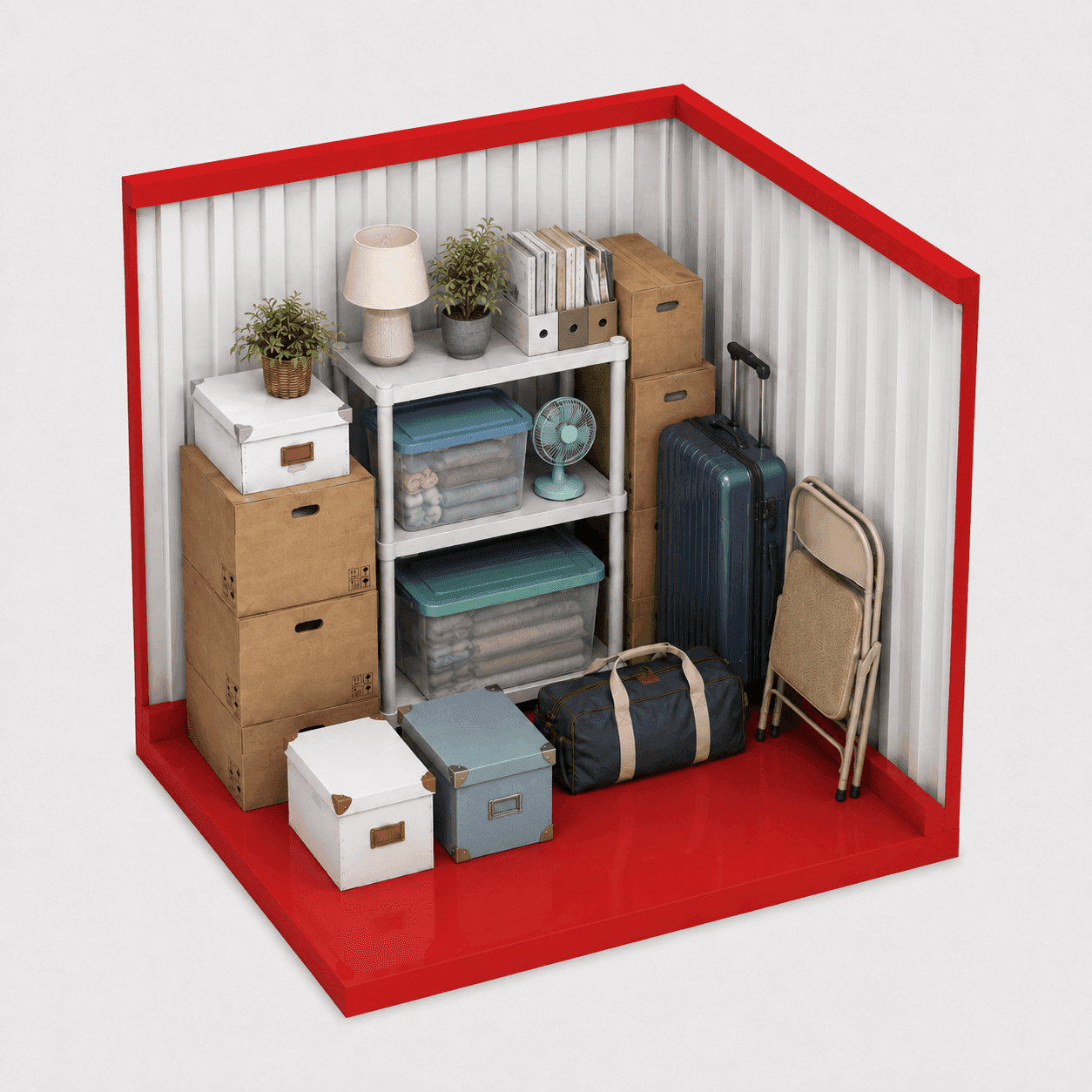

Storage Unit Size Guide
How Big Is a 5x5 Storage Unit? Dimensions, What Fits, and Who It's For
The smallest unit we rent, measured properly. Real box counts, furniture footprints with the numbers behind them, and an honest list of what will not fit.
Compare Every Size
- 5x525 sq ft
- 5x1050 sq ft
- 5x1575 sq ft
- 5x20100 sq ft
- 10x10100 sq ft
- 10x15150 sq ft
- 8x20160 sq ft
- 10x20200 sq ft
- 15x20300 sq ft
- 10x30300 sq ft
- 10x35350 sq ft
- 20x20400 sq ft
- 10x40400 sq ft
- 15x30450 sq ft
- 20x25500 sq ft
- 20x40800 sq ft
- 30x401,200 sq ft
On This Page
- What a 5x5 Storage Unit Actually Is
- What Fits in a 5x5 Storage Unit
- What Does Not Fit in a 5x5 Storage Unit
- Who a 5x5 Storage Unit Is Right For
- How to Know If You Should Size Up or Down
- How to Pack a 5x5 Storage Unit Efficiently
- Climate-Controlled or Standard: Which 5x5 to Choose
- What a 5x5 Storage Unit Costs and How to Think About Value
- Frequently Asked Questions
- Reserve a 5x5 Storage Unit Near You
Section 01
What a 5x5 Storage Unit Actually Is
A 5x5 is the smallest unit we rent, and it is the one people most often get wrong in both directions. Some readers arrive about to rent a closet-sized space for a one-bedroom apartment's worth of furniture. Others are about to pay for a 10x10 when a 5x5 would have held everything with room left over.
Almost every size guide online describes a 5x5 with adjectives. It is "closet-sized." It "fits small items." That is not enough to make a decision with, because whether your things fit is a question about geometry, and geometry has answers.
A 5x5 measures 5 feet wide by 5 feet deep. That is 25 square feet of floor space, a square measuring 60 inches on each side. Our 5x5 units have 8-foot ceilings, which gives you 200 cubic feet of total volume. That volume figure matters more than the square footage, because a 5x5 is a space you fill upward rather than outward. The floor is the smallest part of what you are renting.
The Unit in Three Dimensions
Square footage undersells a storage unit, because what you are renting is volume. Both cutaways below show the same 5x5 at the same scale. The only difference between them is how the boxes are stacked.
Stacked five layers high
One layer on the floor
That is the whole argument for packing vertically. The two drawings are the same rented space at the same price, and the one on the left holds five times as much. Most people use about 40 inches of a 96-inch ceiling, and pay for the rest either way.
The Floor, Drawn to Scale
Looking straight down, here is the floor of a 5x5 at true proportion, with nine medium moving boxes laid out on it. Each box is 18 inches square, so three fit across the 60-inch width with 6 inches to spare. That is one layer. You have room for five of them stacked.
60 in / 5 ft wide · door on front wall
Nine medium boxes per layer. Five safe layers gives you about 45 boxes, if the unit holds nothing else.
Three Ways a 5x5 Gets Used
The same floor, three common loadouts, all drawn at the same scale:
Boxes only
About 45 medium boxes, five layers high, wall to wall.
Queen mattress plus boxes
The mattress takes one full wall. Around 25 boxes fit in what is left.
Washer and dryer plus boxes
They fit side by side with 6 inches spare, using half the floor.
What 25 Square Feet Looks Like in Real Life
- A small walk-in closet, or a generously sized reach-in closet
- A half bathroom or powder room
- The footprint of a standard single bed, with a narrow walking strip beside it
- Roughly the cargo area of a large cargo van, but with three times the ceiling height
Stand in the middle of a 5x5 and you can touch two opposite walls without fully extending your arms. It is not a room you move around in. It is a space you load from the doorway.
Why You Will Never Get All 200 Cubic Feet
Boxes are rectangles. Furniture is not. The gaps between irregular shapes are dead space you are still paying for. A carefully packed 5x5 using uniform boxes reaches roughly 70 to 80 percent of its theoretical volume. One packed with mixed furniture and loose items lands closer to 50 to 60 percent. Every capacity figure on this page reflects that, and says which assumption it uses.
Section 02
What Fits in a 5x5 Storage Unit
How Many Boxes Fit in a 5x5
Moving boxes are fairly consistent across manufacturers. A small book box is 16 by 12 by 12 inches (about 1.5 cubic feet), a medium is 18 by 18 by 16 inches (about 3 cubic feet), and a large is 18 by 18 by 24 inches (about 4.5 cubic feet).
Each medium box is 16 inches tall against a 96-inch ceiling. Six layers would reach it exactly, but stacking to the full 8 feet is neither safe nor practical for one person working alone. Five layers puts your top box at 80 inches, which is realistic.
That third figure, 12 to 18 boxes plus a piece of furniture, is the number most people renting a 5x5 should plan around, because very few renters store boxes and nothing else.
Furniture That Fits, With the Measurements
The constraints: 60 inches in either direction on the floor, 96 inches of height, and about 85 inches on the floor diagonal, which is the longest straight line that will lie flat.
- Twin mattress (38 by 75 in): stands on its long edge with 21 inches of headroom to spare, taking 38 inches of one wall.
- Full mattress (54 by 75 in): stands upright, using 54 inches of a 60-inch wall.
- Queen mattress (60 by 80 in): stands upright with 16 inches of headroom. At 60 inches wide it spans one wall exactly, so it fits but commits that wall entirely.
- Loveseat (about 60 in long): stands on one end, well under the 96-inch ceiling.
- Three-seat sofa (about 84 in long, 38 deep): stands on end and clears the ceiling by a foot, but its 38 by 34 inch footprint eats more than a third of the floor. Possible, rarely wise.
- Desk (48 or 60 in wide): fits, especially with the legs removed. A 60-inch desk spans a wall exactly.
- Small dresser or nightstand: fits easily, and both are useful because you can pack the drawers.
- Bicycle (about 68 to 70 in long): stands against a wall or hangs from a portable rack.
- Full-size refrigerator (30 to 36 in wide, 32 deep): fits, but consumes roughly a third of the floor and cannot be stacked on.
Yes, a Washer and Dryer Fit Side by Side
This is commonly answered wrong, including by the largest operator in the country. A standard washer or dryer is 27 inches wide. Two side by side span 54 inches. Your wall is 60 inches. They fit, with 6 inches left over.
The real constraint is floor consumption, not width. At roughly 30 inches deep, the pair occupies 54 by 30 inches, more than half your 25 square feet. And because they stand only 38 to 43 inches tall, stack boxes or bins on top or you waste the 4 feet of air above them.
Shelving Capacity
If you are storing many small items rather than furniture, shelving transforms a 5x5. The unit has 20 linear feet of wall, minus the door opening, leaving roughly 15 usable feet. Running standard 12-inch-deep shelving along two full walls gives you 10 linear feet of run. At five shelves high, that is about 50 linear feet of shelf in a space you could otherwise fill with maybe 40 boxes.
For records specifically: a standard letter-size file box is 15 by 12 by 10 inches. Roughly 100 fit stacked wall to wall, or about 60 with an access aisle. That makes a 5x5 one of the most cost-effective records storage options available to a small business. Our business storage page covers that use case in more depth.
Section 03
What Does Not Fit in a 5x5 Storage Unit
This is the most useful section on the page. Everything below is a genuine physical or policy limit, not a suggestion.
Physically Too Large
- A king mattress. Standard king is 76 inches wide against a 60-inch wall. Standing it up does not help, because the 76-inch dimension has nowhere to go. It could sit on the 85-inch floor diagonal in theory, but it would block the unit. Treat it as a no.
- A California king (72 by 84 in): same problem, plus the length.
- Sectional sofas. Even a modest two-piece sectional has sections exceeding 60 inches in more than one dimension.
- A full dining table. Most seat-six tables run 60 to 72 inches before leaves.
- Anything longer than about 85 inches that cannot be angled: ladders over 7 feet, long lumber, large rolled rugs, canoes, kayaks.
- Appliance and furniture combinations. A refrigerator plus a washer and dryer plus boxes exceeds 25 square feet. Any two of those three, and very little else.
- A full studio or one-bedroom apartment. The single most common misjudgment. A 5x5 holds a closet or part of a room, not a residence.
Vehicles and Prohibited Items
- Any vehicle. A motorcycle is typically 7 to 8 feet long against 5 feet of depth. Cars, ATVs, jet skis, trailers and scooters are all well beyond the footprint.
- Flammable, combustible or hazardous materials: gasoline, propane tanks, paint, solvents, fireworks, ammunition.
- Perishable food, or anything that attracts pests.
- Living things, including plants and animals.
- Anything illegal or stolen.
- Anything you cannot afford to be without. A storage unit is not a safe deposit box.
If you need vehicle storage, that is a different product. We offer dedicated vehicle, RV and boat spaces, including covered parking at select locations.
Our full storage FAQs cover prohibited items in detail, and your rental agreement is the controlling document. If you are storing anything unusual or high in value, read the agreement rather than relying on a general guide, including this one.
Section 04
Who a 5x5 Storage Unit Is Right For
A 5x5 is the right answer more often than its reputation suggests, provided your storage problem is a category of things rather than a household of things.
Students Between Terms
A dorm room empties into a 5x5 almost exactly: bedding, a mini fridge, a fan, a desk lamp, books, and four or five totes of clothes. Summer storage is the textbook 5x5 case, and because we rent month to month, you are not paying through the school year for a three-month need.
Apartment Dwellers Short on Closet Space
If your actual problem is that seasonal clothing, holiday decorations, luggage and sports equipment have colonized your living space, a 5x5 absorbs all of it. This is an ongoing rental rather than a transitional one, and it usually costs less than the value of the square footage it frees up at home.
Hobbyists and Seasonal Gear Owners
Camping equipment, ski and snowboard gear, golf clubs, fishing tackle and dive equipment share a trait: bulky, used part of the year, awkward at home. A 5x5 with shelving holds a serious amount of it.
Small Businesses Storing Records or Inventory
A 5x5 with shelving holds roughly 60 file boxes with room to walk. For a business archiving seven years of records, that is a fraction of what the equivalent office square footage costs. It also suits online sellers holding a single product line, trade show materials, or marketing collateral.
People Mid-Declutter
If you are staging a home for sale, a 5x5 is enough to remove the personal items and visual clutter agents ask you to clear, without committing to a unit sized for your furniture.
The Pattern Across All of These
A 5x5 works when you can name what is going in it. "My camping gear and off-season clothes" fits a 5x5. "My apartment" does not.
Section 05
How to Know If You Should Size Up or Down
Here is a decision rule that takes about ten minutes and is more reliable than eyeballing it.
The Pickup Truck Test
If everything you intend to store would fit in the bed of a standard pickup, or in two full car loads, a 5x5 will hold it. If you would need a moving truck of any size, you need a larger unit. The test is crude but right far more often than not, because a pickup bed runs roughly 50 to 65 cubic feet, and two or three bed-loads is about the working capacity of a 5x5.
The Furniture Count
Count the pieces of furniture larger than a nightstand that you plan to store. Zero or one, and a 5x5 is very likely right. Two, and it will work only if the rest is boxes and the pieces are small, so expect it to be tight. Three or more, go to a 5x10 and do not talk yourself out of it.
Size Up If Any of These Are True
- You are storing anything from more than one room
- A king or California king mattress is going into storage
- You will need to access items regularly, since a full 5x5 has no aisle
- You are not certain of your inventory, which almost always means there is more of it than you think
- You are storing during a move, when timelines slip and scope grows
A 5x5 Is Enough If Any of These Are True
- Your storage list is one nameable category of items
- You have already boxed and counted everything, and the count is under about 35
- You are storing seasonal or archival things you will visit rarely
- You are currently paying for a larger unit that is visibly less than half full
When the Honest Answer Is That You Do Not Need a Unit at All
If your inventory is under about ten boxes and you have a garage, a basement, an attic or a spare closet with room in it, renting a 5x5 is probably not worth it.
The same goes for storing things you have already decided to get rid of. Paying monthly to defer a decision about a broken treadmill costs more over a year than replacing it. Sell it, donate it, or dispose of it, and skip the unit.
If you are on the line, our storage size calculator lets you build an inventory item by item and returns a size, and the size guide shows every size we rent side by side.
Section 06
How to Pack a 5x5 Storage Unit Efficiently
In a 5x5, packing technique is not a nicety. The difference between a well-packed and a poorly packed 5x5 is roughly 60 cubic feet, which is most of a 5x10's worth of extra capacity for free.
-
Build Upward Before You Build Outward
You are renting 96 inches of height and most people use 40 of them. Fill the walls floor to ceiling before you put a single item in the middle of the floor. The center of a 5x5 should be the last space you use, not the first.
-
Use Boxes That Are All the Same Size
The highest-leverage thing you can do. Uniform boxes stack flush and reach 80 percent volume efficiency. Mismatched boxes leave wedge-shaped gaps at every junction and land closer to 55 percent. On 200 cubic feet, that difference is about 50 cubic feet, or roughly 16 medium boxes you either fit or do not.
-
Take Apart Anything That Comes Apart
Bed frames, table legs, bookshelves and desks flat-pack to a fraction of their assembled volume. A disassembled bed frame is a 6-inch-thick stack against a wall. Assembled, it is a floor-consuming object. Bag the hardware and tape it to the largest piece it came off.
-
Fill the Hollow Things
Dresser drawers, suitcases, coolers, refrigerators, washing machines, storage ottomans and large pots are all volume you have already paid for. Leaving them empty in a 5x5 is the most common avoidable waste.
-
Heavy Low, Light High, Fragile Last
Books, tools and dishes form the base layer. Lamps, bedding and anything fragile go on top. In a unit this small a collapse means unpacking everything, because there is nowhere to set things down.
-
Compress Soft Goods
Vacuum bags reduce comforters, winter coats, pillows and bedding by roughly two thirds, and the flat bricks they produce stack far better than loose bedding ever will. In a 5x5 this can free an entire vertical column.
-
Keep a Reach Zone, Not an Aisle
A 5x5 is too small for a true center aisle. What you want instead is a reach zone: leave the front 12 to 18 inches clear and put anything you will need in the first 30 inches of depth. Everything you will not touch until move-out goes against the back wall.
-
Label the Front Face and the Top
In a wall-to-wall stack you will only ever see one face of each box. Mark the side facing the door as well as the top of every carton.
Our full storage tips guide goes further on protecting furniture and preparing appliances for storage.
Section 07
Climate-Controlled or Standard: Which 5x5 to Choose
We offer 5x5 units in both standard and climate-controlled configurations, though availability varies by location.
Standard Unit
Enclosed and secure, keeping weather and direct sun off your belongings. Interior temperature tracks the outside temperature, which across much of our footprint means summer highs well above 100 degrees inside and winter lows below freezing.
Fine for:
- Hand tools, yard equipment and hardware
- Plastic totes of household goods and holiday decorations
- Camping, sports and outdoor gear
- Metal shelving, patio furniture and durable goods
- Short-term storage over a mild season
Climate-Controlled Unit
Temperature-regulated, holding an interior temperature range year round. That protects belongings from the extreme heat and hard freezes that warp wood, crack vinyl, degrade adhesives and damage electronics.
Worth it for:
- Electronics, computers and anything with a battery or screen
- Wood furniture, especially antiques and veneered pieces
- Vinyl records, film, photographs and artwork
- Leather goods and musical instruments
- Business records you are required to retain
An Honest Limitation Worth Knowing About
Climate control at our facilities means temperature regulation. It does not mean moisture management, and we do not want anyone assuming otherwise on the strength of the name.
This matters because temperature and moisture are two different threats. If you are storing something genuinely moisture-sensitive, such as photographs, paper records, leather, instruments or textiles, a temperature-regulated unit addresses one of those threats and not the other. Take your own precautions for the second: seal items in airtight plastic bins rather than cardboard, add desiccant packs inside the containers, and keep everything off the concrete floor on a pallet or riser. Those steps cost very little and do more for moisture-sensitive items than any unit type will.
We would rather tell you this now than have you discover it later.
More detail on how our temperature-regulated units work is on the climate-controlled storage page.
Section 08
What a 5x5 Storage Unit Costs and How to Think About Value
A 5x5 is the least expensive unit we rent, and pricing starts at $9 per month. What you actually pay depends on your market, the specific facility, whether the unit is climate-controlled, and what is available when you book, so the only accurate number is the live one at the location you are considering.
The Cost Logic That Does Not Change
Prices move. The underlying economics do not, and they are worth understanding before you choose.
- Small units cost more per square foot. Counterintuitive but consistent across the industry. A 5x5 is the cheapest unit in absolute terms and the most expensive per square foot.
- The gap between adjacent sizes is smaller than the gap in capacity. A 5x10 gives you double the space for considerably less than double the price. If you are genuinely uncertain about your inventory, that arithmetic favors sizing up.
- Climate control carries a premium that varies by market. Weigh it against what you are storing rather than defaulting either way.
- The expensive mistake is undersizing. A mid-rental swap means renting a truck twice, moving everything twice, and losing a day. That cost dwarfs several months of the difference between two unit sizes.
What Is Included
Every rental includes a free lock, month-to-month terms with no long-term contract, and 24/7 gate access at nearly all of our locations. A protection plan is required at checkout at all of our facilities. Before you select one, check whether your existing homeowner's or renter's policy already extends coverage to belongings stored off premises, and read your rental agreement for what the plan does and does not cover.
One Thing We Cannot Do
Our facilities are fully automated and unstaffed. You rent online, receive your gate code by email and text, and go straight to your unit. There is no office visit and no appointment.
That model is also why we cannot accept deliveries on your behalf. There is nobody on site to receive them. If your storage plan depends on someone accepting a shipment, a 5x5 with us is not the right fit, and it is better to know that before you book. More on how our facilities operate is on the why choose 10 Federal Storage page.
5x5 Storage Unit, Frequently Asked Questions
A 5x5 storage unit is 5 feet wide by 5 feet deep, for 25 square feet of floor space. With 8-foot ceilings, that works out to 200 cubic feet of total volume. It is comparable to a small walk-in closet or a half bathroom.
About 45 medium moving boxes if the unit holds nothing else and you stack them wall to wall, five layers high. Leave a reach zone at the door and the realistic figure is 35 to 38. If you are also storing a piece or two of furniture, plan on 12 to 18 boxes.
Yes. A queen mattress is 60 by 80 inches, so it fits standing on its long edge under an 8-foot ceiling. At 60 inches wide it spans one full wall of the unit, so it will take up a quarter of your available wall space.
No. A standard king mattress is 76 inches wide and the longest wall in a 5x5 is 60 inches. Standing it upright does not solve the problem, because the 76-inch dimension still has nowhere to go. For a king mattress set, plan on a 5x10 or larger.
Yes, side by side. Standard washers and dryers are 27 inches wide each, so a pair spans 54 inches against a 60-inch wall. They will occupy more than half the floor space, so stack boxes or bins on top of them to use the height above.
A loveseat fits comfortably standing on one end. A three-seat sofa of about 84 inches also fits on end under the 8-foot ceiling, but its footprint takes up more than a third of the floor. Sectionals do not fit.
No. Most motorcycles are 7 to 8 feet long and a 5x5 is only 5 feet deep. Motorcycles need a 5x10 at minimum, or a dedicated vehicle storage space.
No. A 5x5 holds the contents of a closet or part of a room, not a residence. For a one-bedroom apartment, plan on a 10x10.
Our 5x5 units have 8-foot ceilings, which is where the 200 cubic foot figure comes from. If you are planning to store something unusually tall, confirm the specific unit before you book.
A standard letter-size file box is 15 by 12 by 10 inches. Roughly 100 fit in a 5x5 stacked wall to wall, or about 60 if you leave room to walk in and reach the back. Shelving makes the boxes far easier to retrieve individually.
It depends what is going in it. Choose a temperature-regulated unit for electronics, wood furniture, photographs, artwork, documents, leather and musical instruments. A standard unit is fine for tools, plastic bins of household goods and seasonal decorations. Note that our climate-controlled units regulate temperature only, so pack moisture-sensitive items in sealed containers regardless of which unit type you choose.
No. All of our units rent month to month with no long-term contract.
Nearly all of our locations offer 24/7 gate access. Your gate code is sent to you by email and text as soon as your rental is confirmed, and our facilities are unstaffed, so there is no office to visit and no appointment to make.
A 5x10 gives you exactly twice the floor space for considerably less than twice the price, which makes it the better value per square foot. A 5x5 is the better choice only if you are confident your inventory genuinely fits, since paying for space you never use is its own waste.
Reserve a 5x5 Storage Unit Near You
A 5x5 is the right unit when you can name what is going into it. Seasonal gear, a dorm room, a closet's overflow, or a few years of business records all fit comfortably, and you are not paying for volume you will never touch. If your list has grown past one category or more than a couple of furniture pieces, the next size up will serve you better and cost less than fixing it later.