
Storage Unit Size Guide
How Big Is a 5x15 Storage Unit? Dimensions, What Fits, and Who It's For
Seventy-five square feet, fifteen feet deep and only five feet wide. The size that solves length problems, with an honest account of the trade-off that shape creates.
Compare Every Size
- 5x525 sq ft
- 5x1050 sq ft
- 5x1575 sq ft
- 5x20100 sq ft
- 10x10100 sq ft
- 10x15150 sq ft
- 8x20160 sq ft
- 10x20200 sq ft
- 15x20300 sq ft
- 10x30300 sq ft
- 10x35350 sq ft
- 20x20400 sq ft
- 10x40400 sq ft
- 15x30450 sq ft
- 20x25500 sq ft
- 20x40800 sq ft
- 30x401,200 sq ft
On This Page
- What a 5x15 Storage Unit Actually Is
- What Fits in a 5x15 Storage Unit
- What Does Not Fit in a 5x15 Storage Unit
- Who a 5x15 Storage Unit Is Right For
- How to Know If You Should Size Up or Down
- How to Pack a 5x15 Storage Unit Efficiently
- Climate-Controlled or Standard: Which 5x15 to Choose
- What a 5x15 Storage Unit Costs and How to Think About Value
- Frequently Asked Questions
- Reserve a 5x15 Storage Unit Near You
Section 01
What a 5x15 Storage Unit Actually Is
The 5x15 is the least understood size in self storage, because most people never consider it. They compare a 5x10 to a 10x10 and never notice the option sitting between them.
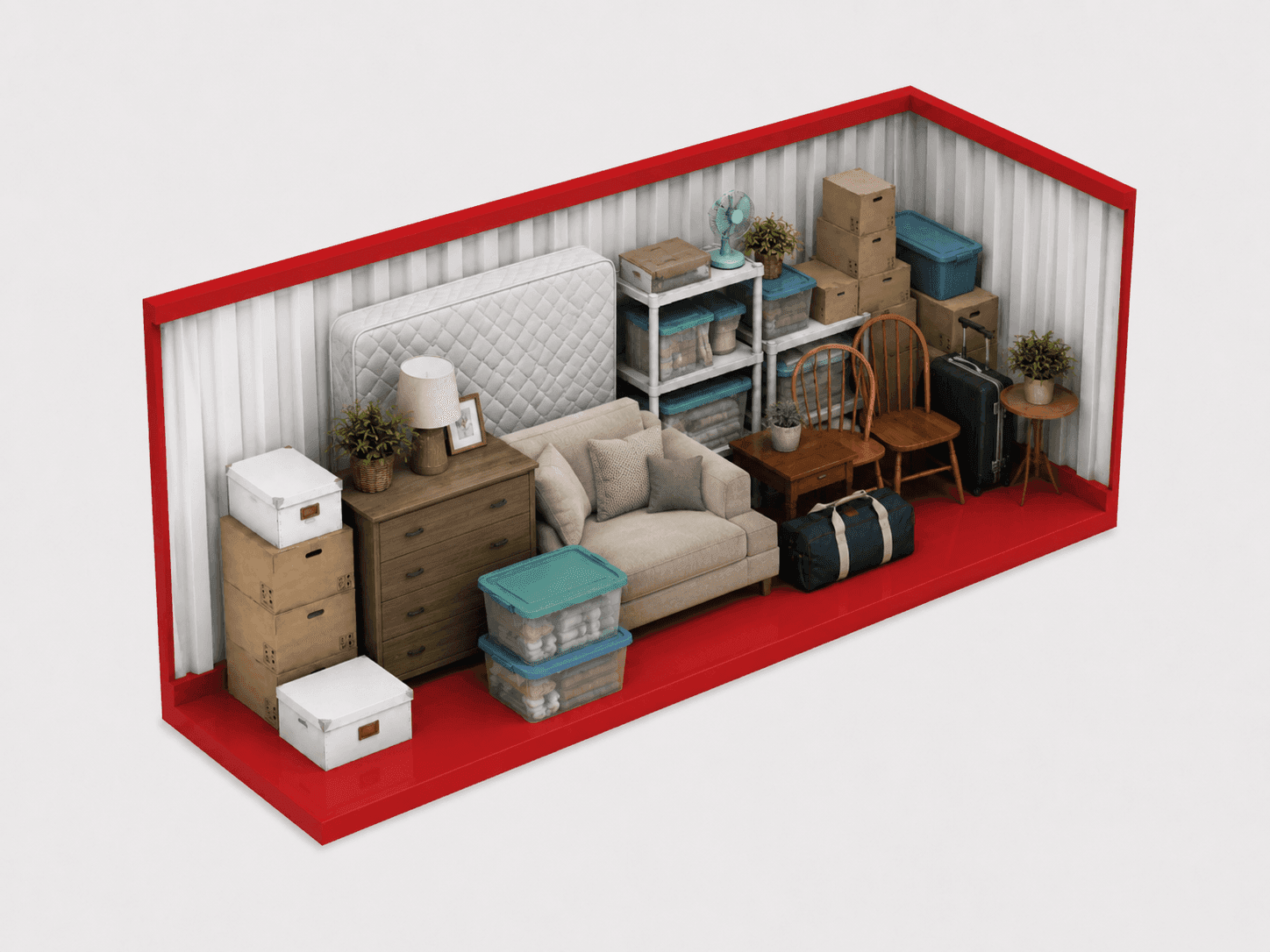
A 5x15 measures 5 feet wide by 15 feet deep: 75 square feet of floor, or a rectangle 60 inches by 180 inches. With 8-foot ceilings that gives you 600 cubic feet, half again as much as a 5x10 and three quarters of a 10x10.
What makes it distinctive is not the capacity. It is the shape. Fifteen feet of depth against five feet of width is the most extreme proportion we rent, and that single fact determines everything about who should rent one and who should not.
The Unit in Three Dimensions
Square footage undersells a storage unit, because what you are renting is volume. Both cutaways below show the same 5x15 at the same scale. The only difference between them is how the boxes are stacked.
Stacked five layers high
One layer on the floor
That is the whole argument for packing vertically. The two drawings are the same rented space at the same price, and the one on the left holds five times as much. Most people use about 40 inches of a 96-inch ceiling, and pay for the rest either way.
The Floor, Drawn to Scale
Looking straight down, here is the floor of a 5x15 at true proportion, drawn with the depth running left to right and the door on the left wall, with one layer of 18-inch medium boxes across it. Three fit across the 60-inch width and ten run down the 180-inch depth, giving you thirty per layer.
180 in / 15 ft deep · door on left wall
Thirty medium boxes per layer. Five safe layers gives you about 150 boxes, if the unit holds nothing else.
Look at the proportion for a moment. That is a corridor, not a room. The far end of your unit is fifteen feet from the door, in a space too narrow to turn around in while carrying anything.
The Trade-Off, Stated Plainly
A 5x15 gives you 75 percent of a 10x10's capacity, and it is usually cheaper. What you give up is access.
In a 10x10 you can walk in, turn around and reach three walls. In a 5x15 everything is arranged along a single 15-foot corridor, and reaching something at the back means moving what is in front of it. If you will open this unit more than a few times, that is a real cost that will not show up on the invoice.
Rent a 5x15 when you are storing things and leaving them. Rent a 10x10 when you are storing things and using them.
Why You Will Never Get All 600 Cubic Feet
A 5x15 packed with uniform boxes reaches roughly 75 to 80 percent of its theoretical volume. One packed with mixed furniture and loose items lands closer to 55 to 65 percent. If you leave an access path down the length, subtract roughly another third. Every figure below says which assumption it uses.
Section 02
What Fits in a 5x15 Storage Unit
Moving boxes are fairly consistent across manufacturers. A small book box is 16 by 12 by 12 inches (about 1.5 cubic feet), a medium is 18 by 18 by 16 inches (about 3 cubic feet), and a large is 18 by 18 by 24 inches (about 4.5 cubic feet).
Each medium box is 16 inches tall against a 96-inch ceiling. Six layers would reach it exactly, but stacking to the full 8 feet is neither safe nor practical for one person working alone. Five layers puts your top box at 80 inches, which is realistic.
The 15-Foot Wall Is What You Are Buying
No other unit under 200 square feet gives you a clear 15-foot run. That makes the 5x15 the natural home for long objects that defeat every smaller size:
- Kayaks and canoes up to about 14 feet, laid flat along the length
- Extension ladders to 14 feet, and most step ladders standing
- Lumber, trim, moulding and pipe in standard 12-foot lengths, with room to maneuver them through the door
- Rolled carpet and large area rugs, which are typically 12 to 15 feet
- Surfboards, paddleboards and longboards
- Racing shells, masts, oars and sailing hardware
- Long folding tables and banquet tables stored flat
One caution on all of these: the item has to get through the door, and a 15-foot object entering a 5-foot-wide unit has almost no room to swing. Bring it in straight, and check the door opening before you book anything close to the limit.
Mattresses and Furniture
Every mattress size fits standing on its long edge against the 180-inch wall, including a king (76 by 80 inches) and a California king (72 by 84 inches), with headroom to spare under the 96-inch ceiling.
- Three-seat sofa (about 84 in): lies flat along the length using less than half the run.
- Two sofas or a sofa and a loveseat: both fit end to end along the 180-inch wall.
- Dining table plus chairs: the table top goes flat against a wall with the legs off, chairs nest in a stack.
- Refrigerator, washer and dryer: all three fit here, unlike a 5x10, though they will consume roughly the first six feet of the unit.
- A bedroom set and a living room set together: workable, which is what makes this a genuine one-bedroom apartment option.
Shelving Capacity
A 5x15 has 40 linear feet of wall, minus the door opening, leaving roughly 36 usable feet. Shelving along both long walls gives you 30 linear feet of run, and at five shelves high that is about 150 linear feet of shelf. For a business archiving records this is one of the most cost-effective configurations we rent, and the narrow width that hurts household storage does not hurt here at all, because you are reaching sideways to a shelf rather than digging past furniture. Our business storage page covers commercial use in more depth.
As a Household Benchmark
A 5x15 holds a compact one-bedroom apartment: a bedroom set, a living room set, a small dining set, kitchen contents and 40 to 50 boxes. Storing it is straightforward. Retrieving any one item from it, before move-out, is not.
Section 03
What Does Not Fit in a 5x15 Storage Unit
The width is the constraint here, and it is unforgiving. Everything that defeats a 5x10 on width also defeats a 5x15, because they are the same 60 inches across.
Sixty Inches Wide Is Still Sixty Inches Wide
- Sectional sofas. Assembled sections exceed 60 inches and cannot be angled in a corridor.
- Wide furniture that cannot be tipped or taken apart: pool tables, large workbenches, oversized armoires, some entertainment centers.
- A two-bedroom home in full. The volume might work on paper; the shape will not. Go to a 10x15.
- Anything you need to walk around. There is no walking around in a 5-foot-wide unit.
- Pallets. A standard pallet is 48 by 40 inches. It fits, but a pallet jack has nowhere to turn, which rules out most palletized business storage.
- Anything longer than about 15 feet, and in practice anything over about 14 feet, because a long object needs room to angle through the door.
Vehicles and Prohibited Items
- Cars, and most vehicles. A 5x15 is long enough for a compact car but only 5 feet wide, and no car is under 5 feet wide including mirrors. A motorcycle fits easily, subject to the vehicle requirements noted below.
- Flammable, combustible or hazardous materials: gasoline, propane tanks, paint, solvents, fireworks, ammunition.
- Perishable food, or anything that attracts pests.
- Living things, including plants and animals.
- Anything illegal or stolen.
- Anything you cannot afford to be without. A storage unit is not a safe deposit box.
The Honest Case Against a 5x15
If you expect to visit this unit regularly, do not rent one. The corridor shape means the last thing in is the only thing you can reach, and everything else is behind it. People who rent a 5x15 for an active need, such as rotating seasonal inventory or storing things they use monthly, tend to regret it within a couple of months.
For the same money or a little more, a 10x10 gives you a room you can stand in the middle of. If access matters at all, that is the better purchase, and we would rather point you there than have you swap units in six weeks.
Our full storage FAQs cover prohibited items in detail, and your rental agreement is the controlling document. If you are storing anything unusual or high in value, read the agreement rather than relying on a general guide, including this one.
Section 04
Who a 5x15 Storage Unit Is Right For
Anyone Storing Long Objects
The clearest case, and the one no other size serves as well. Kayaks, canoes, ladders, lumber, rolled carpet, paddleboards and long tables all want a 15-foot run and nothing else under 200 square feet provides one.
One-Bedroom Households in Long-Term Storage
If you are storing a one-bedroom apartment and you will not need to open the unit until you move out, a 5x15 does the job and typically costs less than the 10x10 most people default to. Deployment, a long overseas posting, a year abroad, a renovation with a fixed end date: all situations where you load once and unload once.
Businesses Storing Records on Shelving
The narrow width stops mattering when everything lives on a shelf at arm's reach. With 150 linear feet of shelf and 24/7 access, a 5x15 is an efficient records archive, and cheaper per box than a wider unit.
Contractors and Trades
Materials come in long lengths. Trim, pipe, conduit, moulding and stock lumber all fit here and fit almost nowhere smaller. Pair that with tools on shelving down one wall and the shape starts to look deliberate rather than awkward.
People Downsizing Who Have Not Decided Yet
Moving from a house to something smaller usually leaves more furniture than the new place can take. A 5x15 holds the surplus while you work out what to keep, sell or pass on, without paying for a unit sized to a whole house.
The Pattern Across All of These
A 5x15 suits storage, not access. If you are putting things away, it is efficient and well priced. If you are keeping things nearby to use, pick a shape you can walk into.
Section 05
How to Know If You Should Size Up or Down
The Access Question Comes First
For every other size, capacity is the first question. For the 5x15 it is second. Ask how often you will open the unit.
- Once, at move-out: a 5x15 is efficient and probably the best value on this page.
- A few times a year: workable if you plan the order you load in.
- Monthly or more: rent a 10x10 instead. You will spend the difference in wasted time within a season.
Then the Truck Test
A 5x15 holds 600 cubic feet, which sits between a 10-foot moving truck (about 400 cubic feet) and a 15-foot truck (about 765). If a 10-foot truck was not quite enough and a 15-foot truck would go home half empty, this is your capacity.
Choose a 10x10 Instead If Any of These Are True
- You will visit the unit regularly
- You are storing a sectional or wide furniture
- You want to be able to walk in and see everything at once
- You are storing business inventory you will pick from
- The price difference in your market is small, which it often is
A 5x15 Is the Right Call If Any of These Are True
- You are storing something longer than 10 feet
- You are loading once and unloading once
- Everything will live on shelving along the walls
- You want one-bedroom capacity at less than one-bedroom cost
- A 5x10 was close but not quite enough
Compare the Real Numbers Before You Decide
A 5x15 is 75 square feet and 600 cubic feet. A 10x10 is 100 square feet and 800 cubic feet. That is a third more space in a far more usable shape. Check what both cost at the location you are considering, because in many markets the gap is smaller than people assume, and the 10x10 is the better buy more often than its price suggests.
Our storage size calculator builds a recommendation from an item-by-item inventory, and the size guide shows every size side by side.
Section 06
How to Pack a 5x15 Storage Unit Efficiently
Packing a 5x15 is a sequencing problem more than a spatial one. In a wider unit a mistake costs you some room. Here it costs you access to everything behind it.
-
Write the Load Order Before You Start
This is the step that separates a good 5x15 from a bad one. Decide what you will need first, second and never, then load in reverse. Fifteen feet of depth is unforgiving of a plan made on the day.
-
Long Items Go In First, Down One Side
Ladders, lumber, kayaks and rolled carpet run the length of the unit along one wall. Place them before anything else, because they cannot be maneuvered in once the corridor narrows.
-
Keep One Side Clear as a Path
Rather than a center aisle, which a 60-inch width cannot spare, run everything down one side and keep a path down the other. That gives you roughly 24 to 30 inches of working width all the way to the back.
-
Build to Full Height at the Back, Lower at the Front
Stack the back third floor to ceiling, since you will not touch it. Keep the front third lower so you can see and reach across it. A wall of boxes at the door defeats the entire unit.
-
Use Uniform Boxes
Uniform boxes reach roughly 80 percent volume efficiency; mismatched sizes land near 55 percent. Across 600 cubic feet that difference is about 150 cubic feet, which is most of a 5x5's worth of space.
-
Shelve the Small Things
Freestanding shelving down one wall turns the corridor from a liability into an advantage, because everything is at arm's reach from the path rather than buried behind something.
-
Label Toward the Path, Not the Door
In a corridor unit you read box labels sideways as you walk past. Label the face that will point at your walking path.
-
Photograph the Unit When You Finish
A photo from the door showing what went where saves a genuinely unpleasant search months later. This matters more in a 5x15 than in any other size we rent.
Our full storage tips guide goes further on protecting furniture and preparing appliances for storage.
Section 07
Climate-Controlled or Standard: Which 5x15 to Choose
We offer 5x15 units in both standard and climate-controlled configurations, though availability varies by location.
Standard Unit
Enclosed and secure, keeping weather and direct sun off your belongings. Interior temperature tracks the outside temperature, which across much of our footprint means summer highs well above 100 degrees inside and winter lows below freezing.
Fine for:
- Hand tools, yard equipment and hardware
- Plastic totes of household goods and holiday decorations
- Camping, sports and outdoor gear
- Metal shelving, patio furniture and durable goods
- Short-term storage over a mild season
Climate-Controlled Unit
Temperature-regulated, holding an interior temperature range year round. That protects belongings from the extreme heat and hard freezes that warp wood, crack vinyl, degrade adhesives and damage electronics.
Worth it for:
- Electronics, computers and anything with a battery or screen
- Wood furniture, especially antiques and veneered pieces
- Mattresses and upholstered furniture in long-term storage
- Vinyl records, film, photographs and artwork
- Leather goods and musical instruments
An Honest Limitation Worth Knowing About
Climate control at our facilities means temperature regulation. It does not mean moisture management, and we do not want anyone assuming otherwise on the strength of the name.
This matters because temperature and moisture are two different threats. If you are storing something genuinely moisture-sensitive, such as photographs, paper records, leather, instruments or textiles, a temperature-regulated unit addresses one of those threats and not the other. Take your own precautions for the second: seal items in airtight plastic bins rather than cardboard, add desiccant packs inside the containers, and keep everything off the concrete floor on a pallet or riser. Those steps cost very little and do more for moisture-sensitive items than any unit type will.
We would rather tell you this now than have you discover it later.
More detail on how our temperature-regulated units work is on the climate-controlled storage page.
Section 08
What a 5x15 Storage Unit Costs and How to Think About Value
What a 5x15 costs depends on your market, the specific facility, whether the unit is climate-controlled, and what is available when you book. Rather than publish a range that goes stale, we point you at live pricing for the locations near you.
The Cost Logic That Does Not Change
Prices move. The underlying economics do not, and they are worth understanding before you choose.
- Larger units cost less per square foot. Consistently, across the industry. A 5x15 costs more per month than a 5x10 and less per square foot.
- The gap between adjacent sizes is smaller than the gap in capacity. Stepping up to a 10x10 buys considerably more space than it costs. If you are genuinely uncertain about your inventory, that arithmetic favors sizing up.
- Oversizing is a real cost too. Half-empty units are common, and the fix is easy under month-to-month terms. If you have been paying for space you do not use, change it.
- The expensive mistake is undersizing. A mid-rental swap means renting a truck twice, moving everything twice, and losing a day. That cost dwarfs several months of the difference between two unit sizes.
The Comparison That Actually Matters Here
The 5x15 competes with the 10x10, not with the 5x10. It offers 75 square feet against the 10x10's 100, usually at a lower monthly rate, and gives up a great deal of usability to get there.
Price both at the location you are considering before you decide. If the gap is small, take the 10x10. If the gap is meaningful and you are storing rather than accessing, the 5x15 is a genuinely good buy that most people never look at.
What Is Included
Every rental includes a free lock, month-to-month terms with no long-term contract, and 24/7 gate access at nearly all of our locations. A protection plan is required at checkout at all of our facilities. Before you select one, check whether your existing homeowner's or renter's policy already extends coverage to belongings stored off premises, and read your rental agreement for what the plan does and does not cover.
One Thing We Cannot Do
Our facilities are fully automated and unstaffed. You rent online, receive your gate code by email and text, and go straight to your unit. There is no office visit and no appointment.
That model is also why we cannot accept deliveries on your behalf. There is nobody on site to receive them. If your storage plan depends on someone accepting a shipment, a 5x15 with us is not the right fit, and it is better to know that before you book. More on how our facilities operate is on the why choose 10 Federal Storage page.
5x15 Storage Unit, Frequently Asked Questions
A 5x15 storage unit is 5 feet wide by 15 feet deep, for 75 square feet of floor space. With 8-foot ceilings that comes to 600 cubic feet of total volume. It is comparable to a long, narrow single-car garage bay or a generous hallway.
About 150 medium moving boxes stacked wall to wall, five layers high, with nothing else in the unit. Leave an access path down the length and the figure is 100 to 105. Alongside a bedroom and living room of furniture, plan on 40 to 50 boxes.
Yes, for a compact one-bedroom. A 5x15 holds a bedroom set, a living room set, a small dining set, kitchen contents and 40 to 50 boxes. The caveat is access: at 5 feet wide and 15 feet deep, reaching anything at the back means moving what is in front of it.
A 10x10 is better if you will visit the unit, if you are storing wide furniture, or if you want to see everything at once. A 5x15 is better if you are storing something longer than 10 feet, or loading once and unloading once, and want more capacity than a 5x10 at a lower rate than a 10x10. A 10x10 gives you 100 square feet against the 5x15's 75.
Yes. A 5x15 gives you a clear 15-foot run, which takes most recreational kayaks and canoes up to about 14 feet laid flat along the length. Leave margin for angling the boat through the door, and check the door opening before booking anything close to the limit.
Yes. Standing on its long edge, a king mattress is 80 inches tall against a 96-inch ceiling and takes 76 inches of the unit's 180-inch length. A California king fits as well.
No. A 5x15 is long enough for a compact car but only 5 feet wide, and no passenger car is under 5 feet wide including mirrors. The smallest unit that takes a car is a 10x20.
Dimensionally yes, with room left over. Storing a vehicle carries requirements that storing household goods does not, including proof of current registration and proof of insurance, so review our vehicle storage information and your rental agreement before booking.
Our 5x15 units have 8-foot ceilings, which is where the 600 cubic foot figure comes from. Confirm the specific unit if you are storing something unusually tall.
Running 12-inch-deep shelving along both long walls gives you 30 linear feet of run, and at five shelves high that is about 150 linear feet of shelf, with a path left down one side. This is one of the most efficient records storage configurations we rent.
A 5x15 holds 600 cubic feet, which sits between a 10-foot truck at roughly 400 cubic feet and a 15-foot truck at roughly 765. If a 10-foot truck was not quite enough, this is your capacity.
It depends what is going in it. Choose a temperature-regulated unit for electronics, wood furniture, mattresses in long-term storage, photographs, documents, leather and instruments. A standard unit is fine for tools, lumber, plastic bins and outdoor gear. Our climate-controlled units regulate temperature only, so pack moisture-sensitive items in sealed containers either way.
Nearly all of our locations offer 24/7 gate access. Your gate code is sent by email and text when your rental is confirmed. Our facilities are unstaffed, so there is no office to visit and no appointment needed.
Reserve a 5x15 Storage Unit Near You
The 5x15 is the right unit when your problem is length, or when you want a one-bedroom apartment's worth of capacity and are willing to trade access for a lower monthly cost than a 10x10. If you will be visiting often, or if what you are storing is bulky rather than long, the 10x10 will serve you better for not much more.