
.svg)
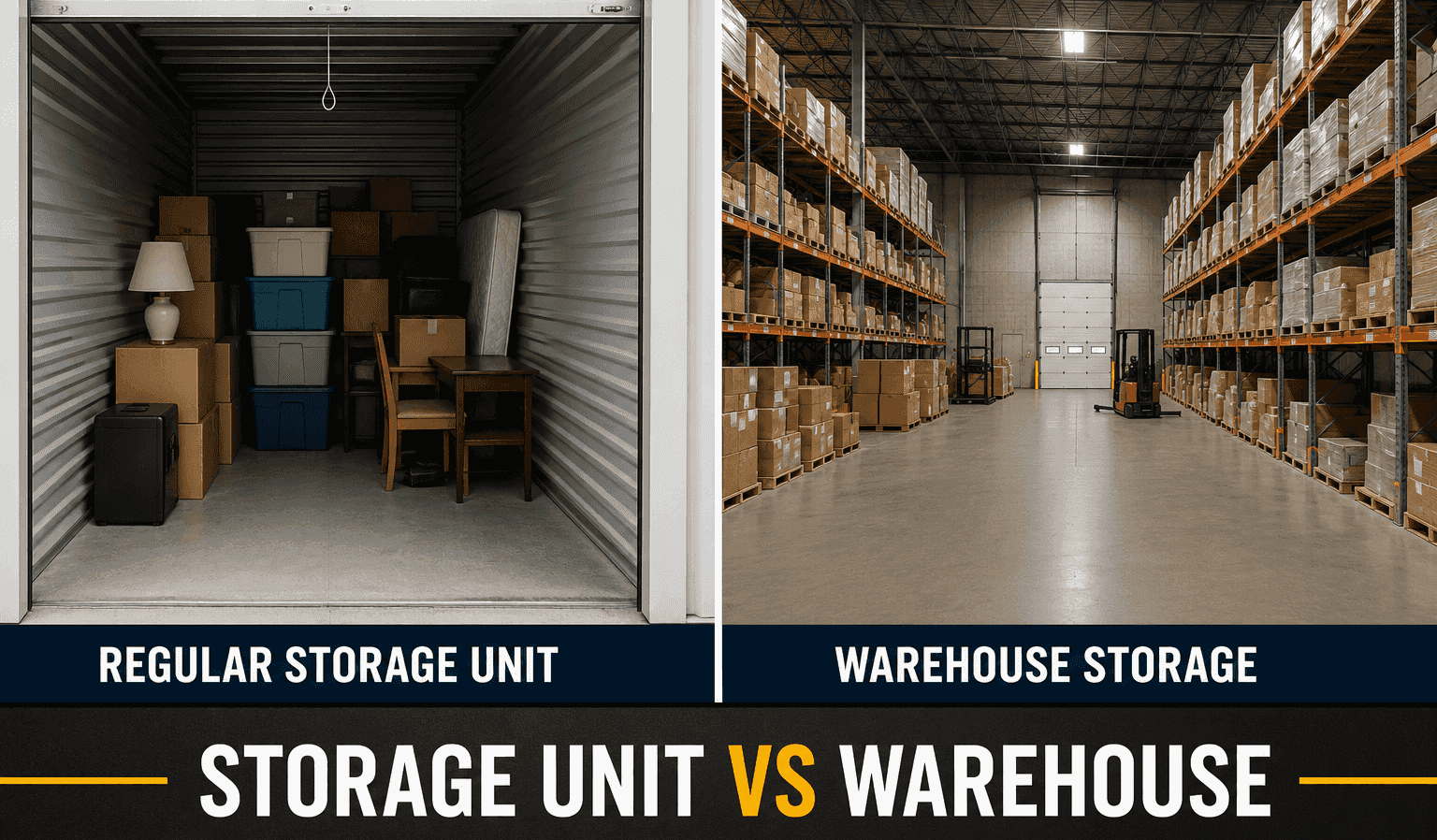
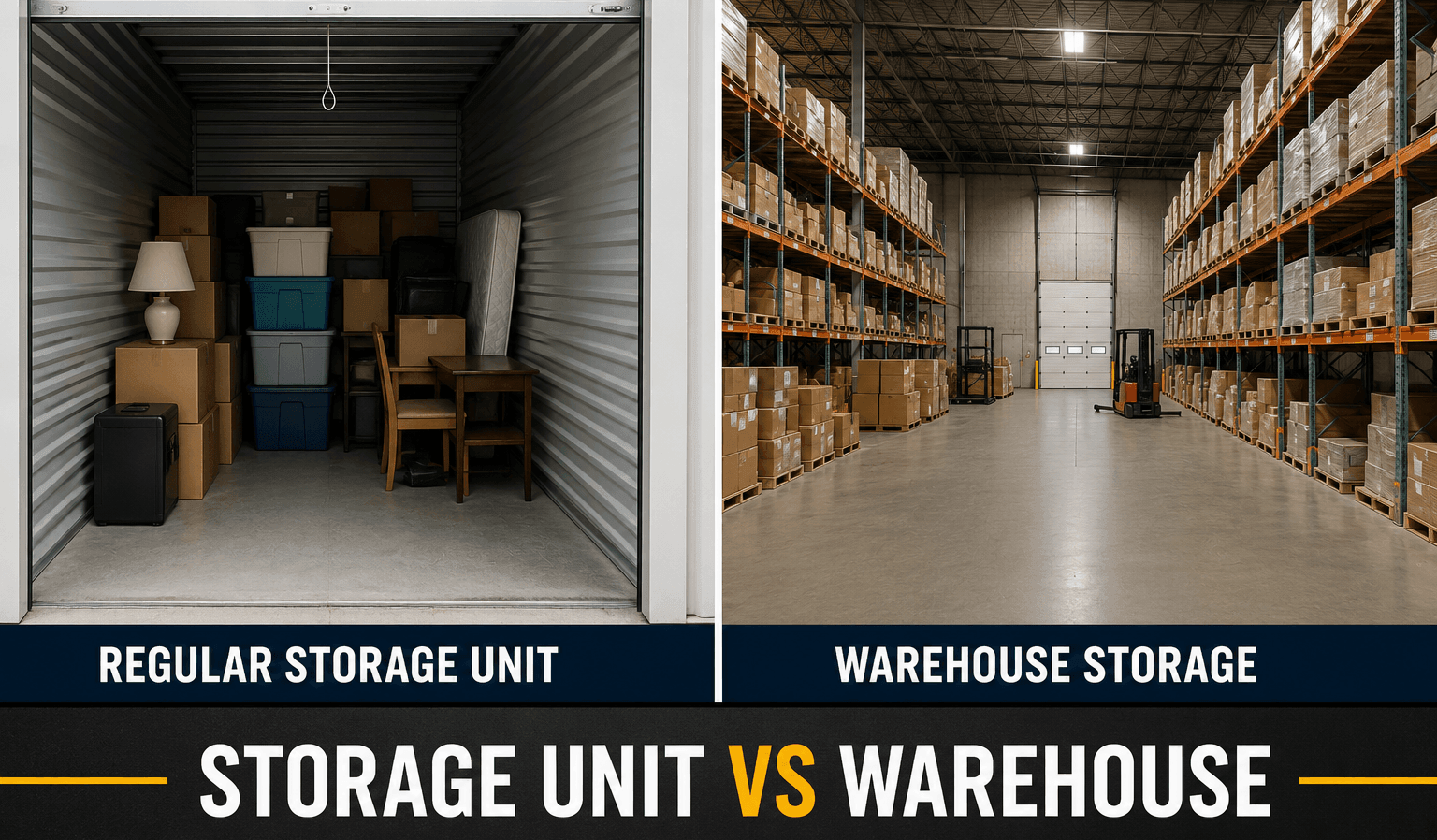
Storage Unit vs. Warehouse for Business Storage: How to Choose (and What Each One Really Costs)
by 10 Federal Storage
Published on July 24, 2026
Every growing business hits the same wall. The garage is full. The spare office is stacked with product. Inventory is living in the back of a van, a basement, and a friend’s barn. Somebody says the word “warehouse,” and suddenly you’re looking at commercial real estate listings, triple-net leases, and five-year personal guarantees for space you may not need.
Here’s the thing most comparisons skip: this isn’t a two-option decision. Between a 5x5 storage unit and a 50,000-square-foot distribution center sits an entire ladder of options, drive-up units, multi-unit setups, small-bay flex space, co-warehousing, third-party logistics, and true high-bay warehouse. Most businesses that lease a warehouse too early do it because nobody showed them the middle rungs.
This guide breaks down every option, what each actually costs in 2026, exactly where the break-even point falls, and what you can and can’t legally do in a self storage unit. By the end, you should be able to point at one rung on the ladder and know it’s yours.
In this guide:
- Business storage is a ladder, not a choice between two things
- What a business storage unit actually is
- What “warehouse” actually means, and the five products hiding behind the word
- Storage unit vs. warehouse: the head-to-head comparison
- The real math: what each option costs per month
- The break-even point: when your business outgrows a storage unit
- What you cannot do in a storage unit
- When a high-bay warehouse is genuinely the right answer
- Business by business: which option fits your operation
- How to size a business storage unit
- The hybrid strategy most growing businesses miss
- Questions to ask before you sign either agreement
- Frequently asked questions about business storage
- Find business storage near you
1. Business Storage Is a Ladder, Not a Choice Between Two Things
Before comparing anything, it helps to see the full range of what’s available. Here are the six rungs, ordered from lowest commitment to highest:
- Rung 1, Small self storage unit (25–100 sq ft). A 5x5, 5x10, or 10x10. Month-to-month, no credit check on a commercial lease, no build-out. Documents, samples, seasonal displays, light inventory, tools.
- Rung 2, Large drive-up self storage unit (150–300 sq ft). A 10x15, 10x20, or 10x30 with a roll-up door you can back a van or box truck up to. Real inventory volume, equipment, trade show booths, work vehicles.
- Rung 3, Multiple units at one facility (300–600+ sq ft). Two or three large units, ideally adjacent. Still month-to-month. Still no lease negotiation. This rung is the one almost everybody skips, and it’s often the smartest value in the entire ladder.
- Rung 4, Co-warehousing or shared warehouse (200–2,000 sq ft). A membership-style model where you rent a caged area or small suite inside a larger building, with shared dock, forklift, and sometimes staff. Costs more per square foot than self storage but gives you dock access and a business-legitimate address.
- Rung 5, Small-bay or flex industrial (1,500–10,000 sq ft). Your own suite in a multi-tenant industrial building. Grade-level overhead door, 16–24 foot ceilings, a small office up front. This is what most small businesses actually mean when they say “we need a warehouse.”
- Rung 6, Full warehouse or high-bay distribution space (10,000–500,000+ sq ft). Dock-high loading, 28–40+ foot clear heights, pallet racking, forklifts, staff, and a multi-year triple-net lease. A genuine logistics operation.
The expensive mistake isn’t choosing wrong between rung 1 and rung 6. It’s jumping from rung 2 straight to rung 5 or 6 because you didn’t know rungs 3 and 4 existed, and then paying a five-year lease on space you use at 40% capacity.
2. What a Business Storage Unit Actually Is
A business storage unit is not a special product. It’s the same enclosed, individually locked unit a homeowner rents, you’re simply renting it in a commercial context. That’s worth saying plainly, because “commercial storage” marketing sometimes implies a separate class of space that doesn’t exist at most facilities.
What does change for business tenants is which features matter:
The two unit types that matter for business
- Drive-up units. Exterior-access units with a roll-up door you can pull a vehicle directly up to. For anyone loading and unloading multiple times a week, contractors, e-commerce sellers, event companies, this is the single most important feature. The difference between backing a van to the door and pushing a flatbed cart 200 feet down an interior corridor compounds fast when you do it 40 times a month.
- Interior climate-controlled units. Temperature and humidity moderated year-round. Necessary for electronics, printed marketing materials, pharmaceuticals and cosmetics, wood and leather goods, musical instruments, artwork, and paper records. Anything with a warranty, an expiration date, or a finish belongs inside.
Typical business storage unit sizes
- 5x5 (25 sq ft, ~200 cu ft), Archived files, sample kits, a few cases of product. Roughly one closet. The classic sales rep or consultant unit.
- 5x10 (50 sq ft, ~400 cu ft), Filing cabinets plus seasonal displays, or one small trade show booth with crates.
- 10x10 (100 sq ft, ~800 cu ft), The workhorse. Roughly 8–10 pallet footprints if you don’t need aisle space, or 4–6 with room to walk. Enough for a small e-commerce operation’s active SKUs. See our full 10x10 storage unit guide.
- 10x15 (150 sq ft, ~1,200 cu ft), Equipment plus inventory. Landscaping gear, restaurant equipment during a remodel, contractor materials. Details in our 10x15 guide.
- 10x20 (200 sq ft, ~1,600 cu ft), A one-car garage. Fits a work vehicle or a serious amount of racked inventory. Our 10x20 guide covers what fits.
- 10x30 (300 sq ft, ~2,400 cu ft), The largest standard self storage size, available at select locations. Roughly the footprint of a small-bay industrial suite’s storage area, at a fraction of the commitment. See the 10x30 guide.
One number that catches people off guard: most self storage units have 8-foot ceilings, some 9 or 10. That’s a hard ceiling on vertical density. A warehouse with a 32-foot clear height stores four times the cubic volume per square foot of floor. If your product is light and stackable, that math matters a great deal. If your product is heavy, fragile, or oddly shaped, it matters much less, you were never going to stack it 30 feet high anyway.
3. What “Warehouse” Actually Means, and the Five Products Hiding Behind the Word
“Warehouse” is doing an enormous amount of work as a word. A 1,800-square-foot flex suite behind a strip center and a 400,000-square-foot automated distribution center are both warehouses, and they have almost nothing in common. Here’s the vocabulary you actually need when you start calling brokers.
Clear height, the spec that defines everything
Clear height is the vertical distance from the finished floor to the lowest overhead obstruction, usually a sprinkler head, joist, or beam. It is not the roof height, and it’s the number that determines how many pallet positions you can stack. Industry rules of thumb in 2026:
- 8–10 feet, Self storage units. Hand-stacked boxes and shelving only.
- 14–24 feet, Small-bay and older second-generation industrial. Two to three pallet tiers with a standard forklift.
- 28–32 feet, Modern Class-A general warehousing. Standard counterbalanced forklifts in 12–13 foot aisles handle this comfortably.
- 32–40 feet, Current Class-A distribution standard. Requires reach trucks and narrower aisles.
- 40 feet and above, True high-bay territory. Requires very-narrow-aisle turret trucks or automated storage and retrieval systems (AS/RS) with stacker cranes. You do not operate this with a rented forklift and a weekend.
The five warehouse products
- Small-bay / shallow-bay industrial. Multi-tenant buildings subdivided into suites, typically 1,500–10,000 sq ft, with 16–24 foot clear heights and grade-level overhead doors (drive straight in, no dock). Higher office-to-warehouse ratio. This is the small business format, and it’s the tightest segment of the market: while national industrial vacancy sits around 7–8%, small-bay space under 50,000 sq ft has been running closer to 4–5% in most metros. Less supply means less negotiating leverage for you.
- Flex space. A hybrid of office and warehouse under one roof, showroom or workspace in front, storage and light assembly behind. Great if you need customers or employees on site. You pay office-adjacent rates for the front portion.
- Mid-bay / general distribution. 28–36 foot column spacing, 24–32 foot ceilings, dock-high loading, deep truck courts. The current Class-A standard for general warehousing.
- High-bay warehouse. Racking systems reaching 40 feet and well beyond, engineered as an integrated system, structure, racking, and handling equipment designed together. Operated with VNA turret trucks or automated stacker cranes. Enormous cubic density in a compact footprint, with a capital cost and technical requirement to match.
- Co-warehousing and 3PL. Not a building type, a service model. Co-warehousing gives you a private caged suite inside a shared facility with pooled dock, forklift, and sometimes fulfillment staff, on flexible terms. Third-party logistics (3PL) goes further: you ship your inventory to somebody else’s warehouse and pay per pallet stored and per order shipped, with no space commitment at all. If your problem is fulfillment labor rather than space, a 3PL solves it and a warehouse lease doesn’t.
Two terms that will come up in every broker conversation
- NNN (triple net). Industrial rents are quoted as base rent, and you pay your proportional share of property taxes, building insurance, and common area maintenance on top. Budget an additional $1.50–$4.00 per square foot per year. A “$10 per foot” quote is realistically $12–$14.
- TI (tenant improvements). Lighting, office build-out, racking, climate systems, security. Landlords sometimes contribute an allowance, usually amortized back into your rent. On a short lease you will likely pay most of it yourself.
4. Storage Unit vs. Warehouse: The Head-to-Head Comparison
Fourteen dimensions that actually differentiate the two. Read this as a diagnostic, not a scorecard, you’re looking for the one or two rows where the difference is decisive for your operation.
- Commitment length. Storage unit: month-to-month, cancel with a short notice period. Warehouse: typically three to five years, sometimes longer, often with a personal guarantee if your business is young or thinly capitalized.
- Total monthly cost. Storage unit: roughly $35–$400 depending on size and market. Warehouse: roughly $1,500–$5,000+ for the smallest viable suite, before utilities.
- Cost per square foot. Storage unit: higher on paper, often $12–$20 per sq ft per year equivalent, but fully loaded. Warehouse: lower base rate, but add NNN, utilities, insurance, and build-out and the gap narrows considerably.
- Minimum viable size. Storage unit: 25 sq ft. Warehouse: realistically 1,500–2,000 sq ft in most markets. This is the single biggest driver of the cost difference, not the rate, the floor.
- Scalability. Storage unit: add or drop a unit in a day; move up or down a size at renewal. Warehouse: you have what you signed for until the lease ends, unless you can sublease.
- Access hours. Storage unit: commonly 24/7 gate access with a personal code. Warehouse: your building, your hours, total control, and total responsibility for locking it.
- Loading. Storage unit: grade-level roll-up door on drive-up units; hand truck, dolly, or ramp. No dock. Warehouse: grade-level or dock-high, depending on the building. Dock-high is essential if you receive full 53-foot trailers.
- Forklifts and pallet jacks. Storage unit: pallet jacks are usually fine on drive-up units; forklift use is typically restricted and requires facility permission. Warehouse: yours to operate.
- Vertical capacity. Storage unit: 8–10 foot ceilings, hand-stacked. Warehouse: 16–40+ feet with racking. If your bottleneck is cubic volume rather than floor space, this is where the warehouse wins outright.
- Staff working on site. Storage unit: not permitted. Warehouse: yes, with appropriate zoning, occupancy, and workers’ comp coverage.
- Customers on site. Storage unit: no. Warehouse or flex space: yes.
- Utilities. Storage unit: included, lighting, climate control where applicable, no separate bills. Warehouse: separately metered electric, gas, water, plus trash and often janitorial.
- Security. Storage unit: perimeter fencing, gated code access, cameras, individually locked units, on-site or remote monitoring. Warehouse: whatever you install and pay for.
- Time to occupancy. Storage unit: same day, many facilities let you rent online and move in without ever meeting a person. Warehouse: 30–120 days for letter of intent, lease negotiation, legal review, and build-out.
Notice the shape of it. Warehouses win on capability, height, dock, forklifts, people, no restrictions. Storage units win on everything to do with cost, speed, and reversibility. The question isn’t which list is longer. It’s whether you need any of the four or five capabilities on the warehouse side badly enough to pay ten to twenty times as much for them.
5. The Real Math: What Each Option Costs Per Month
This is the section Extra Space’s guide, and most others, leave out. Numbers are 2026 national ranges; your market will move them meaningfully, so treat these as a framework rather than a quote.
Self storage, all-in monthly
- 5x5, roughly $35–$60
- 5x10, roughly $55–$90
- 10x10, roughly $95–$155
- 10x15, roughly $130–$210
- 10x20, roughly $170–$270
- 10x30, roughly $250–$400
Add a tenant protection plan or a rider on your business policy (typically $10–$30 a month), and that’s the whole cost. No NNN, no utility bills, no build-out, no broker, no attorney, no deposit in many cases.
Warehouse, all-in monthly
The 2026 national average asking rent for industrial space sits somewhere around $9.50 to $10.20 per square foot per year on a triple-net basis, according to market reports from Cushman & Wakefield, CommercialEdge, JLL, and CBRE. The spread is enormous, roughly $4.50 per foot in Memphis and Indianapolis to $18–$22 in Los Angeles and Northern New Jersey. Small spaces carry a premium of 15–35% over those headline averages, because landlords earn more per foot subdividing a building than leasing it whole.
Here’s what that looks like for a realistic small business suite, 2,000 square feet of small-bay space at $13 per foot NNN:
- Base rent: $13.00/sq ft × 2,000 = $26,000/year, or about $2,167/month
- NNN charges: $2.50/sq ft = $5,000/year, or about $417/month
- Utilities: electric, gas, water, commonly $250–$600/month for a space this size
- Commercial property and liability insurance: $100–$300/month
- Trash, janitorial, landscaping (if not in CAM): $75–$200/month
- Amortized build-out and racking: $150–$500/month over the lease term
Realistic all-in: roughly $3,150 to $4,180 per month, plus a security deposit of one to three months and, in many cases, first and last up front. Over a five-year term that’s $190,000 to $250,000 of committed spend.
The comparison that matters
- A 10x20 drive-up unit: ~$220/month, ~$2,640/year, cancellable in 30 days.
- Three 10x20 units (600 sq ft): ~$660/month, ~$7,920/year, still cancellable in 30 days.
- A 2,000 sq ft small-bay suite: ~$3,600/month, ~$43,200/year, locked in for three to five years.
Three large drive-up units cost about 18% of what the warehouse costs annually and carry no term risk. If those three units hold your inventory, the warehouse conversation is premature, regardless of how much better a warehouse would feel.
6. The Break-Even Point: When Your Business Outgrows a Storage Unit
There is no single square-foot number where self storage stops making sense, because the crossover isn’t really about area. It’s about which constraint is binding. Run through these five triggers, any one of them being true is a genuine signal to move up the ladder.
- You need people working in the space. This is the hardest trigger. Self storage leases universally prohibit occupancy, you can load, unload, and retrieve, but you cannot station employees there to pick, pack, assemble, or answer phones. If your operation requires staffed hours, you need commercial space. Full stop.
- You’re receiving full trailer loads. If freight arrives on a 53-foot trailer that requires a dock, self storage doesn’t work without an expensive intermediate step. Some businesses solve this by having a nearby cross-dock break the load and shuttle pallets over, workable, but you’re now paying twice to move the same goods. Repeated weekly, that’s a warehouse signal.
- Your bottleneck is cubic feet, not square feet. If you’re stacking to an 8-foot ceiling in five units and still running out of room, you’re paying for floor you can’t use vertically. A 24-foot clear height triples your storage per square foot of rent. This is where the per-foot math genuinely flips.
- You’re past roughly 800–1,000 square feet of storage. Below that, self storage almost always wins on total cost. Somewhere between 800 and 1,500 square feet the lines converge, and the multi-unit approach starts feeling clumsy, more doors, more locks, more walking, more mental overhead. Above 1,500, small-bay industrial is usually both cheaper per foot and more functional.
- You need a commercial address, loading dock, or on-site customer access. Storage units don’t serve as a business address for licensing or registration purposes at most facilities, and no self storage lease permits retail traffic. If your business model requires either, that’s a hard requirement a unit can’t satisfy.
And a quiet sixth trigger worth naming: none of the above is true, but your inventory is growing 30% a quarter. If you can see yourself hitting two or three of these triggers within twelve months, start the warehouse search now, because a lease takes 30 to 120 days to execute, and negotiating one under time pressure is how businesses end up in bad deals.
7. What You Cannot Do in a Storage Unit
Being honest about this is more useful than pretending self storage is a universal solution. Most self storage lease agreements, ours and everyone else’s, prohibit the following. Policies vary by facility and by state, so confirm specifics with your location, but this list is broadly consistent across the industry.
Activities that are not permitted
- Operating a business from inside the unit. Storing business property is fine and encouraged. Working out of the unit, running a workshop, assembling product, holding meetings, staffing it during business hours, is not.
- Employees or customers on site as a matter of routine. You and authorized personnel can access it. It is not an open place of business.
- Manufacturing, fabrication, or repair work. No welding, spraying, painting, sanding, or running power tools. Units have no ventilation, no floor drains, and typically no in-unit electrical service.
- Living in the unit. Universally prohibited, everywhere, without exception.
- Modifying the unit. No running electrical, mounting to walls, plumbing, or installing fixed equipment without written permission.
- Subletting. The lease is yours and isn’t transferable.
Items that generally can’t be stored
- Perishable food and anything that attracts pests. Shelf-stable packaged goods are sometimes allowed with facility approval; open or perishable food isn’t.
- Flammable, combustible, corrosive, or toxic materials. Gasoline, propane, solvents, paint, aerosols, fertilizer, pool chemicals, compressed gas cylinders. This is a fire code matter, not a facility preference. For contractors, this is the most common friction point, tools and materials store fine, but the chemicals travel with the truck.
- Fireworks, ammunition, explosives.
- Live plants or animals.
- Unregistered or uninsured vehicles, at most facilities.
- Anything illegal, stolen, or hazardous under EPA or DOT classification.
- Tires, at many facilities, due to disposal costs and fire risk.
If your inventory includes anything on the second list in meaningful quantity, a paint contractor, a pool company, a chemical distributor, a fireworks retailer, the decision is made for you. Warehouse or specialized commercial space is the only compliant path, and no amount of cost comparison changes that.
One more honest note: a storage unit is generally not usable as a registered business address. If you need a physical address for licensing, banking, or your Google Business Profile, pair your storage unit with a registered agent service, a coworking membership, or a virtual office. That combination still costs a fraction of a warehouse lease.
8. When a High-Bay Warehouse Is Genuinely the Right Answer
High-bay warehousing gets brought up in conversations where it has no business appearing, so it’s worth drawing the line clearly. A high-bay facility, racking at 40 feet and up, operated by very-narrow-aisle equipment or automated stacker cranes, solves exactly one problem: you need enormous pallet density on a constrained footprint, with the throughput to justify automation.
Signs high-bay actually fits
- You’re storing thousands of pallet positions of uniform, palletized, stackable goods.
- Land in your market is expensive enough that building up beats building out.
- Your SKU velocity justifies the capital cost of an AS/RS or VNA fleet, typically hundreds of pallet moves a day, every day.
- Your product profile is consistent. Automation punishes irregular packaging brutally.
- You have a ten-year operational roadmap. High-bay design is engineered as a single integrated system, structure, racking, and equipment specified together, and changing course after design means starting over.
Signs it doesn’t
- Your inventory is mixed, irregular, or frequently hand-picked.
- You’re under a few hundred pallets.
- You’re seasonal, and half the year the racks would sit empty.
- You’d be leasing high-bay space rather than building it, in which case you’re usually paying a premium for vertical capacity you can’t reach without equipment you don’t own.
The practical takeaway for the vast majority of small and mid-sized businesses: high-bay isn’t a rung on your ladder. The relevant question for you is drive-up storage unit versus small-bay flex, and the honest middle answer is often co-warehousing or 3PL. If a broker steers you toward tall space, ask exactly which piece of equipment reaches the top three tiers and who is buying it.
9. Business by Business: Which Option Fits Your Operation
Generic advice fails here, because the right answer depends almost entirely on how often you touch the inventory and whether people need to be present. Find yourself below.
- E-commerce and online retail. Storage unit until you’re shipping roughly 30–50 orders a day, then either 3PL or small-bay. The trigger is labor, not space, the moment packing takes a full-time person, you need somewhere they can legally work. A drive-up 10x20 with wire shelving handles a surprising amount of volume before that point.
- Contractors, trades, and construction. Drive-up storage unit, usually indefinitely. Tools, materials, fixtures, and job overflow store beautifully; chemicals and fuel stay on the truck. A 10x20 near your service area beats a warehouse across town on drive time alone. Many established contractors run two or three units for a decade without ever needing a lease.
- Real estate agents and stagers. Storage unit, size dependent on how much furniture you carry. Stagers frequently need a 10x30 or two 10x20s. Drive-up access is non-negotiable.
- Event planning, catering, and rentals. Drive-up units, often multiple, and climate control for linens, glassware, and décor. The seasonal swing is what makes month-to-month so valuable, you can add a unit for wedding season and drop it in January.
- Landscaping and lawn care. Drive-up unit plus outdoor parking for trailers where available. Fertilizer and fuel are the constraint; plan for those to live elsewhere.
- Medical, legal, financial, and accounting practices. Interior climate-controlled unit for records retention. Paper degrades in heat and humidity, and retention requirements often run seven years or more. This is the highest-value, lowest-hassle business storage use case there is.
- Restaurants and food service. Storage unit for equipment, seasonal patio furniture, décor, and paper goods, not for food product. Especially useful during a remodel or between locations.
- Retail and boutique. Storage unit for backstock, seasonal displays, and fixtures. Frees up expensive back-of-house square footage in your lease, which is often the highest-cost space in the business.
- Traveling sales reps and manufacturers’ reps. A 5x5 or 5x10 with 24/7 access, positioned near the highway. Sample cases, literature, trade show materials.
- Manufacturers, assemblers, and fabricators. Small-bay industrial or flex space. You need to work on site, which rules out self storage entirely. Storage units still make sense as overflow for finished goods or raw material.
- Distributors and wholesalers with pallet freight. Small-bay if you can take grade-level deliveries; full warehouse if you need dock-high. Consider a 3PL first, it’s often cheaper than you assume and eliminates the lease entirely.
- Nonprofits and community organizations. Storage units, nearly always. Donated goods, event equipment, and seasonal program materials, with the flexibility to scale with grant cycles.
10. How to Size a Business Storage Unit
Businesses size units differently than households do, because you need to get to things repeatedly rather than close the door and walk away. Here’s a method that accounts for that.
Step 1: Count your footprints, not your volume
- A standard pallet is 48 x 40 inches, about 13.3 square feet.
- A standard shelving unit is typically 36 or 48 inches wide by 18–24 inches deep, roughly 4.5–8 square feet.
- A filing cabinet (4-drawer letter) takes about 4 square feet including drawer clearance.
- A standard moving box (1.5 cu ft) is about 1.2 square feet of floor when set down.
Step 2: Add access space
This is the step people skip and regret. If you need to reach items weekly, plan on 35–40% of your unit being aisle. A 10x20 with a center aisle gives you roughly 120 usable square feet of storage and 80 square feet of walkway, and it will be dramatically more functional than a fully packed 10x15.
Step 3: Go vertical, deliberately
- Install freestanding steel or wire shelving along the side walls the day you move in. It typically triples usable capacity in the same footprint and is the single highest-return $200 you’ll spend.
- Don’t stack pallets on pallets without racking, it’s unstable and, in an 8-foot unit, you only get two tiers anyway.
- Keep the top 12 inches clear of sprinkler heads where present.
Step 4: Organize for retrieval, not for packing
- Fast-moving SKUs go at the front, at waist height.
- Label every box on two sides, you will never see the side you labeled.
- Keep a simple inventory map taped inside the door, or a shared spreadsheet with shelf locations. Anyone on your team should be able to find any item without calling you.
- Photograph the layout after every restock. It takes ten seconds and saves twenty minutes.
Still uncertain? Our storage unit size guide walks through every size with real-world comparisons.
11. The Hybrid Strategy Most Growing Businesses Miss
The framing of “storage unit or warehouse” hides the option that fits a lot of real businesses best: use both, or use several units strategically.
Distributed storage for service businesses
If you serve a metro area, one 10x20 on each side of town beats one 10x30 in the middle. Two smaller units in the right places cut windshield time for your crews every single day. At roughly $220 a month each, the second unit pays for itself the first month it saves a truck four hours of cross-town driving.
Overflow relief for businesses that already have a warehouse
Warehouse tenants routinely rent storage units for seasonal surge, slow-moving SKUs, archived records, and trade show equipment. It’s far cheaper to put dead inventory in a $150 unit than to lease an extra 1,000 square feet at $16 a foot to hold it. Records in particular don’t belong on expensive industrial floor space.
The bridge during a move or build-out
If you’re relocating, expanding, or waiting on a build-out, a month-to-month unit covers the gap without extending a lease you’re trying to exit. This is one of the most common business storage uses and one of the least discussed.
The trial run before you commit
Not sure whether you need 2,000 square feet? Rent to your projected volume in storage units first for six months. If you’re constantly frustrated by the ceiling height and door width, you have your answer, and real data to bring to a lease negotiation. If you’re comfortable, you just saved yourself a five-year commitment.
12. Questions to Ask Before You Sign Either Agreement
If you’re renting a storage unit
- What are the actual access hours, and is gate access truly 24/7?
- What are the roll-up door dimensions, width and height? This determines what equipment fits.
- Can I bring a pallet jack? Is forklift access ever permitted with notice?
- How close can a box truck or van get to the unit door?
- Is the unit climate-controlled, and what temperature and humidity range does that actually maintain?
- What's the notice period to move out, and is rent prorated?
- Are there rate increases on a set schedule, and how much notice do I get?
- Can I add authorized users so my team can access without me?
- Is my business insurance sufficient, or do I need a tenant protection plan?
- Are there restrictions on my specific product category?
If you’re signing a warehouse lease
- What is the clear height, not the roof height?
- Grade-level door, dock-high, or both? How many of each?
- What is the column spacing, and where do columns fall relative to where racking would go?
- What’s the current NNN estimate per square foot, and what’s the three-year history of that number?
- What are the annual rent escalations, fixed percentage or CPI-linked?
- Is there a tenant improvement allowance, and is it amortized into rent?
- Is there a personal guarantee, and can it be burned off after 24 or 36 months of on-time payment?
- Is subletting or assignment permitted?
- Is there an early termination clause, and what does it cost?
- What is the zoning, and does it permit my specific use, including any manufacturing, assembly, or retail component?
- What is the floor load rating, and does it support the racking I plan to install?
- What’s the sprinkler classification, and does it cover the commodity class I’m storing? (This one has killed more deals late in the process than any other.)
14. Find Business Storage Near You
For the large majority of small and growing businesses, the honest answer is that a warehouse is a solution to a problem you don’t have yet, and a commitment you can’t easily undo if you’re wrong. A drive-up storage unit gives you the space today, at roughly a tenth of the cost, with the freedom to add units as you grow and drop them when the season turns.
10 Federal Storage offers business and commercial storage at over 130 locations, with drive-up units for high-turnover inventory and equipment, interior climate-controlled units for records and sensitive product, 24/7 gate access with your own code, contactless online move-in, and month-to-month terms with no long-term contract and no build-out.
Store what you need, scale when you’re ready, and skip the five-year lease until your business genuinely needs one.
Find a business storage unit near you and reserve online in minutes.
13. Frequently Asked Questions About Business Storage
You can use one to store business inventory, equipment, and records, that’s a standard and fully permitted use. What you can’t do is operate from it: no staff working inside, no customers, no assembly or manufacturing, no retail traffic. If your operation is storage-and-retrieval only, a storage unit functions as a warehouse in every way that matters to you. If it requires people on site, it doesn’t.
Dramatically, in total dollars. A 10x20 drive-up unit runs about $170–$270 a month with everything included; the smallest practical warehouse suite runs $3,000–$4,000+ a month all-in. Per square foot, a warehouse looks cheaper on the base rate, but once you add NNN charges, utilities, insurance, and amortized build-out, the gap narrows a lot. The real driver is the minimum: you can rent 25 square feet of self storage, and you generally can’t rent less than about 1,500 square feet of warehouse.
Most small businesses that think they need a warehouse actually need 300–800 square feet of storage, which is two to three large drive-up units. If you genuinely need a lease, small-bay industrial suites typically start at 1,500–2,500 square feet. A useful sanity check: measure what you’re storing today, add 40% for aisle access and 25% for twelve months of growth, and compare that number to what a few storage units would cost.
A facility with racking systems reaching a clear height of roughly 40 feet or more, sometimes well past 100, served by very-narrow-aisle turret trucks or automated stacker cranes. It maximizes pallet density on a small footprint. It is not simply a tall building; the structure, racking, and handling equipment are engineered together as one system. For context, modern Class-A distribution warehouses run 32–40 feet, older second-generation industrial runs 18–24 feet, and a self storage unit is 8–10 feet.
Small-bay industrial is warehouse space, just subdivided for small tenants. Expect 16–24 foot ceilings instead of 32–40, grade-level overhead doors instead of loading docks, more office square footage as a percentage, and unit sizes from about 1,500 to 10,000 square feet. It’s the format most small businesses actually want, and it’s also the tightest part of the industrial market, vacancy in small-bay space has been running well below the national industrial average, so expect limited inventory and firm pricing.
Yes, inventory storage is one of the most common commercial uses of self storage. The exceptions are perishable food, flammable or hazardous materials, aerosols, compressed gases, ammunition, and live plants or animals. Shelf-stable packaged goods are often permitted with facility approval. Confirm your specific product category before you rent.
It depends entirely on what you’re storing. You want climate control for electronics, printed materials, cosmetics and pharmaceuticals, wood and leather goods, artwork, musical instruments, and paper records, anything that warps, fades, corrodes, or grows mold. You generally don’t need it for tools, most construction materials, plastic and metal fixtures, or outdoor equipment. When in doubt, ask whether the item has a warranty or an expiration date; if yes, store it inside.
Generally no. Self storage facilities don’t typically permit units to be used as a registered business address for licensing, banking, or mail. Pair your unit with a registered agent, virtual office, or coworking membership if you need a physical address, the combination still costs far less than a commercial lease.
Typically three to five years, and often longer for build-to-suit or larger spaces. Shorter terms exist but usually come at a rate premium and with less landlord contribution toward build-out. Newer businesses are frequently asked for a personal guarantee. Self storage, by contrast, is month-to-month essentially everywhere.
Consider it seriously if your problem is order fulfillment labor rather than storage space. With a 3PL you pay per pallet stored and per order shipped, with no lease, no staff, and no equipment. It usually costs more per unit shipped than doing it yourself, but eliminates fixed overhead entirely. The rough rule: if your volume is steady and high, in-house wins on unit economics; if it’s seasonal or unpredictable, a 3PL wins on risk.
Pallet jacks are generally fine in drive-up units with a level approach. Forklift use inside a self storage facility is usually restricted and requires advance permission, floors, door frames, and drive aisles aren’t engineered for it. If routine forklift operation is essential to your workflow, that’s a strong signal you need small-bay industrial space.
About the Author
10 Federal Storage
Our team at 10 Federal Storage has been in the self storage industry for decades. With knowledge gained from multiple universities and in the field, we are well-prepared and excited to assist with your storage needs. When you rent a unit with us, you can feel confident that our seasoned customer service team’s help will make your transition as seamless as possible. Customer satisfaction is our number one priority, and we strive to make your experience exceptional with our automated leasing options, diverse unit sizes, and a strong commitment to sustainability.