

Under Bed Storage Ideas: 15 Options Matched to Your Bed
by 10 Federal Storage
Published on November 6, 2026
The space under a bed looks like free storage until you try to use it. The bins you bought scrape the side rail. The center support leg blocks the second row. The sweaters you packed in March come out in October with small holes in the cuffs. And the “dead space” that was supposed to replace a dresser turns out to hold about four boxes.
Whether an under-bed storage idea works comes down to measurements, so this guide starts there. It shows where to measure clearance (it isn’t where most people put the tape), how much a queen, king, full, or twin actually holds once you subtract container walls and the parts you can’t reach, and how to build a rolling drawer whose cut list uses the real dimensions of the lumber you’ll buy rather than the names printed on the tag.
It also covers what doesn’t belong down there and how to protect what does, drawing on university extension entomologists, the National Archives, pesticide label rules, and the National Fire Protection Association.
One note up front, since we run storage facilities: most people reading this don’t need a storage unit. The space under your bed, used well, is often enough. Section 9 lays out the specific situations where it isn’t.
Table of Contents
- Measure Your Clearance Before You Buy Anything
- How Much the Space Under Your Bed Actually Holds
- 15 Under-Bed Storage Ideas, Grouped by the Clearance They Need
- How to Build a Rolling Under-Bed Drawer That Actually Fits
- Choosing Containers: Plastic, Fabric, Wood, and Vacuum Bags
- What to Store Under the Bed and What to Keep Out
- Moths, Carpet Beetles, and Dust: Protecting What You Store
- Keeping It Organized Through the Seasons
- When Under-Bed Space Is Enough (and When a Storage Unit Makes Sense)
- Sizing the Overflow: From Bins to a Unit
- Frequently Asked Questions About Under-Bed Storage
- Make the Space Under Your Bed Earn Its Keep
Measure Your Clearance Before You Buy Anything
Clearance is the vertical gap a container has to slide through, and it is almost always smaller than the distance from the floor to the bottom of the mattress. Measure to the lowest thing a bin will pass under, not to the mattress.
Where to put the tape
- The side rail: On most frames, containers slide in from the side, under the rail. Measure from the floor to the bottom edge of the rail, at the point where you’ll actually push the bin in.
- Slats, cross braces, and the center rail: Many queen and king frames have a center beam with one or more support legs. Measure to the underside of that beam too, since a bin that clears the side rail can still catch on it.
- Several points, not one: Floors aren’t level and rails sag. Measure at the head, the middle, and the foot on both sides, and use the smallest number.
- The floor surface: Thick carpet or a rug under the bed raises the effective floor and adds drag. Measure from the top of the pile, pressed down lightly, not from the subfloor.
Measure the floor plan, too
Height decides which containers fit. Width and depth decide how many. With a tape measure on the floor, record:
- Reach to the first obstruction: From the outside edge of the frame to the nearest center leg or beam, on each side. On a queen frame with center support legs, this is roughly half the mattress width, or about 30 inches.
- Usable length along each side: The distance between the head and foot legs, minus anything that intrudes, such as a nightstand you won’t move.
- Access from the foot: Whether a footboard, bench, or wall blocks containers from sliding in lengthwise.
Subtract a margin
A container needs to be shorter than the clearance, not equal to it. Leave at least half an inch so lids don’t scrape and bins don’t jam when the carpet compresses unevenly. That rule matters more than it sounds: one of the most common wheeled under-bed boxes on the market stands exactly 7 inches tall, which means it won’t slide under a frame with 7 inches of clearance. You’d need closer to 7½ inches.
Write down all three numbers (clearance, reach, usable length) before you shop. Section 3 sorts every idea by the clearance it needs.
How Much the Space Under Your Bed Actually Holds
The gross volume under a bed is its footprint times its clearance. Using standard mattress footprints as a stand-in for the frame and 7½ inches of clearance, the raw space works out to:
- Twin (38 by 75 inches): about 12.4 cubic feet
- Full (54 by 75 inches): about 17.6 cubic feet
- Queen (60 by 80 inches): about 20.8 cubic feet
- King (76 by 80 inches): about 26.4 cubic feet
Raise the clearance to 12 inches and those figures climb to about 19.8, 28.1, 33.3, and 42.2 cubic feet. For a sense of scale, a medium moving box holds roughly 3 cubic feet.
Gross volume isn’t usable volume
You can’t fill that space the way you fill a box. Container walls, lids, wheels, the half-inch margin, the legs, and the middle of the bed you can’t reach all take their share. The honest number is the rated capacity of the containers that actually fit.
Container capacity is usually printed in quarts. A U.S. gallon is defined as 231 cubic inches, so a quart is 57.75 cubic inches, and every 30 quarts is almost exactly one cubic foot. A 56-quart under-bed box holds about 1.9 cubic feet, even though its outside dimensions (roughly 34 by 19 by 7 inches) enclose about 2.6. Tapered walls and the wheel wells account for the rest.
The queen problem, worked out
Take that 34-by-19-inch box and a queen frame with 7½ inches of clearance and a center support. Slid in from the side with its long edge parallel to the rail, each box reaches 19 inches toward the center, which leaves about 11 inches of the 30-inch reach empty. Two boxes fit end to end along each side. That’s four boxes, or about 7.5 cubic feet of usable storage, from roughly 20.8 cubic feet of gross space: around 36 percent.
The same four boxes do better under other beds:
- Twin: Two 19-inch-deep boxes, one from each side, fill the 38-inch width almost exactly. Four boxes use about 61 percent of the gross space.
- Full: Four boxes, about 43 percent, with a 16-inch strip down the middle left over.
- King: The 38-inch reach to the center allows two rows per side, eight boxes, and about 57 percent. The catch is that the inner row only comes out after you pull the outer one.
A queen isn’t a bad bed for storage. Off-the-shelf containers simply fit some beds poorly, and the strip down the middle is where a queen’s capacity disappears. Deeper containers, a custom drawer (Section 4), or access from the foot of the bed recovers most of it.
If you’re also deciding which bed or frame to buy, our measured guide to minimalist bedroom layouts covers mattress footprints, clearances around the bed, and frame types in detail.
15 Under-Bed Storage Ideas, Grouped by the Clearance They Need
These run from the lowest clearance to the highest. Find your number from Section 1, start at the matching idea, and read down: anything that needs less clearance than you have will also work.
1. Flat zippered storage bags
Clearance: about 4 inches and up. Soft-sided bags with a zip lid and a clear window are the only container that works under a low platform frame. They suit sheets, light blankets, and flat-folded off-season shirts. Choose bags with a stiff base panel so they slide instead of bunching, and handles on the short end so you can pull them out without reaching under the bed.
2. Shallow rolling trays for flat supplies
Clearance: about 4 to 5 inches. Gift wrap, sewing patterns, and craft paper store well in a long, shallow tray on wheels, with dividers to keep tape and ribbon from sliding to one end.
3. Bed risers to buy clearance
Clearance gained: risers are commonly sold in heights from a few inches up to about 8. They lift an existing frame so it accepts taller containers. Check the set’s weight rating against the frame, mattress, and the people in it, make sure each leg seats fully in its cup, and skip risers on frames with casters or very narrow legs. Higher beds are also harder to get into; that trade-off matters for anyone with knee or hip trouble.
4. Low-profile lidded plastic boxes
Clearance: about 6 to 7 inches. Rigid boxes in the 5- to 6-inch range are the workhorse for folded clothing and spare bedding. Buy one size in quantity so the boxes line up as a single unit rather than a mismatched row.
5. Under-bed shoe organizers
Clearance: about 6 inches. Divided organizers with a clear top hold out-of-season and occasional pairs. Stuff leather shoes with paper to hold their shape, and keep everyday shoes by the door, where you’ll actually put them back.
6. Wheeled latching boxes
Clearance: about 7½ inches and up. The common 56-quart wheeled box (about 34 by 19 by 7 inches) is the default under-bed container for good reason: the wheels make a loaded box easy to move, and a hinged lid opens without pulling the whole box out. Just remember Section 1: a 7-inch box needs more than 7 inches.
7. A rolling drawer built to fit your bed
Clearance: any height you measure. A custom drawer can be sized to fill the strip down the middle of a queen that stock containers leave empty. Section 4 walks through the height math and a cut list.
8. Luggage that stores its own contents
Clearance: depends on the bag, often 9 inches or more for hard-sided carry-ons. Suitcases sit empty most of the year. Fill them with travel gear or off-season clothing so they aren’t just storing air.
9. An under-bed emergency kit
Clearance: about 4 inches. This is the one item that belongs under the bed specifically because it’s under the bed. The Washington State Emergency Management Division recommends keeping sturdy shoes, work gloves, and a flashlight there, so they’re within reach if broken glass or a power outage greets you in the dark. The American Red Cross gives similar advice for earthquake country: a flashlight and sturdy shoes by each person’s bed. A small drawstring bag near the head of the bed is enough.
10. A toy rotation bin in a kid’s room
Clearance: about 6 inches. Put half the toys under the bed in a lidded bin and swap them every few weeks. The room has half as much out at any time, and rotated toys feel new.
11. A trundle bed
Clearance: built into the frame. A trundle stores a second sleeping surface under the first, turning a kid’s room or office into a guest room. Some designs offer a storage drawer of the same footprint instead, the better pick if you need storage more than a spare bed.
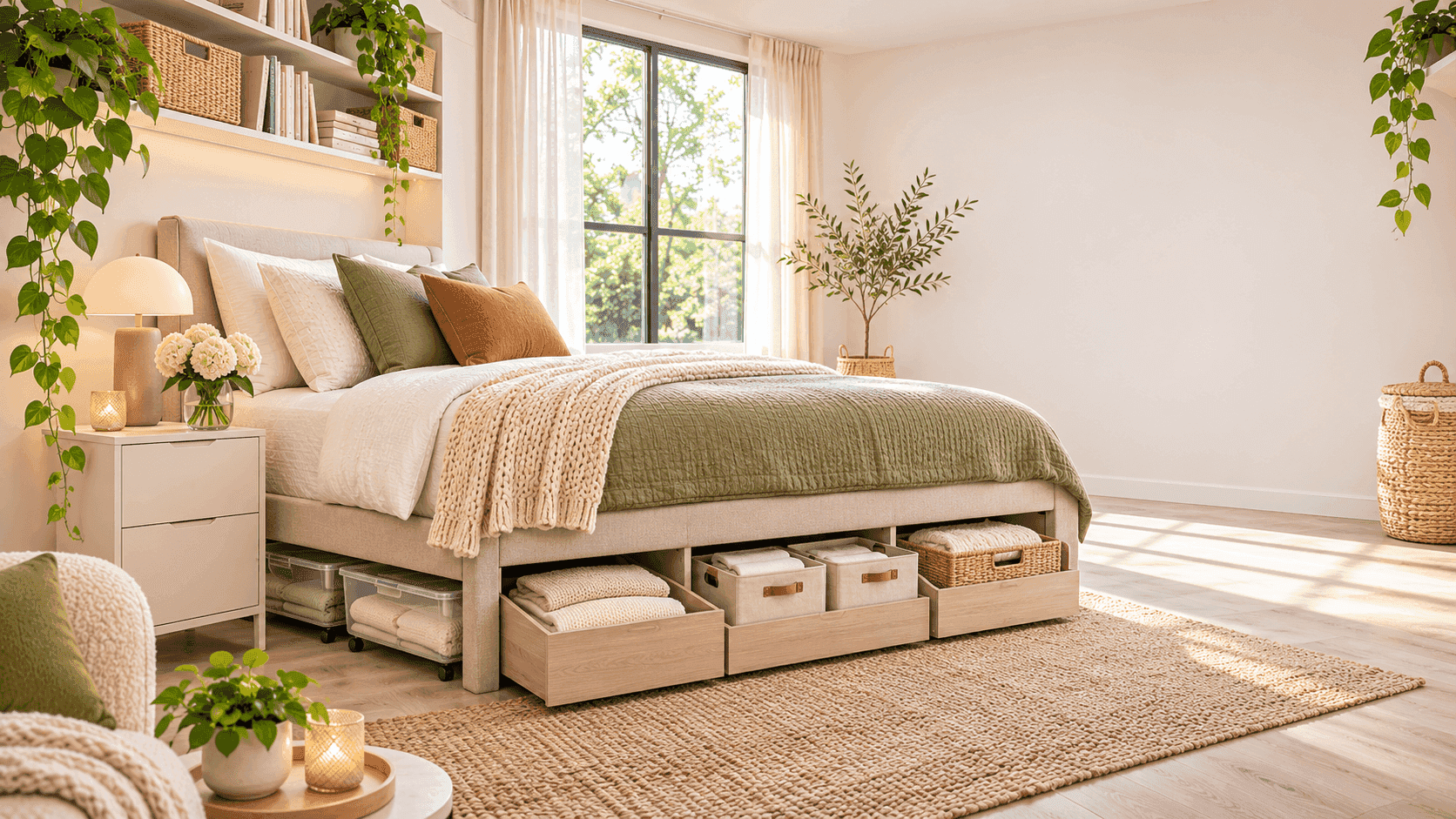
12. A drawer storage bed
Clearance: built into the frame. Drawers in the base can replace a dresser in a small room. They need floor in front of them: a drawer that pulls out 18 inches needs those 18 inches clear, plus room to kneel. Check that a nightstand or wall won’t block them before you buy.
13. A lift-up storage bed
Clearance: the full depth of the base, often 10 inches or more. The mattress deck rises on gas struts and the entire footprint becomes one storage compartment, with no side clearance needed. Lifting a mattress is a chore, so use it for things you reach for monthly or seasonally. If young children live in the home, keep the deck closed when not in use: the Consumer Product Safety Commission has recalled storage furniture, including a storage ottoman, citing the risk that young children could become trapped inside the compartment.
14. A loft bed with a full floor underneath
Clearance: the most of any option. Raising the bed high enough to put a desk, a dresser, or shelving underneath turns under-bed storage into a second room. Know the rule that applies: under federal requirements for children’s bunk beds, any bed whose mattress foundation sits more than 30 inches off the floor counts as a bunk bed, which means guardrails on both sides, with the top of the rail at least 5 inches above the thickest mattress the maker recommends. If you’re raising a child’s bed yourself, treat those numbers as the minimum.
15. A bed skirt or fitted valance to hide it all
Clearance: none needed. A tailored bed skirt hides the bins from the doorway. Pick one with split corners so it doesn’t snag every time you pull a box out.
How to Build a Rolling Under-Bed Drawer That Actually Fits
A shop-built drawer beats a stock bin when your clearance falls between standard container heights, or when you want to fill the space stock bins leave empty. The build is simple; getting the arithmetic right is what makes it fit.
Lumber isn’t the size on the tag
Softwood boards are sold by nominal size, and the American Softwood Lumber Standard (PS 20, published through the U.S. Department of Commerce) sets the smaller dressed size you actually get. For the common “1-by” boards used in drawers, a dry board is ¾ inch thick, not 1 inch, and the widths run:
- 1x4: 3½ inches wide
- 1x6: 5½ inches wide
- 1x8: 7¼ inches wide
- 1x12: 11¼ inches wide
Plywood is undersized too: a sheet sold as ½ inch typically measures about 15/32 inch. Every cut and every height calculation below uses actual dimensions.
Step 1: Work out the height budget
Start from your measured clearance and subtract, in order:
- A top margin: at least ½ inch, so the drawer never scrapes the rail.
- The casters: use the caster’s listed overall mounting height, not its wheel diameter. Overall height includes the plate and the fork, so it is always larger than the wheel.
- The bottom panel: if it’s screwed to the underside of the frame, as in this design, its thickness counts.
What’s left is the maximum width of the board you can use for the drawer sides.
Worked example: 8 inches of measured clearance, minus a ½-inch margin, leaves 7½. Low-profile casters with a listed overall height of 1⅜ inches leave 6⅛. A ½-inch plywood bottom (about 15/32 actual) leaves roughly 5⅝. A 1x6, at 5½ inches, fits with a little to spare, and the finished drawer stands about 7⅓ inches tall. With 7 inches of clearance instead, you’d rip a 1x6 down to about 4⅝ inches or use a narrower board.
Step 2: Size the footprint
- Depth: the reach you measured to the center support, minus an inch. On a queen with a center leg, that’s about 26 to 28 inches, which is 7 to 9 inches deeper than a stock 19-inch box.
- Length: the usable length along the side divided by the number of drawers, minus an inch per drawer for clearance between them.
Step 3: The cut list, as a formula
For a box frame of four boards sitting on top of a plywood bottom, with the front and back running the full length:
- Bottom panel (1): full length by full depth
- Front and back (2): full length
- Sides (2): full depth minus 1½ inches (two board thicknesses of ¾ inch each)
For a 36-by-26-inch drawer, that’s a 36-by-26 bottom, two 36-inch boards, and two 24½-inch boards. If you instead run the sides full depth and fit the front and back between them, the same 1½-inch subtraction moves to the front and back.
Step 4: Assemble, then check
- Glue and screw the frame corners, pre-drilling to avoid splitting.
- Glue and screw the bottom to the underside of the frame. On a long drawer carrying heavy loads, add a fifth caster at the center, since a ½-inch panel spanning 36 inches can sag.
- Mount casters near the corners with screws short enough that they don’t poke through the bottom.
- Use a recessed pull or a cut-out handhold rather than a projecting handle, so the drawer front doesn’t become a trip hazard beside the bed.
- Dry-fit under the bed at every point you measured before you load it.
The payoff: a 36-by-26-by-5½-inch drawer holds about 2.7 cubic feet inside, compared with about 1.9 for a stock 56-quart box. Four of those drawers under a queen at 8 inches of clearance hold roughly 10.8 cubic feet, about 44 percent more than four stock boxes, mostly by reclaiming that strip down the middle.
Choosing Containers: Plastic, Fabric, Wood, and Vacuum Bags
The right container depends on what goes in it and how often it comes out. Each material solves one problem and creates another.
Rigid plastic
Lidded plastic boxes are the default because they keep dust and insects out and stack cleanly. The plastic itself matters more than most people realize, especially for anything that will sit in contact with the plastic for years. Preservation guidance from the National Archives, the Library of Congress, and the Northeast Document Conservation Center consistently names polypropylene, polyethylene, and polyester as stable plastics and tells people to avoid polyvinyl chloride (PVC), which can give off damaging compounds as it ages. Many storage boxes are polypropylene, marked with resin code 5 on the bottom; PVC carries code 3. Conservation guidance also suggests skipping plastics with a strong chemical odor.
Fabric bins and baskets
Fabric and woven baskets look better in an open-front setup and are easy for kids to use. They don’t keep dust out, and soft-sided bins slump when half full. Use them for things you rotate through often, not for anything that will sit for a season.
Wood drawers
Custom wood drawers (Section 4) give the best fit and the most capacity. Seal or paint the inside so raw wood doesn’t snag fabric, and line the bottom with a cotton sheet if you store wool or silk directly in the drawer.
Vacuum compression bags
Vacuum bags shrink bulky bedding and sweaters to a fraction of their volume, which makes them useful under low frames. Two things decide whether they suit what you’re storing:
- Loft: Down and synthetic insulation lose loft when kept compressed for long periods, and the loss can be permanent. Outdoor gear makers advise storing insulated sleeping bags uncompressed for that reason.
- Pest protection: A sealed container keeps clothes moths and carpet beetles out, which is why university extension services recommend airtight storage for clean woolens. A lidded plastic box does that without crushing anything.
Use vacuum bags for synthetic clothing and bedding over a single season. For down, wool, cashmere, and anything with a care label that says otherwise, use a lidded plastic box instead. Whatever you choose, everything has to go in clean and completely dry.
What to Store Under the Bed and What to Keep Out
The floor under a bed is dark, rarely disturbed, hard to inspect, and the first place water reaches if a pipe leaks or a pet has an accident. Some things tolerate that well. Others shouldn’t be there at all.
Good candidates
- Off-season clothing: washed or dry cleaned first, in lidded boxes.
- Spare bedding and guest linens: the classic use, especially in homes without a linen closet.
- Out-of-season and occasional shoes: in a divided organizer.
- Luggage: ideally filled with travel gear rather than air.
- Gift wrap, craft supplies, and flat paper goods: in a shallow tray.
- Rotation toys and kids’ outgrown clothes awaiting a younger sibling: labeled by size.
- An emergency kit: shoes, gloves, and a flashlight (idea 9 in Section 3).
Keep these out
- Lithium-ion batteries and power banks: The National Fire Protection Association’s battery safety guidance says to store batteries away from anything that can catch fire and not to charge devices under a pillow, on a bed, or on a couch. Spare tool batteries, power banks, vapes, and e-bike batteries in a bin of sweaters under the mattress fail both tests.
- Photographs, documents, and paper keepsakes: The Northeast Document Conservation Center advises storing family papers and photos at least four inches off the floor to reduce the risk of damage from floods and leaks, and the National Archives recommends keeping them away from pipes, windows, and other leak sources. Under a bed is, by definition, on the floor. A closet shelf is the better spot.
- Food and pet food: Even sealed, it attracts pests to the room where you sleep.
- Anything you need weekly, or that’s heavy to drag: If you’re kneeling on the floor every few days or straining to pull a bin out, it belongs at waist height.
- Mothballs in an open bin: covered in the next section, because the rules are stricter than most people expect.
If the list of things you want to keep under the bed is long, it’s worth asking whether all of it needs keeping. Our room-by-room decluttering guide covers the decision rules and where each category should go when it leaves.
Moths, Carpet Beetles, and Dust: Protecting What You Store
The conditions that make under-bed space convenient (dark, undisturbed, out of sight) are the same conditions fabric pests prefer. University of California Statewide IPM Program guidance notes that clothes moth damage often turns up in carpeted areas beneath furniture, and that carpet beetle larvae do most of their feeding in dark, undisturbed places. Both feed on animal fibers such as wool, silk, fur, and feathers; carpet beetles don’t feed on synthetic fibers, which is why a bin of wool sweaters is the one at risk.
What actually prevents damage
- Clean before storing: Extension guidance is consistent that soiled fabric, with food, sweat, or body oils on it, is more attractive to moth larvae. Wash or dry clean every wool and silk item before it goes under the bed.
- Tight containers: Cornell University’s guidance puts it plainly: clean garments in properly sealed containers should be safe from clothes moths. The tight seal does the work.
- Vacuum under the bed: Pull everything out at least each season and vacuum the floor, baseboards, and the bins themselves. Lint and shed hair are food for carpet beetle larvae.
- Inspect when you rotate: Look for small irregular holes, silken webbing or cases, and tiny shed larval skins, especially in folds and under collars.
What cedar and lavender actually do
According to UC IPM, the oil in aromatic eastern red cedar can kill small clothes moth larvae but doesn’t affect large ones, and cedar loses that ability after several years. Colorado State University Extension goes further, citing a study suggesting chests more than three years old are practically useless for killing larvae, and notes that a well-made cedar chest protects mainly because it’s tightly built. UC IPM’s carpet beetle guidance calls cedar chests unreliable. On herbal sachets, Cornell notes there is little research data on their effectiveness.
Cedar isn’t harmful. But a cedar block in a loose bin is not protection, and a tight lid matters far more than what’s inside.
Mothballs: the label is the law
Mothballs are registered pesticides, typically naphthalene or paradichlorobenzene, and their labels carry legal force. University of Florida IFAS and the National Pesticide Information Center both point out that labels direct use only in tightly closed, airtight containers, precisely so the fumes don’t build up in rooms where people and pets breathe them. Tossing a few into an ordinary bin under the bed you sleep in is the scenario the label exists to prevent. Some paradichlorobenzene labels also warn against use in plastic storage containers, because the chemical can damage some plastics. If you use them at all, read and follow the specific product’s label.
If you find an infestation
Extension services describe freezing as a non-chemical way to kill clothes moths in a washable or delicate item, with guidance that varies by source: Colorado State cites 72 hours below 0°F after the item has been at room temperature, while UC IPM describes several days below 18°F. Seal the item in a plastic bag first, and brush it out afterward. Heavy or widespread infestations are a job for a licensed pest control professional.
Dust and allergies
Mayo Clinic’s guidance for dust mite allergy includes cutting clutter that collects dust from the bedroom. If someone in the room has a dust mite allergy or asthma, closed containers, a regular vacuum schedule, and a conversation with an allergist about what’s right for that room come before any storage plan.
Keeping It Organized Through the Seasons
Under-bed storage fails slowly: out of sight, it fills with whatever didn’t have a home. A few habits prevent that.
- One category per container: Winter sweaters in one box, guest sheets in another. Mixed bins are where things get lost.
- Labels on the side that faces out: Label the short end of each box, the end you see when you lift the bed skirt, not the lid.
- A written inventory: A note on your phone listing what’s in each bin saves pulling out four boxes to find one scarf.
- A twice-a-year swap: Many people tie the wardrobe rotation to the clock change in spring and fall. It’s also the natural moment to vacuum under the bed and check stored wool for pest damage.
- Leave one container empty: A spare box gives the clothes you just rotated out a place to go, so they don’t end up on a chair.
- Hold the line at the edge of the frame: If containers stick out past the bed, they’re a trip hazard on the way to the bathroom at night. Anything that doesn’t fit inside the footprint needs a different home.
When Under-Bed Space Is Enough (and When a Storage Unit Makes Sense)
We rent storage units, so weigh this section accordingly. For most people looking up under-bed storage ideas, the honest answer is that they don’t need one. The arithmetic in Section 2 says a queen bed can hold roughly 7 to 11 cubic feet of organized storage, and a closet’s top shelf adds more. That’s enough for one or two people’s off-season clothing and spare bedding.
Skip the unit if any of these apply
- The overflow is a few boxes of clothing and linens. Use the space under the bed, the closet shelf, and the back of the closet first. Renting space for four bins’ worth of sweaters costs more over a year than the sweaters are worth.
- You haven’t decluttered yet. Storing things you’d let go of with an hour of honest sorting is paying rent on a decision you haven’t made.
- It’s cheaper to replace than to keep. Add up twelve months of rent and compare it with the cost of buying the item again when you need it.
- There’s no end date. “Someday” isn’t a plan, and units rented for someday tend to stay rented for years.
A unit can make sense when there’s a defined reason
- You live in a studio or a bedroom with no closet, and the season’s rotation genuinely exceeds what fits, even after the measuring and the custom drawers.
- You’re between homes, with a lease that ends before the next one starts or a closing date that doesn’t line up.
- You’re staging a home for sale and need bulky items, including the bins from under the bed, out of sight while the house is listed.
- You’re renovating the bedroom and need it empty for a few weeks.
- Two households are combining and you need time to decide which bed, which dresser, and which bins of linens stay.
A one-sentence test settles most cases: “I’m storing these things because ___, until ___.” If you can fill in both blanks, a unit may be the right tool. If you can’t, the space under your bed is probably the right one.
Sizing the Overflow: From Bins to a Unit
If your situation fits one of the defined reasons above, size the space with the same arithmetic you used under the bed.
Start with what you have
- Stock under-bed boxes: count them and multiply by rated capacity. A 56-quart box holds about 1.9 cubic feet, so eight boxes hold about 15.
- Moving boxes: a medium box holds roughly 3 cubic feet.
- Furniture: width times depth times height in inches, divided by 1,728, gives cubic feet.
Compare it with a unit
Our storage unit size guide lists a 5x5 unit at 25 square feet and about 200 cubic feet, and a 5x10 at 50 square feet and about 400 cubic feet. Nobody packs a unit solid, so plan on using about three quarters of that.
Put that next to Section 2 and the scale is striking: a 5x5 holds roughly as much as the space under ten queen beds. A few bins of off-season clothing alone almost never justify one, which is the point of the previous section. Where a small unit earns its place is when the bins travel with something bigger, such as a dresser and a mattress during a move, or a room’s worth of furniture during a renovation. For that kind of overflow, start with small units and move up only if the furniture footprint demands it.
If what you’re storing is sensitive to heat and cold
For wood furniture, mattresses, and natural-fiber clothing held through a hot summer or a cold winter, a climate-controlled unit is temperature-regulated, which protects against extreme temperatures. Packing still matters: everything goes in clean and dry, in lidded containers, off the floor, the same rules that apply under your bed.
Frequently Asked Questions About Under Bed Storage
How much clearance do you need for under-bed storage?
It depends on the container. Flat zippered bags fit in about 4 inches, low-profile boxes need about 6 to 7, and common wheeled boxes need about 7½ inches or more. Measure from the floor to the lowest part of the frame a container must pass under, usually the side rail, and leave at least half an inch of margin.
Is it bad to store things under your bed?
Not if you store the right things the right way. Clean, off-season clothing and spare bedding in lidded containers do well under a bed. Problems come from open bins that collect dust, items that attract pests, and anything that can’t tolerate sitting on the floor, such as photographs and important papers.
What should you not store under your bed?
Keep out lithium-ion batteries and power banks, which fire safety guidance says should be stored away from anything that can catch fire. Also keep out photographs and documents, which preservation guidance says belong at least four inches off the floor, along with food, heavy items, and anything you use weekly.
Do cedar blocks keep moths away from stored clothes?
Not reliably. University extension guidance says cedar oil can kill small clothes moth larvae but not large ones, and that cedar loses potency after a few years. Clean clothing in a tightly sealed container is the more dependable protection.
Are vacuum storage bags safe for clothes and comforters?
For synthetic clothing and bedding over a single season, generally yes. For down, wool, and other natural fibers, long compression can flatten the fill or fibers, so a lidded box is the gentler choice. Always follow the item’s care label.
Can you put mothballs in an under-bed storage bin?
Only if the specific product’s label allows that use and the container is truly airtight. Mothballs are registered pesticides, their labels have legal force, and they are meant to keep fumes out of living spaces. Some labels also prohibit use in plastic storage containers.
How do I make my bed higher for more storage?
Bed risers are the simplest option. Check the weight rating against the frame, mattress, and sleepers, and make sure every leg sits fully in its riser. Replacing the frame with a taller one or a storage bed is the sturdier long-term fix.
Is a lift-up storage bed worth it?
For seasonal storage in a small room, often yes, because the whole footprint becomes usable and no side clearance is needed. Lifting the mattress each time makes it a poor fit for things you need weekly, and the deck should stay closed when young children are around.
How do I hide under-bed storage?
A tailored bed skirt or fitted valance hides containers from view. Matching containers set back an inch or two from the edge of the frame also read as tidy even without a skirt.
Make the Space Under Your Bed Earn Its Keep
The best under-bed storage starts with a tape measure, not a shopping cart. Measure to the side rail and the center beam, buy containers at least half an inch shorter than your clearance, and expect stock bins to use somewhere between a third and two thirds of the space depending on the bed. Fill the rest with a drawer built to fit if the numbers justify it.
Then store the right things: clean, off-season, and replaceable, in containers that close tightly. Keep batteries, papers, and food somewhere else, skip the mothballs unless you’re following the label to the letter, and pull everything out to vacuum and check for pests when the seasons change.
Done that way, the space under your bed handles more than most people expect. If your plans include more than it can hold, such as a move, a renovation, or a home on the market, size it with the arithmetic above and set an end date.
Find a storage unit near you for the stretch your home needs extra room.
About the Author
10 Federal Storage
Our team at 10 Federal Storage has been in the self storage industry for decades. With knowledge gained from multiple universities and in the field, we are well-prepared and excited to assist with your storage needs. When you rent a unit with us, you can feel confident that our seasoned customer service team’s help will make your transition as seamless as possible. Customer satisfaction is our number one priority, and we strive to make your experience exceptional with our automated leasing options, diverse unit sizes, and a strong commitment to sustainability.