

Best Storage Options for an RV, Trailer, or Camper
by 10 Federal Storage
Published on November 6, 2026
Where you keep an RV between trips comes down to more than budget and convenience. The right option depends on what is most likely to damage your rig where you live, and on what your HOA and city will allow.
A travel trailer parked in San Antonio and the same trailer parked outside Milwaukee face completely different threats. One is fighting sun, heat, and hail for most of the year. The other is fighting a freeze that will split a water line in a single night. A roof over the space helps a great deal with the first and does almost nothing about the second. Pick the storage option without knowing which threat you are defending against and you can pay for protection you do not need while skipping the step that matters.
This guide starts with the specific things that wear out a parked RV, using guidance from federal safety agencies, the national fire code, and public health authorities. Then it walks through every realistic storage option, at home and off-site, and shows which threats each one actually handles. Two points change the decision for many owners: most RVs are too tall for a home garage, and indoor storage only replaces winterizing if the building is heated.
We rent RV and trailer parking, and near the end we will tell you plainly when you should not pay for it. Several common situations are better solved at home, and we would rather say so than sell you a space that does not fix your actual problem.
Table of Contents
- The Short Answer: Which RV Storage Option Fits Which Situation
- What Actually Damages a Parked RV
- Storing an RV at Home: Driveway, Side Yard, and Backyard
- Can an RV Fit in a Home Garage?
- Building an RV Carport or RV Garage
- Outdoor RV Parking at a Storage Facility
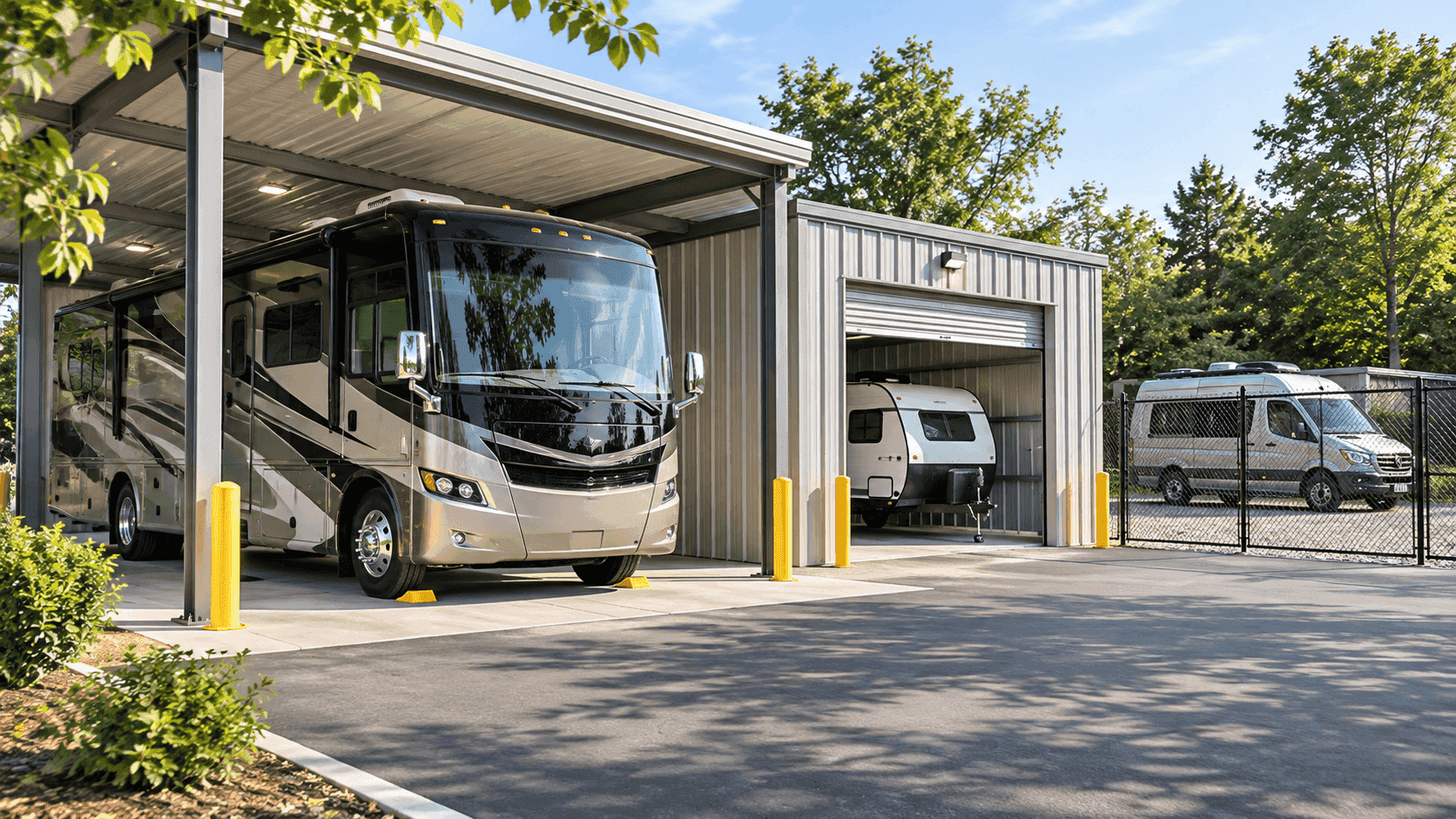
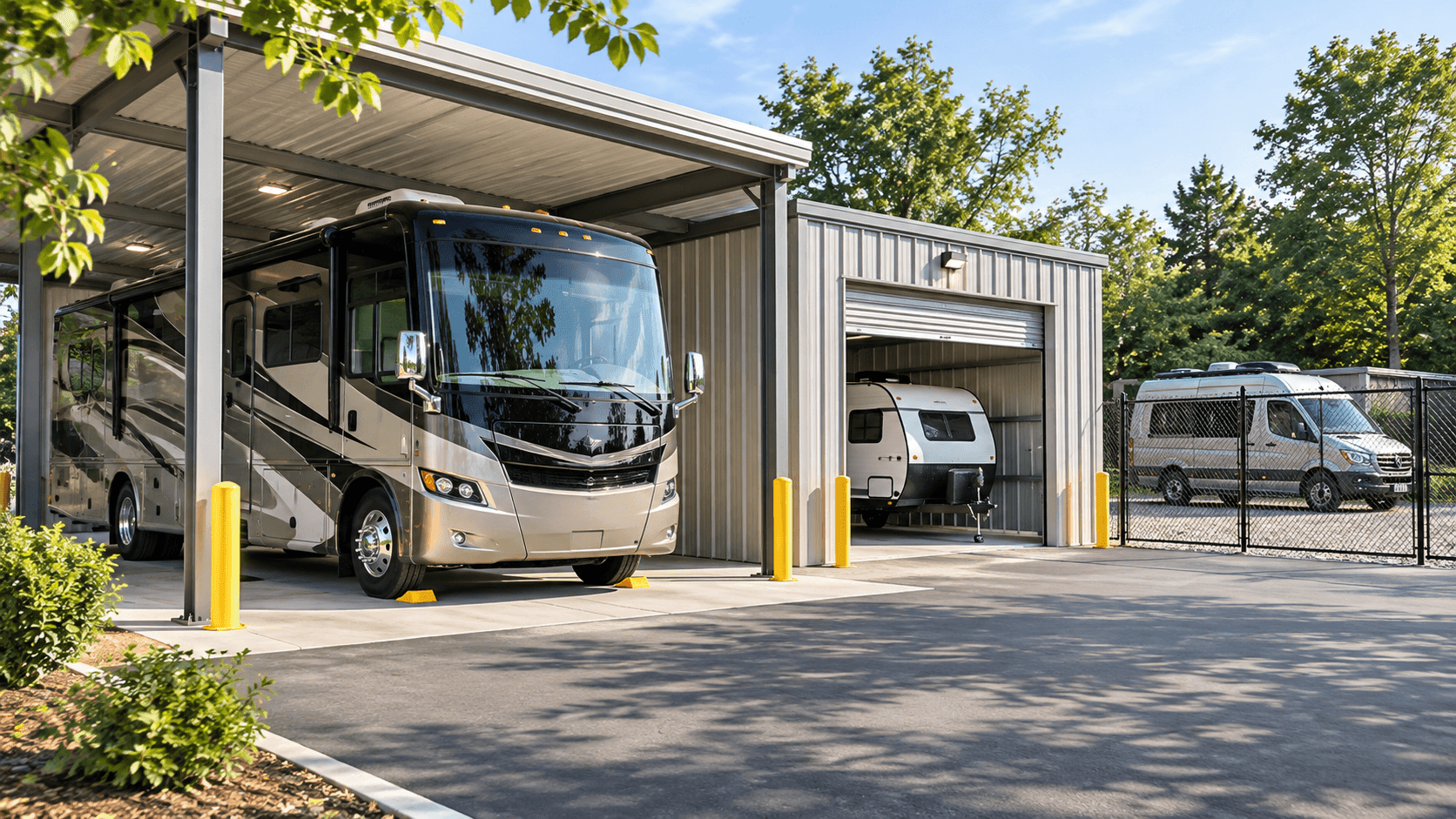
- Covered RV Storage: What a Roof Does and Does Not Do
- Enclosed and Indoor RV Storage
- Dealer Lots, Private Land, and Seasonal Campground Storage
- Choosing by Climate: Sun Belt, Hail Belt, Freeze Belt, and the Coast
- Insurance and the Questions to Ask Before You Store
- When You Should Not Pay for RV Storage
- Frequently Asked Questions About RV Storage Options
- Storing Your RV, Trailer, or Camper with 10 Federal Storage
The Short Answer: Which RV Storage Option Fits Which Situation
If you want the conclusion before the reasoning, here it is. The best RV storage option is the cheapest one that handles the specific threats you face, and that you are legally allowed to use.
- Driveway or side yard at home: best when your HOA and city allow it, you camp often, and theft is not a concern on your street. Free, but fully exposed to sun and weather.
- Home garage: best for teardrops, folded pop-ups, A-frames, and some low-roof camper vans. Most other RVs are too tall for a residential garage door.
- A carport or RV garage you build: best for owners who plan to keep the RV for years and have the lot, the permits, and the budget.
- Outdoor parking at a storage facility: best when the main problem is an HOA rule, a driveway that is too short, or security. The most affordable off-site option, with the same weather exposure as a driveway.
- Covered parking: best in high-sun and hail-prone regions, where most damage arrives from above.
- Enclosed or indoor storage: best for small towables that physically fit through the door, and for high-value rigs at specialty indoor facilities. It does not replace winterizing unless the building is heated.
Two rules apply no matter which option you choose. First, no unheated storage option keeps plumbing above freezing, so an RV that will sit through freezing weather needs to be winterized everywhere. Second, storage does not stop deterioration that is already underway. A roof seam that is failing in October will still be failing in March, wherever the RV spends the winter.
What Actually Damages a Parked RV
The RV Industry Association’s owner research puts median RV use at roughly 30 days a year. The other 335 or so days, the vehicle sits. That is when most of the wear happens, and it comes from six sources. Each storage option handles some of them and ignores others, which is why naming them first makes the choice easier.
Sun and heat
Ultraviolet light and heat are the slow, constant threat. They harden roof sealants, chalk fiberglass and gelcoat, fade decals, crack vinyl, and age tires. Tires deserve special attention because they fail without much warning. The National Highway Traffic Safety Administration specifically names recreational vehicles among the vehicles at risk from tire aging, because they are driven infrequently, and lists sunlight exposure, warm climates, and poor storage as factors that speed it up. The agency notes that tire aging is a greater concern in the southern parts of the Sun Belt.
NHTSA does not set a fixed replacement age. It points owners to vehicle and tire manufacturers, whose recommendations range from about six to ten years from the date of manufacture. Check the four-digit date code on your sidewalls and your tire maker’s guidance, and note that a tire can look fine and still be past it.
Freezing temperatures
Water expands when it freezes, and an RV’s plumbing runs through thin walls and an exposed underbelly. A single hard freeze can split a line, crack a water pump housing, or ruin a water heater tank. The important point for choosing storage is simple: outdoor spaces, covered canopies, and unheated enclosed buildings all reach outdoor temperatures eventually. Only proper winterizing or a heated building prevents freeze damage.
Hail and wind
Hail punctures roof membranes, cracks skylights and vent covers, and dents aluminum siding. According to the Insurance Information Institute, Texas recorded 902 major hail events (hailstones an inch or larger) in 2025, more than twice the count in second-place Kansas, with Oklahoma, Nebraska, Missouri, and Colorado close behind. Wind is the other overhead risk: it drives rain into seams, slams awnings, and can move an unsecured cover until it chafes through the finish underneath.
Water intrusion
Most expensive RV damage is water that got in slowly through a seam, a vent, a window frame, or a cab-over joint and then soaked the wood and foam behind it. Storage location matters here mostly in how quickly you notice a problem: a rig you see every week gets a leak caught early.
Rodents and insects
Mice and other rodents treat a parked RV as shelter. The Centers for Disease Control and Prevention notes that rodents may build nests in cars, trucks, campers, and other vehicles, especially those used infrequently. They chew wiring, nest in insulation and air intakes, and leave droppings that require careful cleanup (more on that in the FAQ). Food left aboard and nearby tall grass or woodpiles make it worse, and no roof or wall keeps a determined mouse out.
Theft and vandalism
Towables are easy to steal because anyone with a matching hitch can take one. Motorhomes and trailers alike attract break-ins for batteries, generators, solar panels, and catalytic converters. Security comes from a gate, cameras, lighting, and coded entry, or from locks you add yourself: a coupler lock, a wheel lock, and a removable hitch.
Keep those six in mind. The sections that follow show which ones each storage option actually addresses.
Storing an RV at Home: Driveway, Side Yard, and Backyard
Keeping the RV at home is the cheapest option and the most convenient one. You can load it the night before a trip, check on it whenever you walk past, and leave on a moment’s notice. For owners who camp most weekends, that convenience is worth a great deal, because every trip that starts with a drive to a storage lot is a trip that is a little easier to skip.
The catch is that two separate sets of rules decide whether you can do it at all.
- HOA covenants. Many homeowners associations prohibit recreational vehicles in driveways, on the street, or anywhere visible from the street, sometimes with a short loading window measured in hours. Read the actual recorded covenants and any rules the board has adopted since, not what a neighbor appears to be getting away with.
- Municipal and county ordinances. Plenty of cities restrict RV parking on residential streets, in front yards, or forward of the house, independently of any HOA. Some allow RVs only on a paved surface, only behind the front building line, or only behind a screening fence. Your city or county code, usually searchable online, is the authority.
Either layer can prohibit what the other allows, so check both. Enforcement is usually complaint-driven, which means a setup that has gone unnoticed for two years can become a violation notice after one new neighbor moves in.
What home storage does and does not protect against
A driveway or yard offers the same weather exposure as an open lot: full sun, full hail exposure, and outdoor temperatures. What it adds is visibility. You will notice a sagging tire, a torn cover, or a water stain on the ceiling far sooner than you would at an off-site lot, and early detection is worth more than most people credit.
Security depends on your street. A trailer in a lit driveway on a quiet cul-de-sac is a different risk from one parked along a busy road. A coupler lock and a wheel lock are inexpensive either way.
Backyard and side-yard specifics
- Surface matters. Grass and soft soil let stabilizer jacks and tires sink, and they hold dampness under the rig. A gravel or paved pad is better, and a building permit may apply if you pour one.
- Clear the perimeter. Tall grass, shrubs, and woodpiles next to the RV give rodents cover right up to the frame. Keep a mowed or graveled margin around it.
- Watch overhead branches. They drop sap and debris, scrape the roof in wind, and give rodents and squirrels a bridge onto it.
- Plan the path. Measure the gate opening and the turn into the yard before you try it with a 30-foot trailer.
Can an RV Fit in a Home Garage?
A two-car garage looks big enough for a camper van or a Class C motorhome. For most RVs it is not, and the reason is the door, not the floor.
Residential garage doors are typically 7 or 8 feet tall, according to garage door manufacturer Garaga, with taller doors in the 10-to-12-foot range reserved for purpose-built RV bays. Most RVs are far taller than a standard opening once you count the roof air conditioner:
- Class C motorhomes: commonly 11 to 13 feet including rooftop equipment. Not close.
- Most travel trailers and fifth wheels: 10 to 13.5 feet. Not close.
- High-roof Class B camper vans: roughly 9 to 10 feet. Too tall for nearly any residential door.
- Low-roof camper vans, folded pop-ups, A-frames, and most teardrops: often under 7 feet. These are the realistic garage candidates.
If you are not sure where your rig falls, our guide to average RV dimensions walks through height by type and how to measure to the true top of the roof. Measure your door opening with the door fully raised, not the ceiling inside, because the rolled door and its track hang down into the opening.
Propane cylinders and the fire code
If your RV does fit, there is a fire code question before you park it. Fire codes based on NFPA 58, the national liquefied petroleum gas code, restrict propane cylinder storage inside residential buildings, and fire officials in both Minnesota and Florida note that the restriction covers attached and detached garages. In general, only small one-pound-class cylinders are permitted inside. The 20- and 30-pound cylinders on a travel trailer’s A-frame are well above that.
Local adoption varies, and some fire marshals treat a detached shed differently from an attached garage. The practical answer for most owners is to remove the cylinders, close the valves, and store them upright outdoors in a ventilated spot, then confirm the local rule with your fire marshal. Motorhomes with a permanently mounted propane tank raise a separate question that is worth asking the same office directly.
A garage still gets cold
An attached garage runs warmer than the outdoors, but an unheated one can still drop below freezing during a cold snap in much of the country. A garaged RV in a freezing climate still needs to be winterized.
Building an RV Carport or RV Garage
For owners with the land and a long ownership horizon, a dedicated structure combines convenience and protection in one place. It also carries the most up-front decisions.
- Permits. Many jurisdictions require a building permit for a carport, an RV garage, or a new concrete pad, and some limit how tall an accessory structure can be or how close to a property line it can sit. Start with your local building department.
- HOA approval. Where an HOA exists, architectural review usually applies to any new structure, and some covenants prohibit RV structures entirely.
- Clearance. Size the structure to your RV’s true height, including the air conditioner, plus margin for a future rig that may be taller. A carport sized exactly to today’s trailer can rule out the next one.
- Wind and snow loads. Metal carports are sold in different engineering ratings. In high-wind coastal areas or heavy-snow regions, the rating matters as much as the dimensions, and your building department may require a specific one.
A carport is covered storage, with everything that implies: strong protection from sun and hail, little protection from cold or wind-driven rain. An enclosed RV garage protects against nearly everything except freezing, unless you heat it. Costs vary too widely by region and materials to quote, so get local bids before comparing against rented space.
Outdoor RV Parking at a Storage Facility
An assigned space in a gated lot is the most common off-site option and the most affordable. It solves the problems that send most people looking for storage: an HOA letter, a driveway the RV does not fit, or a street where it is not safe.
What it does not do is change the weather. An outdoor space is exactly as exposed to sun, hail, and freezing as your driveway. You are trading weather protection you never had for security and compliance you did not have either.
What separates a good lot from a bad one
- Drive aisle width. The single biggest factor in whether you can back a long rig into its space without a spotter. Walk the aisle before you rent and picture your tongue swinging through it.
- Surface. Paved or compacted gravel holds up under jacks and tires. Soft or poorly drained surfaces let a heavy fifth wheel settle over a winter. Pads under the landing gear help on any surface.
- Gate access hours. RV trips start early and end late. A lot with office-hours gate access makes a 5 a.m. departure impossible.
- Security you can see. Perimeter fencing, coded gate entry, cameras covering the rows rather than just the entrance, and lighting at night.
- Space length options. Lots typically sell spaces in set lengths. Measure your rig’s overall length, including the tongue, and add roughly five feet for maneuvering before you choose.
Making an outdoor space work harder
Most of the protection an outdoor space lacks can be partly added back by the owner:
- A fitted, breathable RV cover rather than a tarp. Tarps trap moisture against the sidewalls, and their grommets and edges chafe through gelcoat and decals over a season of wind.
- Tire covers to keep direct sun off the sidewalls, which addresses the tire aging factor NHTSA names.
- Blinds and curtains closed to keep sun off upholstery and the dash.
- Locks on the coupler and a wheel, plus anything removable (generators, batteries, solar panels) taken home.
Covered RV Storage: What a Roof Does and Does Not Do
Covered storage is a parking space under a canopy, with open sides. It is a meaningful upgrade over an open space, and it is worth being specific about what the roof does and does not buy you.
What a canopy handles well
- Direct overhead sun. The roof, the roof sealants, and the top surfaces take the most UV of any part of an RV. Shading them slows the hardening and cracking that lead to leaks.
- Hail. A canopy takes the hit that would otherwise land on the roof membrane, skylights, and vent covers. In the hail belt, this alone can justify the cost.
- Direct rain and snow on the roof. Less standing water on seams and less snow load on a structure that was not designed to carry much of it.
- Heat buildup. A shaded RV runs noticeably cooler inside, which is easier on interior materials, adhesives, and anything left aboard.
What it does not handle
- Freezing. An open-sided canopy offers essentially no protection from cold. Winterize exactly as you would in the open.
- Low-angle sun. Morning and late-afternoon sun reaches under the canopy and onto the sidewalls and tires on one side. Tire covers are still worthwhile.
- Wind-driven rain. Sideways rain reaches window frames, side seams, and slide-out seals.
- Rodents. A roof does nothing to keep mice out.
The clearance check
Every canopy has a clear height, and many slope from front to back. Measure your RV to the top of its tallest rooftop item, then compare against the clearance at the lowest point of the structure over your space, not the tallest. A rooftop air conditioner that clears the front edge and catches the back edge is an expensive way to learn the difference.
Is covered storage worth it?
Where sun and hail are the dominant threats, it is usually the best value in RV storage: much of the protection of an indoor building at a fraction of the cost. That describes most of Texas, the Gulf South, the desert Southwest, and the hail corridor that runs through Oklahoma, Kansas, Nebraska, Missouri, and Colorado. Where the main threat is freezing, the case is weaker, because a canopy does little about cold. Covered spaces are also less widely available than open ones and tend to fill first, so expect a waiting list in some markets.
Enclosed and Indoor RV Storage
Fully enclosed storage protects against sun, hail, rain, and casual theft better than anything else. Whether it is the right choice for you depends on two questions: will your RV fit, and is the building heated?
Will it fit?
Standard self-storage drive-up units have roll-up doors commonly 7 to 8 feet tall. That is the same height problem as a home garage. Folded pop-ups, A-frames, teardrops, dismounted truck campers, and smaller enclosed cargo trailers can fit through a typical drive-up door. Travel trailers, fifth wheels, and motorhomes of every class generally cannot, and renting a longer unit does not change that, because the door is the constraint. The RV dimensions guide works through the door arithmetic type by type.
Full-size RVs need a purpose-built indoor RV facility: a large building with tall doors, often a warehouse or hangar-style structure, sometimes with individual bays. These exist in many markets but are less common and more expensive than open or covered parking.
Is it heated?
This is the question that decides whether you still need to winterize. An unheated building slows temperature swings but still drops below freezing during a hard cold snap in much of the country. Some specialty indoor facilities heat their buildings to stay above freezing, and that is the only storage option that can genuinely replace winterizing. Ask the facility directly what the building’s minimum temperature is, and get the answer in writing before you skip the antifreeze.
When enclosed storage earns its premium
- High-value rigs where the cost of a damaged roof or finish dwarfs the storage bill.
- Long-term storage of a year or more, where cumulative sun and weather exposure add up.
- Small towables that physically fit a standard drive-up unit, where enclosed storage may cost little more than a parking space and adds room for gear.
One limitation applies even to the best building: a fully enclosed RV is out of sight. Plan to visit, open it up, and look for leaks and pests on a schedule.
Dealer Lots, Private Land, and Seasonal Campground Storage
Three less common options are worth knowing about, mostly because each solves a specific problem.
- Dealer or service-center storage. Some RV dealers store customer units, often tied to winterizing, de-winterizing, or service work. Convenient if the rig is going in for service anyway, but expect business-hours access only.
- Private land, through a friend, a farm, or a peer-to-peer listing. Often inexpensive and sometimes covered, such as an equipment barn. Get the arrangement in writing, confirm your RV insurance covers the location, and ask what security exists. A barn shared with hay, equipment, and livestock feed is also a rodent magnet.
- Seasonal storage at a campground. Some campgrounds let seasonal guests leave their RVs on site or in an off-season lot. Ideal if you return to the same park every year. Check whether the RV must be winterized by park staff or by you, and what happens during off-season weather events.
Choosing by Climate: Sun Belt, Hail Belt, Freeze Belt, and the Coast
Put the threats and the options together and the decision mostly comes down to where you live. These are broad patterns, and plenty of places fall into more than one.
Sun Belt: Texas, the Gulf South, Georgia, the Carolinas, Florida
Sun and heat run nearly year-round, and this is the region NHTSA singles out for tire aging. Covered storage gives the most protection per dollar here. If covered space is not available, an outdoor space with a breathable cover and tire covers is the fallback. Freeze risk is real but short-lived in much of this region, so winterizing for a few cold nights still matters even when the forecast looks mild.
Hail Belt: North and Central Texas, Oklahoma, Kansas, Nebraska, Missouri, Colorado
A single spring storm can do more damage than years of sun. Covered or enclosed storage moves from nice-to-have toward essential, and comprehensive insurance coverage matters more here than almost anywhere.
Freeze Belt: Wisconsin, Illinois, Michigan, New Hampshire, and higher elevations everywhere
Winterizing is the protection that matters most, and no unheated option replaces it. Because the RV is genuinely unusable for several months, the honest comparison is between a cheaper open space with thorough winterizing and a heated indoor building that removes the freeze risk entirely. Covered storage helps with snow load on the roof but does little for cold. Battery care matters more here too, since deep-cycle batteries left discharged through a hard winter often do not recover.
Coastal areas: the Carolina and Gulf coasts and Southwest Florida
Hurricanes add risks that no storage type fully solves: storm surge, flooding, and wind strong enough to damage canopies or move unsecured rigs. Ask any facility about flood history and drainage, and whether its covered structures are rated for local wind loads. Have a plan to move the RV inland or to higher ground if a storm is forecast, and confirm what your insurance covers for flood and wind while the RV is in storage. Salt air also speeds corrosion on frames, hitches, and exposed metal, so a thorough rinse before storage pays off.
Where there is little hail, little freezing, and moderate sun, an outdoor space with a good breathable cover is often all the protection that makes financial sense.
Insurance and the Questions to Ask Before You Store
Storage changes your RV’s risk profile, and insurance is where that matters financially. This section is deliberately general. Coverage terms vary by insurer, state, and policy, and the only reliable answers come from your own policy documents and your agent.
Questions for your insurer
- Does my policy have a storage or lay-up provision, and what changes about my coverage if I use it?
- Am I covered for hail, wind, flood, theft, and vandalism while the RV is parked at this specific location?
- Are contents covered, and are there limits on items left inside a stored RV?
- Does storing off-site, or on someone else’s land, change anything about my coverage?
Many storage facilities also require or offer their own protection plan. These typically carry a coverage ceiling well below the value of most RVs, so treat them as a supplement to your own policy rather than a substitute for it.
Questions for any storage facility
- What are the gate access hours, and is access by code, app, or key?
- How wide are the drive aisles, and are spaces pull-through or back-in?
- What is the clear height under covered spaces, at the lowest point?
- Is there a dump station, power at the space, or a wash area? (Many facilities have none of these.)
- Is maintenance, washing, or working on the RV permitted on site?
- What paperwork is required? Current registration and proof of insurance are common.
- For indoor storage, is the building heated, and to what minimum temperature?
The answers to the amenity questions shape your prep routine. If there is no dump station, tanks must be emptied before you arrive. If there is no power, batteries need to come home or be disconnected.
When You Should Not Pay for RV Storage
We rent RV and trailer parking, and we would still rather you not rent a space that does not solve your actual problem. These are the situations where paying for storage is usually the wrong answer.
Home parking is legal and you camp often
If your HOA and city both allow it, the RV fits, and you are out most weekends in season, keep it home. Every trip that starts with a drive to a lot is a little easier to skip, and an RV that gets used is in better condition than one that sits. Many owners store off-site only for the off-season and park at home the rest of the year.
It fits in your garage
A teardrop, a folded pop-up, or a low-roof van that clears your garage door has free, secure, weather-protected storage already. Use it, and move the propane cylinders outside.
You are paying for a roof to solve a freezing problem
Covered storage is a strong choice against sun and hail. It is not a substitute for winterizing, and neither is an unheated building. If the real worry is a frozen water line, the fix is a winterizing routine or a genuinely heated building, not an upgrade from open to covered.
The RV needs repairs first
Storage does not pause deterioration. A failing roof seam, tires past their age, or a rodent problem that already started will all be worse after a season of sitting. Most storage facilities do not allow repairs on site, so whatever the rig needs, it needs before it arrives.
It has not moved in two seasons
If no trip is on the calendar and the RV has sat untouched for two years, the monthly bill may be deferring a decision rather than solving a storage problem. It is worth running the numbers on selling before paying for another year. Storage should serve a plan.
When it does make sense
Off-site storage earns its cost when your HOA or city prohibits home parking, when the rig does not fit your property, when your street is not secure, or when you would rather not look at a 34-foot fifth wheel from the kitchen window all winter. For those problems, a gated space is the right tool, and our RV and trailer storage page covers what that looks like at our facilities.
Frequently Asked Questions About RV, Trailer and Camper Storage Options
What is the best way to store an RV long term?
Match the storage option to the main threat where you live, then prepare the RV for that threat. Covered or enclosed storage is the strongest choice where sun and hail dominate. In freezing climates, thorough winterizing matters more than the type of space. Everywhere, empty the holding tanks, remove all food, deal with the batteries, protect the tires from direct sun, and check on the RV every few weeks.
Is covered RV storage worth it?
Usually, in high-sun and hail-prone regions such as Texas, the Gulf South, and the central Plains, because a canopy takes the UV and hail that would otherwise hit the roof, sealants, and skylights. It does little against freezing, wind-driven rain, or rodents, so in cold northern climates the case for paying extra is weaker.
Is it better to store an RV inside or outside?
Inside protects against more threats, but most full-size RVs are too tall for standard drive-up storage doors and residential garages, so indoor storage usually means a specialty RV building at a higher price. An unheated indoor space still reaches freezing temperatures, so it does not replace winterizing. For many owners, covered parking is the better value.
Do I still need to winterize an RV in covered or indoor storage?
Yes, unless the building is heated to stay above freezing. Outdoor spaces, covered canopies, and unheated garages and buildings all reach outdoor temperatures during a hard cold snap. If the RV will sit through freezing weather, drain the water system and protect the lines wherever it is parked.
Can I park my RV in my driveway?
It depends on two separate sets of rules: your HOA covenants, if you have an HOA, and your city or county ordinances. Either can prohibit RV parking in a driveway, on the street, or in a front yard, sometimes allowing only a short loading window. Check both before relying on home storage.
Will my travel trailer fit in my garage?
Probably not, unless it is a teardrop, a folded pop-up, or an A-frame. Residential garage doors are typically 7 or 8 feet tall, while most hard-sided travel trailers stand 10 feet or taller including the roof air conditioner. Measure the door opening with the door raised, not the ceiling inside.
Can I leave propane tanks on my RV in storage?
For outdoor or covered parking, closing the cylinder valves and covering the regulator is common practice, but ask the facility whether it has its own rule. For a garage or other building, fire codes based on NFPA 58 generally restrict propane cylinders larger than about one pound inside residential buildings, so remove A-frame cylinders and store them outdoors. Confirm local requirements with your fire marshal.
How do I safely clean up mouse droppings in a stored camper?
Follow CDC wet-cleaning guidance and never sweep or vacuum droppings, which can put particles in the air. Open the RV to air out for about 30 minutes, wear rubber or plastic gloves, and spray droppings and nests with a disinfectant or a bleach solution of roughly one part household bleach to nine or ten parts water. Let it soak at least five minutes (some county health departments say 10 to 15), then wipe up with paper towels and bag the waste.
How often should I check on a stored RV?
Every four to six weeks is a reasonable rhythm for a long sit. Look for new water stains or soft spots, signs of rodents, tire pressure loss, damage to the cover, and anything that has shifted. A seam leak caught in the second month is a tube of sealant. Caught in the sixth, it can mean a floor repair.
Storing Your RV, Trailer, or Camper with 10 Federal Storage
If off-site storage is the right answer for you, here is what it looks like with us, including what we do not offer, so you can plan your prep around it.
- Outdoor RV and trailer parking in a range of space lengths, commonly 20, 30, and 40 feet, inside gated facilities.
- Covered parking at select locations for added protection from sun, rain, and snow. Availability varies, so check your nearest facility.
- Enclosed drive-up units for smaller towables such as pop-ups and teardrops that genuinely fit through the door, and for the gear that accumulates between trips.
- 24/7 gate access at nearly all locations, so early departures and late returns work on your schedule.
- Month-to-month terms, so you can store through the off-season and stop when you are using the RV.
- Wide drive aisles laid out for maneuvering large rigs. Our facilities are unstaffed and run online, so there is no one on site to spot you while you back in.
What we do not offer: no dump station, no shore power or charging at the space, no wash area, and no maintenance or repairs on site. Overnight occupancy is not permitted. Empty and flush your tanks before you arrive, and take the batteries home or disconnect them.
What you will need: current registration and proof of insurance for the RV or trailer, and no fluid leaks. Motorized RVs must be operable; towables do not need to be. A protection plan is required at checkout, and its coverage ceiling sits well below the value of most RVs, so keep your own policy in place.
Measure your rig’s overall length and true height before you reserve. Our guides to average RV dimensions and types of RVs cover both, and the RV storage page has a full pre-storage checklist.
Find RV and trailer storage near you and reserve online.
About the Author
10 Federal Storage
Our team at 10 Federal Storage has been in the self storage industry for decades. With knowledge gained from multiple universities and in the field, we are well-prepared and excited to assist with your storage needs. When you rent a unit with us, you can feel confident that our seasoned customer service team’s help will make your transition as seamless as possible. Customer satisfaction is our number one priority, and we strive to make your experience exceptional with our automated leasing options, diverse unit sizes, and a strong commitment to sustainability.